
_julesvernex2.jpg)


Maratea
Maratea is the only town on Basilicata’s Tyrrhenian coast. The regional coastline there is thirty kilometres long — squeezed between Campania in the north and Calabria in the south — and the town of Maratea occupies almost all of it.…
Basilicata is the in-step of Italy’s boot — a small mountainous region wedged between Campania, Puglia and Calabria, with two very short stretches of coast on the Tyrrhenian and Ionian. About 550,000 people live across 10,000 square kilometres of what is, by some measures, Italy’s most depopulated region. The countryside is scattered with abandoned hill villages. The mountains hold some of the darkest night skies in Europe. One of its two cities — Matera — is 9,000 years old, a continuously-inhabited warren of cave-dwellings carved into a canyon wall, and one of the most extraordinary urban landscapes on earth. The other — Potenza, the capital — is barely worth a coffee stop by comparison.
For centuries Basilicata was shorthand in Italy for backward, impoverished, forgotten. Carlo Levi’s memoir Christ Stopped at Eboli (1945) — a diary of his 1935-36 internal exile as an anti-fascist doctor posted to the Basilicatan village of Aliano — was the book that made the rest of the country notice the region’s condition. The title comes from a saying of the peasants he met: “Christ stopped at Eboli, meaning that Christianity, the state, civilisation never got further south.” In 2019 Matera was European Capital of Culture. The region has pivoted, hard, from being the example of Italian poverty to being one of its most interesting offbeat destinations. It remains, however, tiny, sparsely inhabited, and quiet. The character of a visit to Basilicata is fundamentally different from that of most of Italy: empty roads, stone villages, wide views, silence.
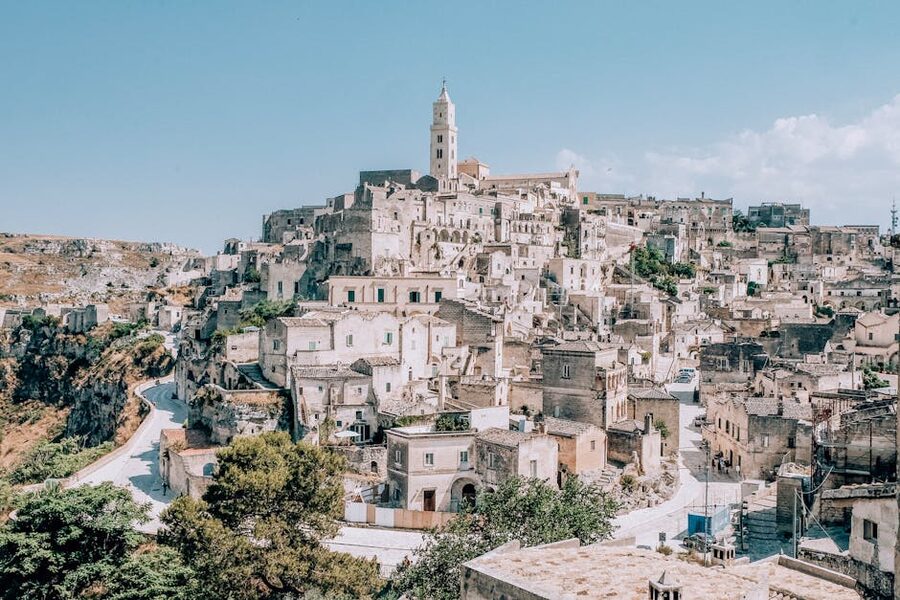
Geographically: a small, mountainous, mostly-rural region. Two provinces (Potenza, the larger, in the west; Matera, the smaller, in the east). The land is dominated by the Lucanian Apennines — Monte Pollino on the Calabrian border is 2,267 m, the second-highest point south of Lazio after Etna. Two small coasts: a 62-km Ionian strip with sandy beaches (Metaponto, Policoro, Nova Siri), and a very short Tyrrhenian strip — 30 km centred on Maratea, dramatically cliff-backed and utterly different in character from the rest of the region.
Historically, this was Lucania — the Roman name for the pre-Roman tribal territory of the Lucani (a Samnite offshoot, Oscan-speaking). The name “Basilicata” is a later medieval term, from the Greek basilikos (“belonging to the emperor” or “viceroy”) and refers to the region’s status as a viceregal Byzantine province in the 9th-10th centuries. Both names have survived: modern residents are still called Lucani, the regional wine is Lucano-branded, but the administrative name is Basilicata.
Magna Graecia: Greek colonists founded important cities here in the 7th-6th centuries BC (Metapontion, Heraclea Lucanica, Siris — all on the Ionian coast). Pythagoras lived at Metapontion in his later years. After the Greeks came Rome, then Lombards, then Normans, then Hohenstaufens — Frederick II stayed repeatedly at the castle of Melfi and issued his Constitutions of Melfi there in 1231. Then Angevins, Aragonese, Spanish viceroys, Bourbons, united Italy.
Population peaked at around 650,000 in the 1950s; continuous emigration (first to the Americas, later to northern Italy and Germany) has reduced it to about 550,000 today. Some hill villages have fewer than 200 inhabitants left.
No international airport. The practical options are:
By train: Basilicata’s rail network is limited. Ferrovie Appulo Lucane runs Bari to Matera (1h40), plus the main Italian state railway runs services to Potenza from Naples and Taranto. Matera has a single central station. Maratea is on the Tyrrhenian mainline (Napoli-Reggio Calabria), about 3h from Napoli. The Ionian coast is served by the slow Taranto-Reggio regional line.
Car is essentially mandatory for exploring outside Matera.
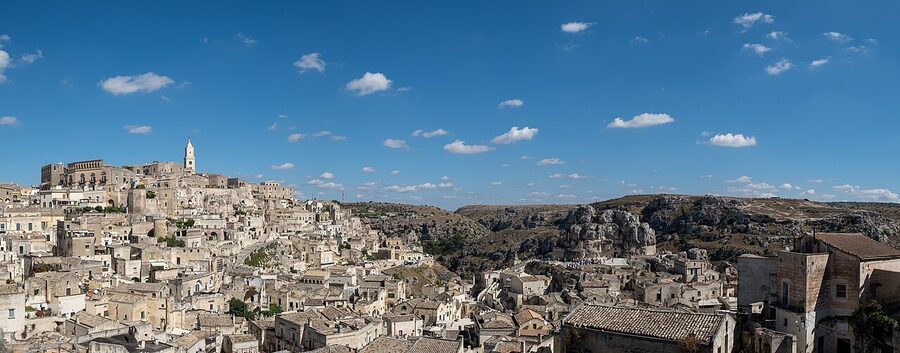
Matera is the reason most foreign visitors come to Basilicata. It’s among the oldest continuously-inhabited settlements in the world — the earliest cave-dwellings on the site date to roughly 7,000 BC, and there has been a city of one form or another here for 9,000 years. The old town is built into and out of the tufa canyon walls of the Gravina di Matera, a ravine cut by an intermittent river. Thousands of houses are carved directly into the rock; above and around them, drystone buildings were added on top in the Middle Ages.
The two districts of the old town are the Sasso Caveoso (south, more primitive, fewer renovations) and the Sasso Barisano (north, more prosperous historically, more restored now). Between them, on the highest part of the site, sits the 13th-century Romanesque cathedral and the small, dense civic centre of Piazza Vittorio Veneto.
Until the 1950s the Sassi were slums — 16,000 people living in cave-houses without running water, electricity or sanitation, sharing space with their donkeys and chickens. Carlo Levi’s book and subsequent campaigns led to a 1952 law (the “Law for the Displacement of the Sassi”) that moved every inhabitant into new-built housing outside the canyon. The Sassi stood empty for thirty years. Since the 1980s they have been progressively restored and re-inhabited — as houses, hotels, restaurants, museums. UNESCO listed the site in 1993. Matera was European Capital of Culture in 2019, which accelerated everything.
What to do:
Matera has also become Hollywood’s preferred set for Biblical-era stand-ins for Jerusalem — Mel Gibson’s The Passion of the Christ (2004) and the 2021 James Bond film No Time to Die were filmed here. You will see Bond location stickers in the Sasso Caveoso.
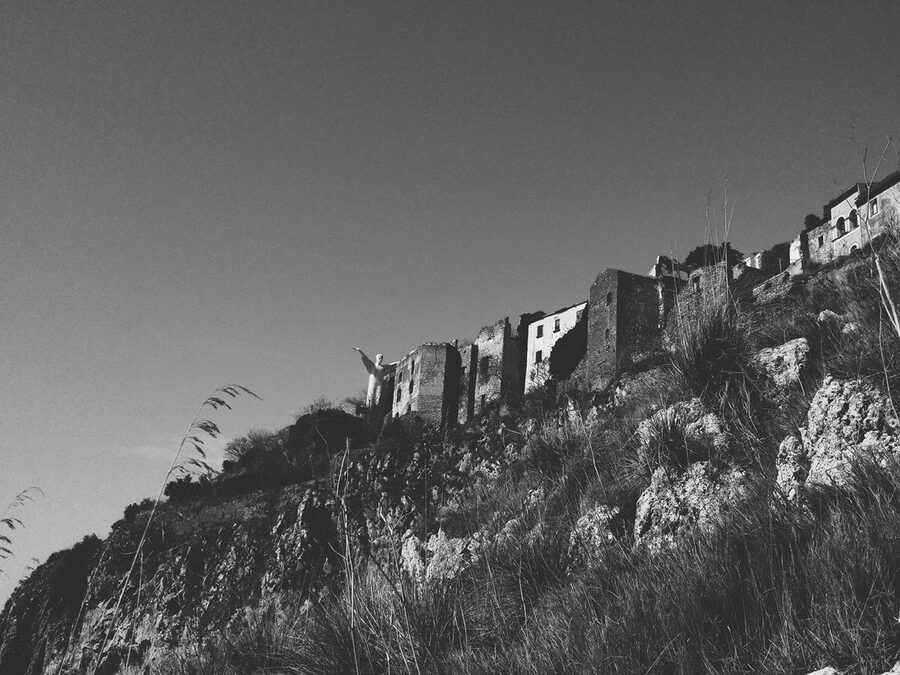
Maratea is the “Pearl of the Tyrrhenian” — a single small town (population about 5,000) strung across the only coast Basilicata has on its western side. Thirty kilometres of dramatic cliff coastline, inside what is effectively a fjord running between Campania’s Cilento and Calabria’s Pollino. The town is actually split into four parts: Maratea Paese (the medieval hilltop centre), Maratea Porto (the small marina below), Marina di Maratea (the newer seaside district), and Fiumicello (the main beach area).
The town’s defining feature is the Cristo Redentore di Maratea — a 21-metre marble statue of Christ the Redeemer that stands on Monte San Biagio at 644 m. It was erected in 1965 on the commission of a local marquis, Count Stefano Rivetti, in deliberate response to Rio’s Cristo Redentor. The Maratea version is larger than you expect when you stand at its base, and the view from the headland it occupies runs the full length of the Tyrrhenian coast from Sapri in Campania down to Praia a Mare in Calabria. It’s one of the best single-location panoramas in the Italian south. Park at the top lot, walk up 400 metres to the statue and the small basilica of San Biagio. Free entry.
Below, in the town: 44 churches (locals claim one for every day of Lent, although only about 30 are still standing). The medieval centre has narrow alleys, small piazzas with fig trees, a 10th-century Torre Cattedrale. The coast has a dozen swimmable small beaches — Spiaggia Nera (black volcanic sand), Spiaggia d’a Secca, Calaficarra — most reached only by path or by boat. In summer, boat trips run from the Porto to explore the grottoes along the coast, including the Grotta delle Meraviglie — a small show cave right on the seafront at Maratea Porto, 120 metres of chambers, €5.
Maratea is genuinely out of the way. The nearest proper transport hub is Sapri in Campania (20 minutes by car). This is a feature not a bug — the town has resisted the kind of mass-tourism build-up that has ruined much of the rest of the Tyrrhenian coast. See the Maratea guide for the full town.
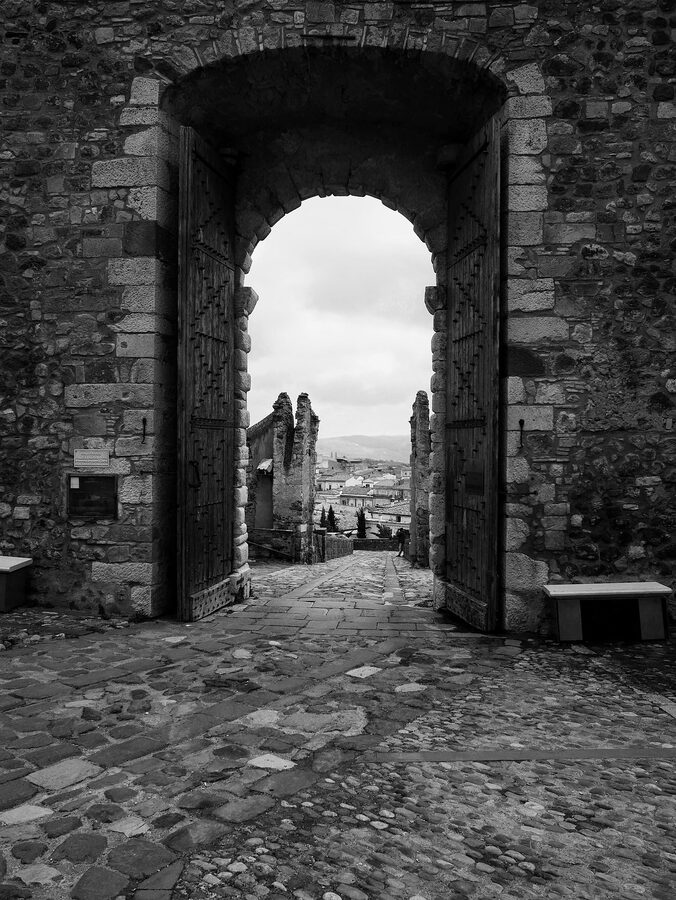
The northern Basilicatan Vulture area — named for the extinct Monte Vulture volcano — was a political centre in the 11th-13th centuries under successive waves of Normans, Hohenstaufens and Angevins. Two stops:
Melfi — the seat of Frederick II’s southern court. His castle here (11th-century Norman foundation, expanded in 1231) is where he issued the Constitutiones Melfitanae in 1231, the first comprehensive state legal code in medieval Europe. The castle is now the Museo Archeologico Nazionale del Melfese, with finds from the surrounding Lucanian tombs. Town itself has a good medieval centre and Romanesque cathedral. €3 castle entry.
Venosa — the Roman city of Venusia, birthplace of the poet Horace (65 BC), who mentions the town in his Satires. The archaeological park has Roman ruins (amphitheatre, thermal baths) alongside the 11th-century Abbazia della Santissima Trinità — a Norman Benedictine abbey that became the burial place of Robert Guiscard and his family. The Incompiuta — the “unfinished” extension to the abbey, started in 1200 and abandoned — is architecturally remarkable. €4 combined ticket.
This area is also the heartland of Aglianico del Vulture DOCG — Basilicata’s great red wine — see the food-and-wine section below.
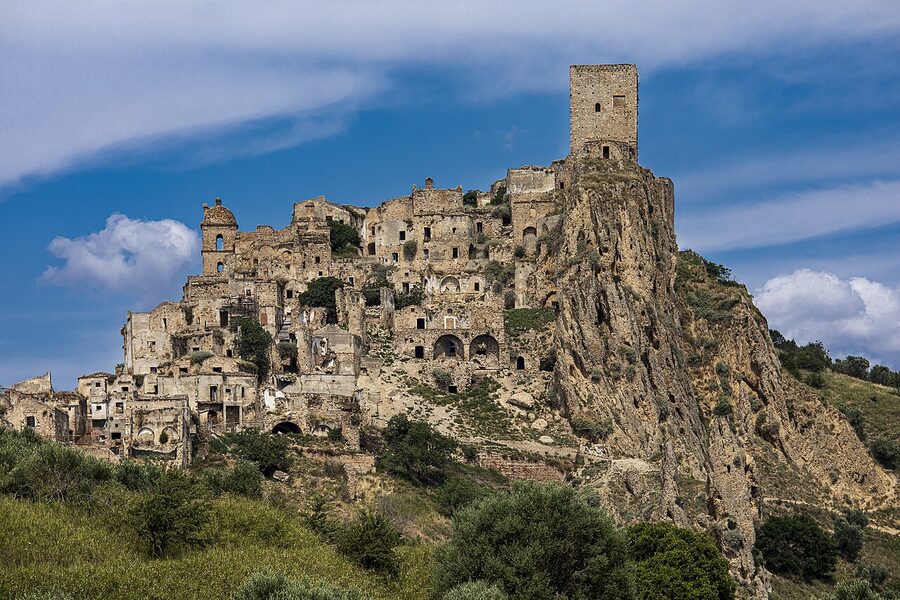
Inland Basilicata has a number of abandoned or semi-abandoned villages — a product of the 20th-century emigration and specific geological catastrophes. The most visited is Craco — a medieval village on a conical hill that was evacuated in 1963 after a major landslide threatened to collapse the hill, and never re-occupied. The empty town survives in 1963 condition: stone houses, narrow streets, churches with their doors still open. It can only be visited on guided tours (hard hats mandatory, €10, book in advance at the ticket office in the adjacent newer Craco village). Mel Gibson’s The Passion of the Christ also used it as a film set.
Other similar sites: Pietragalla (volcanic-rock cellars dug into the tufa, a whole neighbourhood of them), and Aliano — Carlo Levi’s place of exile, preserved as a literary pilgrimage site with his restored house as a museum.
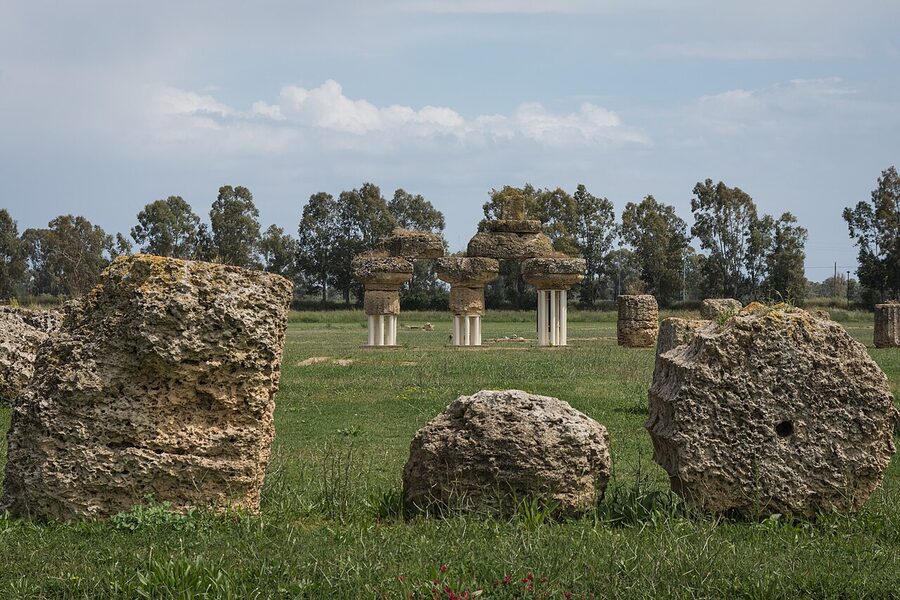
Metaponto was a major Greek colony founded in the 7th century BC at the mouth of the Bradano river on the Ionian coast. At its peak in the 6th-5th centuries BC it had a population of over 20,000 and controlled a broad plain. Pythagoras moved here from Kroton after being expelled by the Krotoniates, and died in Metaponto around 495 BC.
What survives:
Most Italian visitors combine Metaponto with a beach stop; the Ionian coast near here (Bernalda, Nova Siri) has long sandy beaches of the standard southern-Italian resort type.
The Parco Nazionale del Pollino — shared with Calabria (see the Calabria hub for more) — covers much of southern Basilicata. The Basilicatan side is mostly around Rotonda and Terranova di Pollino, with Monte Pollino itself (2,248 m) straddling the provincial border. Good for hiking in summer, the protected Bosnian pine (pino loricato) forest, and some of Europe’s darkest night skies (the park is an International Dark Sky Park).
The park also has the Volo dell’Angelo — a zip-line between two hilltop villages (Castelmezzano and Pietrapertosa in the Dolomiti Lucane, just north of the park) — one of the highest and fastest zip-lines in Europe. Summer only. €40. Worth it if you have the stomach.
Basilicatan food is mountain-peasant, Lucanian in heritage, heavy on bread, pork, chilli and legumes. Five to try and one to drink:
Lucanica — the pork sausage that gave its name to the Lucanian region. Varro and Cicero both mention lucanica in the 1st century BC. Different village-level variants (smoked, fresh, chilli-stuffed, fennel-stuffed). Lucanica di Picerno IGP is the current PGI-protected version.
Peperoni cruschi di Senise IGP — dried sweet red peppers from the Senise valley. The peppers are dried on strings in the sun (i cruschi — “the crunchy ones”), then flash-fried in oil for 30 seconds to produce a spectacularly thin crisp pepper that’s eaten as a snack, crumbled over pasta, or used in pasta e patate con peperoni cruschi — the definitive Basilicatan primo.
Pasta con la mollica — pasta with toasted breadcrumbs (a poor-man’s parmesan when cheese was too expensive), anchovies and garlic. The Basilicatan answer to a bad-harvest dinner. Now everywhere.
Pane di Matera IGP — the traditional Matera bread, made with durum-wheat semolina and Matera’s natural wild yeast. Large round loaves, thick crust, pale crumb, keeps for a week. Shape (conical ridge on top) is distinctive. Buy from any of the old-town bakeries — Panificio Perrone on Via Roma is the best known.
Canestrato di Moliterno IGP — a hard mixed sheep-and-goat’s milk cheese from the Moliterno valley, aged 6+ months. Salty, dry, excellent on top of pasta.
Aglianico del Vulture DOCG — one of Italy’s four greatest red wines (alongside Barolo, Brunello, and Amarone, most sommeliers would argue). Made from the Aglianico grape grown on the volcanic slopes of Monte Vulture in the north of the region. Dark, tannic, dense, with notes of black cherry, tar, chocolate and violet. Needs 8-10 years in the cellar as a minimum for the Riserva versions. Top producers: D’Angelo, Paternoster, Elena Fucci, Grifalco, Basilisco. €20-50 per bottle, and some Riserva vintages from the 2000s are now €80+.
Basilicata works in spring (April-June) and autumn (September-October). Summer is hot (30-35°C inland) and busy only in Matera and the Ionian coastal resorts; elsewhere, even August stays manageable. Winter is cold (potential snow in Potenza and the Pollino), and many hill-village restaurants close — but Matera stays fully operating and is arguably at its most atmospheric in January with low-angle light and an empty cathedral square.
Plan around: the Volo dell’Angelo only operates April-October; the Sagra del Maiale Nero at Gesualdo (late November) for pork-lovers; the Matera Film Festival in June.
Short visit (2-3 days): Matera only — worth it and more.
Standard visit (5-6 days): Matera (2-3 nights) + Maratea (2 nights) + one night in the Vulture for Melfi and the Aglianico vineyards.
Full visit (10 days): add the Ionian coast and Metaponto, the Pollino National Park, and Craco/Aliano on the interior loop.
Individual city guide: Maratea. Further guides for Matera and Melfi as they come online. For adjacent regions: Puglia on the Ionian-Adriatic side, Calabria to the south, Campania across the mountain border to the west, and Sicily if you are continuing down the boot.
Maratea is the only town on Basilicata’s Tyrrhenian coast. The regional coastline there is thirty kilometres long — squeezed between Campania in the north and Calabria in the south — and the town of Maratea occupies almost all of it.…