
Molise
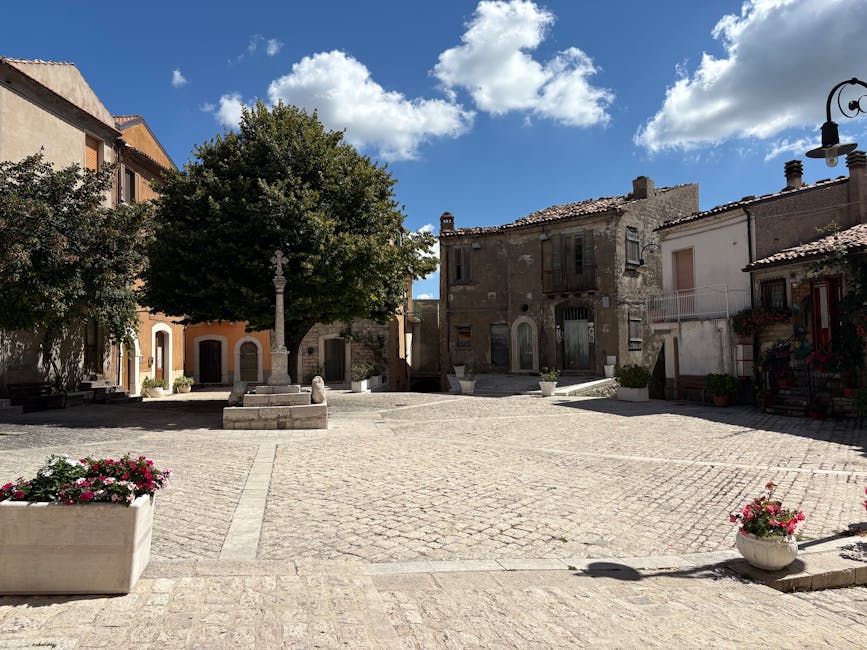
Molise is Italy’s youngest region — only separated from Abruzzo in 1963 — and the smallest mainland region by population. Around 295,000 people live in 4,500 square kilometres of mountain, valley and thirty-five kilometres of Adriatic coast. There is one city of any size (the capital, Campobasso, about 48,000 people), one archaeological site that should be on every classicist’s bucket list (Saepinum), one 700,000-year-old Homo erectus settlement (Isernia La Pineta, among the oldest in Europe), and the oldest family business in the world (the Pontifical Bell Foundry in Agnone, documented continuously from AD 1040). A running joke, circulating since the 2010s on Italian social media, has tourists claiming Molise doesn’t exist. The regional tourist board leaned into the meme and made Il Molise non esiste (“Molise doesn’t exist”) into an unofficial slogan. The region does in fact exist, and most of what is in it is more interesting than the rest of central Italy lets on.
The reason foreigners skip it: no airport of its own, no famous city, no single entry in the international guidebooks. The reason locals stay: the food’s very good, the roads are quiet, the hilltowns are unmanicured, and the coast — what little there is — has retained a tranquillity the rest of the Adriatic lost in the 1970s. Come for a long weekend on the way between Rome and the deep south. Stay three days longer than you planned. That is the standard Molise story.
What Molise actually is
Geographically, Molise is a roughly rectangular slice of central-southern Italy on the Adriatic side of the Apennines. Bounded by Abruzzo to the north, Lazio to the west, Campania to the south, and Puglia to the south-east. The Adriatic coast runs for 35 kilometres, from the mouth of the Trigno river to the mouth of the Saccione, with Termoli as the single coastal town of any size. Inland, the land rises through foothills (300-600 m) and then up to the Matese massif on the Campania border (Monte Miletto, 2,050 m) and the Mainarde on the Abruzzo side.
Two provinces: Campobasso (the capital, with 132 comuni) and Isernia (the inland western province, 52 comuni). Total regional population about 295,000 — down from about 430,000 in 1950 — as a continuous emigration to northern Italy, Canada, Argentina and Australia has depopulated the mountain villages across three generations. Some hill towns have lost 70% of their population in the last 50 years. The regional government runs an ongoing “come back” campaign paying returning emigrants small subsidies to restore abandoned houses.
Historically this was the heart of the Samnite territory — the pre-Roman Italic confederation that fought Rome in the three Samnite Wars of the 4th and 3rd centuries BC, and was eventually absorbed under Augustus. The Samnite ruins at Pietrabbondante (see below) are the best-preserved monuments of this civilisation anywhere. After Rome came Lombards (the Ducato di Benevento), Normans, Hohenstaufens, Angevins, Aragonese — the usual southern Italian succession of overlords — and then the Kingdom of Naples, then the Kingdom of the Two Sicilies, then unified Italy from 1861.
Getting there
Molise has no commercial airport of its own. Practical arrival points:
- Naples (NAP) — 2h by car to Campobasso, about the same by train with a change
- Pescara (PSR) — 1h30 by car, the closest airport
- Rome Fiumicino (FCO) — 2h30 by car to Campobasso, 3h by direct coach
- Bari (BRI) — 3h by car, relevant if combining with Puglia
By train, Termoli is on the Bologna-Bari Adriatic mainline (Frecciabianca and regional services stop there — 3h from Bologna, 3h30 from Bari). Campobasso is at the end of a branch line from Termoli (about 1h30 slow regional). Isernia is on the Rome-Naples-Isernia-Campobasso-Termoli regional line, about 2h from Rome. Frequency is not great; check Trenitalia for timetables.
By car, the A14 motorway hits Termoli, and from there the SS647 goes inland to Campobasso (about an hour). The A1 Rome-Naples motorway exits toward Isernia from San Vittore; from there, the SS17 runs east through the region. A car is strongly recommended — the region is deep rural and public transport is limited.
Campobasso
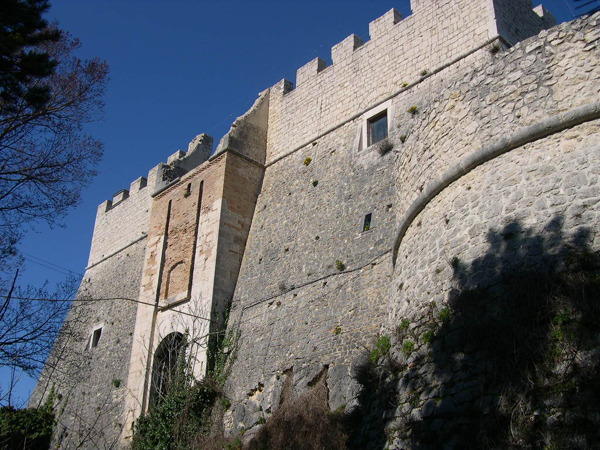
Campobasso is the regional capital — 48,000 people, on a series of hills in the centre of the region at 700 m altitude. The city divides into a modern lower town (a regular 19th-century grid designed by the Bourbon governor Carlo Borbone) and an old upper town (medieval, tight, climbing up to the Castello Monforte on top of the hill). Most tourist interest is in the upper town and the castle.
Worth an afternoon:
- Castello Monforte — 15th-century hilltop castle, rebuilt over a Lombard fortification, now a memorial. Free entry; the climb is steep. Monumento ai Caduti war memorial at the summit, plus a small on-site wind observation station.
- Chiesa di San Bartolomeo — 13th-century Romanesque in the upper town, with a frescoed apse.
- Museo dei Misteri — a small museum dedicated to the city’s ten Misteri (miracle floats) that are paraded through town each Corpus Christi. The floats themselves are the older part: painted wood structures from the 1740s, each supporting live actors rigged in metal harnesses to appear suspended in mid-air. The Misteri procession is one of the strangest living religious spectacles in Italy; if you can come for Corpus Christi (moveable, May-June), do.
- Museo Sannitico — the Samnite Museum, with archaeological finds from Pietrabbondante and nearby Samnite sites.
For a full city guide see the Campobasso article.
Saepinum / Altilia
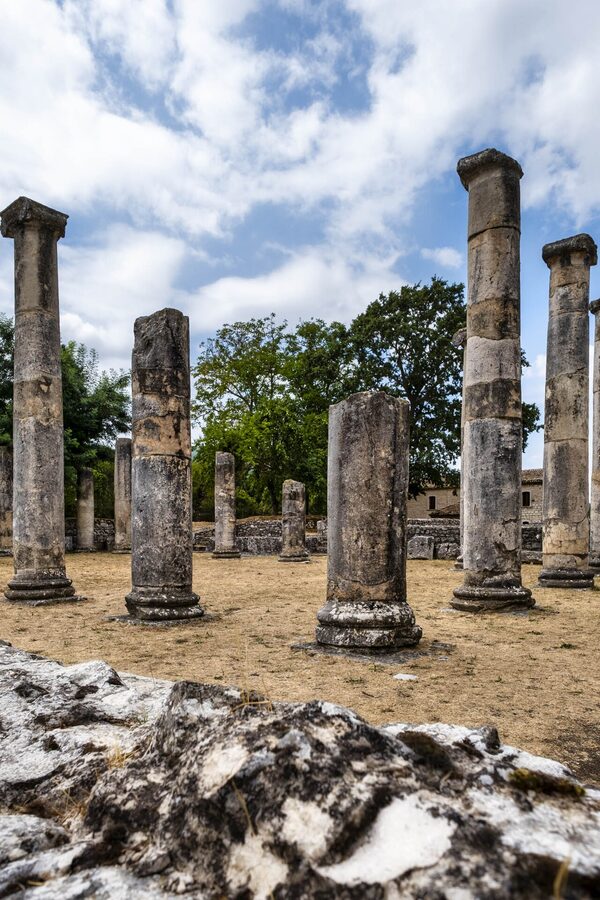

Thirty kilometres south of Campobasso, near the village of Sepino, lies the single most rewarding archaeological site in southern Italy that almost nobody visits: Saepinum (locally called Altilia). A complete Roman provincial town, founded around the 1st century BC as a market town on a Samnite shepherd’s trail (tratturo), destroyed around the 9th century AD in Saracen raids, and left undisturbed ever since. The medieval survivors moved up the hill to where modern Sepino now sits, and the Roman town was slowly absorbed back into pasture.
What you see today is essentially a complete Roman town plan: the city walls with four main gates intact (Porta Benevento, Porta Boiano, Porta Tammaro, Porta Terravecchia), the main east-west and north-south streets, the forum, the basilica, the curia, the baths, the macellum (market), a theatre carved into the side of the city wall (2nd century AD), and a small on-site museum in a farmhouse at the Porta Boiano end. A handful of 18th-century farmhouses are built directly on top of the Roman structures (their walls blend into the Roman walls), giving the place an extraordinary continuity of layers.
Free entry, always accessible (there’s no perimeter fence — the site is open pasture). Allow 2 hours. The small museum opens Tue-Sun. No café or facilities; bring water. Come in April-May or September-October for the best light and the fewest sheep in the way.
Pietrabbondante
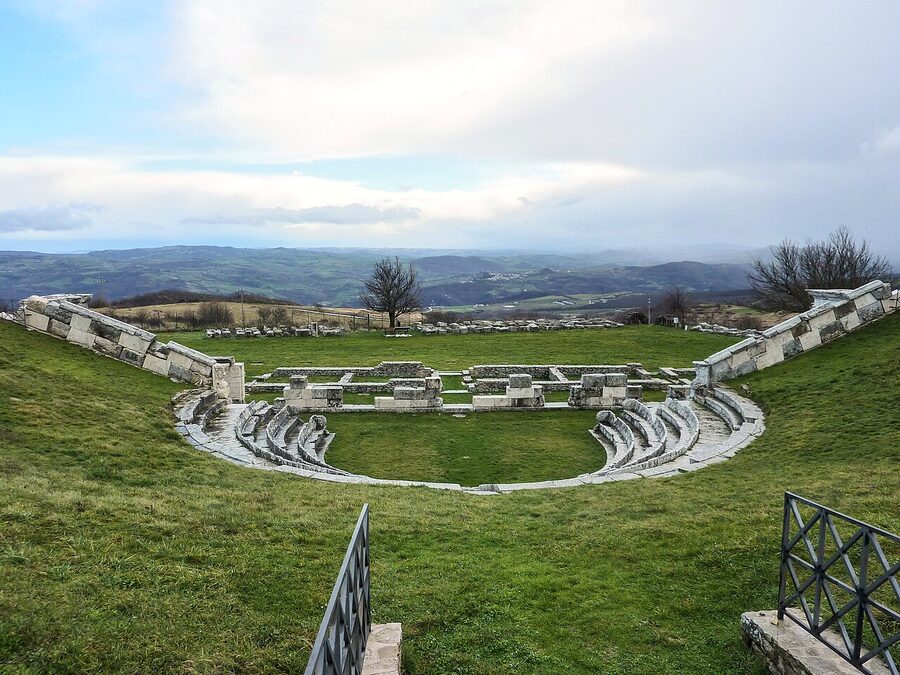

Forty kilometres north-west of Campobasso, in the Isernia province, is Pietrabbondante — the religious and political centre of the Samnite Pentri tribe in the 4th-1st centuries BC. The site is on a high ridge (1,025 m) with views across to the Matese. What survives is remarkable:
- A large Samnite theatre, built around 100 BC, with stone seating cut to an ergonomic S-curve (back-support!) — the oldest known use of this shape in theatre architecture.
- A templar complex — two temples on a shared platform, dedicated to pre-Roman Italic deities.
- A small museum on site with finds from Samnite cremation burials, votive bronzes, and the iron weapons the tribe carried.
Combined with Saepinum, this is the most complete picture of the Samnite civilisation that Rome fought and eventually absorbed. €4 entry. Open Tue-Sun. Combine with lunch at the village (excellent pezzata at Ristorante La Pergola).
Isernia La Pineta
Near Isernia city is the La Pineta archaeological site — a Middle Pleistocene settlement dated to approximately 700,000 years ago. It’s one of the oldest confirmed Homo erectus sites in Europe, and the best-preserved. The site yielded stone tools, animal bones (bear, elephant, rhinoceros, hippopotamus — the Pleistocene Italian fauna), and the remains of a tooth attributed to Homo erectus. The site is covered by a purpose-built museum building that encloses the excavation and provides climate control.
Visitor access: Museo Paleolitico di Isernia La Pineta, Contrada Ramiera Vecchia, Isernia. €4 entry. Open Tue-Sun. Small, well-curated, deeply strange to stand in a covered stratum and look at the surface where humans were chipping stone 700,000 years before you were.
Agnone and the bell foundry
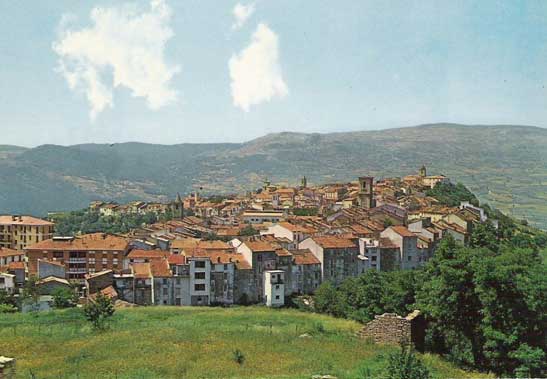

Agnone, a hilltop town in the north of the region at 830 m, is home to the Pontifical Marinelli Bell Foundry — the oldest continuously operating family business in the world, documented from 1040 AD. The Marinelli family has been casting bells for twenty-six generations. Their bells ring at the Vatican (they cast the bells for Saint Peter’s), at the Verona Arena, at the UN headquarters in New York, and in cathedrals across the Catholic world. The factory accepts visitors by appointment — €5, 90-minute guided tour with a member of the family, sees the traditional clay-mould process and the firing pits. Fonderia Marinelli, Via d’Onofrio 3-5. Tours in Italian with English translation.
Also in Agnone: on 24 December each year, the town holds the ‘Ndocciata — an ancient fire festival, possibly of pre-Christian origin, in which men carry giant lit torches (the ‘ndocce, up to 4 metres tall, made of bundled firewood) through the town in procession. Several hundred torches, carried on shoulders through narrow streets after dark. UNESCO is currently reviewing it for Intangible Heritage listing.
Termoli and the coast
Termoli is the only coastal town of any size — a compact fishing port and seaside resort, population about 32,000, on a small rocky promontory. The old town (Borgo Antico) is a walled medieval quarter with tight alleys, a small cathedral (11th-century Apulian Romanesque, with a recently restored 13th-century façade carving of the miracle of the holy relic of Saint Basso), and the 13th-century Castello Svevo commissioned by Frederick II on the site of a Norman tower. The modern town wraps around the east side.
The big draw is the beach — long sandy lidi on either side of the old town (Rio Vivo beach to the west, Sant’Antonio to the east), Blue Flag certified, family-friendly, €20-30 for an umbrella and two sun-loungers for a day.
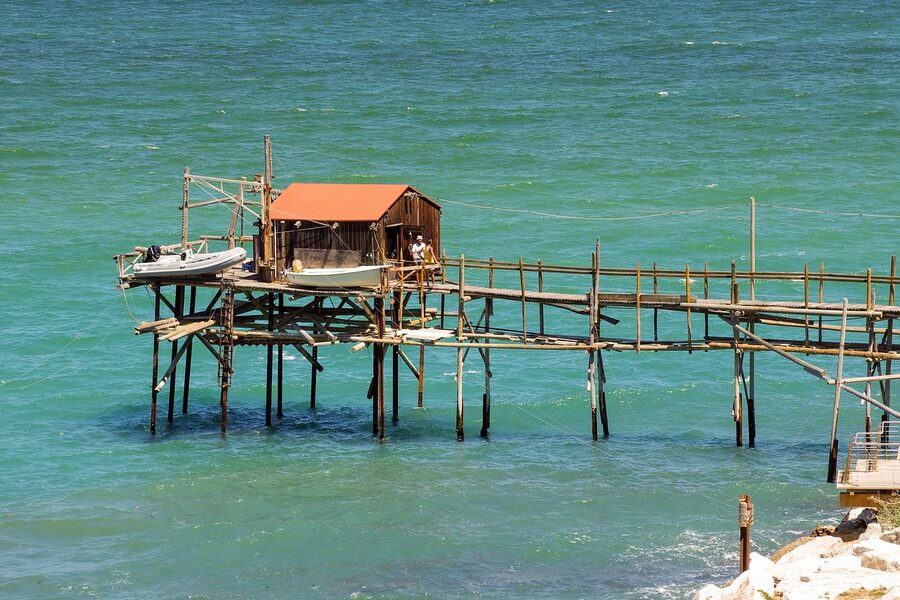
The trabucchi (or trabocchi) are the cultural specialty of the Molise and north Puglia Adriatic — wooden fishing platforms extending from the shore on stilts, with long boom arms holding square nets that are winched up to trap fish. They’re a traditional Abruzzese-Molisan-Pugliese fishing technology, documented since at least the 18th century. Several around Termoli still operate — some as working platforms, some as seasonal restaurants that serve the day’s catch on the deck. Trabucco Cuttinelli and Trabucco Turchino are the most reliably open to visitors; book ahead in summer.
From Termoli, ferries run to the Tremiti Islands (technically in Puglia province, but the easier approach is from Termoli — 60 min by ferry). The islands are a small protected archipelago with diving, snorkelling, and a 9th-century monastery.
The Matese and the Mainarde
The two mountain areas of the region are underrated for walking.
Parco Regionale del Matese covers the south-western corner of the region (plus more of Campania). High pastures, beech forest, wolves, wildcats, and Lago del Matese (a small high-altitude lake). Walking trails from Campitello Matese (a small ski station at 1,400 m) and from San Polo Matese.
Parco Nazionale d’Abruzzo, Lazio e Molise — Italy’s second-oldest national park, established 1923. The Molise portion is the Mainarde chain, on the border with Abruzzo. Home to the Marsican brown bear (about 50 individuals left in the wild), the Apennine wolf, and the rarer European otter. The park visitor centre at Pizzone has guided walks, wildlife tracking options, and a small children’s museum.
Food and wine
Molisan food sits between Abruzzese, Campanian, and mountain peasant traditions. Five things to eat and one to drink:
Cavatelli al Sugo — the local hand-rolled pasta (eyeball-sized, cigar-shaped), typically served with a long-simmered pork or lamb ragù, sometimes with rocket. A meal in itself.
Pezzata — a mutton stew, pre-Lent tradition, made with old ewe meat slow-cooked with wild fennel, bay and tomato. The annual Sagra della Pezzata at Capracotta on the first Sunday of August is the place to try the village-level version.
Pampanella — pork belly from San Martino in Pensilis, seasoned aggressively with garlic, rosemary, paprika and wine, roasted in wood ovens. Possibly the most flavoured-forward pork dish in Italy.
Caciocavallo di Agnone DOP — the other thing Agnone is famous for. Pear-shaped cow’s milk cheese hung in pairs on ropes to cure. Aged 30 days for eating fresh, 12 months for aged. Try at the Di Nucci cooperative in Agnone.
Confetti di Sulmona — technically Abruzzese, but produced in Molise too: sugared almonds, the foundation of Italian wedding sweets. The Pelino factory in Sulmona (over the border in Abruzzo) is the biggest producer; Molise has a Fratelli Mucci branch in Agnone.
Tintilia del Molise DOC — the region’s indigenous red grape. Tintilia was nearly extinct by the 1980s (only a handful of vines left), revived by local producers over the last 25 years. Now the pride of Molisan viticulture: a dark, medium-bodied red with spicy black-fruit characters. Best producers: Di Majo Norante (who revived it), Cianfagna, Borgo di Colloredo, Cipressi. €12-25 a bottle. The white equivalent is Falanghina del Molise, from the same family as the Campanian version. The local olive oil (Venafro DOP, from the Colline Venafrane around Venafro) is one of the oldest DOP olive oil designations in Italy — mentioned by Pliny the Elder.
When to visit
Molise is a shoulder-season destination. April-June and September-October are the sweet spots: manageable temperatures (18-26°C), hill towns green, the archaeological sites quiet, the festivals (truffle fair at San Pietro Avellana in mid-October, Sagra della Pezzata at Capracotta in August, olive harvest at Venafro in November) spread through the calendar.
Summer is warm (28-33°C) in the valleys but pleasant at altitude; August is hot and locals flee to the coast — Termoli and its lidi are crowded, but that’s as crowded as anywhere in Molise gets, which by Italian standards is not crowded. Winter is cold, the hill towns are atmospheric but many restaurants close, and ski at Campitello Matese is a rare option for a modest-sized Italian ski area.
Dates worth planning around: Misteri procession at Campobasso on Corpus Christi (May-June); ‘Ndocciata at Agnone on 24 December; Sagra della Pezzata at Capracotta on the first Sunday of August; Processione dei Serpari at Cocullo (technically Abruzzo but easy to combine) on the first Thursday of May — the famous snake-charmer procession.
How long
Weekend: Campobasso + Saepinum + Termoli (2 nights, probably based in Campobasso).
Long weekend (4 days): add Pietrabbondante, Agnone, and one of the nature parks.
A week: full slow loop — Campobasso, Saepinum, Pietrabbondante, Agnone, Isernia La Pineta, coast at Termoli with a ferry to the Tremiti Islands. This is also plenty of time to eat properly.
Individual city guides: Campobasso, and forthcoming guides to Termoli and Agnone.