Sicily

Sicily is the largest island in the Mediterranean, older than Rome, has been occupied or governed by seven separate powers in the last three thousand years, and does not really think of itself as part of Italy. If you speak to a Sicilian about a trip to “the continent,” they mean Italy. If you speak to a mainland Italian about Sicily, they will tell you that Sicilians are Sicilian first and Italian second, and then cheerfully reel off five stereotypes they would never say out loud to a Sicilian. Both sides are broadly right. Sicily has been a Greek colony, a Phoenician trading post, a Roman grain province, a Byzantine exarchate, an Arab emirate, a Norman kingdom, and a Spanish viceroyalty. Each of those layers is still visible, in buildings that are still standing, in dialects that are still spoken, and in food that is still cooked in the same way it was cooked in 900 AD.

This is the first thing to understand about coming here. Sicily is not a version of Italy with different beaches. It is its own place. You will hear Arabic-origin words ordering coffee in Palermo. You will eat a dish in Trapani that has more in common with Tunis than with Milan. You will stand in front of a Doric temple at Agrigento that has been standing there, largely unchanged, for 2,450 years. You will drink a red wine from the slopes of an active volcano. You will climb a medieval hilltop town built on the temple of a goddess that predates the Greeks. None of this is a metaphor. All of it is what is there.

I have been coming to Sicily since 2008. I still have not seen it all and I do not expect to. The island is 25,711 square kilometres — slightly larger than Belgium — with five million residents, three UNESCO world heritage sites on the mainland and two more on the islands, fourteen Doric temples from the Greek period still standing, a functioning Byzantine mosaic cycle you can walk into, a working operatic theatre from 1897, an active stratovolcano whose paroxysmal eruptions close the airport roughly once a year, and the single best cannoli shop I know of, which is not named but which I will narrow down in the Palermo section below. If you have ten days, you can see a third of what is essential. If you have two weeks, you can see half. If you have a month, you still won’t see it all, but you will start to understand what you are looking at.

Sicily in one paragraph

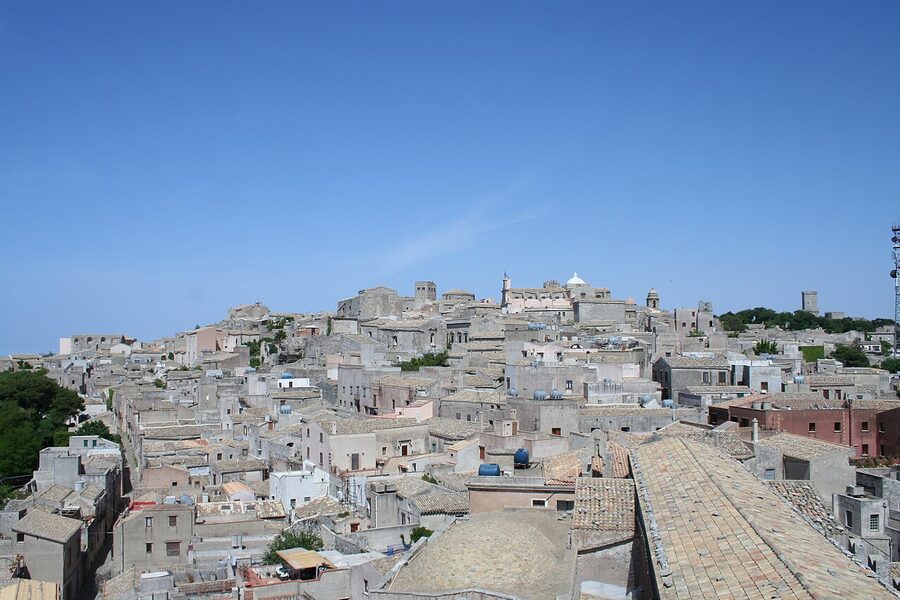
The medieval town of Erice on a mountain above Trapani, western Sicily
Erice, at about 750m above Trapani. This is the kind of town Sicily produces — a medieval shell wrapped around a Norman castle wrapped around a Greek precinct to Venus wrapped around a prehistoric Elymian cult site. Walk any village and the archaeology goes down the same way. Photo by b.roveran / Wikimedia Commons (CC BY 2.0)

Italy’s largest region by area and its fifth most populous. 25,711 km², 4.8 million residents, nine provinces, capital Palermo (673,000). Separated from the mainland by the 3-km Strait of Messina. Two main mountain ranges: the Peloritani and Nebrodi in the north, the Madonie inland west. An active stratovolcano — Mount Etna, 3,357m — on the east coast. Seven offshore island groups, two of which (Aeolian and Pantelleria) are themselves volcanic. Five UNESCO world heritage sites: Arab-Norman Palermo + Cefalù + Monreale; Val di Noto late baroque; Villa Romana del Casale late Roman mosaics; Aeolian Islands; Mount Etna; and Syracuse & the Necropolis of Pantalica. Common languages: Italian (official), Sicilian (regional — a separate language, not a dialect), plus Italian-spoken Arbëreshë (Albanian) in a handful of villages. Demonym: Siciliano / Siciliana.

Getting to Sicily

Three routes, depending on where you are coming from and how much of the crossing you want to see.

By air. Three international airports — Palermo (PMO), Catania (CTA), and Trapani (TPS) — plus a smaller airport at Comiso (CIY) in the southeast. Catania is the busiest and has the most direct European flights; Palermo is second. From within Italy, Ryanair, ITA Airways, Wizz and EasyJet all fly Rome and Milan to Catania and Palermo multiple times a day. From the UK, BA and EasyJet fly direct in summer. Flights into Catania during Etna paroxysmal activity occasionally divert or are cancelled — check the airport status page (aeroporto.catania.it) if you see ash warnings. Car hire at the airport is usually the cheapest in Italy because Sicily has a permanent surplus of rental vehicles.

By ferry. Four routes. Naples–Palermo overnight ferry (11h, about €50 passenger foot, €150 with car) run by Tirrenia and Grimaldi, leaves nightly around 8pm and arrives Palermo 6am — the best way to do the first trip because you wake up sailing into the Palermo harbour with Monte Pellegrino in front of you. Civitavecchia–Palermo (14h, once daily). Villa San Giovanni–Messina (20 minutes, €50-80 for car, continuous daytime service) is the mainland-Calabria shuttle if you’re driving down the Italian boot. And the Salerno–Messina catamaran (9h, summer only).

By train with car. Trenitalia still runs the old Intercity Notte service from Rome and Milan to Palermo and Syracuse, with your train carriages loaded onto the Messina ferry — the last European rail service of its kind. It takes 12-15 hours depending on departure point, costs about €80 in a couchette, and is the trip to do if you like infrastructure weirdness. There is no longer a through ferry service for your car; you park at Villa San Giovanni or pay for a car ferry separately.

Getting around the island. Rent a car. Sicily’s train network covers the coast but not the interior; the rail from Palermo to Catania goes through Enna and takes 3.5 hours for what is a 2-hour drive. The inland towns (Ragusa, Modica, Enna, Caltagirone, Piazza Armerina) are reachable only by car or by infrequent buses. If you are not driving, base in two or three coastal cities and day-trip from each.

The seven conquests — why Sicily looks like nowhere else

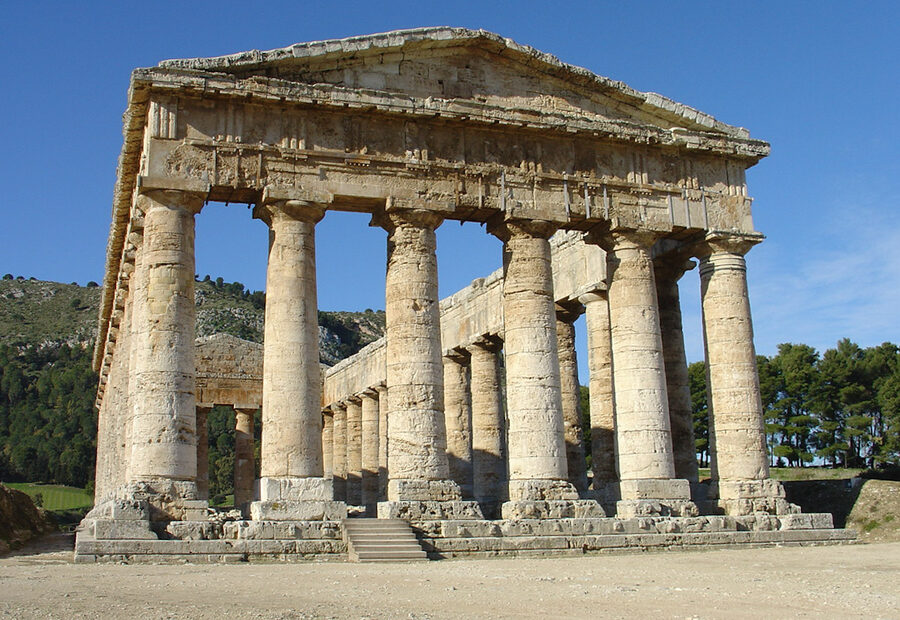
The unfinished Doric temple at Segesta, built by the Elymians around 420 BC
The temple at Segesta — Doric, c. 420 BC, and never finished. The columns were never fluted; there was never a roof. The Elymians who commissioned it were destroyed by Carthage before the building was complete, and everyone since has left it the way it was found. One of the eeriest buildings in Europe. Photo via Wikimedia Commons (Public domain)

The reason Sicily is so layered is that every one of the seven powers who took it from the previous one built on top of what was already there rather than tearing it down. This is unusual. In most of Europe, a Norman conquest meant burning the old capital and starting over; in Sicily the Norman kings kept the Byzantine bureaucracy, the Arab architects, and the Greek churches, and issued their decrees in three languages. The cumulative effect is that an ordinary Sicilian town has, by archaeological layering, seven civilisations underneath it, and you can sometimes see four of them at once.

The short version of the history:

Elymian / Sicanian / Sikel (pre-Greek). Three indigenous peoples lived on the island before the Greeks arrived. The most visible survival is at Segesta in the west, an Elymian city whose unfinished Doric temple still stands.

Greek (735-212 BC). From around 750 BC, Greek colonists settled the east and south coasts. Syracuse, founded 734 BC by Corinthians, became the largest Greek city in the world at its peak, rivalling Athens. Agrigento, Gela, Selinunte, Taormina, Catania and Messina are all Greek foundations. The temples at Agrigento and Segesta, the theatre at Syracuse, and the theatre at Taormina are Greek-built structures you can still walk into.

Carthaginian (6th century–241 BC). The Phoenicians held the west — Palermo, Motya (now a small island in Marsala lagoon), Solunto. The Greek-Punic wars (580-265 BC) were fought primarily on Sicilian soil; Carthage won most battles and lost the war.

Roman (241 BC–535 AD). After the First Punic War, Sicily became Rome’s first overseas province. It was the grain basket of the empire. Major surviving Roman structures: the Villa Romana del Casale at Piazza Armerina, with its 3,500 square metres of 4th-century floor mosaics (UNESCO-listed and the best late-Roman mosaic cycle in Europe), and the amphitheatre and odeon at Catania.

Byzantine (535-965 AD). When Belisarius retook Sicily for Justinian in 535, the island stayed Greek-speaking and Eastern Christian for four centuries. Greek remained the dominant language. A few Byzantine churches survive, mostly in the eastern half of the island.

Arab (827-1091 AD). The Aghlabids and later the Fatimids took the island in a 75-year campaign. Palermo became the capital of an independent Emirate of Sicily and, by the 10th century, one of the largest and richest cities in Europe, with a population estimated at 300,000. The Arabs introduced citrus, sugarcane, pasta, rice cultivation, silk, a sophisticated irrigation system still in use today, and the foundational vocabulary of modern Sicilian cuisine (everything ending in -ata, -eddu, the whole couscous-based food culture of the west coast, plus cassata and sorbet).

Norman (1061-1194). Roger I de Hauteville, a Norman mercenary and minor son of a minor baron from the Cotentin peninsula in France, took the island off the Arabs in a thirty-year campaign and crowned himself Great Count. His son Roger II became the first King of Sicily in 1130 and reigned over what was, at that moment, the most sophisticated court in Europe: Norman knights and administrators, Arab viziers and architects, Byzantine Greek artists, Jewish translators, Lombard settlers, and a chancery that issued documents in Latin, Greek, and Arabic. Roger’s Cappella Palatina in Palermo and the cathedrals at Monreale and Cefalù are the flagship works of what is now called Arab-Norman architecture — fused Byzantine mosaic, Arab muqarnas ceilings, and Norman structural forms, found nowhere else in the world.

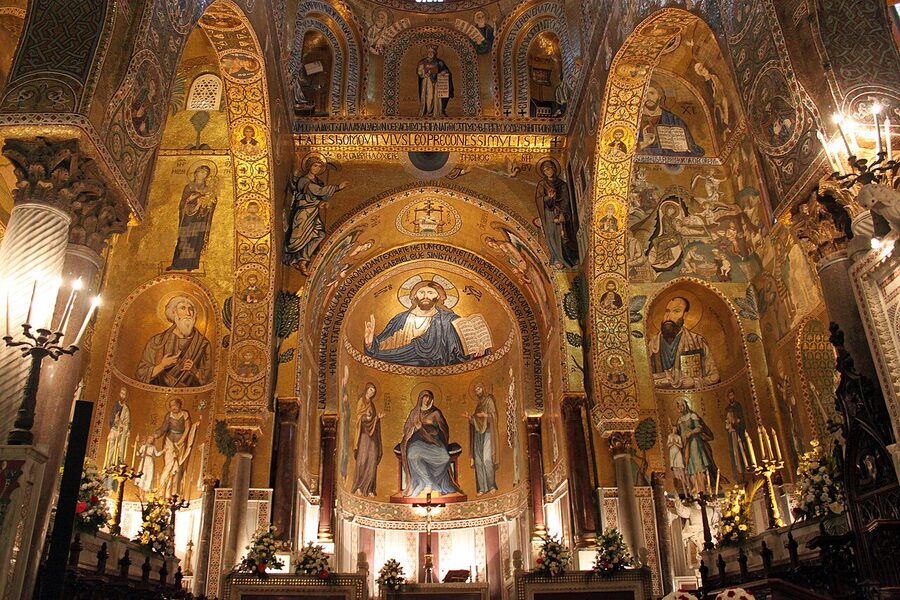
The Palatine Chapel inside the Norman Palace in Palermo
The Cappella Palatina inside Palazzo dei Normanni, Palermo — built 1132-1140 for Roger II. The painted wooden ceiling is Arab muqarnas, the mosaics are Byzantine, the plan is Latin Western, the inscriptions are in three languages. Nothing quite like it exists anywhere else. Go early; it closes midday. Photo by Liilia Moroz / Wikimedia Commons (CC BY-SA 4.0)

Hohenstaufen, Angevin, Aragonese, Spanish, Bourbon, Italian (1194-present). After the Norman line ended, the island passed through Emperor Frederick II — whose court in Palermo, where he grew up, is where the first Italian-language poetry was written — and then through a rolling series of French, Spanish, Austrian and Bourbon administrations. Spanish rule (1412-1713) was the longest and the most architecturally productive: the 1693 earthquake that destroyed the southeast gave Spain’s Sicilian viceroyalty the opportunity to rebuild a dozen cities in the late baroque style that is now the Val di Noto UNESCO listing. Sicily joined the Kingdom of Italy in 1860 after Garibaldi’s Expedition of the Thousand landed at Marsala.

The take-away is that seven hundred years of the last thousand are visible above ground. You can look at a single town — Cefalù, say — and see Arab houses next to a Norman cathedral next to a baroque square next to an Art Nouveau train station. This is normal here.

Palermo and the Arab-Norman west

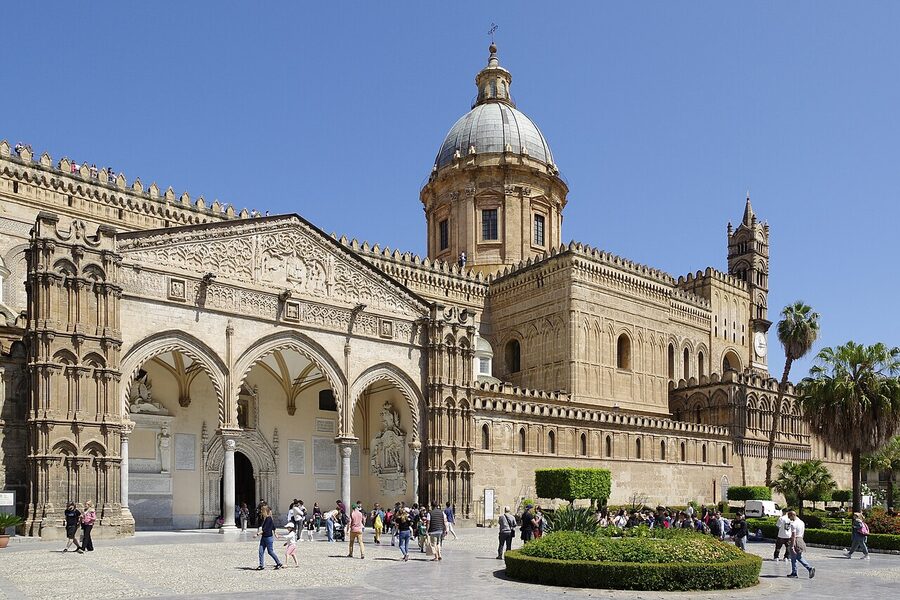
The Cathedral of Palermo with its Arab-Norman architecture and crenellated walls
The Cathedral of Palermo — founded 1185 on the site of an Arab mosque, which itself occupied the site of a Byzantine basilica. The two towers were added in the 14th century, the cupola is 18th-century. Once you learn to look at Sicilian buildings for the seams, you see them everywhere. Photo by Berthold Werner / Wikimedia Commons (CC BY-SA 4.0)

Palermo. The capital, pop. 673,000, the densest, loudest, most contradictory city in Italy. Layer cake: Arab palace under Norman palace under Spanish viceregal palace. The five places you cannot skip: the Palatine Chapel inside the Norman Palace (book ahead — tickets include the royal apartments, which are Bourbon-era and worth a second look); the Duomo of Palermo, whose architectural timeline is a one-building tutorial on the seven conquests; the Ballarò market and the Vucciria market, which are not polished and should not be (street food, not sit-down); the Teatro Massimo, the third-largest opera house in Europe, built 1897, and the location of the final scene of The Godfather Part III; and the Catacombs of the Capuchins, 8,000 mummified Palermitans in the basement of a monastery, which is as genuinely unnerving as Italian tourism gets.

Eat at Osteria dei Vespri (Palazzo Gangi — yes, the ballroom from Visconti’s Il Gattopardo) for sit-down; at Franco u’ Vastiddaru (corner of Vittorio Emanuele) for pane ca meusa (spleen sandwich, and before you decide it sounds awful, know that 400,000 Palermitans eat one every week); at I Segreti del Chiostro inside the Santa Caterina complex for cannoli made daily by the nuns of the community; and at Cappadonia (Via Isidoro la Lumia) for gelato, which is a genuine contender for the best in Italy.

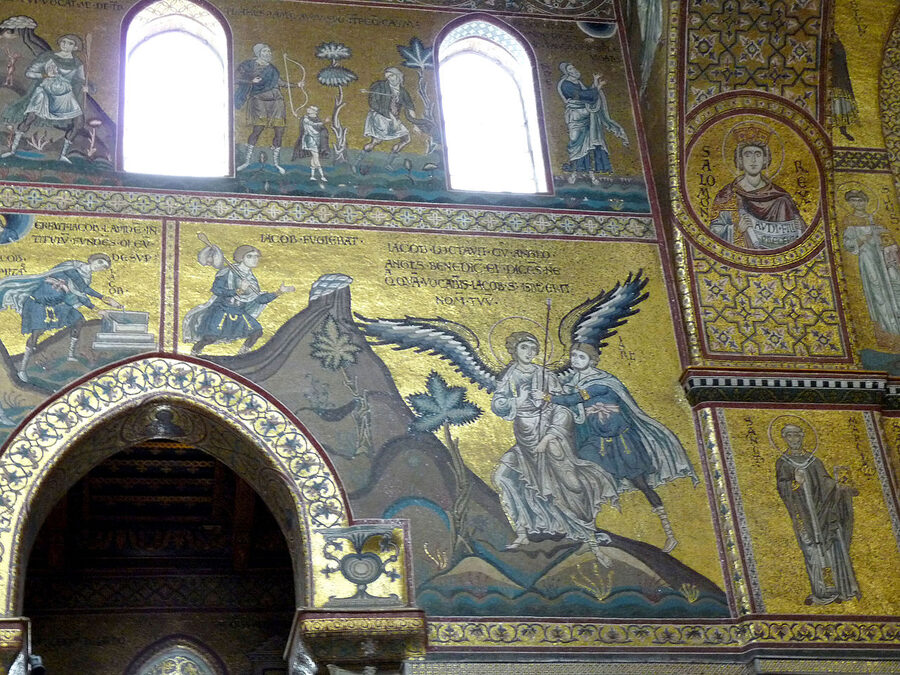
The gold-ground Byzantine mosaics covering the interior of the Duomo of Monreale
The mosaic cycle at Monreale — 68,000 square feet of gold-ground Byzantine work, made between 1180 and 1200 by Greek mosaicists brought in from Constantinople under William II. The largest single mosaic cycle in the world, and the one that, after Ravenna, best shows what a functioning medieval Byzantine church was supposed to look like. Photo by michael clarke stuff / Wikimedia Commons (CC BY-SA 2.0)

Monreale is a bus ride above Palermo, 8km up the mountain. The cathedral and the cloister are the trip. Go for the mosaic cycle — William II’s 1180s commission, 68,000 square feet of gold-ground Byzantine mosaic, still intact. Half a day.

Cefalù, an hour east along the Tyrrhenian coast, is the single prettiest small town in northern Sicily. Norman cathedral (1131, Roger II’s original foundation), medieval lanes behind it, fishing harbour below, the La Rocca crag rising behind, and a three-kilometre beach fronting the old town. A day to visit, two if you want to swim and eat dinner at Qualia.

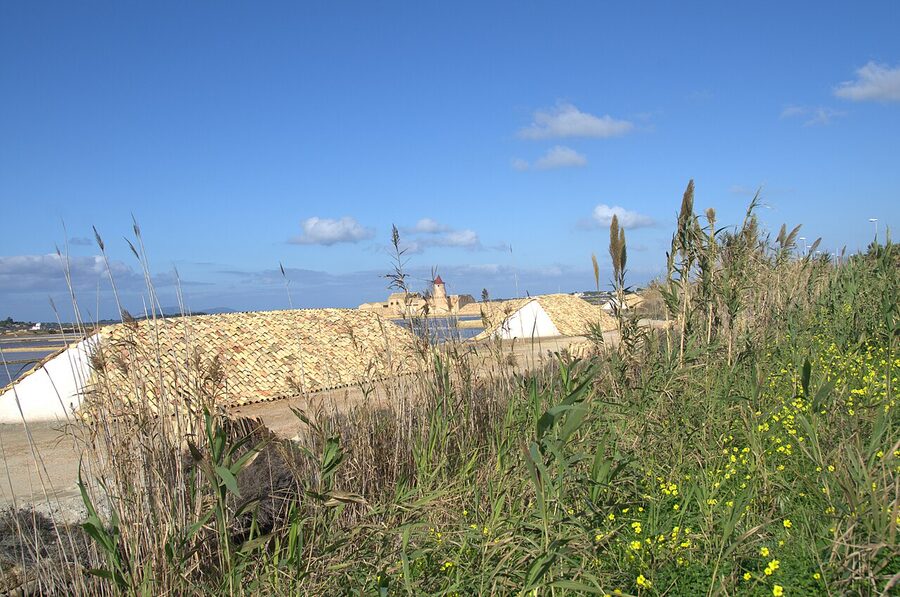
Trapani, Erice, Marsala. The west coast is the less-touristed half of Sicily and in some ways the more interesting. Trapani is the port city — baroque centre, working fishing harbour, tuna-salting museum, and the jumping-off point for the Egadi islands (Favignana is the one to go to). Erice sits at 750m on the mountain above Trapani, reachable by a six-minute cable car. Medieval within the walls, Norman castle at the peak, Doric temple foundations under the castle — a silhouette that reads closer to Urbino in the Marche than to anywhere else on this island — and Maria Grammatico’s almond pastry shop — the most famous in Sicily, run by a nun-turned-pastry-chef whose memoir was made into a 1990s bestseller — on Via Vittorio Emanuele 14. Marsala, half an hour south of Trapani, is the wine town (see the food and wine section below) plus the Saline salt flats whose sunsets are the famous shot you see on every Sicily Instagram account.

The salt flats of Marsala on the west coast of Sicily, with traditional windmills
The Saline di Marsala. The windmills were introduced by Flemish engineers under Spanish rule in the 16th century and are still used to move water between evaporation basins. The salt is harvested by hand in July and August; go to the basins in September-October for the best water colours. Photo by Filippo Piazza / Wikimedia Commons (CC BY-SA 3.0)

Selinunte and Segesta are both around ninety minutes from Palermo inland. Selinunte (the larger) has seven Doric temples in various states of collapse across a 270-hectare archaeological park on the sea — the largest Greek archaeological park in Europe. Segesta (the more striking) has one almost-intact Doric temple sitting alone on a hillside, plus a Greek theatre 400m above the temple with a view over the Gulf of Castellammare. Allow half a day for one, a full day if you’re doing both.

Agrigento and the Valley of the Temples

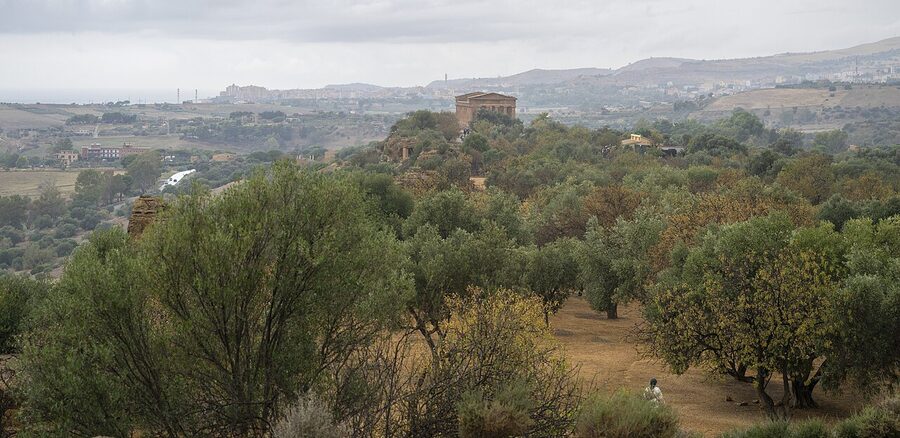
The Temple of Concordia in the Valley of the Temples at Agrigento
The Temple of Concordia, Agrigento. Built c. 440 BC. The Doric columns are the originals; the apparent intactness is partly a consequence of the 6th-century conversion to a Christian church, which preserved the structure while everything around it was quarried for the nearby town. Go at dawn — the temple is angled to catch the first light. Photo by Cayambe / Wikimedia Commons (CC BY-SA 4.0)

The Valley of the Temples — despite the name, it is a ridge rather than a valley — at Agrigento is the single most important Greek archaeological site outside Greece. Eight temples in various states: the Temple of Concordia is the famous one, near-intact because it was converted into a Christian church in the sixth century; the Temple of Juno sits on the cliff edge at the ridge’s eastern end; the Temple of Olympian Zeus — the largest Doric temple ever begun — survives as footprint plus scattered stones because the Romans and later locals quarried it for building material. Allow half a day minimum. Entry is €15, with an extended ticket including the Regional Archaeological Museum for €20. The museum is genuinely worth it, especially for the Telamon statue from the Zeus temple.

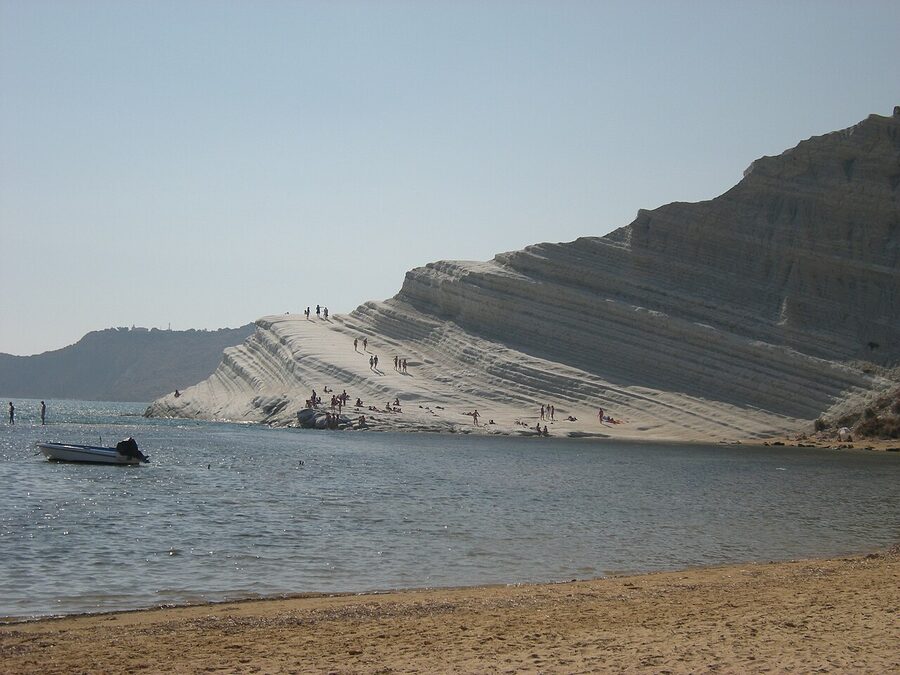
The white chalk cliffs of Scala dei Turchi stepping down to the sea at Realmonte
The Scala dei Turchi at Realmonte, twenty minutes west of Agrigento. Pure white marl chalk, naturally stepped by wave action, sitting above a turquoise bay. The surface has started to degrade from tourist traffic; the park is now officially closed to climbing and beach access is controlled during peak months. View from the boardwalk above. Photo by Carnby / Wikimedia Commons (CC BY 3.0)

Twenty minutes along the coast from Agrigento, at Realmonte, is the Scala dei Turchi. White chalk marl cliffs, naturally stepped by wave action, above a turquoise bay. It has been photographed to death in the last five years and the authorities closed the direct beach climb in 2022 because of erosion; you now view from the boardwalk above. Still worth forty minutes. Combine with Agrigento for a single day.

The town of Agrigento itself is less compelling than the temples — a working mid-sized Sicilian city with a nice Norman cathedral and a surprisingly good street food scene around Via Atenea. Stay overnight at one of the agriturismi in the surrounding countryside (Borgo Giallonardo, Masseria del Carboj) rather than in the town centre.

Catania, Etna, and the eastern coast

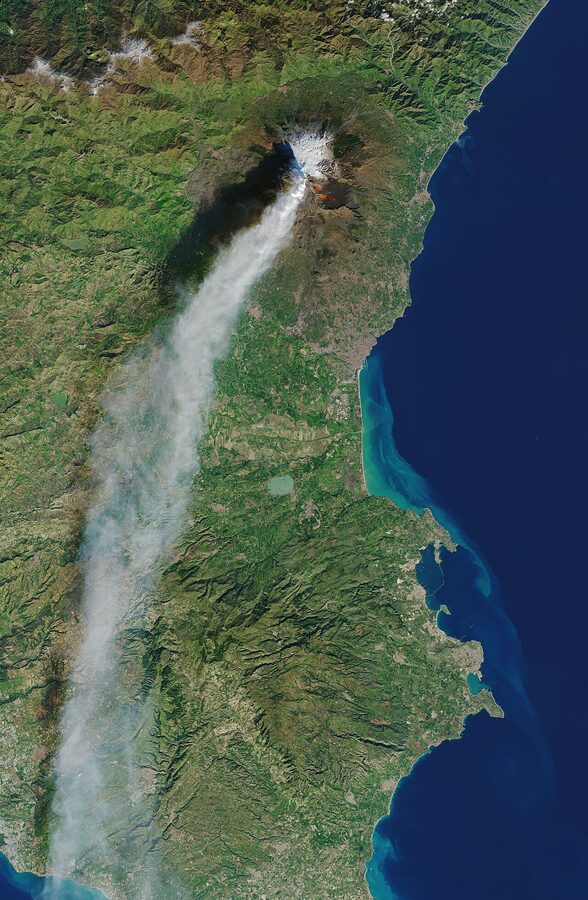
Satellite view of Mount Etna erupting from a side vent in eastern Sicily
Etna from space, during a paroxysmal eruption. The volcano is Europe’s most active stratovolcano, rises to 3,357m, and has been continuously active throughout recorded history. Eruptions in the last decade have closed the Catania airport roughly once a year. Check flight status if you see ash warnings. Photo by NASA Earth Observatory / Joshua Stevens using Landsat data / Wikimedia Commons (Public domain)

Mount Etna is 3,357 metres high, covers 1,190 square kilometres, has four summit craters and 400 flank cones, and is continuously active. Eruptions in 2021, 2023, and 2024 sent ash to Catania and closed the airport. Eruptions at the summit in winter produce a combination of snow and lava that nothing else in Europe really matches visually. You can climb the volcano in three modes: the cable car up the south side from the Rifugio Sapienza to 2,500m, then 4WD minibus to 2,920m (about €90 round-trip, two hours, easy); a guided hike from Piano Provenzana on the north side (€60 for the half-day, six hours, moderate); or a full-summit climb with a volcanological guide (€150-250, eight hours, demanding and weather-contingent). The south is closer to Catania and more developed; the north is quieter and tends to have better views of craters. Go in late May-June or September-October; the southern side gets snow in winter and tourist heat in August.

The Circumetnea railway — a narrow-gauge single-track line that loops around the volcano from Catania in about 3 hours — is the sentimental way to see the region. It passes through the pistachio town of Bronte (see the food section), the wine country on the eastern slopes, and half a dozen small towns that were partially buried by the 1669 eruption. €9 for the full loop.

Catania itself is Sicily’s second-largest city (311,000), built on a lava plain, destroyed by eruptions in 1669 and again by the 1693 earthquake, and rebuilt in the same dark basalt-and-white-limestone baroque palette both times. It is less polished than Palermo and more workmanlike, which means the street food is better and the nightlife is stronger. Don’t miss the Via Etnea (the long pedestrian spine aimed at the volcano), the fish market (pescheria) on Piazza Alonzo di Benedetto, and the Roman theatre and odeon on Via Teatro Greco.

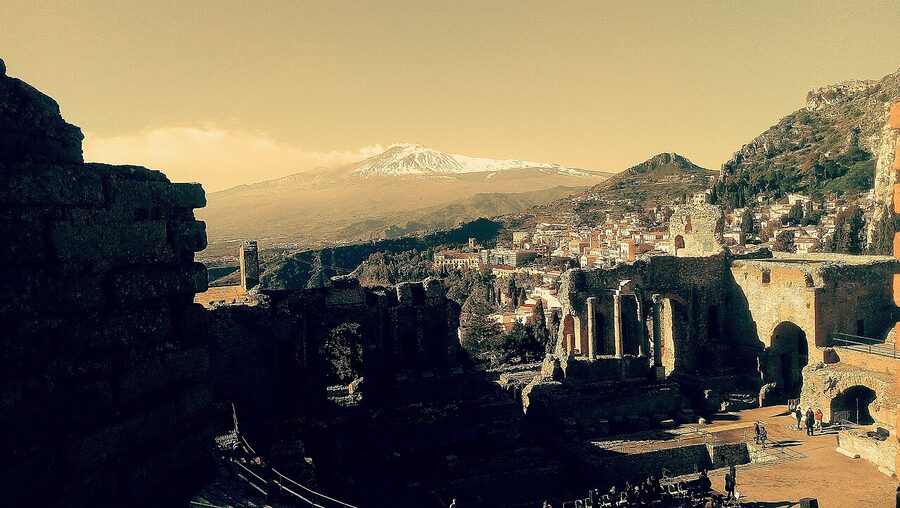
The ancient Greek-Roman theatre of Taormina with Mount Etna and the Ionian coast in the background
Taormina’s ancient theatre. Built by the Greeks in the 3rd century BC, rebuilt by the Romans in the 2nd century AD, and almost fully preserved because the town was partially abandoned for centuries. The stage-sight line was designed deliberately to frame Etna on the horizon. Open-air concerts and opera happen here every summer. Photo by Pierowriter / Wikimedia Commons (CC BY-SA 4.0)

Taormina, an hour north of Catania by train, is the coastal hill town everyone has seen in photographs — partly because its Greek-Roman theatre has Etna in the background and partly because HBO’s The White Lotus shot its second season at the San Domenico Palace in 2022. It is touristy. It is also genuinely beautiful, and the theatre is worth the climb whatever the queue looks like. Time Taormina for May or October — July and August are unpleasantly crowded. Base down the mountain in Giardini Naxos if you want beach access; up in Taormina proper if you want the town.

Between Taormina and Messina, the Isola Bella — a tiny wooded island connected to the mainland by a sand spit that disappears at high tide — is one of the canonical Sicilian photographs. Walk down the cable car route from the town, half a day. The water is clean, the beach is pebbly, and the snorkelling is surprisingly good.

Messina itself, at the northeastern tip where the ferries arrive, was almost entirely levelled in the 1908 earthquake — 84,000 dead out of 150,000 residents, one of the worst natural disasters in European history — and rebuilt in a bland 1910s civic style. The cathedral has a mechanical astronomical clock that chimes at noon and is worth twenty minutes. Otherwise Messina is a transit town.

Syracuse and the southeastern baroque

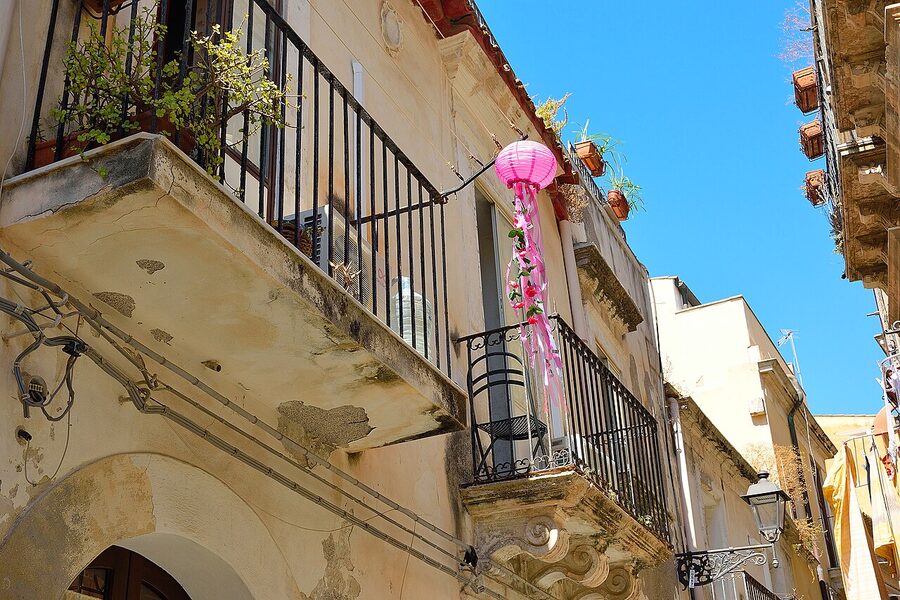
Medieval narrow lanes in Ortigia, the historic island centre of Syracuse
The lanes of Ortigia. The island is small enough to walk end-to-end in twenty minutes; dense enough that you can spend three days getting lost in it. Stay in the historic centre — most of the agriturismi and B&Bs in Ortigia occupy converted 17th-century palazzi. Photo by Alfonso Messina Siracusa / Wikimedia Commons (CC BY-SA 4.0)

Syracuse is two cities stitched together. The mainland archaeological park (Neapolis) has the 5th-century BC Greek Theatre, the Roman amphitheatre, the Ear of Dionysius (a bell-shaped limestone cave with acoustic properties that let a tyrant overhear his prisoners), and the Altar of Hieron II. This is the monumental Syracuse. The more rewarding half is across the bridge on Ortigia, the small island that forms the historic centre — a kilometre long, 800 metres wide, dense with baroque palaces, the cathedral built inside the surviving Doric columns of the Greek Temple of Athena, Piazza Duomo (one of the great European squares), the spring of Arethusa (a freshwater spring twenty metres from the sea that features in Ovid’s Metamorphoses), and the morning fish market. Stay on Ortigia; day-trip to the mainland park. Two nights minimum. Three is better.

For food: Sicilia in Tavola on Via Cavour for the busiate al pesto trapanese; Don Camillo for the tasting menu (€65, Michelin-starred, seafood-driven); and Fratelli Burgio on Via del Crocifisso for the best granita con brioche breakfast in southeastern Sicily. The fish market opens 7am and closes by 1pm.

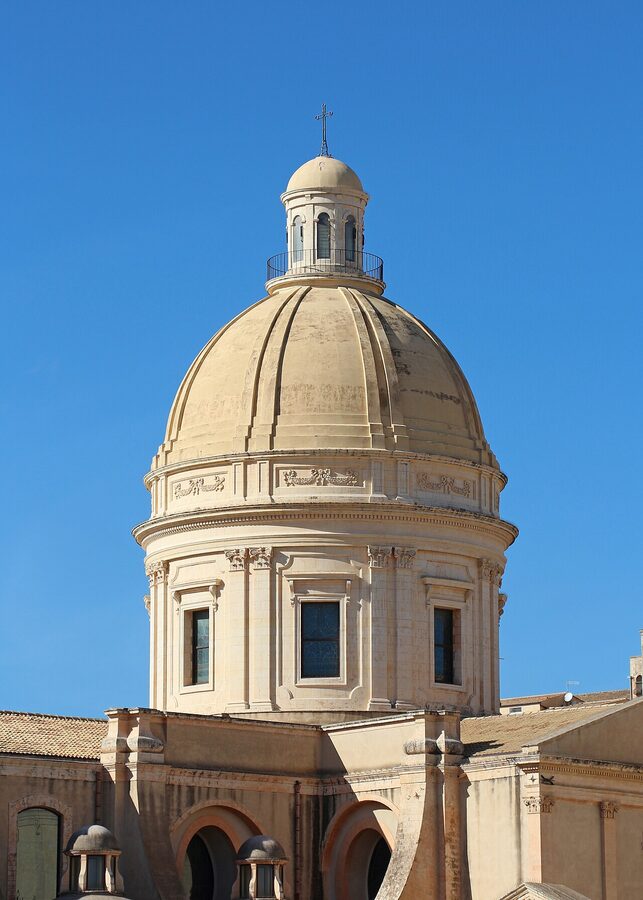
The dome of Noto Cathedral, centrepiece of Val di Noto late baroque
The dome of Noto Cathedral. The original collapsed in 1996 — a structural failure unrelated to earthquake — and was rebuilt by 2007 using the original plans and much of the salvageable stonework. Noto is the purest baroque town in Sicily and the best place to understand what 1693-1740 architecture was trying to do. Photo by Bernard Gagnon / Wikimedia Commons (CC BY 4.0)

Noto, forty minutes south of Syracuse, is the best-preserved Sicilian baroque town. After the 1693 earthquake destroyed the southeastern cities (some estimates put the death toll at 60,000), a committee of architects — Rosario Gagliardi, Vincenzo Sinatra, Antonino Mastrelli — rebuilt Noto from scratch on a new site using a single architectural grammar, and the result is a kilometre-long Corso Vittorio Emanuele lined with honey-coloured limestone palazzi and the cathedral at one end. A half-day walk, ideally starting at 7am before the light hardens. The third Sunday of May is the Infiorata flower festival, when the Via Nicolaci is covered in floral mosaics — book accommodation six months ahead.

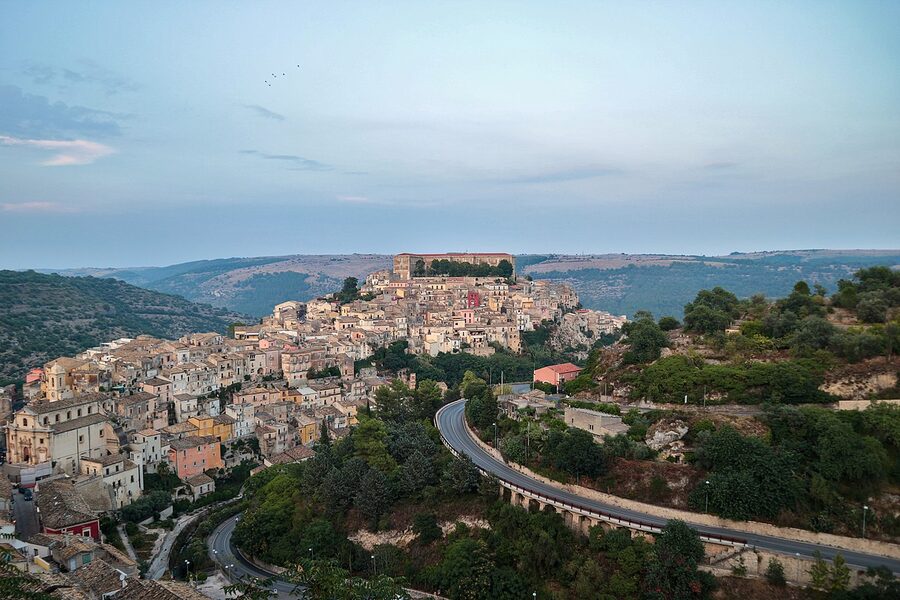
Ragusa Ibla at twilight, Val di Noto late baroque architecture
Ragusa Ibla at twilight. The lower town — the older of the two Ragusas — was rebuilt in situ after 1693 on the same medieval street plan, which is why it reads as a baroque town built on medieval scaffolding. The upper town, Ragusa Superiore, was built new on a flat bluff above. Both are UNESCO; Ibla is the more photogenic. Photo by Daniele Napolitano / Wikimedia Commons (CC BY-SA 4.0)

Ragusa, an hour further west, is two towns on two hills: Ragusa Superiore (rebuilt flat, 18th-century) and Ragusa Ibla (rebuilt on the old site, more vertical, more medieval-feeling). A single staircase of 340 steps — called the Scalinata — connects them. Spend the day in Ibla: the Cattedrale di San Giorgio, the Giardino Ibleo at the edge, and Duomo Ristorante for the best tasting menu in eastern Sicily (€110, three Michelin stars, book three weeks out). Half a day for the upper town.

Modica is twenty minutes south of Ragusa, in a gorge, and is known primarily for its cioccolato modicano — a cold-process chocolate recipe brought by Spanish Conquistadors from Mexico in the 17th century that has not really changed since. The result is grainier and less sweet than northern Italian chocolate. Antica Dolceria Bonajuto (founded 1880) is the classic shop.

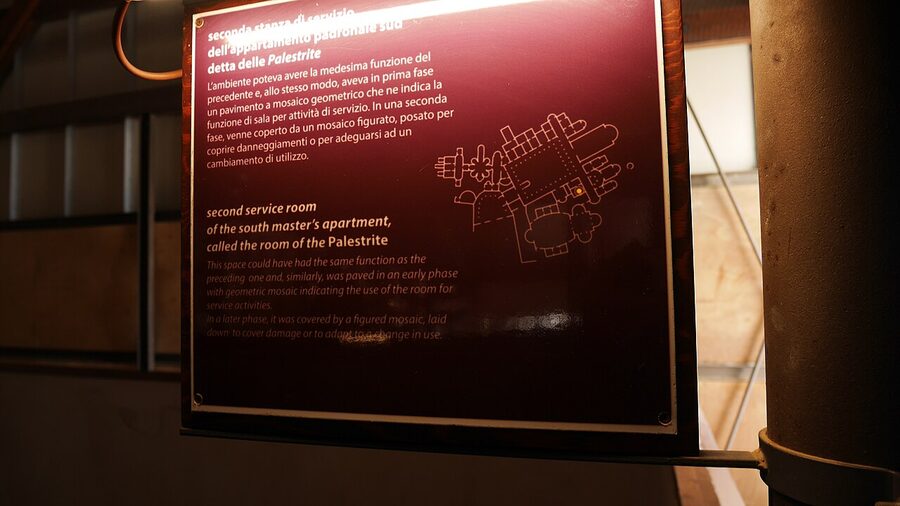
To fill out a southeastern loop: Caltagirone for the ceramic staircase (142 painted majolica steps up to Santa Maria del Monte), Scicli for the Chiesa di San Bartolomeo and the Commissario Montalbano filming locations, and Piazza Armerina for the Villa Romana del Casale — a 4th-century Roman villa whose 3,500 square metres of floor mosaic survived because the whole thing was buried under a mudslide in the 12th century and only rediscovered in 1929. The mosaics are the finest and largest late-Roman cycle anywhere; the “bikini girls” mosaic showing women doing athletics is the one you have probably seen in print. Allow two hours minimum.

A detail of the Bikini Girls mosaic at Villa Romana del Casale, Piazza Armerina
The Bikini Girls mosaic — 4th-century women in athletic costume, from the floor of a salone at Villa Romana del Casale. Buried under a mudslide in the 12th century, excavated in 1929, now under a protective roof with a raised walkway. The full cycle is 3,500 square metres; this is one panel of about thirty. Photo by Moleskine / Wikimedia Commons (CC BY-SA 4.0)

The islands — Aeolian, Egadi, Pelagie, Pantelleria

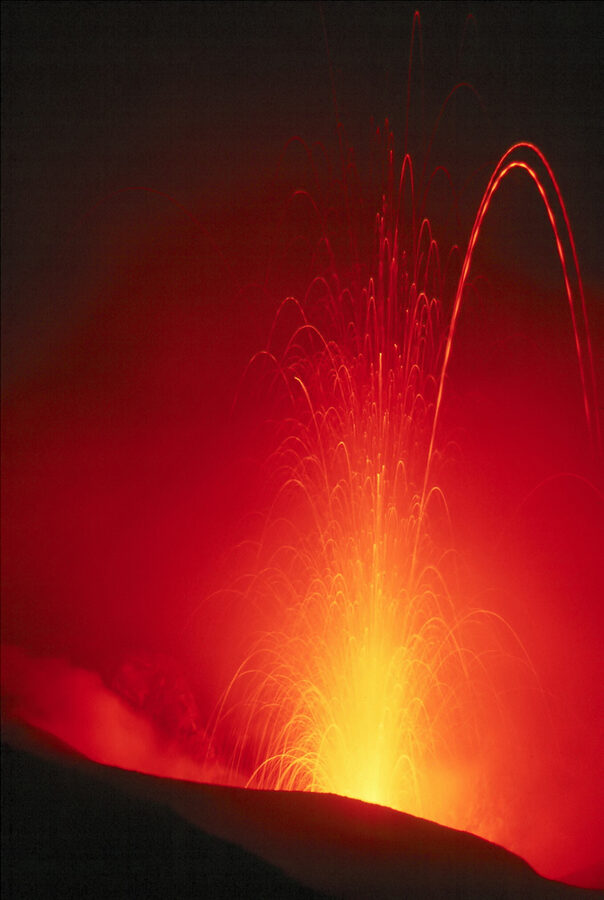
Stromboli volcano erupting at night in the Aeolian Islands
Stromboli at night. The volcano has been in continuous low-level eruption for at least 2,000 years — explosive Strombolian activity every 10-20 minutes, reliably, all day and all night. Boat trips from Panarea or Lipari at sunset let you watch from the sea. Climbing the volcano is permitted with a guide to 400m (the crater is at 918m). Photo by Wolfgang Beyer / Wikimedia Commons (CC BY-SA 3.0)

Sicily has seven named offshore island groups. Three of them are worth the trip by themselves; the other four are for specialised purposes.

The Aeolian Islands are seven volcanic islands in the Tyrrhenian off the north coast. Lipari (the largest, and the base for most visitors), Vulcano (for the mud baths and the main crater walk), Salina (for the capers, the vineyards, and the best food), Stromboli (for the active volcano and the black beaches), and Panarea, Alicudi and Filicudi for progressively less development and no WiFi. The whole group is a UNESCO world heritage site. Ferries from Milazzo (45 minutes northeast of Messina) run year-round; daily fast ferries from Palermo and Naples in summer. Allow a week to do the group justice, three days for the highlights.

The Egadi are three small islands off the west coast near Trapani. Favignana, the largest, has bicycle-friendly roads, tuna-processing history (the Tonnara Florio is worth a visit), and some of the clearest water in Italian coastal waters. Levanzo has a Palaeolithic cave with painted aurochs. Marettimo is the remote, mountainous one. Favignana is the ferry hub; 30 minutes from Trapani.

Pantelleria is a volcanic island 110km southwest of Sicily, closer to Tunisia than to Palermo. Black lava landscape, Arab-origin dammusi houses, the Passito wine from Zibibbo grapes (one of Italy’s best dessert wines), and thermal pools. Reach it by a 40-minute flight from Palermo or a 6-hour ferry from Trapani. Small, expensive, unforgettable — a favourite of the Milan design crowd.

Lampedusa and Linosa, the Pelagie islands, are 200km south of Sicily and technically closer to North Africa than to any part of Europe. Lampedusa has the Rabbit Beach, repeatedly rated one of the best beaches in the world. It is also one of the primary arrival points for migrants crossing the Mediterranean, and this tension is visible in the town. Go if you want to swim; be aware of the context.

Ustica is one volcanic island 60km north of Palermo. It has the best diving in Sicily and not much else — a marine reserve, a short walking loop, and one good restaurant. Day trip by ferry from Palermo.

Food and wine

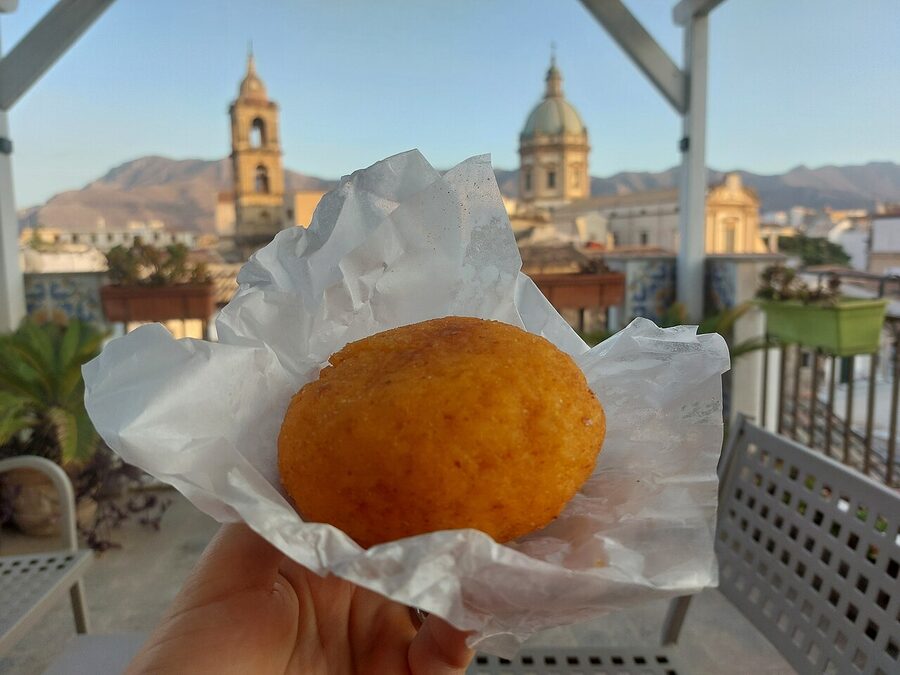
An arancina filled with pasta alla Norma ingredients, Palermo style
An arancina — feminine in Palermo because the rice ball is thought of as an orange (arancia, feminine), which is what it looks like when you pick it up. In Catania and the east, the ball is called arancino (masculine). Sicilian etymology has been fighting about this for a century. Neither side is wrong. Photo by Mediocrity / Wikimedia Commons (CC0)

Sicilian food is a three-way conversation between Arab, Greek, and Norman-Spanish cooking, adapted for an island that grows almost everything. The essential dishes:

Arancini / arancine. Deep-fried risotto balls, stuffed with meat ragù, butter-and-ham, or vegetables. The feminine in Palermo, masculine in Catania. Best at a street stall.

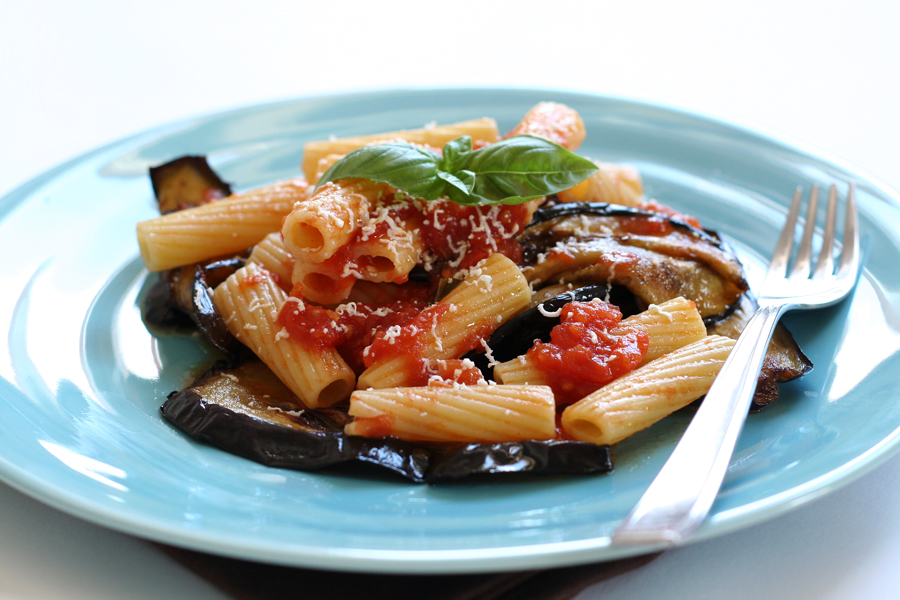
Pasta alla Norma. Pasta with fried aubergine, tomato, basil, and salted ricotta. From Catania; named after the Bellini opera. Eaten with short tube pasta (maccheroncini or penne), not long noodles.

A plate of pasta alla Norma — the Catania pasta with aubergine and salted ricotta
Pasta alla Norma as it should look — short tube pasta, a generous pile of fried aubergine, a heavy grating of salted ricotta on top, a few basil leaves. The ricotta salata is what distinguishes it from any other aubergine pasta; do not accept a version topped with parmesan. Photo by Paoletta S. / Wikimedia Commons (CC BY 2.0)

Pasta con le sarde. Bucatini with sardines, wild fennel, pine nuts, raisins, and saffron. The emblematic Palermo pasta. The combination sounds wrong. It is not.

Caponata. Sweet-and-sour aubergine stew with tomato, capers, olives, celery, and vinegar. Eaten cold as a side or antipasto.

Couscous alla Trapanese. In western Sicily. Fish couscous, introduced by Arab cuisine, and still cooked the way it was in 900 AD. The best version is at Cantina Siciliana in Trapani or Pocho in San Vito Lo Capo.

Cannolo. Fried pastry tube filled with sweetened sheep’s-milk ricotta. Not filled until ordered. If the cannolo shell is soft, it was filled too early; walk out. The best cannolo in Palermo is at I Segreti del Chiostro (Piazza Bellini). In Piana degli Albanesi, a half-hour bus ride south, is the canonical regional version.

Granita with brioche. Sicilian summer breakfast. A semi-frozen fruit or coffee slush served with a soft sweet bun. Common at every bar in July and August; particularly good at Bar Caprice in Taormina and Caffè Sicilia in Noto.

Cassata. A round cake of sponge, sweetened ricotta, marzipan, and candied fruit. Arab in origin (the word qas’a means the large bowl it was mixed in). Best at Pasticceria Maria Grammatico in Erice.

Pistacchio di Bronte. The pistachios grown on the volcanic slopes of Etna around the town of Bronte, DOP-protected since 2009, famously intense in colour and flavour. Most of the pistachio gelato in northern Italy is made with them; the town itself has a pistachio festival in September.

For wine: Marsala is the Sicilian fortified wine (the Jerez of Italy), rescued in the 1980s after a generation of neglect — Marco de Bartoli is the reference producer. Etna DOC is the most interesting Sicilian appellation and the fastest-growing: Nerello Mascalese on the north slope of the volcano, elegant and ageable; Carricante for whites. Nero d’Avola is the dominant island red, planted almost everywhere. Passito di Pantelleria (Zibibbo) is the great Sicilian dessert wine. For tastings: Donnafugata, Planeta, Tasca d’Almerita, and Graci on Etna.

When to visit

Late April through mid-June and mid-September through mid-October are the right months. Wildflowers in spring, almond blossom in February if you want the full picture (the Agrigento Mandorlo in Fiore festival is the first week of February and is very good), grape harvest in September-October, wild fennel and capers in May.

July and August are hot — 35°C on the interior plains, crowded on the coast, expensive. Italians take their own August holidays, which means many family restaurants close for two to three weeks. If you’re going in August, base on an island or in the mountains; do not base inland or in a coastal town without air conditioning.

November through March is quiet, cheap, and unpredictable. You will get rain. You will also find many small restaurants closed. The upside: the archaeological sites are nearly empty, Etna often has snow, and the orange and lemon trees are in fruit. Palermo in December is one of my favourite things in Italy.

Key dates to plan around: Sant’Agata in Catania (3-5 February — the third-largest Catholic procession in the world after Mecca and Seville), the Infiorata in Noto (third Sunday of May), the Couscous Fest in San Vito Lo Capo (last week of September), the Santa Rosalia festival in Palermo (15 July), and the Targa Florio vintage car rally around the Madonie (usually October).

How to put it together

Sicily is not a single-week destination. Seven days will buy you one coast or the other but not both; ten days lets you do a rapid loop; two weeks is the minimum to see what the island is about without rushing.

One week in the east. Fly into Catania. Base one night in Catania, two in Syracuse (Ortigia), one in Noto or Ragusa, one on Etna (Linguaglossa or the north-slope agriturismi), and one in Taormina. Covers all the southeast baroque, the volcano, and half of the Greek east-coast sites. Works with one hired car.

One week in the west. Fly into Palermo. Two nights in Palermo proper (with a Monreale morning), one in Cefalù, one in Trapani with an Erice day trip, one at Selinunte or Agrigento, and one on Favignana. Covers Arab-Norman Palermo, Phoenician west coast, Greek Agrigento, and the Egadi.

Ten days end to end. Palermo (2 nights — including Monreale) → Cefalù (1) → Agrigento area (1) → Ragusa Ibla (1) → Syracuse (2) → Etna north slope (1) → Taormina (1) → fly out of Catania. Works as a single-direction drive; covers four of the five UNESCO sites.

Two weeks, comprehensive. Palermo (2) → Cefalù (1) → Erice / Trapani / Segesta (2) → Selinunte and Scala dei Turchi (1) → Valley of the Temples (1) → Piazza Armerina / Caltagirone (1) → Ragusa Ibla (1) → Noto and Modica (1) → Syracuse (2) → Etna + Taormina (2). One hired car, one-way from Palermo to Catania.

Three weeks. Add the Aeolian Islands (5 days) at the end. Fly out of Naples after the ferry back.

Before you go

Sicily is a lot. It will not be a quick visit if you do it properly. The right approach is to pick a coast — east or west — and see it well; come back for the other coast on a second trip; come back again for the islands. Trying to do the whole island in a week is the single most common mistake people make.

The mental adjustment that helps: do not read the island through Italian eyes. The natural bridge from Sicily to the mainland on the Tyrrhenian side is Campania (overnight ferry Palermo-Naples), where the Arab-Norman story continues and the volcanic landscape picks up again at Vesuvius. This is not a version of Tuscany with better weather. The Arab layer matters; the Greek layer matters more than the Roman one; the Norman layer is almost unique in European architectural history; the baroque is a disaster-response baroque that reads differently from its Roman parent. If you come with an ear for what is genuinely Sicilian as opposed to generically Italian, the island opens up. If you come expecting Tuscany with palm trees, you will miss most of what is in front of you.

For the individual stops within Sicily, city guides are now appearing — Castellammare del Golfo (rank 41 recovery, with the Zingaro Nature Reserve and the Tonnara di Scopello on its doorstep) is the first, with Palermo, Syracuse, and Taormina next in the queue. For how Sicily fits into a wider Italy trip, the regional hubs on this site cover Calabria (straight across the Strait), Basilicata (natural onward leg if you are working the Tyrrhenian coast upwards), Puglia (across the heel), and further north, Umbria and Tuscany. If you are travelling soon and want a second opinion on the specific dates, the Italian-language Corriere Viaggi site and Italy Segreta both publish reliable local-sourced updates.

And come back. No one sees Sicily on one trip.

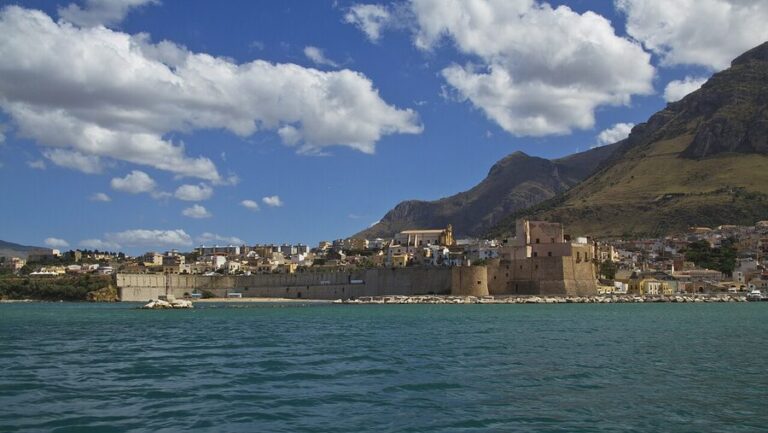
Castellammare del Golfo

Castellammare del Golfo — the small Sicilian fishing town halfway between Palermo and Trapani, with a 10th-century Arab-Norman castle, a working fishing harbour, the Tonnara di Scopello and the Zingaro nature reserve on its doorstep, and the historical distinction of having exported half of the Prohibition-era American Mafia.