Campania

Campania is the Italian region that contains more of the things non-Italians travel to Italy for than any other — five UNESCO world heritage sites on the mainland, three of the most famous islands in the Mediterranean, Europe’s most densely populated active volcanic zone, the best-preserved Roman city in the world, the best-preserved Greek temples in the world, the invention of pizza, the invention of opera, and the single most photographed stretch of coastline on the planet. It is also, by several of the usual measures, one of Italy’s poorer regions. The contrast between the postcard Campania (Positano, Capri, Pompeii) and the working Campania (the Naples suburbs, the inland towns of Avellino and Benevento, the stretches of coast between Salerno and Agropoli where the bus stops at eight and the restaurants close at nine) is stark, and it is the thing you most need to understand about the place.

Italians themselves use the word Campania felix — “fortunate countryside” — the Roman name for the bay of Naples hinterland. The fertility is real. The region grows tomatoes, lemons, mozzarella’s dairy buffalo, wine grapes going back to the Greeks, and all of the olive oil you have ever drunk that was not Tuscan or Pugliese. It also grows population at the second-highest rate of any Italian region, which is a polite way to say that the Naples urban area is genuinely crowded. You will notice this. You will also notice that in three days based in one small coastal town you can see Greek temples, Roman cities, Byzantine mosaics, Norman cathedrals, Bourbon palaces, and a 2020s espresso bar where the pastries are still made by the original family.

I have been working my way through Campania since 2007 — a week here, ten days there, a longer posting during a university semester in 2015, several returns since — and I have not quite finished. The region is far larger than most first-time visitors assume. The Amalfi Coast is one hour long by car, barring traffic. The three Gulf islands are a full day each, minimum. Pompeii plus Herculaneum is a long day. Naples wants at least three. Paestum and the Cilento want two. That is two weeks and you have not yet been to Caserta or Ischia. Plan accordingly.

Campania in one paragraph

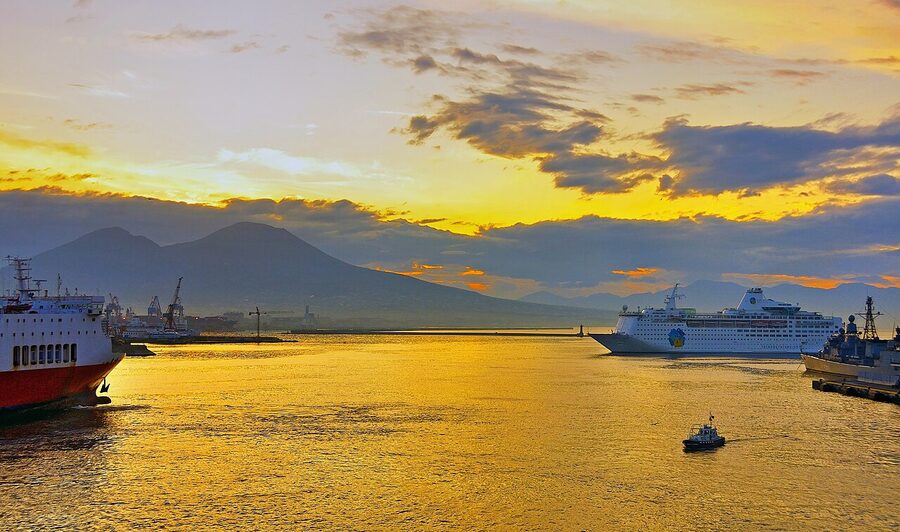
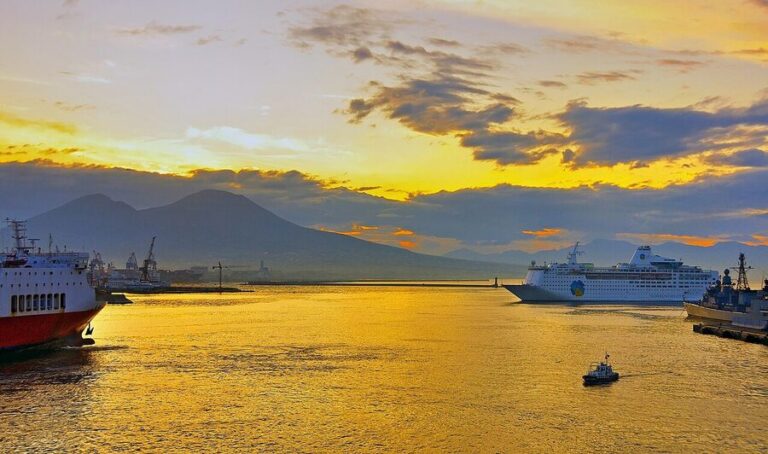
Mount Vesuvius above the Bay of Naples at dawn
Vesuvius from Naples harbour. The volcano is 1,281m high, last erupted in March 1944, and sits 9km east of a city of 914,000. Roughly three million people live in its immediate red zone. It is the most populated active volcano in Europe by a large margin, and that fact shapes almost everything about how Campania works. Photo by Vlasenko / Wikimedia Commons (CC BY-SA 3.0)

Southern Italian region on the Tyrrhenian coast, 13,671 km², 5.58 million residents (2025 — Italy’s third-most populous region), five provinces: Naples, Salerno, Caserta, Avellino, Benevento. Capital Naples (pop. 914,000 in the city; 3 million in the metro). Two major bays — the Bay of Naples to the north and the Bay of Salerno to the south, separated by the Sorrento-Amalfi peninsula. Active stratovolcano (Vesuvius, 1,281m, last erupted 1944). Active caldera (the Phlegraean Fields, currently in a long slow uplift phase). Five UNESCO world heritage sites: the Historic Centre of Naples; Pompeii + Herculaneum + Torre Annunziata; the Amalfi Coast; the Royal Palace of Caserta with the 18th-century aqueduct; and the Cilento/Paestum park. One UNESCO biosphere reserve (Cilento). Three Gulf islands: Capri, Ischia, Procida. Demonym: Campano / Campana. Regional language: Neapolitan (distinct from Italian, spoken as a first language by roughly four million people).

Getting to Campania

Naples International Airport (NAP, Capodichino) is 7 km from the city centre, with direct flights from most European capitals and a handful of long-haul routes. From the airport, the Alibus runs to Naples Centrale station every 15 minutes (€5, 20 minutes) and to the port at Molo Beverello (€5, 30 minutes) for the island ferries. Salerno has its own small regional airport (QSR) — usually cheapest for Amalfi Coast trips.

By train, Naples Centrale is a major node on the high-speed backbone. From Rome, the Frecciarossa or Italo services take 1h10 (€40-70 depending on booking window). From Milan, 4h30 (€80-120). From Florence, 2h40. Regional trains then run the Vesuvian loop (Circumvesuviana — the famously rattly commuter line to Pompeii, Herculaneum, and Sorrento) and the coast line south to Salerno and the Cilento.

By ferry, Naples has three passenger ports: Molo Beverello (high-speed hydrofoils to Capri, Ischia, Procida, and the Amalfi Coast), Calata Porta di Massa (car ferries to the same islands plus Palermo and the Aeolians), and Mergellina (alternate hydrofoil hub further west). All three are within a 15-minute walk of each other.

For internal travel: if you are doing the Amalfi Coast, do not drive if you can avoid it. The SS163 Amalfitana is 50 km of one-lane switchback cliff road; in summer it can take three hours to drive from Sorrento to Salerno when an accident blocks it, which is most days. Take the SITA bus (€10 day ticket, runs every 20 minutes peak) or a local boat. For Naples-region day trips (Pompeii, Herculaneum, Caserta), use the train or a private driver; parking in Naples is an urban combat sport and not worth the euros saved.

Naples — the capital and the case against skipping it

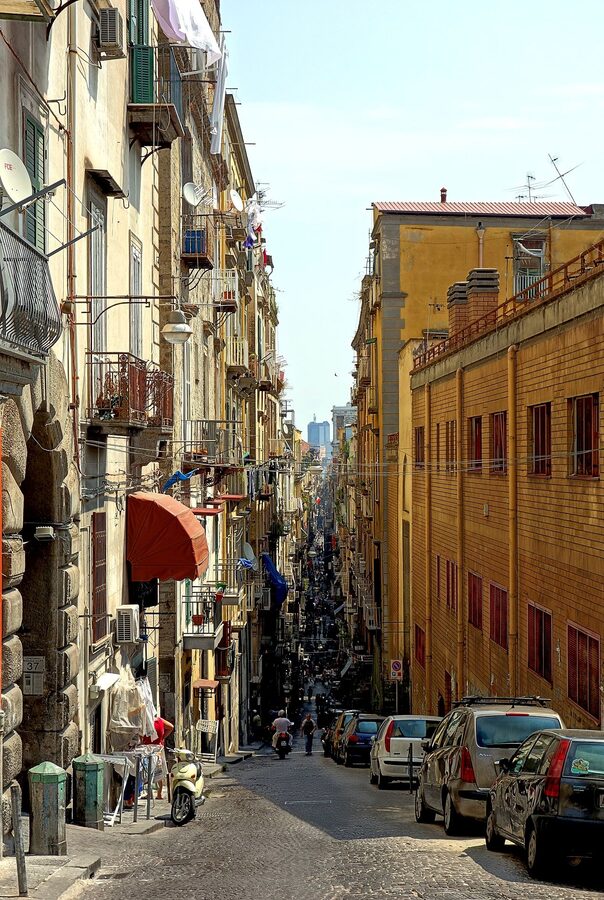
Spaccanapoli — the straight street cutting through the historic centre of Naples
Spaccanapoli. A 2-km pedestrian street cutting in a straight line from the Spanish Quarter in the west to the Forcella neighbourhood in the east — laid out as the Roman decumanus inferior in the 3rd century BC and still in daily use. Walking it end to end is the single best introduction to Naples. Photo by Velvet / Wikimedia Commons (CC BY-SA 3.0)

A large number of foreign visitors skip Naples. They stay in Sorrento or the Amalfi Coast, do Pompeii as a day trip, and never set foot in the city itself. This is a mistake. Naples is the single richest urban setting in southern Italy — a city of 914,000 that was for four centuries the capital of one of the largest European kingdoms (the Bourbon Kingdom of Naples, which at its height included most of the southern peninsula and Sicily), the birthplace of modern opera, the home of the oldest state university in the world (Federico II, founded 1224), and the city where half of Italy’s best food was invented. It is also one of Europe’s most visually saturated urban experiences — dense, layered, loud, chaotic, extraordinarily beautiful in places and extraordinarily ugly in others, often within one block.

The five things I would see on a first visit, roughly in walking order:

The historic centre (UNESCO). Walk Spaccanapoli from west to east: 2 km, the Roman decumanus inferior, still pedestrian, still dense. Stop at the Piazza del Gesù for the church and the Guglia; at San Domenico Maggiore; at the Cappella Sansevero (book ahead — €10, 30 minutes, home of the Cristo Velato, one of the most astonishing pieces of 18th-century sculpture in Europe, a marble figure of Christ covered by a veil that is also made of marble); at San Gregorio Armeno (the presepi craftsmen’s street, where every artisan makes Nativity figurines year-round).

The Duomo and the Cappella del Tesoro di San Gennaro. San Gennaro is the patron saint of Naples; his vial of dried blood is said to liquefy three times a year (19 September, 16 December, first Saturday of May). You can take the miracle at face value or leave it; either way, the chapel is a baroque riot of silver and the ritual gets the whole city on its feet. Worth a morning.

The Museo Archeologico Nazionale. The museum holds most of the movable finds from Pompeii and Herculaneum — the frescoes, the mosaics, the bronze statuary. Do not go to Pompeii without going here first or after; the frescoes on the walls at Pompeii are mostly copies, and the originals live in the museum. Allow three hours. €22, open Wednesday to Monday 9-7:30.

The Certosa di San Martino. A fortified 14th-century Carthusian monastery on the Vomero hill above the city, with the best single view of the Bay of Naples and a remarkable collection of Neapolitan baroque painting inside. Take the Montesanto funicular up and walk down through the Spanish Quarter.

The underground. Two or three kilometres of Greek cisterns, Roman aqueducts, and wartime bomb shelters survive under the city and can be toured from Piazza San Gaetano. The tours are an hour and a half, €12, and are the single best way to feel how old Naples actually is.

For food, base your eating around the pizzerias of the Decumano MaggioreDa Michele on Via Cesare Sersale (the one Julia Roberts ate at in Eat Pray Love; genuinely excellent, but go early or prepare to queue); Gino Sorbillo on Via dei Tribunali 32 (the better pizza in the strict purist view); 50 Kalò on Piazza Sannazaro for the modern school. All €8-15 for a pizza. Coffee: the entire country bows to Naples; I like Caffè del Professore on Piazza Trieste e Trento, and Gran Caffè Gambrinus next door for the 19th-century marble atmosphere.

Stay away from the port area at night if you are alone. Stay in the Chiaia or Vomero districts if you want a quiet base. Stay in the Spanish Quarter (Quartieri Spagnoli) if you want to be in the middle of everything and can tolerate scooters at 3am.

Vesuvius, Pompeii, and Herculaneum

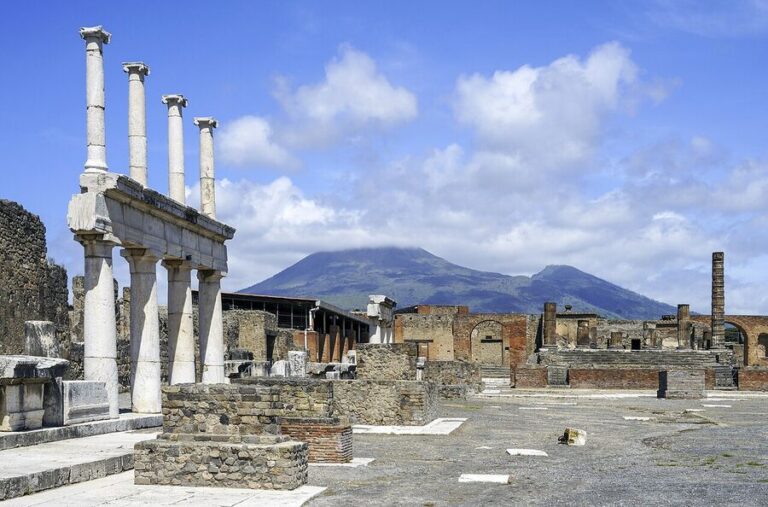
The ruins of Pompeii with Mount Vesuvius behind
Pompeii. The city buried by the 79 AD eruption of Vesuvius, partially excavated since 1748, and the single most complete Roman urban site in the world. Entry €22, allow 5 hours minimum — and go early in summer, because the site has almost no shade. Photo by Mister No / Wikimedia Commons (CC BY 3.0)

Two Roman cities were buried by the 79 AD eruption of Vesuvius. One, Pompeii, was buried in four metres of ash and pumice; the other, Herculaneum, was hit by a pyroclastic surge that carbonised wood and fabric rather than destroying them. Both have been excavating since the mid-18th century, both are UNESCO-listed, and both are open to visitors. They are not the same experience and should not be treated as interchangeable.

Pompeii is the big one. 66 hectares within the old city walls (of which about two-thirds are excavated), about 20,000 residents at the time of destruction, intact Roman urban grid, forum, theatre, amphitheatre, brothel, bakery, temple complexes, dozens of houses with frescoes, the casts of the victims made by injecting plaster into the voids left in the hardened ash. Entry €22; the site is open 9-19 in summer, 9-17 in winter. Plan for five hours minimum. Bring water, sunscreen, a hat, proper walking shoes. The site has very little shade. Take the audio guide (€8) or a licensed private guide (€15 per person in a group) — the alternative is walking through a vast ruined city with almost no interpretation.

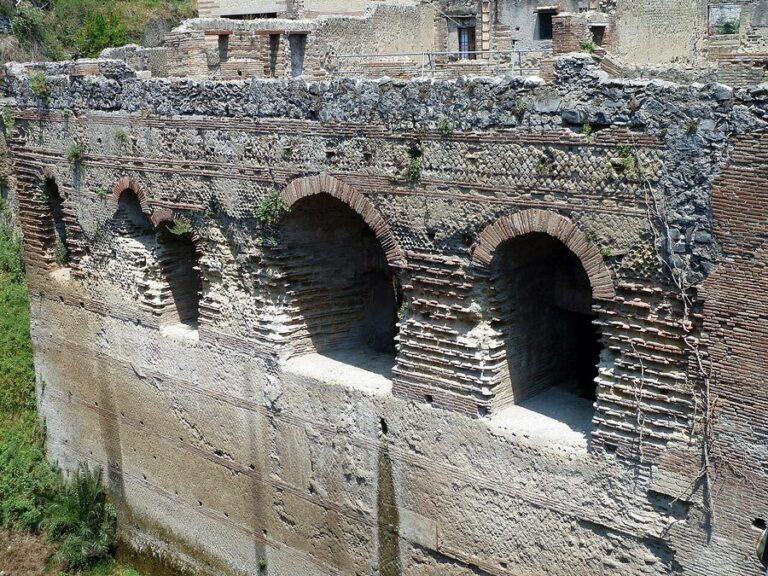
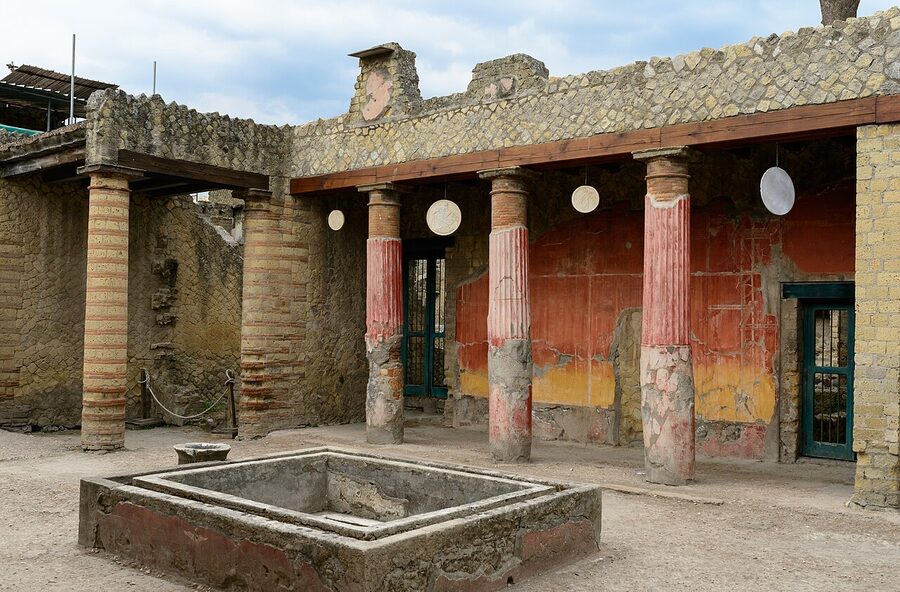
The excavated ruins of Herculaneum (Ercolano) below the modern town on top
Herculaneum, excavated 20m below the modern town of Ercolano that sits directly on top of it. Smaller than Pompeii, better-preserved — carbonised wooden doors, stairways, and roof beams are still in situ, which Pompeii does not have. Three hours. Photo by Norbert Nagel / Wikimedia Commons (CC BY-SA 3.0)

Herculaneum is the better preservation. A quarter the size of Pompeii, 4,000 to 5,000 residents at destruction, buried under 20 metres of pyroclastic material that both destroyed the upper storeys and — critically — preserved organic material that Pompeii’s ash did not. Wooden doors, staircases, roof beams, and furniture survive. The frescoes are brighter. The mosaics are intact. An entire Roman boathouse at the ancient shoreline contained the skeletons of about 300 people who fled there and were killed by the pyroclastic surge. Entry €14, open 9-18 in summer; allow three hours. Go in the afternoon after Pompeii, which is the morning trip, and stay for the sunset over the bay from the old shoreline.

Vesuvius itself can be climbed. The road from Ercolano goes up to 1,000m, where you park; from there a guide leads you the remaining 280m on foot along a cinder-gravel path to the rim of the main crater. The walk is steep but not technical — 25 minutes up, the same down — and you can look directly into the active crater, which since 1944 has been quiescent but is still fumarolic. Entry to the park is €15, open 9-15 in winter, 9-17 in summer. Closed during active unrest (rare, but check the Parco Nazionale del Vesuvio website).

How to combine. The classic day is Pompeii in the morning (Circumvesuviana train from Naples to Pompei Scavi, 35 minutes), Vesuvius after lunch (shuttle bus from Pompeii’s Piazza Anfiteatro), and return. Alternatively: Herculaneum in the morning (Ercolano Scavi station, 20 minutes from Naples), Pompeii after lunch. Do not try to do all three in one day unless you enjoy exhaustion.

The Amalfi Coast — Positano, Amalfi, Ravello

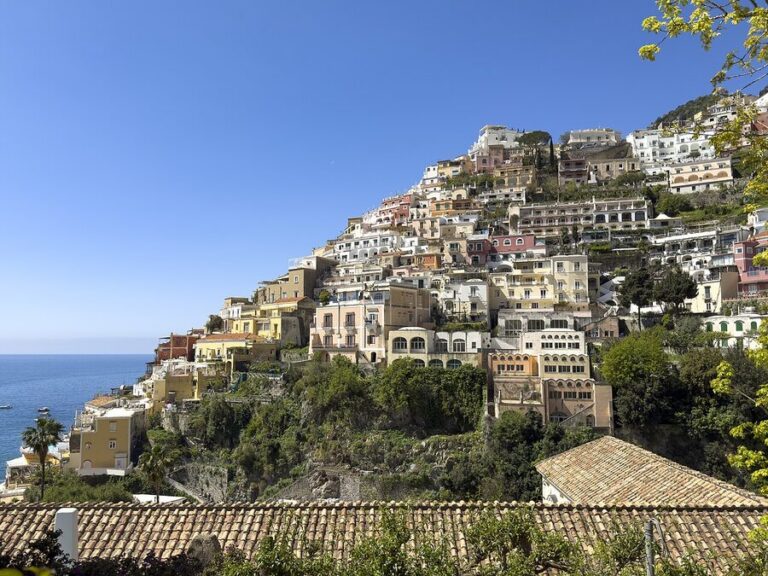
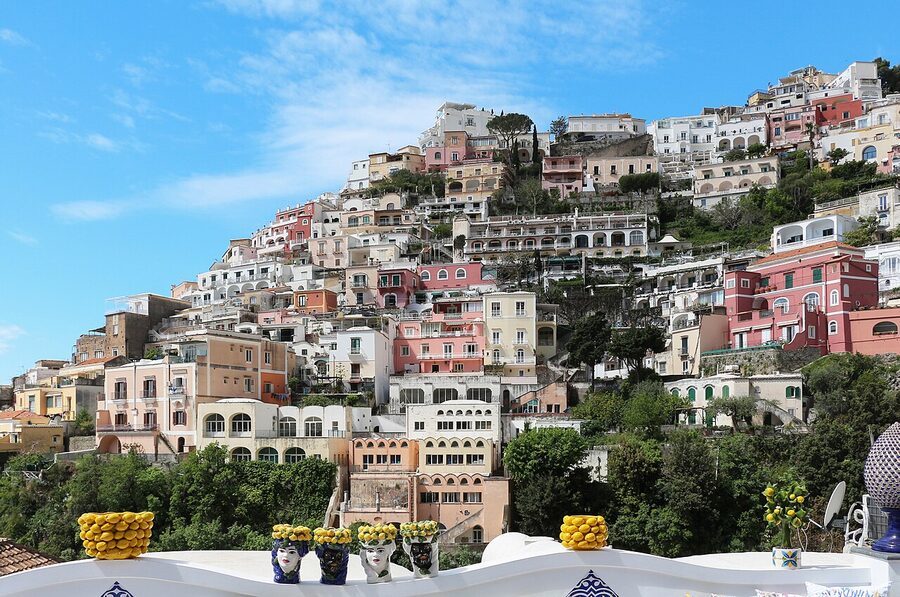
The village of Positano on the Amalfi Coast
Positano. A former fishing village turned international tourist capital; the cliffside is colour-coded in pastel pinks and yellows because of a 1950s urban regulation that paint had to contrast with the blue sea. It works; it is also heavily commercial; and in June-September you should plan around avoiding rather than being in it. Photo by Bernard Gagnon / Wikimedia Commons (CC BY 4.0)

The Amalfi Coast — Costiera Amalfitana — is 50 kilometres of Tyrrhenian coastline south of the Sorrento Peninsula, from Positano in the west to Vietri sul Mare in the east. UNESCO-listed in 1997. Thirteen communes. Four of them are famous (Positano, Amalfi, Ravello, Praiano), four more are worth a meal (Cetara, Minori, Maiori, Vietri sul Mare), and five can be passed through. The whole thing is a single serpentine road (the SS163) cut into the cliff face in the 1840s, mostly under Spanish and Bourbon engineers.

Positano. The most photographed village. Pastel-painted houses tumbling down a near-vertical cliff. The Spiaggia Grande public beach, the Chiesa di Santa Maria Assunta with its majolica dome, the Via Pasitea that spirals down and up. Stay here if you want to be in the postcard; base elsewhere if you want to do the postcard on your own terms. In June-September it is crowded to the point of discomfort.

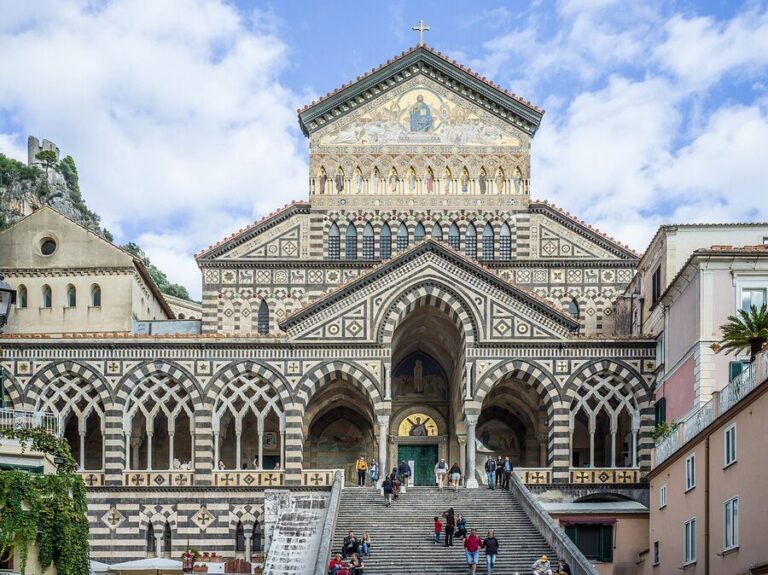
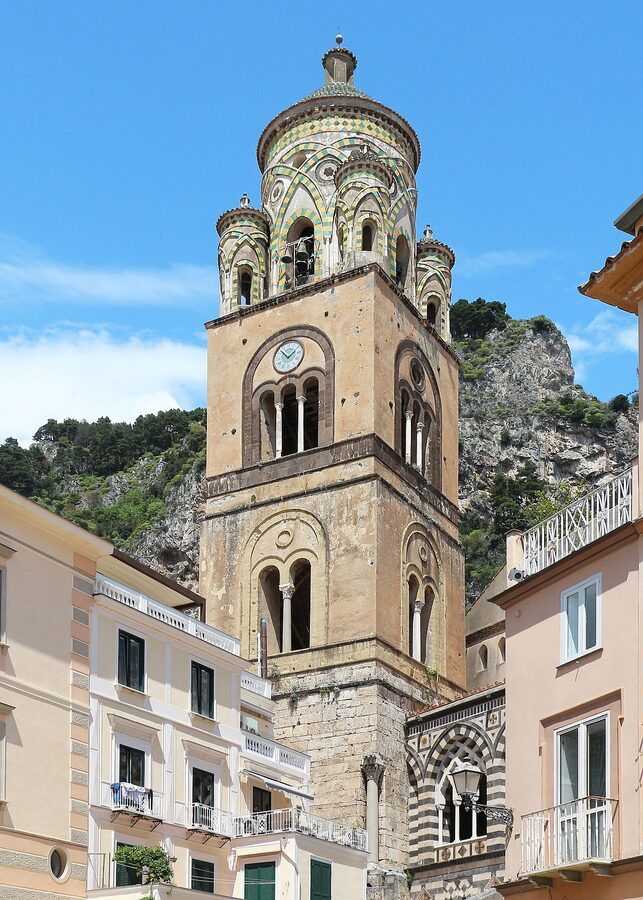
The striped Arab-Norman facade of Amalfi Cathedral
Amalfi Cathedral (Sant’Andrea). The 13th-century Arab-Norman façade is a striped limestone-and-tufa composition that looks closer to Sicily than to Campania. The apostle Andrew’s relics have been kept in the crypt since 1208; the bronze doors were cast in Constantinople in the 1060s. Photo by Bernard Gagnon / Wikimedia Commons (CC BY 4.0)

Amalfi town. The historic centre of the Duchy of Amalfi, which in the 9th-11th centuries was one of the four great Italian maritime republics (alongside Venice, Genoa, and Pisa). The striped Arab-Norman Cathedral of Sant’Andrea dominates the main piazza; the Chiostro del Paradiso next to it is a Moorish-style courtyard that is worth the €3 entry; the Paper Museum two kilometres up the Valle delle Ferriere tells you how the republic made its money. Smaller and quieter than Positano, and the SITA bus hub for the coast.

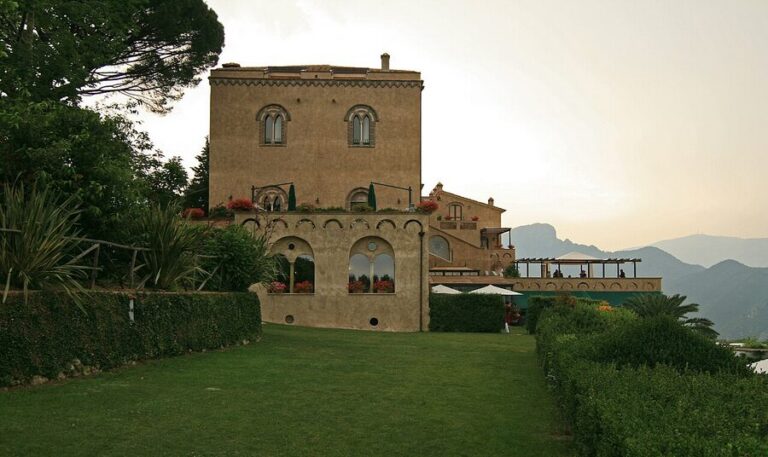
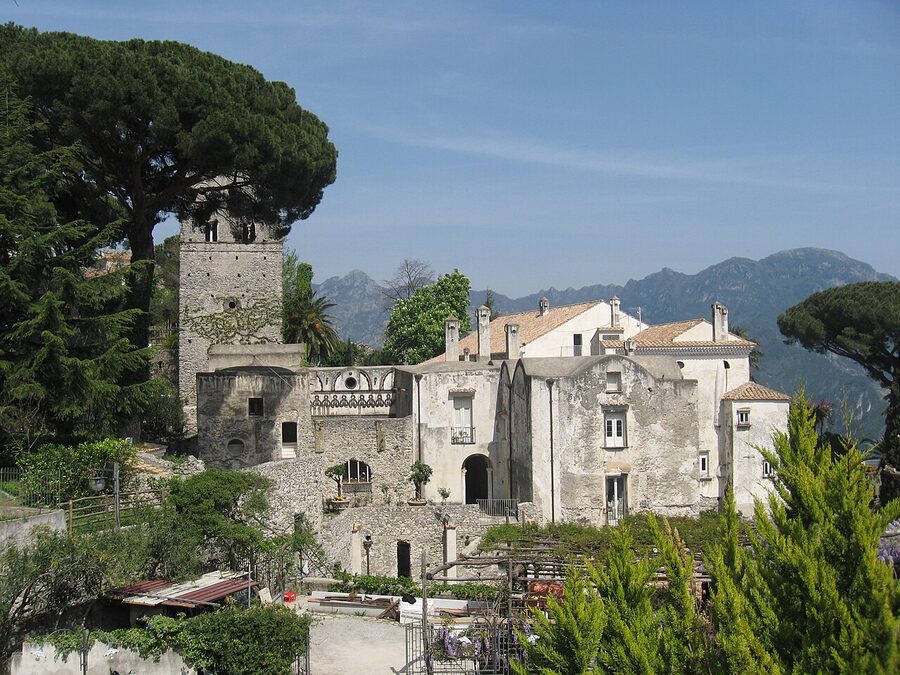
Villa Rufolo and its gardens at Ravello, high above the Amalfi Coast
Villa Rufolo, Ravello. Thirteenth-century, ruined in the 18th, restored by a Scottish collector in the 19th, now the summer venue for the Ravello Festival concerts — orchestra on a platform projecting over the drop to the sea. If you are anywhere near Ravello in July-August, book a concert and arrive at sunset. Photo by Istvanka / Wikimedia Commons (CC BY-SA 3.0)

Ravello. Three hundred metres above the coast on a promontory reached by a short switchback road from Amalfi. Two remarkable villas — Villa Rufolo (13th-century, with gardens that inspired Wagner’s stage set for Parsifal; the summer Ravello Festival concerts happen on a platform in the Rufolo gardens, over the drop to the sea) and Villa Cimbrone (1904-1917, with the Terrazza dell’Infinito lined with antique busts, looking out at nothing but sea). Both €7 entry, open 9-19 in summer. Plus the Cathedral of Ravello with its 12th-century pulpit. Stay for dinner; most visitors leave at 5pm and the town emptying out is the pleasant part.

Boat along the coast. The best way to see the Amalfi Coast is from the water. Day tours from Amalfi or Positano run €80-120 per person, typically Amalfi → Furore (the fjord) → Conca dei Marini (Emerald Grotto) → Positano → Li Galli islets → return. A private boat is €500-900 for the day for up to 8 people; if you have a group, the per-person cost is often lower than the day tour and the experience is unrecognisably better.

Sorrento and the peninsula

The Sorrento Peninsula is the 25-kilometre ridge of limestone mountains that separates the Bay of Naples from the Bay of Salerno. The north side (Sorrento, Massa Lubrense, Piano di Sorrento) is gentler, more agricultural, and oriented toward the ferry routes to Capri. The south side is the Amalfi Coast proper.

Sorrento town is the regional base most non-Italians use. A clifftop town of 16,000 residents with Roman foundations, a 16th-century cathedral, a good archaeological museum, and a genuinely excellent sunset view west over Vesuvius. It is also where the Circumvesuviana line terminates, which makes it the easiest base for combining the Amalfi Coast (by SITA bus or boat) with Pompeii/Herculaneum/Naples (by train). The downside: Sorrento is heavily touristed, English-dominant, and in July-August booked to capacity. Off-season it is lovely; in June, the pinch point, it is already unpleasant.

If Sorrento sounds too obvious, the two alternative bases on the peninsula are Massa Lubrense (20 minutes west, smaller, quieter, access to the Baia di Ieranto nature reserve) and Vico Equense (20 minutes east, the working Italian town, home of the pizza al metro — pizza sold by the metre length — invented at the Pizza a Metro Da Gigino since 1960, still in operation, €9 per half metre). I would base in Vico Equense over Sorrento on a second trip.

At the very tip of the peninsula is Punta Campanella — a marine reserve with no road access (a 40-minute walk from Termini) and the single best swim in the region. Also Marina del Cantone with the restaurant Lo Scoglio on the pontoon, famous for spaghetti ai ricci (sea urchin pasta); reservations essential.

The three islands — Capri, Ischia, Procida

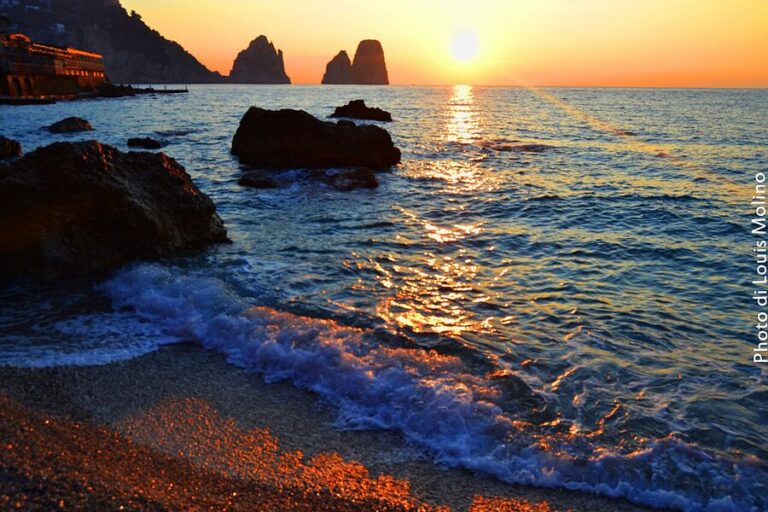
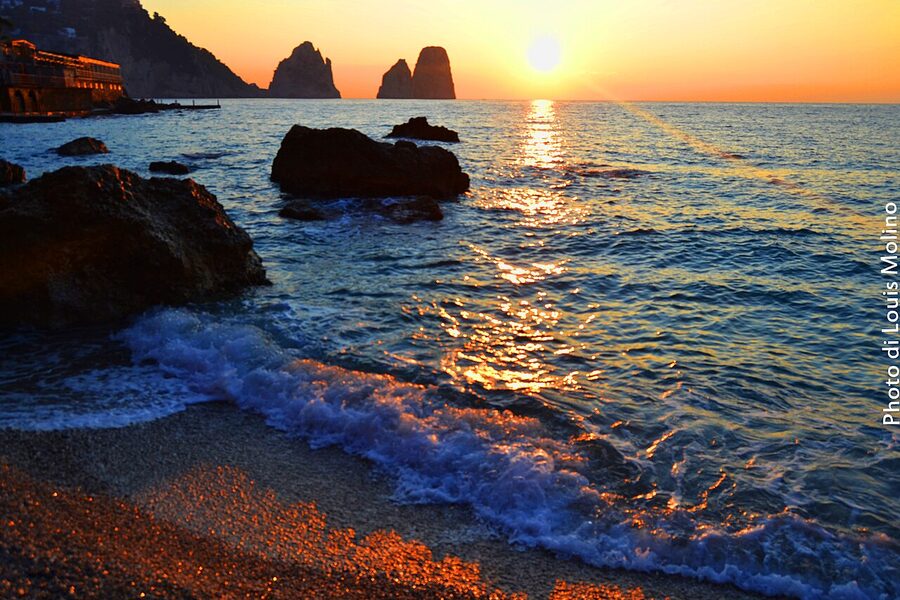
The Faraglioni of Capri at dawn
The Capri Faraglioni at dawn. The three limestone stacks rise 109m off the southeastern coast; the middle one (called Faraglione di Mezzo) has a natural sea arch you can pass under by rowboat. Boat tours around the island leave continuously from Marina Grande between 9am and 5pm in season. Photo by Luigi “Louis” Molino / Wikimedia Commons (CC BY-SA 4.0)

Capri is the famous one. A 10-square-kilometre limestone island off the tip of the Sorrento peninsula, population 14,000, reached by a 40-minute hydrofoil from Naples or a 25-minute hydrofoil from Sorrento (€22 one-way). The ferry lands at Marina Grande; a funicular takes you up to the town of Capri (higher end), and a short bus ride goes across to Anacapri (quieter). The three things you cannot skip: the Faraglioni (best seen by boat tour of the island, €25 per person, 90 minutes), the Giardini di Augusto (terrace gardens with the best land view of the faraglioni), and the Grotta Azzurra (Blue Grotto — a sea cave you enter by lying flat in a small rowboat; €18 plus €15 for the rowboat; seasonally closed in rough sea). Go in May or late September; avoid July-August, when the island is overrun.

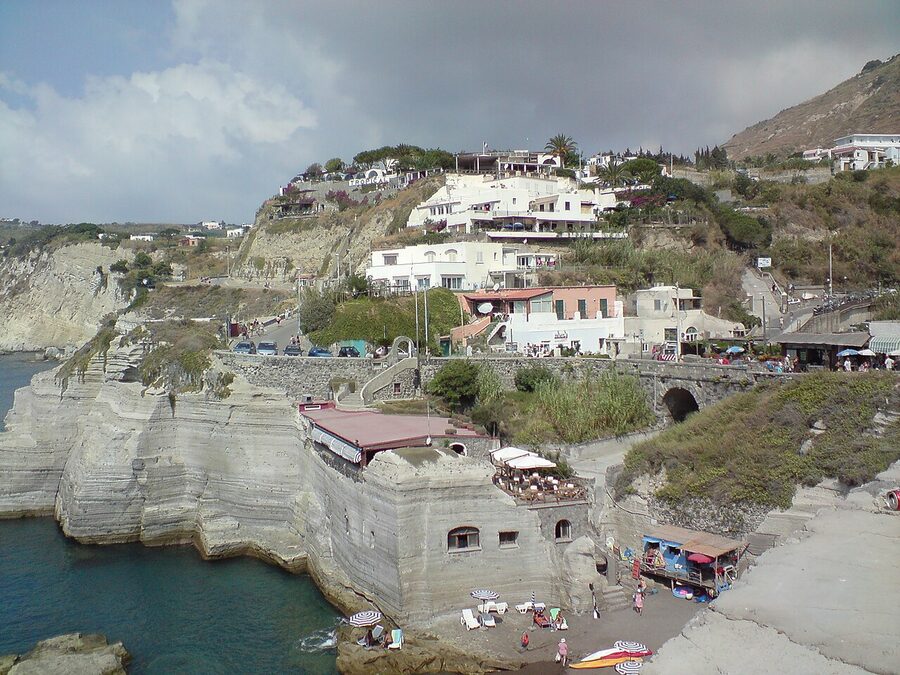
The village of Sant'Angelo on the southern coast of Ischia
Sant’Angelo, Ischia. A fishing village with no car traffic — you park a kilometre above the town and walk down. The islet of Torre di Sant’Angelo on the right is connected to the main island by a sand isthmus that appears and disappears with the tide. Photo by Effenberger / Wikimedia Commons (CC BY-SA 3.0)

Ischia is the largest of the Bay of Naples islands — 46 km², population 64,000 — and the working one. Volcanic, thermally active, with natural hot springs and spa gardens on the west and south coasts. The main town, Ischia Porto, is where the ferries come in (50 minutes from Naples, €20). Lacco Ameno on the north coast is the elegant spa town; Sant’Angelo on the south is the fishing village without road access and my favourite stop on any Italian island. The 15th-century Aragonese Castle on an offshore island connected by causeway is the single best architectural site. Ischia works as a day trip but is much better over two or three nights. Cheaper than Capri in every way.

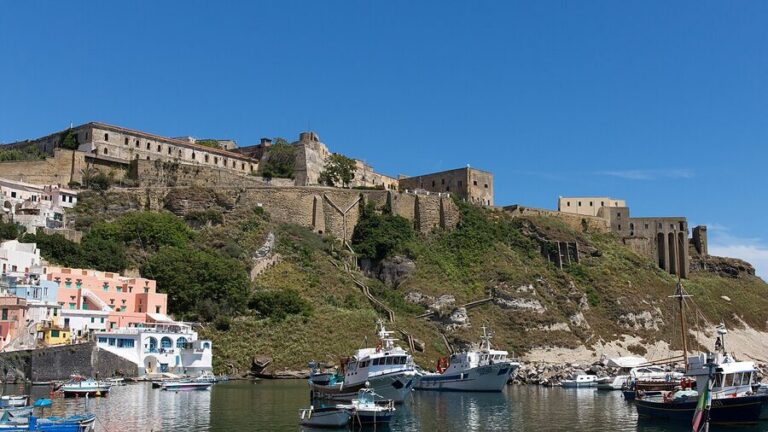
Marina Corricella on Procida — pastel fishing village
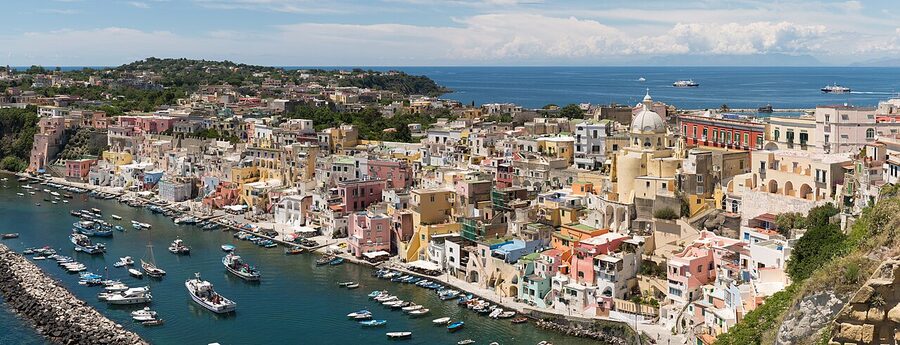
Marina Corricella, Procida. The oldest fishing village on the island — no road access, only boat or the 300-step staircase from the main road above. Named Italian Capital of Culture 2022, which brought a short tourism wave that has already started to ebb. Come midweek in May for the closest thing to the town it used to be. Photo by Ekrem Canli / Wikimedia Commons (CC BY-SA 4.0)

Procida is the smallest — 4 km², population 10,500 — and the least-visited. Pastel fishing village (Marina Corricella) with no road access, a 15th-century abbey (San Michele Arcangelo), a long lemon-grove coast, one good beach (Chiaia), and a 300-step staircase that is the local gym. Named Italian Capital of Culture in 2022, which drove a small tourism uptick that has started to fade. Film location for Il Postino (1994) and The Talented Mr Ripley (1999). Fourteen minutes by hydrofoil from Ischia; a day trip minimum, but staying overnight is the genuinely different experience — by 8pm all day-trippers have left and the island is quiet in a way Capri and Ischia simply cannot be.

If you are only seeing one island: Ischia for two-plus nights, Capri for a long day trip, Procida for an overnight. If you can do only one Italian island and you have seen the others, Procida.

Paestum and the Cilento

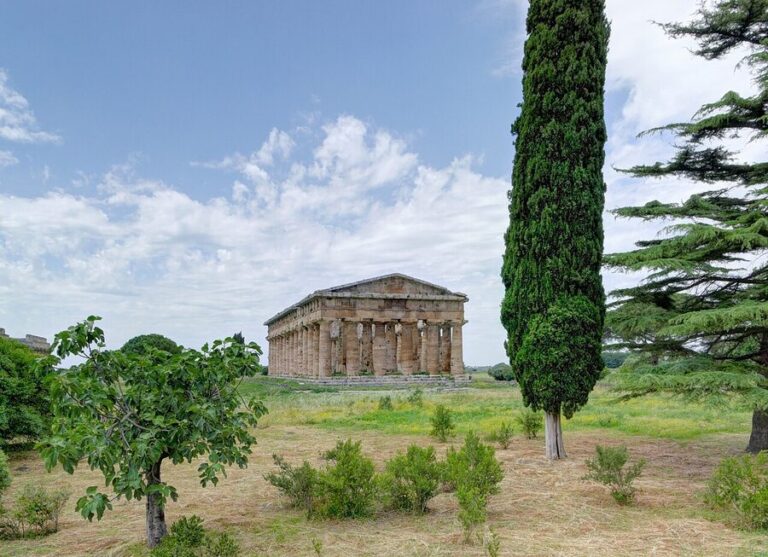
The Temple of Hera II at Paestum, an intact 5th-century BC Greek temple
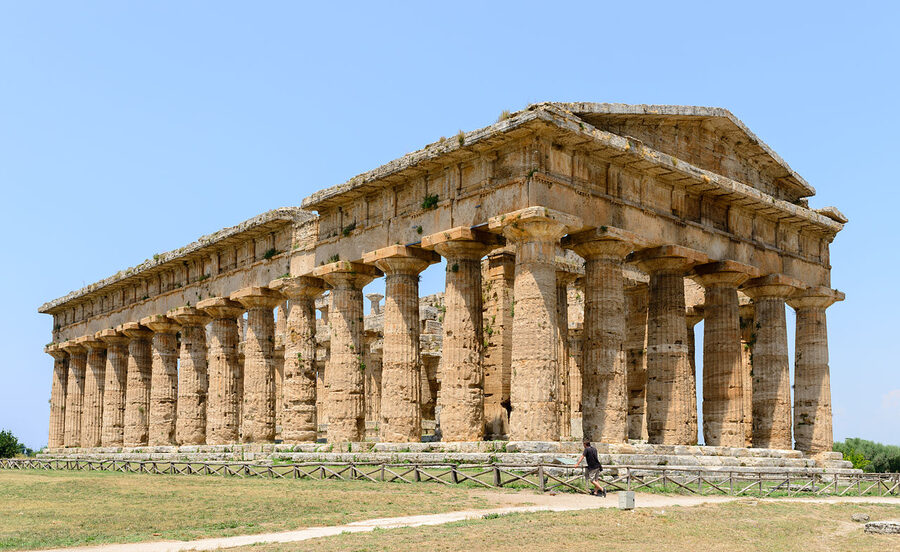
The Temple of Hera II at Paestum — built around 450 BC, intact except for the roof and the cella columns. The original Greek colony, called Poseidonia, was founded here around 600 BC. The three extant temples are the finest Greek Doric temples outside Greece. Photo by Norbert Nagel / Wikimedia Commons (CC BY-SA 3.0)

An hour south of Salerno, on the flat alluvial plain of the Sele river, three almost-intact Doric Greek temples stand in a field among the modern archaeological fences. This is Paestum — originally Poseidonia, founded by Greek colonists from Sybaris around 600 BC, re-founded as a Roman colony in 273 BC, abandoned in the 8th century AD when malaria and Saracen raids drove the population to the hills. The temples are the Temple of Hera I (550 BC), the Temple of Hera II or “of Poseidon” (450 BC), and the Temple of Athena (500 BC). All three are more intact than almost any surviving Greek temple in Greece itself. Entry €12, allow four hours including the museum (which holds the Tomb of the Diver fresco, 480 BC, the only surviving Greek fresco from the classical period). UNESCO-listed since 1998 together with the Cilento park.

The Cilento and Vallo di Diano National Park stretches south and east from Paestum, 181,000 hectares of Apennine ridges and coastal cliffs, almost none of it developed. Five UNESCO-listed archaeological sites within the park (Paestum, Velia, the Padula Charterhouse, and two lesser sites), plus a long coastline with small seaside villages (Acciaroli, Pisciotta, Palinuro) that feel like the Sicilian coast looked in the 1960s. The Cilento is where Campania goes when it wants to escape Campania. The food is remarkable — the Mediterranean diet was first defined, scientifically, at Pioppi in Cilento by the American physiologist Ancel Keys in the 1950s — and the local wine, Aglianico-based, is excellent.

If you have a week in the south, spend two nights at Paestum (at the Tenuta Duca Marigliano or the Savoy Beach Hotel), two in the Cilento interior (Castelabate or Pollica), and two on the Cilento coast at Marina di Camerota or Palinuro. It is, in my view, the single most underrated week in Italian travel.

The Royal Palace of Caserta and the inland

The Royal Palace of Caserta — the 18th-century Bourbon palace by Luigi Vanvitelli
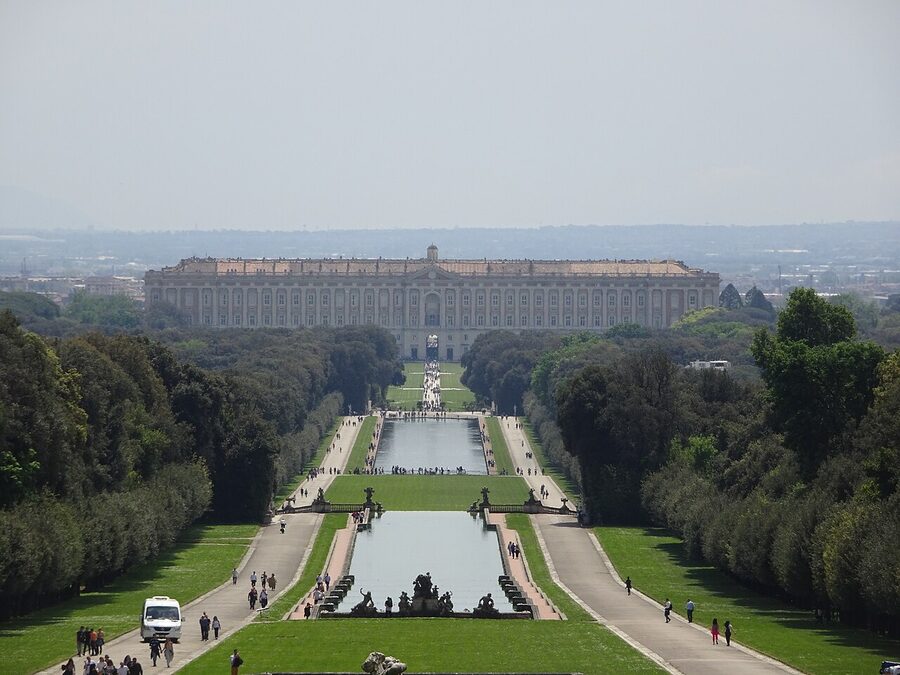
The Reggia di Caserta. Commissioned by Charles III of Bourbon in 1752 to rival Versailles. Designed by Luigi Vanvitelli. 1,200 rooms, 1,742 windows, 23 hectares of gardens, a 3km-long axial cascade ending at the Fontana di Venere e Adone. UNESCO-listed. Open daily except Tuesday; entry €15. Photo by augurgo / Wikimedia Commons (CC BY-SA 4.0)

Thirty-five minutes north of Naples by train, sitting on the Campanian plain, is the Reggia di Caserta — a baroque Bourbon palace built between 1752 and 1780 to rival Versailles. It does not, quite. But it is one of the five biggest palaces in Europe by floor area, has a garden axis three kilometres long that ends in the Fontana di Venere e Adone, and is UNESCO-listed together with the 38-kilometre Carolino aqueduct that feeds its cascades. Designed by Luigi Vanvitelli; completed by his son Carlo. Used as Allied headquarters during the 1944 Italian campaign — the German surrender in Italy was signed in the Sala degli Alabardieri on 29 April 1945. Used again as Naboo’s royal palace in the Star Wars prequels.

Entry €15, open 8:30-19:30 except Tuesday. Plan for four hours minimum: two for the palace, two for the gardens. Rent a bicycle at the park gate (€4 per hour) — the gardens are too big to walk end-to-end comfortably. The Giardino Inglese at the top end of the park (added 1785, on Hamilton’s advice) contains a deliberate “ruined Roman temple” among real archaeological fragments plundered from Pompeii, which is the kind of thing only 18th-century aristocrats did.

Beyond Caserta, the Campanian interior is a set of three provinces — Caserta itself, Benevento, and Avellino — that most travellers never see and that contain some of the region’s best wine, its best mountain food, and the almost-unchanged Lombard-era hill towns of the upper Volturno valley. The two specific stops I would make on a longer trip: Benevento (Roman arch of Trajan, 8th-century Lombard church of Santa Sofia, UNESCO) and Sant’Angelo dei Lombardi area in the Irpinia wine country. Both are 90 minutes from Naples by car, and neither is in 99% of foreign travel itineraries.

Food and wine

A Pizza Margherita — the canonical Neapolitan pizza
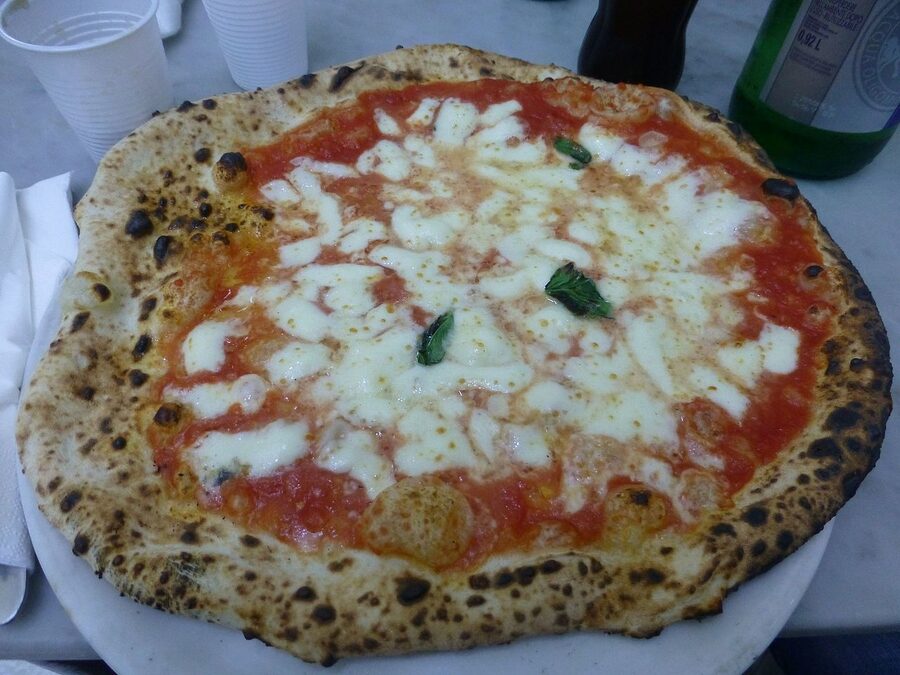
A Pizza Margherita. Tomato, mozzarella, basil. Invented c.1889 in Naples by the pizzaiolo Raffaele Esposito in honour of Queen Margherita of Savoy. The pizza is listed on UNESCO’s Intangible Cultural Heritage register as the Pizzaiuolo Napoletano (2017). Photo by Kos88 / Wikimedia Commons (CC BY-SA 4.0)

Campania invented more of what people consider “Italian food” than any other region. Pizza, obviously — the Naples wood-fired Neapolitan style, UNESCO-protected as intangible cultural heritage since 2017, at its best in Naples itself and nearly impossible outside Campania. Pasta — the dried pasta industry of Gragnano (a small town on the Sorrento peninsula) is the reference for all of southern Italian dry pasta. Mozzarella — the mozzarella di bufala campana DOP is made from the milk of water buffalo raised on the Caserta and Salerno plains, and should not be refrigerated once bought; eat it the day you buy it. Parmigiana, caponata, sfogliatelle, babà, pastiera (the Easter tart of ricotta and wheat), taralli (the savoury biscuit), struffoli (the Christmas honey-dipped dough balls) — all Campanian.

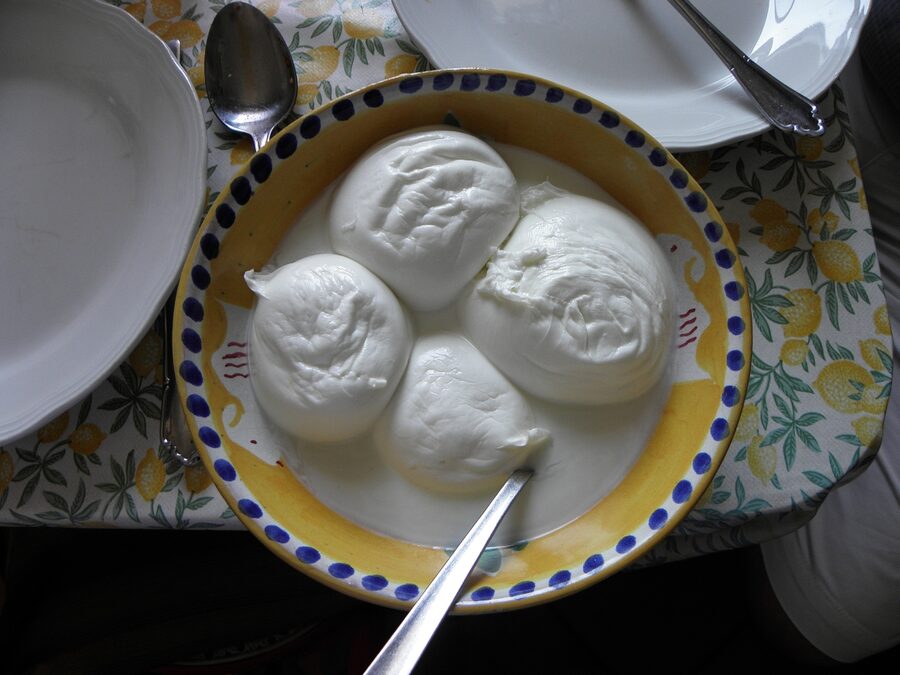
Mozzarella di Bufala Campana DOP
Mozzarella di Bufala Campana DOP. Made from water-buffalo milk on the Caserta and Salerno plains, EU-protected since 1996. Eat it the day you buy it; the fat structure breaks down after 18 hours in the fridge and the texture goes rubbery. The best versions come from the Battipaglia and Vannulo producers. Photo by Ra Boe / Wikimedia Commons (CC BY-SA 3.0 de)

The specific things to eat in the specific places:

In Naples: pizza margherita or marinara at one of the Decumano Maggiore pizzerias (Da Michele, Gino Sorbillo, or 50 Kalò); spaghetti alle vongole at one of the Borgo Marinari restaurants under Castel dell’Ovo; friggitoria snacks — pasta cresciuta, arancini, cuoppo of fried fish — from any of the street friggitorie; sfogliatelle still warm from the bakery at Pasticceria Pintauro on Via Toledo.

On the Amalfi Coast: delizia al limone (the lemon pastry, a dome of sponge filled with lemon cream, covered in white chocolate glaze) from Pasticceria Pansa in Amalfi; scialatielli ai frutti di mare (the Amalfi pasta with seafood) at Trattoria Cumpà Cosimo in Ravello; colatura di alici (a garum-like anchovy liquid used in cooking) from the fishing village of Cetara.

In the interior: laganelle e ceci (pasta and chickpeas) anywhere in Irpinia; truffle dishes in the Matese mountains north of Caserta; Genovese ragù (onions and meat slow-cooked for hours, Neapolitan-style — nothing to do with Liguria despite the name).

Wine. Four appellations matter. Taurasi DOCG — Aglianico-based red from Irpinia, ageable 20-30 years, often called “the Barolo of the south” by people who have had neither; the reference producer is Mastroberardino. Fiano di Avellino DOCG — a white from the same province, more floral and mineral than northern Italian whites; drink with fish. Greco di Tufo DOCG — another white Irpinian, more citric, perhaps the most distinctive of the three. Lacryma Christi del Vesuvio — red and white wines from vines grown on the slopes of Vesuvius; the volcanic soil shows up in the flavour as a faint mineral funk. Not the greatest wine in Italy, but genuinely worth drinking in the context of where you are drinking it.

Limoncello — the sweet lemon liqueur — is made across the Amalfi Coast and Sorrento peninsula using the sfusato amalfitano and femminello sorrentino lemon varieties. Avoid the supermarket tourist-label versions. Buy from the small producers in Amalfi, Positano, or Minori, or specifically from Limonoro in Sorrento, which has been making it since 1905.

When to visit

Late April through mid-June, and mid-September through mid-October, are the right windows. The sea warms enough to swim by about 10 June and stays warm through mid-October. Summer festivals (Ravello Festival, Naples Music Village) run July-August. The Amalfi Coast traffic is bearable in May and September; in July-August it is not.

July and August should be avoided if you have a choice. Italian domestic tourism peaks around Ferragosto (15 August), at which point Amalfi Coast accommodation prices triple, Capri’s Marina Piccola holds a thousand people, and the Circumvesuviana trains to Pompeii become functional discomfort. If you must come in high summer, base on Ischia or in the Cilento — both handle volume better than the Amalfi Coast.

November through March is quiet, cheap, and for the right traveller pleasant. You will get rain. You will also find Naples at its best, Pompeii almost empty, and the Amalfi Coast with half its restaurants closed but the other half properly itself. I have spent a January in Naples that I would not trade. Bring layers; inland Campania can be surprisingly cold.

Key dates: the San Gennaro miracle in Naples (19 September, 16 December, first Saturday of May — the three days the saint’s blood is said to liquefy); Ravello Festival (July-August, orchestra concerts on the Villa Rufolo terrace); Festa del Pizzaiuolo in Naples (September); Capri and Ravello Jazz Festival (July).

How to put it together

Campania is not a single-week destination. One week buys you the core of one zone; two weeks are a reasonable minimum for the whole region.

Five days, classic. Fly into Naples, two nights in Naples (one full day for the city, one day for Pompeii + Vesuvius), then transfer to Sorrento or Positano for three nights (day trips to Capri, Amalfi, Ravello). Works with the Circumvesuviana + SITA buses.

Ten days, expanded. Add three nights on the Amalfi Coast proper (one in Positano, two in Ravello or a smaller village), one night at Paestum, one night in Procida. Fly out of Naples.

Two weeks, comprehensive. Add Ischia (two nights), the Cilento (two nights at Palinuro or Castelabate), Caserta (one night), and Benevento for the Lombard-church detour. Fly into Naples, out of Naples. This is the trip where you stop seeing headlines and start seeing the region.

Combined with the rest of Italy. The natural northern neighbour is Lazio (Rome — two-hour train) and Umbria (four-hour train to Perugia). South, Basilicata (Matera — three-hour drive) and Puglia (Bari — three-hour drive). Across the water, Sicily (overnight ferry from Naples to Palermo). Any of these make natural onward legs.

Before you go

Campania is the region where Italian tourism is most obviously in tension with Italian life. The Amalfi Coast is now at a tourism volume that its infrastructure cannot absorb; Capri is overtly closed to day visitors in high summer; Pompeii has had to introduce a daily entry cap. At the same time, Naples is in what is clearly a real renaissance — cleaner, safer, more alive than it has been since before the cholera outbreak of 1884 — and the Cilento remains one of Italy’s least-visited protected coastal zones. The tourism is not where the life is. Once you accept that, the region opens up.

What I would personally do now, on a first trip: three days in Naples, two days at Pompeii and Vesuvius from a Naples base, five days at a smaller town on the Sorrento Peninsula or inland Amalfi Coast (not Positano), two days on Ischia, and two days at Paestum and the Cilento. Skip Capri. Come back for it on a later trip when it is off-season and you have the island to yourself for an afternoon. The postcard Campania will wait. The working Campania will be different in five years.

For individual city guides, see the Sicily hub for comparison and context on the southern Italian framework. The Basilicata, Calabria, and Puglia hubs on this site cover the neighbouring southern regions. City guides now live for Amalfi, Positano, Ravello (the Amalfi Coast trinity), Pompeii, Herculaneum, and Paestum. Naples and Capri in progress.

Naples

An editorial guide to Naples, the most under-visited major Italian city. The 535-year capital of an independent kingdom, the Bourbon-era cultural infrastructure, the Spaccanapoli centro storico, the underground city, the pizza, the day-trips. Where to stay and what to skip.
Procida

The smallest, quietest, and least-visited of the three Gulf of Naples islands — Marina Corricella in its hundred colours, the Terra Murata citadel, the 2022 Italian Capital of Culture. Where to stay, when to come, what most visitors miss.

Ischia

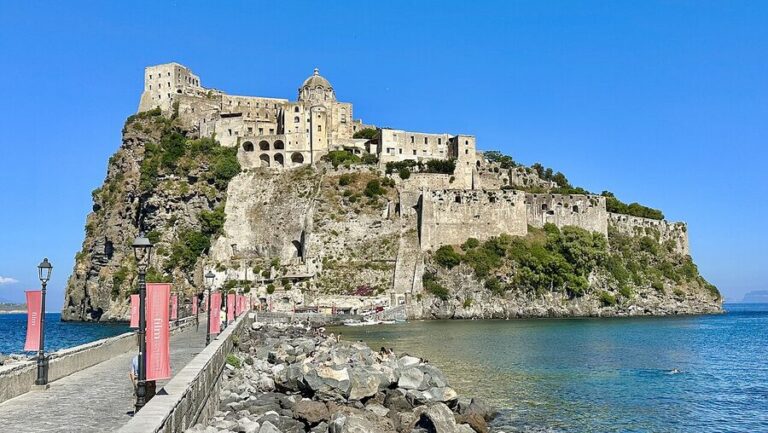
The largest and most liveable of the Gulf of Naples islands — thermal springs, William Walton gardens, the Aragonese Castle on its causeway, Sant Angelo, Monte Epomeo, and the six-commune geography that determines which base suits which visitor.

Capri

A long editorial guide to Capri — the Gulf of Naples island of Augustus and Tiberius, the Piazzetta and the Blue Grotto, Villa Jovis and the Faraglioni, Anacapri and Monte Solaro. How to get there, what to skip, when to go.

Paestum

Paestum — the Greek colony of Poseidonia founded c.600 BC on the southern Campanian coast. Three Doric temples better-preserved than anything standing in Greece itself; the Tomb of the Diver, the only surviving Greek painted wall-painting from the Classical period; and the Cilento National Park stretching south.

Herculaneum

Herculaneum — the smaller, better-preserved, quieter twin of Pompeii. 20 metres below the modern town of Ercolano, preserved by pyroclastic flows that carbonised wood and fabric rather than destroying them. The Villa of the Papyri scroll library being digitally read by the Vesuvius Challenge in 2024.

Pompeii

Pompeii — the single best-preserved ancient city in the world, buried by Mount Vesuvius on a morning in autumn 79 AD, partially excavating since 1748, still 40% unexcavated. The Forum with Vesuvius behind it, the plaster casts of the victims, the Villa of the Mysteries Dionysiac fresco, the Amphitheatre (oldest stone Roman), the House of the Vettii reopened 2023.

Ravello

Ravello, the clifftop town 365m above the Amalfi Coast where Wagner sketched Parsifal, Villa Cimbrones Terrazza dellInfinito looks out over a 350m drop, the oldest outdoor music festival on the coast has run since 1953, and Gore Vidal lived for 34 years. Villa Rufolo, Villa Cimbrone, the Duomos 1272 pulpit, and the Ravello Festival.

Positano

Positano, the cliff-hanging village on the Amalfi Coast that John Steinbeck effectively launched to international tourism in 1953. A Byzantine Madonna in a majolica-domed church, a Roman villa buried under it, the Li Galli islands of the sirens offshore, and the Sentiero degli Dei path of the gods overhead.

Amalfi

Amalfi, the capital of a medieval Mediterranean maritime republic that once had 80,000 residents; now a town of 4,900 with the single most architecturally layered cathedral complex in southern Italy, the 1343 storm that ended the republic, the Chiostro del Paradiso, the Paper Museum, and scialatielli at La Caravella.