
Calabria
Calabria is the toe of the Italian boot. It has 780 kilometres of coastline — more than any other mainland region — facing three different seas (the Tyrrhenian to the west, the Ionian to the east, the Strait of Messina to the south). It contains three national parks covering nearly a fifth of the land area, two of the top five archaeological finds of the 20th century (the Bronzes of Riace), a cuisine that runs hotter than anywhere else in Italy (a family of chillies the Italians call peperoncino calabrese), and some of the oldest Greek colonies in Europe. It is also the region that, on most summer itineraries, gets bypassed on the way between Naples and Sicily. That is a mistake.
Calabria is not an easy place. It has fewer tourists than any other coastal Italian region, which is partly because the infrastructure is older, partly because a number of its interior towns have thinned out through emigration, and partly because the ‘Ndrangheta — the Calabrian mafia, arguably now the most powerful organised crime group in Europe — has cast a long reputational shadow. Day-to-day, for a visitor, that shadow is almost invisible. The beaches are empty, the food is spectacular, the Greek ruins are unfenced, and almost nobody queues for anything. Come knowing that you’ll be on your own navigation — English is less widespread here than in Tuscany — and you’ll be rewarded.
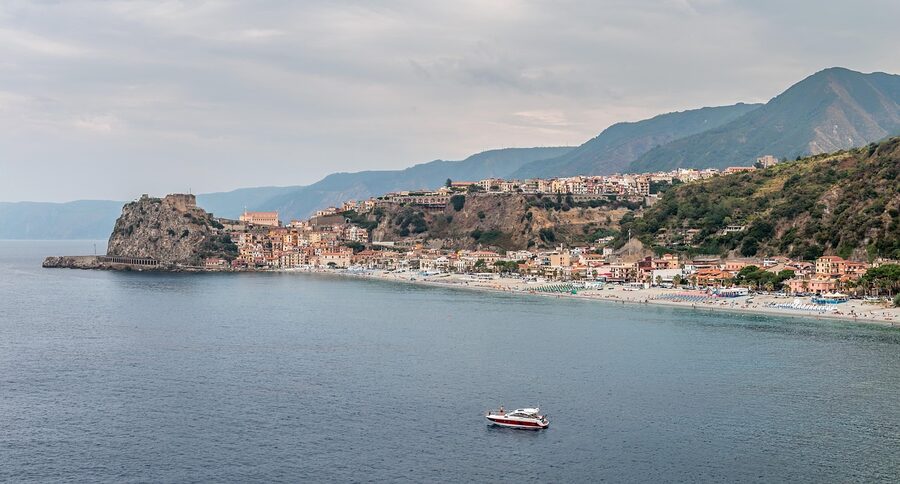
What Calabria actually is
Geographically: a long narrow region shaped like a boot-tip, 250 km long and never more than 110 km wide, with a central mountainous spine running nearly the full length and narrow coastal plains on either side. Three major mountain groups — the Pollino in the north (straddling the Basilicata border), the Sila in the middle, and the Aspromonte in the south — each with its own national park. The highest peak is Serra Dolcedorme in the Pollino at 2,267 m.
Population is around 1.9 million, down from 2.15 million in the 1960s (steady emigration through the 20th century; the trend continues). Five provinces: Cosenza (the largest, in the north), Catanzaro (the capital, in the middle), Crotone (east coast), Vibo Valentia (small Tyrrhenian coastal province), and the Metropolitan City of Reggio Calabria (the southern tip, facing Sicily).
Historically: the peninsula was one of the earliest Greek colonial destinations — colonists arrived in the 8th century BC, founding cities at Kroton (modern Crotone), Locri, Rhegion (Reggio), Sybaris and others. Taken together these are the heart of Magna Graecia — “Greater Greece” — the extensive Greek-speaking world of southern Italy. The Greek identity and language persisted through the Roman period, the Byzantine reconquest (6th-11th centuries), and into the Middle Ages; a Greek dialect called Grecanico is still spoken by a few hundred elderly speakers in a handful of mountain villages in the far south (Bova, Gallicianò, Roghudi). Byzantine-Greek monastery culture left behind the astonishing small churches of the region (see Cattolica di Stilo below).
After Byzantium came Normans, then Hohenstaufens, then Angevins, then Aragonese, then the Kingdom of Naples, then the Two Sicilies, then unified Italy in 1861. The 19th and 20th centuries were particularly hard: a series of earthquakes (most devastatingly the 1908 Messina quake that levelled Reggio Calabria), continuous poverty, and heavy emigration to the Americas and northern Europe.
Getting there
Two airports:
- Lamezia Terme (SUF) — the central coast, the main gateway, with year-round routes from Milan, Rome, Venice, Paris, London Stansted, Munich, Warsaw. Ryanair, ITA, Ryanair again.
- Reggio Calabria (REG) — small regional airport, very limited schedule. Useful mostly for domestic connections.
By train: the Tyrrhenian coastal line (Rome-Naples-Salerno-Reggio Calabria) is the spine. High-speed Frecciarossa and Frecciargento services run Rome-Reggio (about 5h30) and Milan-Reggio (9h, usually overnight). Cities served: Paola (for Cosenza, change), Lamezia Terme, Vibo-Pizzo, Rosarno (for Tropea), Gioia Tauro, Villa San Giovanni (the ferry port to Messina), Reggio Calabria Centrale.
By car: the A2 Autostrada del Mediterraneo (previously A3 Salerno-Reggio Calabria) runs the full length, all toll-free since 2018. The drive from Rome to Reggio is about 7 hours. The east coast is served by the SS106 Jonica, a non-motorway state road — slower but the more scenic route if you’re taking your time.
By ferry: Villa San Giovanni runs constant ferry service to Messina in Sicily, a 20-minute crossing, for cars and foot passengers; this is the standard route into Sicily.
The three national parks
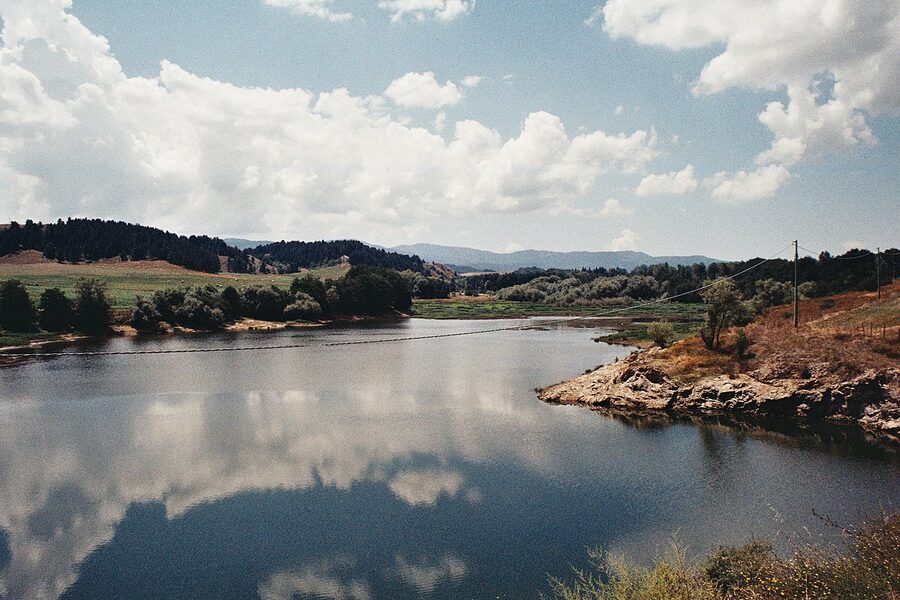

Almost 20% of Calabria is protected national parkland, divided across three contiguous parks.
Parco Nazionale del Pollino — the largest national park in Italy (192,000 hectares), straddling the Calabria-Basilicata border. The Pollino plateau is a high rolling upland; the Bosnian pine (pino loricato) — a prehistoric relic species — is the park’s living emblem. A pine named “Italus”, growing at 1,900 m in the Pollino, was confirmed in 2017 to be 1,230 years old, the oldest scientifically-dated tree in Europe.
Parco Nazionale della Sila — the central plateau (74,000 hectares), between Cosenza and Crotone. Beech, fir, and Corsican pine forest, mountain lakes (Arvo, Ampollino, Cecita), and the vacche podoliche — a local cattle breed that still pasture in summer. Come for walks, for trout fishing, and for the caciocavallo silano DOP cheese. Accessible from Camigliatello Silano (the main village).
Parco Nazionale dell’Aspromonte — the southern mountain range (64,000 hectares), a steep Apennine massif with seven peaks over 1,800 m. The ndrangheta associations with Aspromonte are historical (the hills sheltered kidnap victims in the 1970s-80s) but today the park is a serious walking and nature destination. The Cascate del Mundo is a three-tier waterfall in the park’s heart and one of the best short hikes in southern Italy.
The Greek heritage
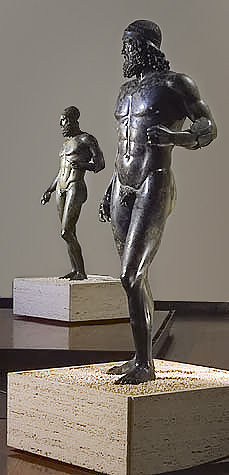
Calabria was a heartland of Magna Graecia — “Greater Greece” — the network of Greek colonies that covered southern Italy and Sicily from the 8th century BC. At its peak, cities like Sybaris, Kroton and Locri were larger than most Greek mainland poleis. Pythagoras founded his school at Kroton. Zaleucus wrote the first Western written law code at Locri. The gymnasts of Kroton dominated the Olympic Games for a century.
The physical legacy is concentrated at a few places:
Museo Archeologico Nazionale della Magna Grecia, Reggio Calabria — the principal museum. Two floors of Magna-Graecian art and artefacts, plus the Bronzi di Riace on a separate climate-controlled floor. The museum is worth travelling for on its own merits. €8 entry, closed Mondays. Book the Bronzi slot in advance (separate queue).
Locri Epizefiri — the archaeological site of ancient Locri, on the Ionian coast. A large Greek and later Roman town, including a theatre and the sanctuary of Persephone (where a famous archaic relief of the goddess was found, now in the Reggio museum). Free entry, open site.
Crotone (Kroton) — archaeological park at Capo Colonna, where one surviving column of the great Greek temple of Hera Lacinia still stands. The rest of the temple was dismantled in the 16th century by the bishop of Crotone to build a cathedral. The single column and the wide plateau around it retain an impressive atmosphere of absence.
Sybaris — the ancient city of proverbial luxury and excess (the word “sybaritic” comes from it), destroyed by Kroton in 510 BC. Now an archaeological site at the mouth of the Crati river on the Ionian coast. Less impressive than the other two because the ground water has mostly swallowed the remains.
Byzantine Calabria
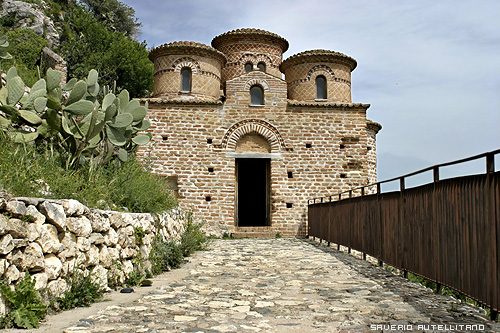

The 6th-11th centuries brought Byzantine rule to Calabria (the Byzantine Empire reconquered the Italian south from the Lombards under Justinian, and held most of it until the Normans arrived in the 11th century). The Byzantine-Greek religious heritage produced a dense population of small monasteries, cave hermitages and simple brick churches — most of which survive in some form in the Aspromonte and Stilo valleys.
The masterpiece is the Cattolica di Stilo — a tiny 10th-century church on the side of a mountain in the village of Stilo. Cubic plan, five small domes, four columns inside lifted from an earlier Roman building. The interior has fragmentary 11th-century frescoes. The proportions and the decorative brickwork are some of the purest Byzantine architecture on the Italian peninsula. Free entry; volunteer caretaker usually on site.
Other Byzantine survivals: the tiny 10th-century San Marco at Rossano, the Cattolica at Santa Severina, and the Codex Purpureus Rossanensis — a 6th-century Greek illuminated manuscript, one of the oldest illustrated Gospels in the world, kept in the museum at Rossano Cathedral.
The coast
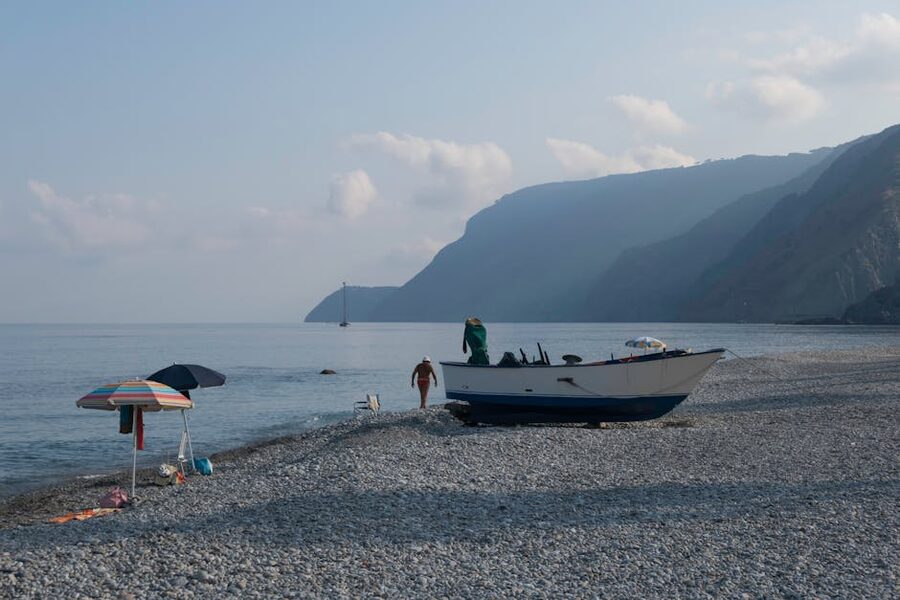
Calabria has 780 kilometres of coast, which is more than any other region in Italy except Sardinia and Sicily. The coast splits broadly into four:
The Tyrrhenian north (from the Basilicata border to Capo Vaticano) — long sandy beaches, cliffs behind, small resort towns. Key stops: Diamante (murals, the annual Peperoncino Festival in early September), Praia a Mare, Scalea, Fuscaldo. See the Scalea guide for the coastal strip in detail.
Capo Vaticano and Tropea — the single most tourist-popular stretch, a small cape sticking into the Tyrrhenian with white-sand beaches, clear water, and the hilltop town of Tropea on a dramatic bluff above the sea. Famous for the cipolla rossa di Tropea PGI (red onion). Tropea itself is a two-night stop; the beaches at Capo Vaticano (Grotticelle, Baia di Riaci) are genuinely world-class.
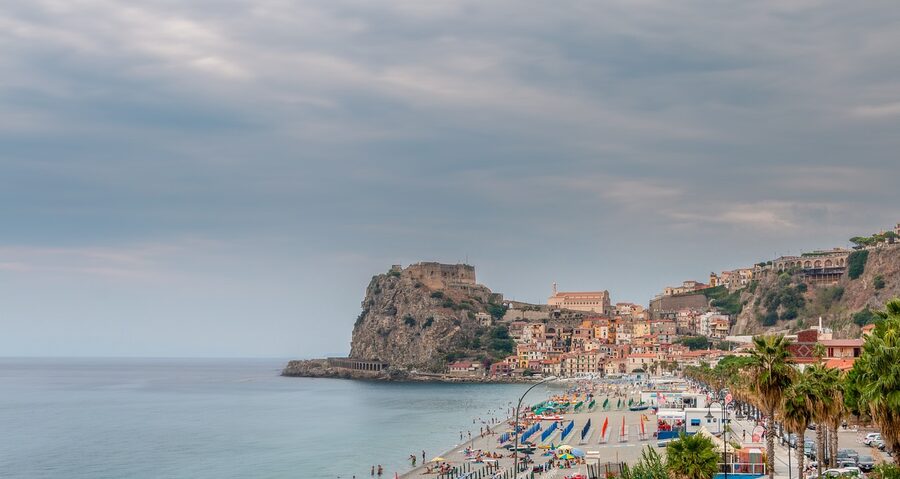
The Strait of Messina — the narrow (3 km at its closest) channel between Calabria and Sicily. Scilla and Bagnara Calabra on the Calabrian side, with fishing villages, swordfish boats (passerella — swordfish hunting with traditional long spotter-masts), and the mythological setting of Scylla and Charybdis. Scilla’s old fishing quarter, Chianalea, is a tight row of houses built directly on the water — worth the detour.
The Ionian coast — from Reggio up to the Basilicata border. Longer, flatter, less developed, very little shade. Greek ruins at Locri and (further north) Sybaris. Towns: Locri, Gerace (hilltop town a few km inland), Soverato, Crotone, Cirò Marina. The Ionian is the side of the region most visited by Italians and least by foreigners.
The interior: hill towns and villages
Away from the coast, the Calabrian interior is a depopulating landscape of beautiful, largely empty hill towns. A selective list:
Gerace — a hilltop Norman town above Locri, with a Romanesque cathedral (one of the largest in Calabria) and a Jewish quarter. Population 2,500, down from 8,000 a century ago. One of the most atmospheric walk-around small towns in southern Italy.
Stilo — the Cattolica village (above), plus a good hill town in its own right, with Norman-era fortifications.
Morano Calabro — a spectacular conical hill town in the Pollino, with streets spiralling up to a ruined Norman castle at the top.
Rossano — old hilltop town with the Codex museum (above) and an intact medieval weaving tradition.
Bova — one of the remaining Grecanico-speaking villages in the far south, at 900 m. Visit with a guide from the Associazione Culturale Grecanica if you want the language in situ.
Pentedattilo — a ghost town, abandoned after earthquakes in the 18th and 20th centuries, now being partially resettled as an artists’ colony. Spectacular location on a five-fingered rock (the name means “five fingers” in Greek).
Food and wine
Calabrian food is assertive, poor-peasant in origin, and built around a handful of intense flavours: chilli, fennel, olive oil, pork. Five things to eat and one to drink:
‘Nduja — the definitive Calabrian product. A soft, spreadable, violently spicy pork sausage made from raw pork fat, lean pork, and a terrifying quantity of peperoncino. Aged 3 months. Eaten on toasted bread, stirred into pasta (fileja alla ‘nduja), or melted over pizza. Originated in the village of Spilinga on the Monte Poro plateau; now made across the region. The village of Spilinga holds the annual Sagra della ‘Nduja on 8 August.
Cipolla Rossa di Tropea IGP — the red onion of Tropea. Sweeter and less pungent than most red onions; eaten raw in salads, baked whole, or made into sweet jam (marmellata di cipolle) for a cheese board.
Pasta alla Nerano — wait, that’s Campanian. Calabrian equivalent: pasta alla silana — pasta with caciocavallo and mushrooms. Or spaghetti alla Sanguinaccio (spaghetti with a blood-based sauce — rural Sila tradition).
Pesce spada — swordfish. The Strait of Messina is a famous swordfish fishery, with traditional spotter-boats (passerelle) dating back centuries. Grilled, involtini (rolled), carpaccio. Pesce spada alla ghiotta — Messinese-style with olives, capers, tomatoes — is the classic cross-strait dish.
Fileja — the local hand-rolled pasta, a little longer than cavatelli, twisted around a thin rod to give it a hollow middle. Standard partners: ‘nduja, pork ragu, or a light tomato-pepper sauce.
Cirò DOC — the region’s flagship wine. Made from Gaglioppo grapes on the Ionian coast around the village of Cirò Marina. Dark, structured, with a characteristic mineral edge. Cirò is the oldest continuously produced Italian red wine (Greek colonists at Kroton made it in the 8th century BC and supposedly used it to toast Olympic victors). Modern Cirò has been undergoing a quality revolution over the last fifteen years; top producers include Librandi, Ippolito 1845, ‘A Vita, Sergio Arcuri. €10-25 a bottle. The white equivalent is Cirò Bianco, made from Greco Bianco.
Also: Bergamot citrus — the Reggio coast is the only place in the world that commercially produces bergamot oil (used in Earl Grey tea and high-end perfume). The industry is small but the orchards run along the coast south of Reggio; perfume houses buy the entire annual production. Try a bergamot liqueur at any wine bar in Reggio.
When to visit
Summer (June-September) is beach season and the region is at full capacity (though still quieter than the rest of coastal Italy). July and August can hit 40°C inland and the Ionian is usually busier than the Tyrrhenian. Spring (April-June) is the best — wildflowers in the Sila and Pollino, warm sea by June, empty beaches. September-October is extended summer with the addition of grape and olive harvest and quieter coastal towns. Winter is cold at altitude (ski resorts operate in the Sila — Camigliatello, Lorica) but the low coasts stay mild and some hotels stay open on the Tyrrhenian.
Two events worth planning around: Peperoncino Festival at Diamante (early September, four days of chilli-heavy everything); Sagra della ‘Nduja at Spilinga (8 August). Both are regional, serious, and not staged for foreign tourists.
How long
Long weekend: Tropea + Capo Vaticano (2-3 nights).
A week: Tropea (2 nights) + Reggio Calabria for the Bronzi (1 night) + Scilla (1 night) + a Sila or Pollino mountain stop (2 nights).
Ten days or more: full coastal loop plus an interior week in one of the national parks. This is also the time frame at which Calabria starts to make sense as a standalone trip rather than a pass-through on the way to Sicily.
Individual city guides: Gioia Tauro, Scalea, and Reggio Calabria as they go live. For onward regional context see the Campania hub to the north (Amalfi Coast, Naples, Pompeii).