
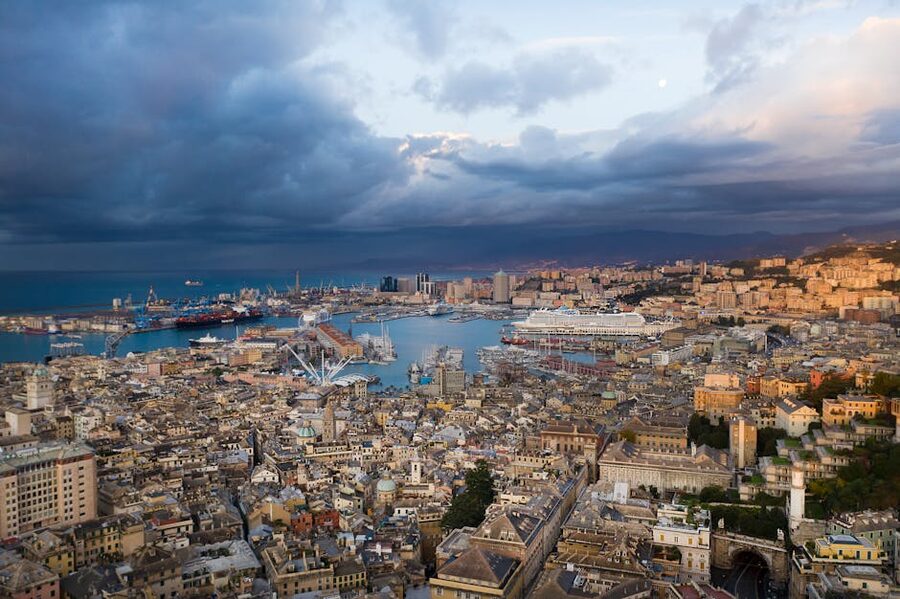
Genoa has been Italy’s working port for two and a half thousand years. It is also — less famously but just as truly — the city with the largest medieval centre in Europe, forty-two UNESCO-listed Renaissance palaces on a single street, the biggest aquarium on the continent, the neighbourhood where Christopher Columbus grew up, and a monumental cemetery that is one of the most extraordinary pieces of 19th-century art in Italy. The whole thing is welded together on a one-kilometre-wide strip of flat land between the sea and the Apennines. If you pay attention, it reveals a lot, fast.
I hadn’t planned to write enthusiastically about Genoa. I had been through it a dozen times on the way to the Cinque Terre without stopping. When I finally did stop — two nights, originally, the third night added on the second afternoon — I couldn’t work out why nobody had mentioned that this was one of the most interesting cities in Italy. I still don’t. The guidebooks are shy about it, the Italian tourist board pushes Florence and Venice first, and Genoa is cheerfully getting on with being itself. What follows is one way to see it.
In This Article
- What Genoa actually is
- Getting there
- The caruggi
- The Cathedral of San Lorenzo
- Via Garibaldi and the Palazzi dei Rolli
- Piazza De Ferrari and the Palazzo Ducale
- The Porto Antico and the Aquarium
- Boccadasse
- The Cimitero di Staglieno
- Famous Genoese
- Eating and drinking in Genoa
- Where to stay, and for how long
- When to come
- Is Genoa worth a full visit?
What Genoa actually is
Geography dictates everything. Genoa sits in a natural amphitheatre where the Apennines come down to the Ligurian Sea, and the available flat land is so narrow that the city has had to expand vertically and along the coast rather than outward. The result is a strip of urban fabric about 30 kilometres long east to west and, in the centre, barely 500 metres wide between the water and the cliffs behind. Population is around 580,000 in the commune, about 800,000 in the metropolitan area. It’s Italy’s sixth-largest city and, by cargo tonnage, the country’s largest port.
Culturally, Genoa is odd. The dialect is barely Italian (it’s closer to Niçard and Provençal in some of its vocabulary). The city was independent longer than almost anywhere else in the country — the Repubblica di Genova ran continuously from 1005 to 1797, nearly eight centuries. At its peak in the late 16th and early 17th centuries, Genoese bankers financed the Spanish Empire, Genoese admirals commanded European fleets, and Genoese merchants ran trading posts from Alexandria to the Black Sea. The city’s proud local saying is La Superba — the Proud One — which was Petrarch’s name for the place.
Modern Genoa is the product of three twentieth-century collisions. First, heavy industrialisation (shipbuilding, steel, oil refining) that peaked in the 1960s and then slowly declined. Second, heavy bombing in 1942-45 that damaged large tracts of the port and old town. Third, the 1992 Columbus quincentennial, which funded a massive regeneration of the Porto Antico by the Genoese-born architect Renzo Piano — the single biggest investment in the historic centre since the Baroque. What you see walking the city today is the layered product of all three. It’s rarely pretty in a polished way. It is almost always interesting.
Getting there
Genoa has its own airport — Cristoforo Colombo (GOA) — on a polder right next to the port, five kilometres west of the centre. It’s small and has been losing flights steadily; the main carriers are Ryanair, easyJet and ITA with limited European service, plus seasonal charters in summer. Volabus express coaches run from the arrivals hall to Piazza De Ferrari in 30 minutes for €6. Taxis are a flat €22 to the centre.
The better connections are by train. Genova Piazza Principe is the main station (adjacent to the old town; most inter-city arrivals stop here). Genova Brignole is the secondary station, 1.5 km east, closer to the modern centre. High-speed Frecciabianca and Frecciarossa from Milan take 90 minutes, from Turin 1h40, from Rome about 4h30. The coastal regional line west to Ventimiglia and east to La Spezia runs through both stations with frequent service; this is how you reach the Cinque Terre, Portofino, Sanremo and so on.
If you’re driving, the A7 (from Milan), A10 (from Ventimiglia/France) and A12 (from Rome/Tuscany) all converge at Genoa. The infamous 2018 collapse of the Ponte Morandi viaduct cut the A10 for two years; the replacement Ponte San Giorgio, designed by Renzo Piano and built in eighteen months, opened in August 2020 and is now the main route west. Parking inside the historic centre is not practical; use Parcheggio Piazza della Vittoria or Marina Porto Antico and walk in.
The caruggi
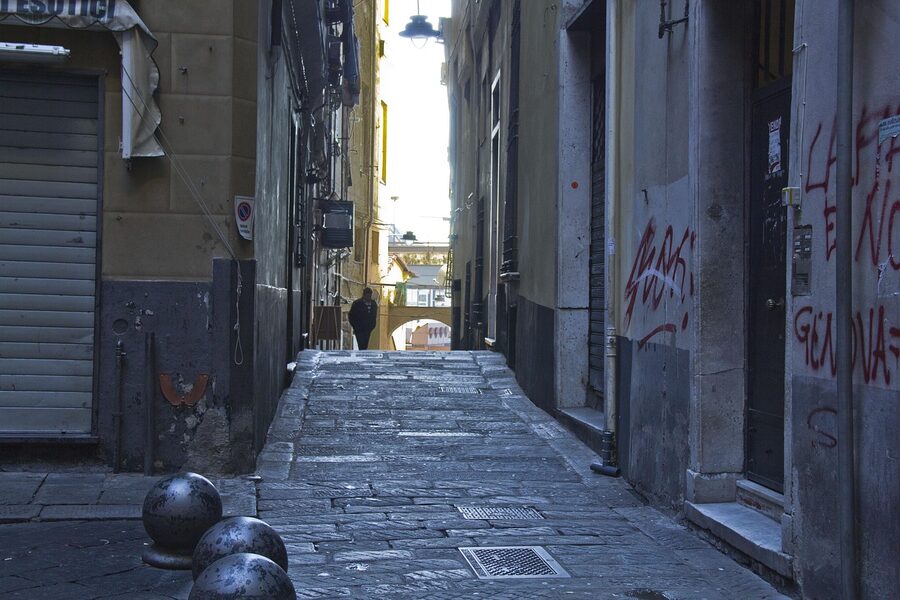
The caruggi — Ligurian for “narrow alleys” — are the centrepiece of Genoa. This is the largest continuously inhabited medieval quarter in Europe, a maze of lanes running north-south and east-west across an area of roughly 1.5 square kilometres between the port and Piazza Corvetto. Most of the streets are three to five metres wide, flanked by six-and seven-storey houses, paved in ciappe di Lavagna (local slate). Getting lost in them is not only likely, it’s the right strategy.
A few orienting points and what to look for:
Via San Lorenzo runs from Piazza De Ferrari down to the port past the cathedral. It’s one of the few caruggi streets wide enough for cars.
Via del Campo — subject of a famous 1967 song by the Genoese singer-songwriter Fabrizio De André about the neighbourhood’s sex workers and small traders. The song is still played in every bar in the quarter. The street itself is now partly gentrified but retains a handful of old-style alimentari and workshops.
Sottoripa — the covered portico running along the south side of Piazza Caricamento, facing the old port. Built in the 12th century, it’s the oldest covered walkway in Europe and still houses the same kinds of businesses it always did: fried-fish stalls, farinata bakeries, sailmakers, and a single bar per block.
Piazza San Matteo — a small square owned historically by the Doria family (admirals, bankers, doges), lined with four black-and-white striped medieval Doria palaces and the family’s private church. Exceptional and quiet.
Don’t walk the caruggi after 10pm on the streets south of Via San Luca — the quarter still has its old social complexity and some of the southern alleys are genuinely rough. Before 10pm, everywhere is fine and full of people.
The Cathedral of San Lorenzo
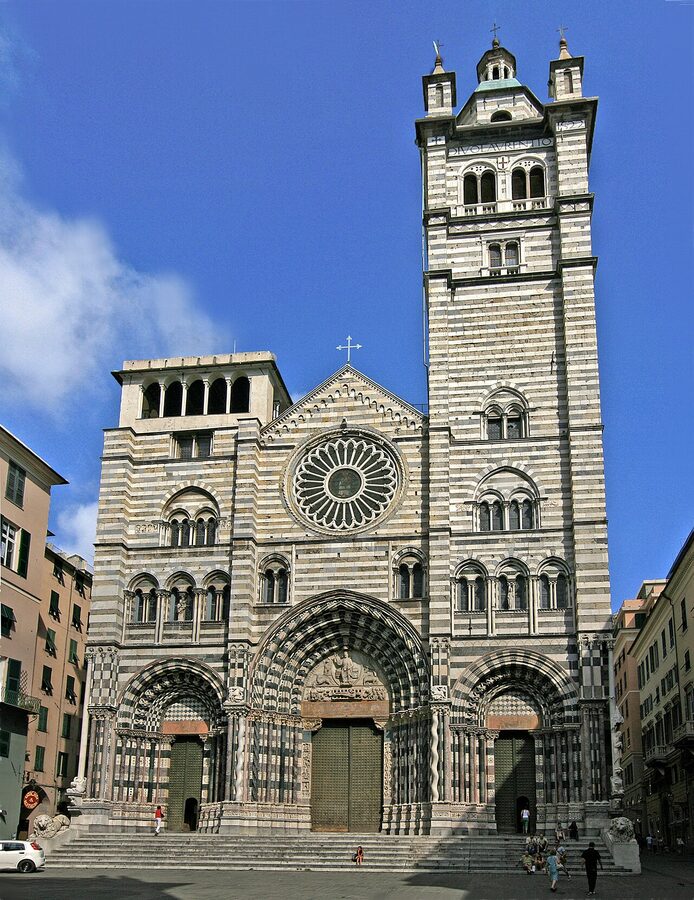
The Cattedrale di San Lorenzo is the city’s main church, consecrated in 1118 over an earlier Early Christian basilica. The striped black and white marble façade is the single most distinctive in Liguria — it’s used in a couple of other regional churches (Santa Maria Assunta in Monterosso, Santa Margherita degli Scalzi in Genoa itself) but the cathedral is the original. Gothic windows, a Romanesque portal with carved lions, and twin bell towers: one finished in 1455, the other never completed (the building simply stops above the eaves).
Three things to see inside: the Cappella di San Giovanni Battista (which contains the ashes of John the Baptist, brought back from the Crusades in 1099 — the reliquary casket is 15th-century silver); the Museo del Tesoro in the crypt, which has the Holy Grail according to one medieval tradition (the Sacro Catino, a green glass bowl supposedly used at the Last Supper, acquired by Genoese Crusaders at Caesarea in 1101 — modern analysis says it’s Roman glass from the 1st century AD, but the lore persists); and the British naval bomb that hit the south aisle in February 1941 and failed to detonate. It’s still there, housed in a glass case, a reminder of how close the cathedral came to joining the fraction of Genoa that the RAF did manage to destroy.
Cathedral entry is free. Treasury €6. Open 8am-noon, 3-7pm; closed Mondays.
Via Garibaldi and the Palazzi dei Rolli
.jpg)
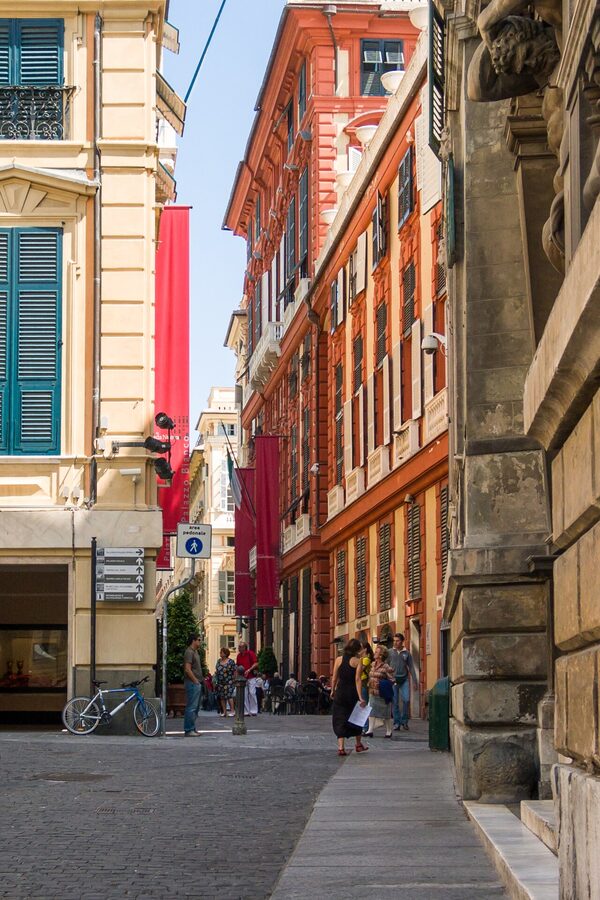
Via Garibaldi is the single most important street in Genoa and the reason the city is on the UNESCO list. A 250-metre stretch of what was, in 1558, newly-laid Strada Nuova — a deliberately planned aristocratic street running east-west in the upper town — lined with forty-two Renaissance and Baroque palaces commissioned by Genoa’s banking dynasties between the 1560s and the 1650s. These are the Palazzi dei Rolli, so called because their owners were placed on a register (rollo) obliging them to host state visitors to the Republic in exchange for tax benefits. Rubens visited several on his 1607 Italian tour and filled a sketchbook; the drawings he made are still in a single surviving volume in the Biblioteca Reale of Turin.
Three palaces are open as museums:
Palazzo Rosso (Via Garibaldi 18) — the most important picture collection in Liguria. Two floors of paintings in gilded rooms: Van Dyck’s full-length portraits of the Brignole-Sale family (the original owners), Dürer’s Portrait of a Young Man, Guido Reni, Guercino, Caravaggio’s Ecce Homo (arrival confirmed in 2021 after restoration). The roof terrace is open and gives the best panoramic view of the caruggi. €9 adults.
Palazzo Bianco (Via Garibaldi 11) — more Flemish and Italian paintings, including Filippino Lippi and Caravaggio’s Ecce Homo‘s possible variant. Combined ticket with Palazzo Rosso €14.
Palazzo Doria-Tursi (Via Garibaldi 9) — the biggest of the three, now part-city-hall, part-museum. Houses Paganini’s Guarneri del Gesù violin (the Cannone Guarnerius of 1743, played publicly once a year by a guest violinist), the original 1745 letters from Christopher Columbus, and the decorative arts collection. Same ticket as the others.
Every few years the city runs the Rolli Days — a weekend when up to forty of the palaces are open to the public for free, with guided tours and concerts in the courtyards. Usually October and May. Worth planning a trip around.
Piazza De Ferrari and the Palazzo Ducale
_in_2021.04.jpg)
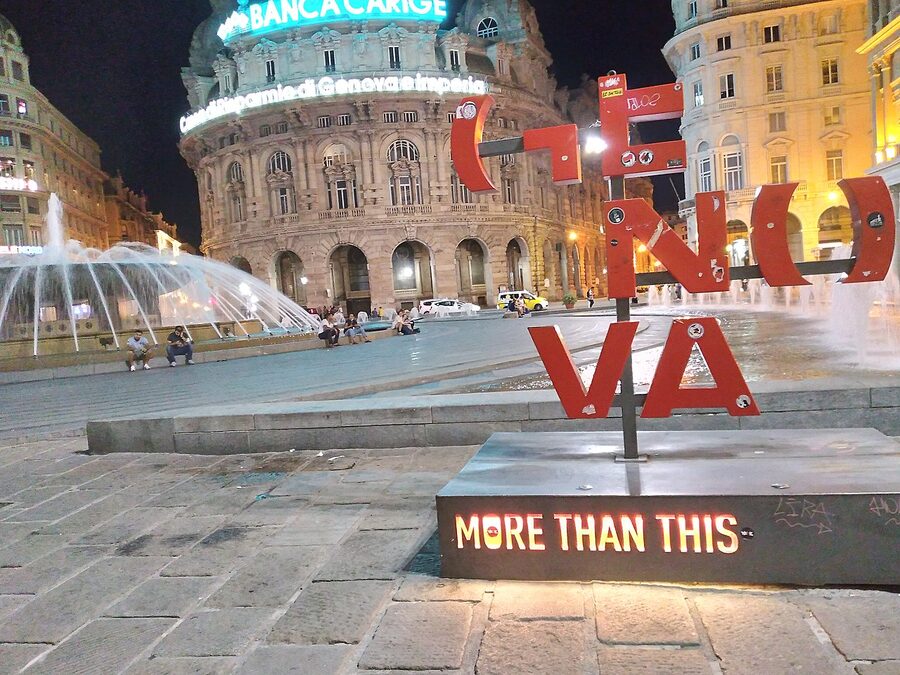
Piazza De Ferrari is the modern heart of Genoa — an oval traffic-free square with a single large bronze fountain in the middle, surrounded by Liberty-era and Fascist-era civic architecture. The Palazzo Ducale takes up the entire southern side. The Teatro Carlo Felice opera house closes the east. Two banks, a deconsecrated Augustinian church, and a post-war Borsa (stock exchange) cover the rest.
The Palazzo Ducale was the seat of the Doges of the Republic from 1339 to 1797. Bombed and partially destroyed in 1777 (fire, not war) and rebuilt in neo-classical style in 1783. After the Republic fell, the building went through various institutional uses — police headquarters, law courts — before becoming Genoa’s main exhibition and cultural centre in 1992. It hosts temporary shows (usually one big summer exhibition plus several smaller ones at the same time), and the courtyard Cortile Maggiore is free to walk through. The small Torre Grimaldina, a medieval prison tower at the back with remaining graffiti from 18th-century prisoners, is occasionally opened for exhibitions.
The Porto Antico and the Aquarium
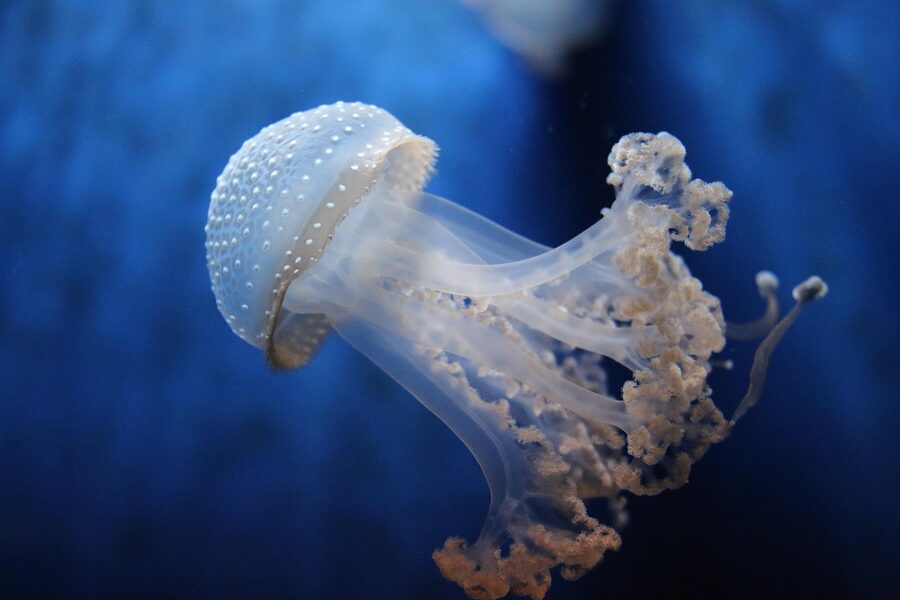
The Porto Antico (Old Port) was abandoned to cargo traffic by the 1970s and redeveloped for the 1992 Columbus quincentennial by Renzo Piano, a Genoese architect who later designed the Centre Pompidou and the Shard. His plan turned the disused quays into a pedestrian and cultural waterfront with the Aquarium as the anchor tenant. It’s the largest aquarium in Europe — 71 exhibits, 12,000 animals, 600 species, open-air penguin enclosure with a distant view of the lighthouse — and genuinely good. €29 adults, €21 children. Buy tickets online; the queue on-site is significant in summer.
Elsewhere in the Porto Antico: the Bigo panoramic lift (Renzo Piano’s spider-crane structure gives you a 40-metre-high view for €5); the Biosfera (a glass bubble of tropical vegetation); the Galata Museo del Mare (a large and excellent maritime museum — Italy’s biggest — with a working submarine, the Nazario Sauro, moored alongside); and the Neptune Galleon (a full-scale replica Spanish galleon built for Roman Polanski’s 1986 film Pirates, moored since and boardable for €6).
A good half-day strategy: start at the Galata Maritime Museum (2 hours), walk along the waterfront to the Aquarium (2 hours), finish with a farinata on Via Sottoripa opposite.
Boccadasse
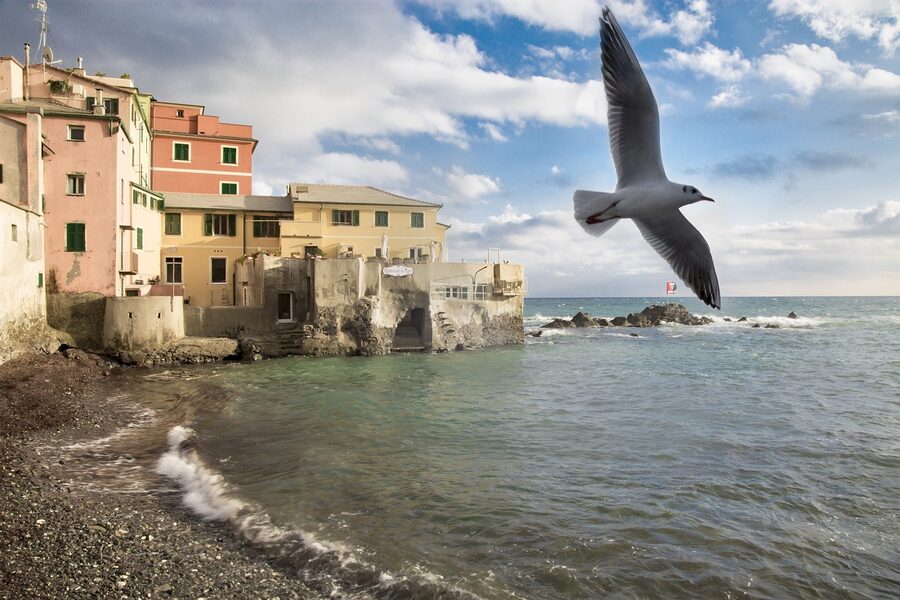
Boccadasse is a small fishing village that has been swallowed by the eastern expansion of Genoa but somehow preserved its character unchanged. A single pebble beach, fifty pastel houses curving around the bay, a handful of fishing boats pulled up on the shore, one church on a rock at the east end, and one of the best gelato bars in Liguria (Antica Gelateria Amedeo, on the seafront, since 1913). Technically it’s just a neighbourhood of the Albaro district; emotionally it’s a separate town.
You can walk to Boccadasse from Piazza De Ferrari in about an hour along the Corso Italia seafront. Bus 31 from Piazza De Ferrari takes 20 minutes. Go at sunset — the sea wall faces due south and catches the last light. Dinner at Osteria di Vico Palla nearby is worth the reservation if you can get one.
The Cimitero di Staglieno
.JPG)
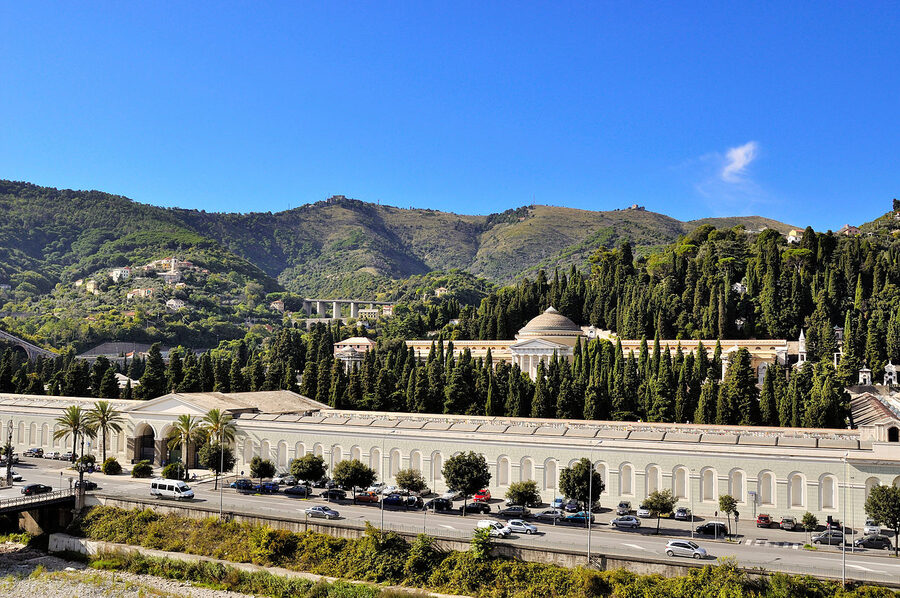
The Cimitero Monumentale di Staglieno, five kilometres north of the centre, is the single strangest and most artistically significant sight in Genoa. Opened in 1851 as a suburban replacement for the overcrowded church graveyards of the old town, it became — across the second half of the 19th century — the preferred resting-place for the city’s bourgeois dynasties, who competed in commissioning ever more elaborate tombs from the local school of sculptors. The resulting complex, spread across 330,000 square metres of hillside, contains several thousand life-size and near-life-size marble figures of the deceased, their families, angels, allegories and classical gods, by sculptors including Giovanni Battista Villa, Santo Varni and Augusto Rivalta. The Victorian taste for sentimental mortuary sculpture had a commercial peak here; the tombs are precise, unflinching, often weirdly intimate.
Giuseppe Mazzini is buried here. So is Constance Lloyd (Oscar Wilde’s wife). So is the singer Fabrizio De André. The Tomba Ribaudo — an Art Nouveau figure that appeared in the cover of a Joy Division album (Closer, 1980) — is perhaps the most-photographed single grave in Europe.
Take bus 34 from Piazza De Ferrari (20 minutes). Entry is free. Open 7.30am-5pm daily. Allow at least two hours. Pick up a map at the gatehouse — the cemetery is enormous and poorly signposted.
Famous Genoese
Cristoforo Colombo — Columbus was born in Genoa in 1451, baptised in the parish of Santo Stefano, son of a wool-weaver named Domenico Colombo. The family house (reconstruction, the original was destroyed in the 18th century) is at Piazza Dante just south of the old town, and a small museum inside documents the voyages. Genoa’s relationship with Columbus is ambivalent — the city took him on as a civic hero in the 19th century for nationalist reasons, and the 1992 quincentennial was the biggest event in recent city history, but the modern view of what the voyages meant to indigenous peoples has tempered the enthusiasm. The statue in Piazza Acquaverde outside Piazza Principe station is unmissable and routinely debated.
Niccolò Paganini — born in 1782 in a house on Via Garibaldi, the most famous virtuoso violinist in history. His 1743 Guarneri del Gesù violin, nicknamed Il Cannone (the Cannon) for its powerful voice, is preserved at Palazzo Tursi and played once a year by a guest virtuoso on the anniversary of his death (27 May). The annual Premio Paganini competition, founded 1954, brings young violinists from around the world to the city every two years.
Giuseppe Mazzini — born 1805, founder of Giovine Italia (Young Italy) and one of the three architects (with Garibaldi and Cavour) of Italian unification. His birthplace on Via Lomellini is now the small Museo del Risorgimento; his mother’s rooms are preserved more or less as they were.
Andrea Doria — 16th-century admiral and de facto ruler of Genoa for three decades, who turned the declining republic into a financial power in alliance with Spain. The Doria family palaces at Piazza San Matteo and Piazza del Principe are still owned by descendants; the one at Piazza del Principe is an occasional museum.
Renzo Piano — born 1937, still active. The redevelopment of the Porto Antico, the new Ponte San Giorgio, and the quiet contemporary additions around the old town are all his.
Eating and drinking in Genoa
Genoese cuisine is one of the most distinctive in Italy — I covered the region-wide dishes (pesto, focaccia, farinata, cappon magro, anchovies) in the Liguria hub. Here are four specifically Genoese places to eat them:
Sa Pesta (Via dei Giustiniani 16) — a sciamadda (farinata bakery) that has been doing the same thing since 1828. Farinata cooked in a wood-fired oven on a copper tray, cut in squares, eaten standing or at a tiny wooden counter. €3 a wedge, plus cold pasta salads and torta pasqualina by the slice. No reservations, no seats for more than about eight people. Lunch only.
Trattoria Vegia Zena (Vico del Serriglio 15) — tucked deep in the caruggi, the place I’d go for a proper sit-down Genoese dinner. Hand-made trofie al pesto, stuffed anchovies, cappon magro on request. €40 per head with house wine.
Antica Osteria della Castagna (Via Romana della Castagna 20r) — my favourite for a more local, slightly out-of-centre dinner, in the hillside neighbourhood of Albaro. The minestrone alla genovese here, enriched with the last spoonful of pesto stirred in off the heat, is the single best version I’ve had.
Klainguti (Piazza Soziglia 98-100) — a 200-year-old Austrian pastry shop (the founders were Grisons-Swiss bakers who came to Genoa in 1828) with the city’s best sacher torte and a chocolate-filled puff called a Falstaff. Verdi, apparently, was a regular. Open from breakfast.
For a drink: the old-school aperitivo bar on Piazza Matteotti across from the Palazzo Ducale is Cambusa, where the vermouth is local (Martini, Cinzano — both from Turin, but the Genoese drink them hardest). For late-night natural wine: Les Rouges in Vico della Casana, a tiny room with a well-curated cellar.
Where to stay, and for how long
The two practical neighbourhoods for tourism are the historic centre (in or right by the caruggi, immersive but the streets are dark at night) and the area around Brignole station (safer feeling, a short walk from Piazza De Ferrari, mostly 19th-century apartment blocks). Good mid-range hotels: NH Collection Marina (right on the Porto Antico quay, from €160), Hotel Bristol Palace (a Liberty-era grand hotel on Via XX Settembre, from €140), Hotel Cairoli (a small and well-run family hotel a block from the cathedral, from €110). For luxury, Grand Hotel Savoia opposite Principe station has been the city’s top address since 1897.
Two nights is the minimum for the city itself. Three is comfortable and lets you add Boccadasse, Staglieno and either a day trip to the Cinque Terre or an afternoon at the Abbey of San Fruttuoso (boat from the Porto Antico in summer). Four nights if you want to add Portofino.
When to come
Genoa is warm but not stifling in summer (25-30°C typical), and the port keeps the humidity down. The city crowds peak during the Salone Nautico (boat show, late September), a huge event that occupies the Marina and most of the hotels. Outside of that, you can find a room any week of the year.
My preferred window is May-June or September-October. The light is good, the evenings long, the aperitivo culture at its best. Winter is quieter and has its own appeal — the city’s Liberty-era streets look excellent in fog, and the wine-bar scene is active. January-February is the off-peak.
Plan around: the Salone Nautico if you like boats (late September); the Rolli Days for the palaces (May and October, dates vary); the Paganini Violin Competition in April (even-numbered years); the Euroflora flower exhibition (every five years, next one 2027); the Notte Bianca (White Night) in early October, when the old town stays open all night.
Is Genoa worth a full visit?
If you only have a week in Italy, probably no — Florence and Venice will give you more famous sights and more polished experiences per day. If you have ten days, yes — for the contrast with everywhere else, for the UNESCO Rolli palaces that virtually no one outside Italy knows about, and for the food. If you have two weeks, absolutely — pair it with the Cinque Terre to the east and a day or two on the Portofino headland.
The surrounding region has its own guides — start with Liguria, the Cinque Terre and Sanremo when those go live — but Genoa itself is the anchor. The city that gets no love is, once you look at it properly, the most rewarding city in Italy for a particular kind of traveller: the one who likes layered texture, working cities, and food made by people who have been making it continuously for centuries. That’s the pitch. It’s better than the pitch sounds.