
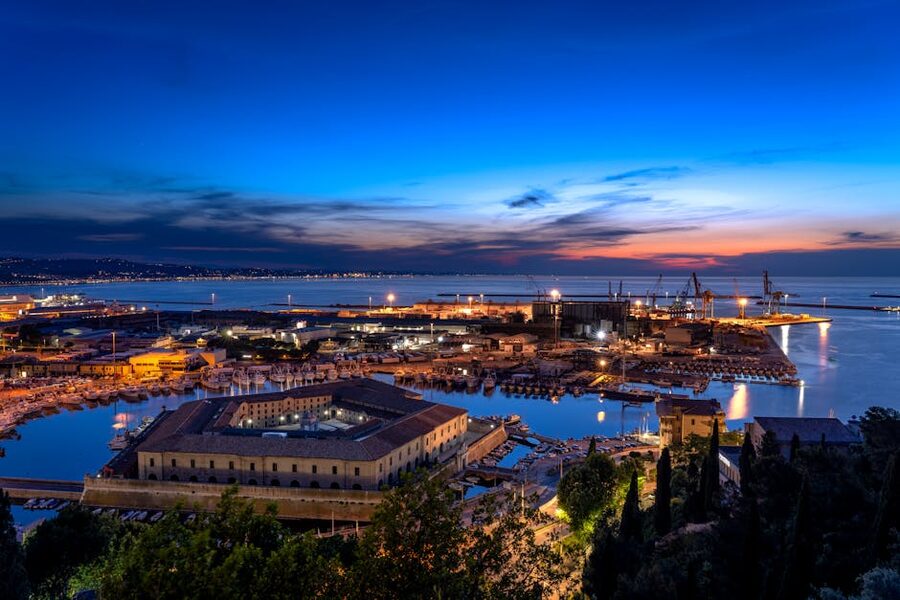
Ancona is the city that every ferry passenger sees from the car deck and almost nobody gets off the ship to visit. It has a Roman triumphal arch on the water, a Romanesque cathedral on a headland, and the best anchovies on the Adriatic. It was heavily bombed in 1943, hit by a major earthquake in 1972, and has spent the seventy years since getting itself back together. It’s still here, and the parts that survived are very good indeed.
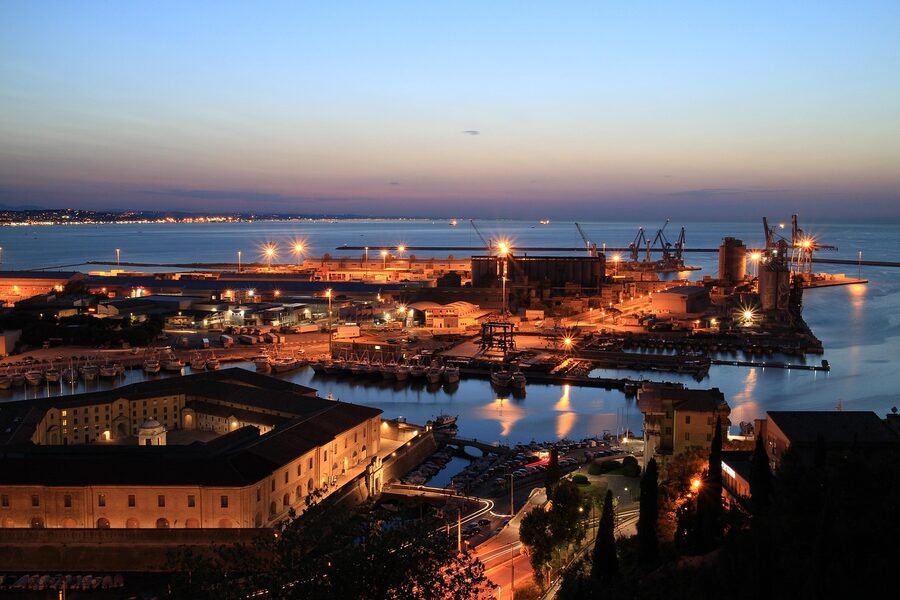
This is not Urbino. Ancona is a working port — one hundred thousand people, Italy’s biggest Adriatic ferry hub, container cranes and fishing boats and day-trippers to Greece all sharing the same water. Parts of the centre are industrial, parts were rebuilt in a hurry, and there are stretches you cross quickly on the way to somewhere better. But the medieval and classical core, once you find it, is one of the quiet surprises of central Italy. I like the place more than the guidebooks do.
In This Article
- What Ancona actually is
- Getting there
- The Arch of Trajan
- The Cathedral of San Ciriaco
- Santa Maria della Piazza and the medieval heart
- The Loggia dei Mercanti
- The Mole Vanvitelliana
- The Passetto
- The museums
- The port and the ferries
- Food and wine in Ancona
- When to come, and for how long
- Is Ancona worth a stop?
What Ancona actually is
The city was founded around 387 BC by Greek exiles from Syracuse, fleeing the tyrant Dionysius the Elder. They called it Ánkōn — the elbow — because the coastline bends sharply at this point and the natural harbour tucks inside the curve. It’s the only major natural harbour on the long, mostly straight Italian Adriatic coast, which is why the Greeks came, why the Romans extended the docks, why the Papal State fortified it, and why container ships still dock here today.
Population is around 100,000. It’s the capital of The Marche region, seat of the regional government, a university town, and the main passenger port for ferries to Croatia (Split, Zadar), Greece (Patras, Igoumenitsa), Albania (Durrës) and, in summer, Montenegro. The ferry-truck traffic is routed around the old town via the Asse Nord-Sud, a cut-and-cover expressway that gets you in and out without clogging the historic streets.
History, briefly: Greek settlement, then Roman (Trajan built the modern harbour), then a duchy nominally loyal to the Byzantine empire, then an independent maritime republic in the 11th-15th centuries (one of the five — Venice, Genoa, Pisa, Amalfi, Ancona), then absorbed into the Papal States in 1532 when Pope Clement VII’s troops marched in, then Napoleonic, then unified Italy from 1860. The two defining modern events are the British/American bombing raids of 1943-44 (the old town lost about 40% of its building stock) and the earthquake of 14 June 1972 (long, sliding, damaged what the bombs had missed). What you see today is a mix of careful restoration and fast post-war rebuilding.
Getting there
Ancona is on the Bologna-Lecce railway line, which runs the full length of the Adriatic coast. Frecciargento and Frecciarossa trains from Milan take 3 hours 40; from Bologna about 1 hour 30; from Rome via Falconara about 3 hours (change at Falconara). The main station is Ancona Centrale, about 2 km from the historic centre — there’s a local train shuttle to Ancona Marittima (the ferry port) or take a taxi for about €10.
Ancona-Falconara Airport (AOI) is 12 km west of the city with limited year-round domestic service and seasonal European charters (mostly UK, Germany, Romania, Albania). For international arrivals, Bologna or Rome Fiumicino are the practical airports.
If you’re driving, the A14 Bologna-Taranto motorway exits directly at Ancona Nord or Ancona Sud. Parking in the old town is genuinely scarce; use the Parcheggio Traiano on Via Gramsci or the underground Parcheggio degli Archi near the station. Expect €1.50-2 per hour.
The Arch of Trajan
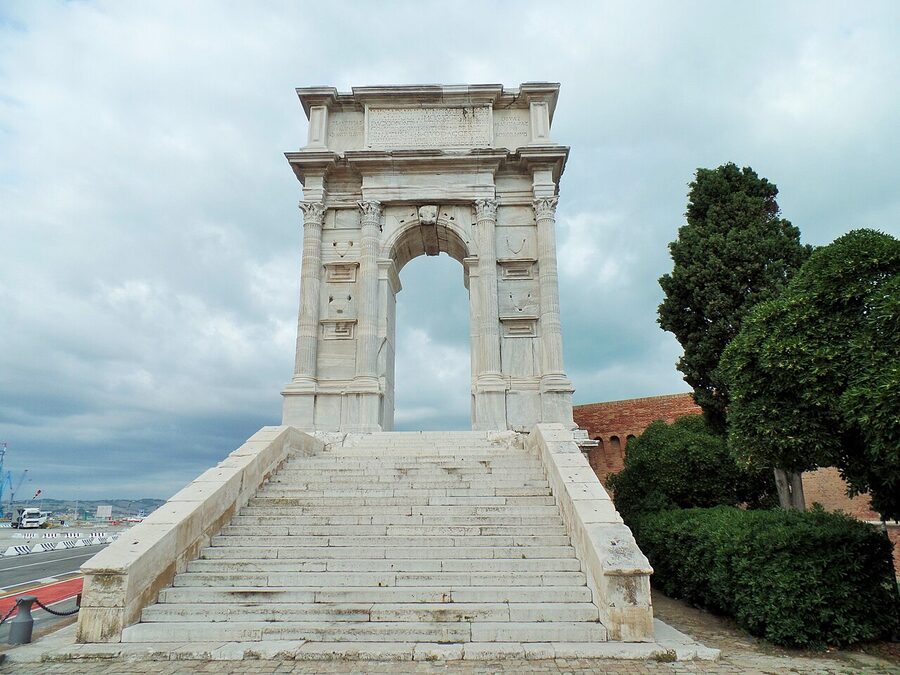

The Arco di Traiano is the city’s best-preserved piece of antiquity and the reason to start any visit on the waterfront. Built in AD 115 by Apollodorus of Damascus — the same architect who designed Trajan’s Column and Forum in Rome — it commemorates the emperor’s reconstruction of the harbour. At the time, Trajan needed Ancona as the fleet’s staging port for the Dacian and Parthian wars, and the city received the full imperial treatment: a new mole, a naval base, and this single-span arch in Greek Pentelic marble placed directly on the quayside. The inscription was dedicated by the Senate and the Roman people to Trajan, his wife Plotina, and his sister Marciana. Statues of all three originally topped the arch; they were stripped in the late Middle Ages and melted down.
What you see now is the arch itself — 18 metres high, 8 metres wide, a single opening with a reeded entablature and intact Corinthian pilasters — and a view across the harbour past the modern docks toward the cathedral. A second, smaller arch stands next to it, the Arco Clementino, built in 1738 by Pope Clement XII when the port was extended again. The juxtaposition is instructive: sixteen centuries between the two, same role, same location.
The arch sits in an open pedestrianised zone on Lungomare Vanvitelli. No entry fee, always accessible. Come at sunset — the marble goes golden, the cranes turn into silhouettes, and the cruise ships leaving for Croatia pass just behind.
The Cathedral of San Ciriaco
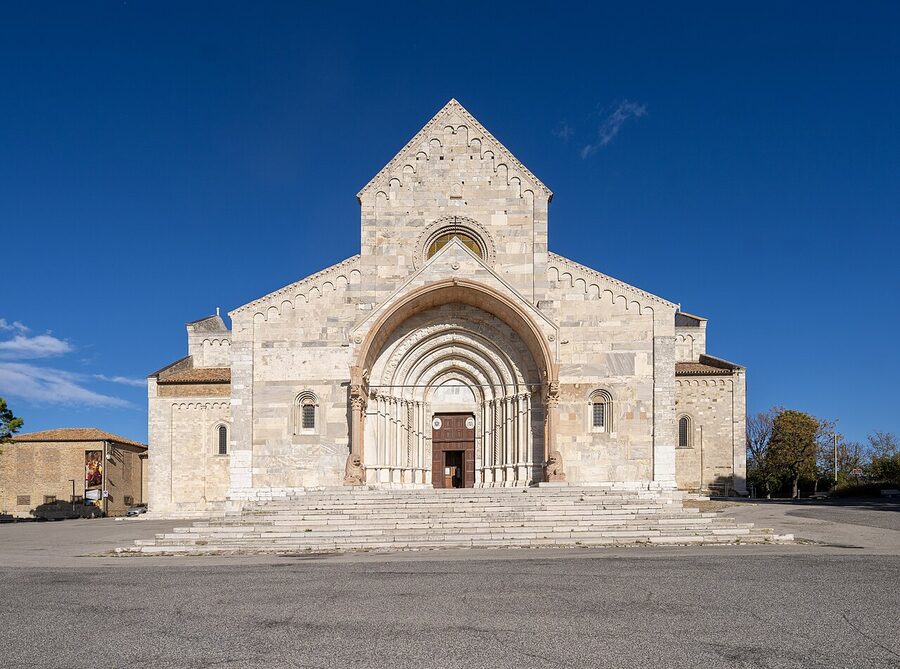

The Cattedrale di San Ciriaco sits on Colle Guasco, the northernmost of Ancona’s four hills, directly above the old port. The site has a continuous religious history going back to a Greek temple of Aphrodite, replaced by a 6th-century early Christian basilica, replaced by the present Romanesque cathedral which was consecrated in 1189. The architect is thought to have been Margheritone d’Arezzo. The plan is a Greek cross with a dome over the crossing — one of the first in Italy, predating Brunelleschi by 250 years — which makes the interior wider and brighter than you expect from the outside.
Don’t skip: the Romanesque portal (two pink-marble columns on stone lions, 13th century); the crypt (with 3rd-century Christian sarcophagi and the relics of Saint Ciriaco, patron of the city); and the apse windows, which frame the view straight down to the harbour. Entry is free. Open 8am-noon, 3pm-6pm. Walk up via the long flight of steps on Via Giovanni XXIII, or drive around the hill and park at the top.
There’s one small but excellent museum attached: the Museo Diocesano, which has carved Early Christian ambos, a 14th-century silver reliquary of San Ciriaco, and fragments of the earlier basilica. €5, worth thirty minutes.
Santa Maria della Piazza and the medieval heart
.jpg)
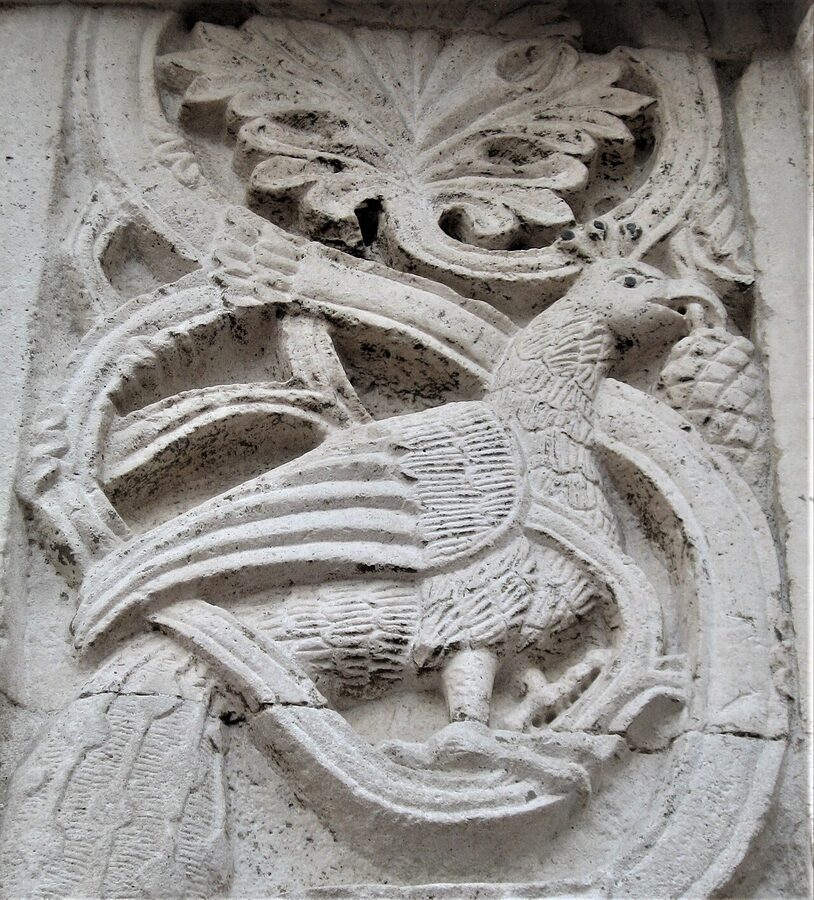
Five minutes’ walk below the cathedral, down the slope toward the port, is Santa Maria della Piazza — a small Romanesque church on the site of two earlier Early Christian buildings (the 6th and 7th centuries), whose mosaic floors have been excavated and are visible through a glass floor panel inside. The 1210 façade by Master Filippo is the main reason to stop: five rows of blind arcading, each with small carved figures (biblical scenes, signs of the zodiac, animals), and a central portal with two standing lions. It’s one of the most complete Romanesque façades in the region.
The surrounding streets — Vicolo della Loggia, Piazza della Repubblica, Corso Mazzini — are the most coherent piece of medieval Ancona, small-scaled, tight-knit, largely rebuilt but on the old street plan. This is where to walk in the early evening for the passeggiata — the pre-dinner stroll — and where most of the old-school bars and cafés still are.
The Loggia dei Mercanti
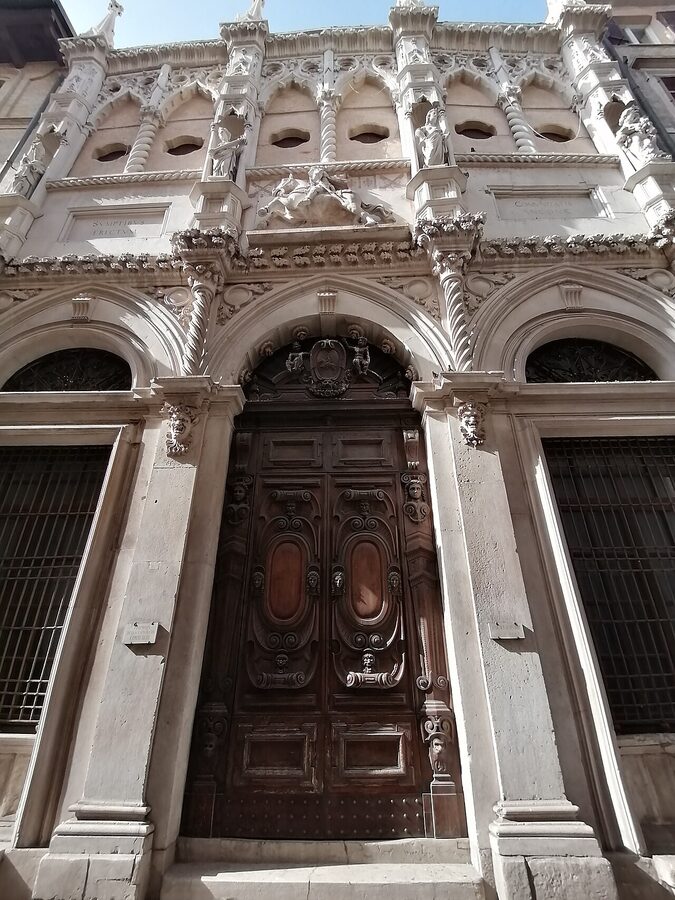
_03.jpg)
On Via della Loggia, two minutes from Santa Maria, is the Loggia dei Mercanti — the merchants’ loggia, an open exchange where 15th-century Anconetan traders met to do business. The façade is a single surviving work by Giorgio da Sebenico (Juraj Dalmatinac) from 1459 — four Venetian Gothic arches alternating with four carved knights in niches, topped with a frieze of virtues. The interior was frescoed by Pellegrino Tibaldi in the 16th century and restored after war damage. It’s usually open to walk through as part of the Chamber of Commerce building, or during temporary exhibitions.
The Mole Vanvitelliana
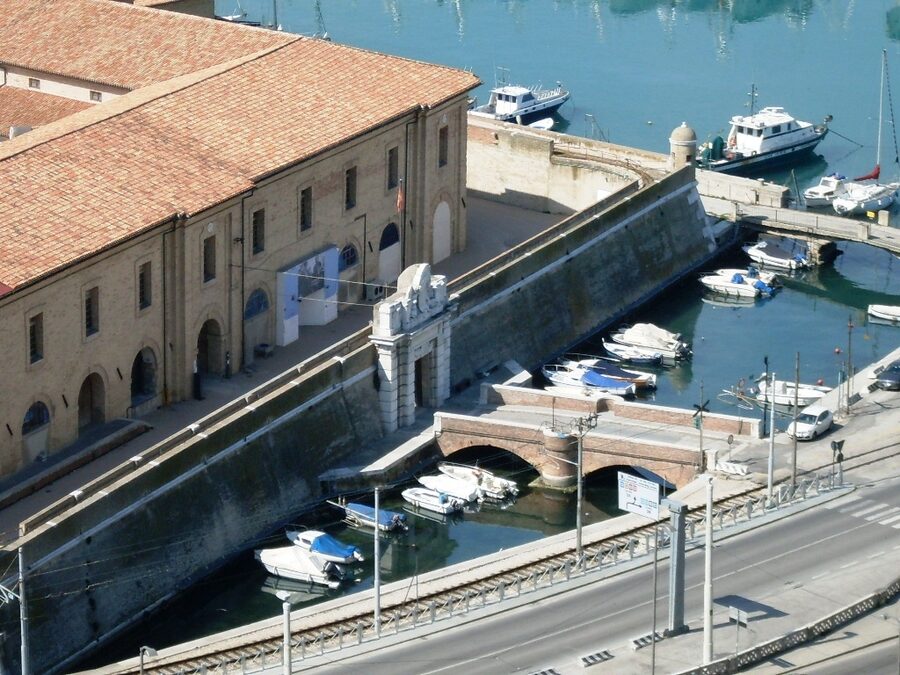

A short walk south along the quay, stranded on its own artificial island and connected to land by a narrow causeway, is the Mole Vanvitelliana, also called the Lazzaretto. Luigi Vanvitelli (the same Neapolitan architect who designed the Royal Palace at Caserta) built it between 1733 and 1743 as a pentagonal quarantine station, where goods arriving from plague-affected ports could be fumigated and held for the statutory forty-day wait. The form — five bastions, a central courtyard, a small temple at the heart — is pure Vauban-era defensive military engineering repurposed for public health.
Today the building is a cultural centre. The Museo della Città is inside, along with an exhibition space that hosts travelling shows. In summer, there’s a bar and open-air cinema in the central courtyard. The causeway walk across is free; museum entry is €6. It’s worth a visit for the architecture alone, and the view of the old city across the water.
The Passetto
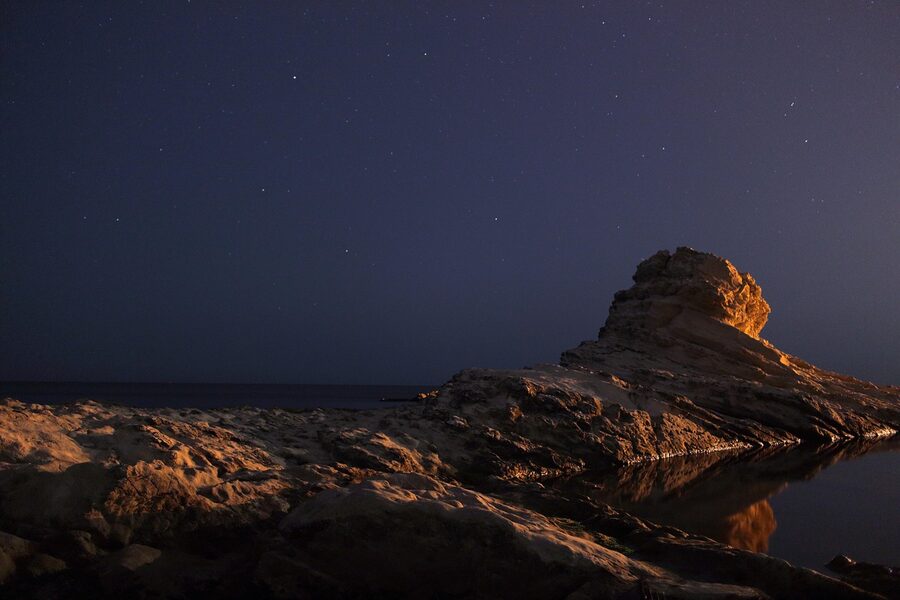
At the eastern edge of the city, where the land runs out and the Adriatic begins properly, is the Passetto — a cliff-edge neighbourhood built around a monument to the Anconetan fallen of the First World War. The monument itself is an unusually beautiful circular colonnade in pale local stone, designed by Guido Cirilli in 1930. From the piazzale in front of it you can see along the whole east coast of the city, the Adriatic all the way to Monte Conero on clear days, and — if you stay past sunset — the lights of the ferry traffic pulling out for Greece.
The best bit is what’s below. A long staircase of 270 steps (there is also a lift now, €0.50, for the less ambitious) drops down the cliff face to the Spiaggia del Passetto, a small pebble beach at sea level. Cut into the cliff, on both sides of the beach, are dozens of grotte — small rock caverns used since the 19th century by Anconetan fishermen as boat shelters. Most are still active, colour-coded in faded paintwork, with tackle and lines hanging in the shade. A handful have been converted into beach bars. It’s the working-class equivalent of the Amalfi Coast and completely free, which is a better combination than it sounds.
The museums
Pinacoteca Civica Francesco Podesti (Palazzo Bosdari, Via Pizzecolli 17). The city’s main picture gallery, in a 16th-century palace. The two standout works: Titian’s Apparition of the Virgin to Saint Zachary (1520), a large altarpiece painted for a church in Ancona and now the centrepiece of the collection; and Carlo Crivelli’s Madonna of the Candle. There’s also a good Lorenzo Lotto (Sacred Conversation, 1546 — Lotto spent his last years in Loreto and died not far from Ancona) and two paintings by the local 19th-century master Francesco Podesti after whom the gallery is named. €5, open Tue-Sun.
Museo Archeologico Nazionale delle Marche (Palazzo Ferretti, Via Ferretti 6). The regional archaeological museum, specialising in the Piceni — the pre-Roman Italic tribe who gave the region its name. The collection is better than most people expect: bronze-age burial goods, the famous Dischi-corazze (disc-shaped cuirasses, unique to the Piceni), Greek trade pottery from the Ancona harbour excavations, and a full Hellenistic tomb reconstructed in one room. €8, open Tue-Sun. Allow 90 minutes.
The port and the ferries
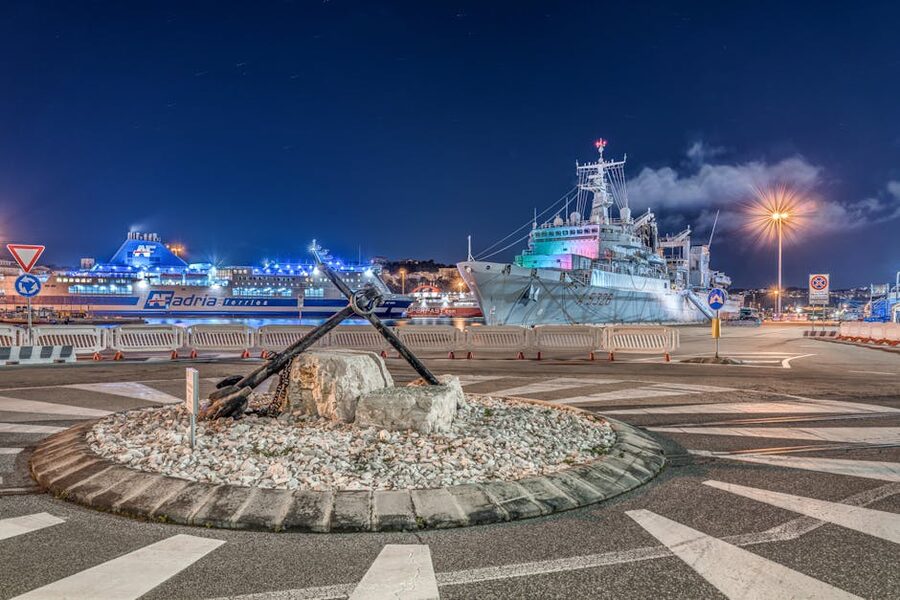
Even if you’re not sailing anywhere, the working port is worth an hour. The best vantage is the pedestrian bridge at Porta Pia which crosses the dock road and gives you a clear line of sight along the commercial quays. From there you can see the overnight ferries — ANEK, Superfast, Minoan — loading for Patras and Igoumenitsa; the smaller Jadrolinija and Liberty Lines boats for the Croatian coast; and the truck traffic that Ancona has been handling for the past 2,400 years in one form or another.
If you are sailing: arrive 2 hours before departure, go to the Stazione Marittima (the passenger terminal) first for the boarding card, then drive to the pier. Cabins book out by May for the summer season. Foot passengers are fine walking on at the gate. Fare for Patras: €70-130 per adult plus €150-250 per car for a 20-hour overnight crossing.
Food and wine in Ancona
Anconetan cuisine is Adriatic fishing cuisine with a small Roman inheritance. Three things to eat and one to drink:
Brodetto all’anconitana — the local fish stew, in a tomato-and-vinegar broth with thirteen kinds of fish. The classic thirteen include mazzancolle (red prawns), moscioli (wild mussels — see below), sogliola (sole), scorfano (scorpion fish), gallinella (gurnard), seppia (cuttlefish), and rana pescatrice (monkfish). Eaten with grilled bread, no pasta. Restaurant portion for two: €40-60. Half-price and excellent: Osteria del Pozzo on Via Bonda, or La Moretta on Piazza Plebiscito.
Stoccafisso all’anconitana — dried cod, rehydrated, baked slowly with tomatoes, potatoes, olive oil, carrots, anchovies, olives and a splash of white wine. The odd thing about stoccafisso all’anconitana is that the Marchigiani eat more of it per head than anyone else in Italy — a landlocked tradition in a coastal city, imported from Norway by Venetian ships and absorbed into the local repertoire by the 16th century. The annual Sagra dello Stoccafisso at Portonovo in early September is the best time to try eight or nine versions in a single afternoon.
Moscioli — the wild mussels that grow on the rocks of the Conero headland, just south of the city. Slow Food presidium, smaller and sweeter than farmed mussels, mainly eaten steamed with lemon or in spaghetti al sugo di moscioli. Season: May to October. The best place to eat them is Portonovo, a 15-minute drive from the city.
Rosso Conero DOC — the local red wine, 85-100% Montepulciano grapes grown on the limestone slopes around Mt Conero. Dark, structured, spicy, built for fish stews and grilled meat. Top producers: Garofoli, Umani Ronchi, Moroder, Le Terrazze. €12-30 per bottle. Look for the Riserva versions — they age well for 8-10 years and get a smoky black-cherry thing going that is very pleasant indeed.
When to come, and for how long
Ancona works year-round. Summer is hot (28-32°C) and the port is busiest with ferry passengers; the beaches at Passetto and Portonovo are the places to be in the afternoon. Spring (April-June) and autumn (September-October) are ideal — everything is open, temperatures are 18-24°C, and the city is at ease. Winter is quiet, the port is still running but on reduced schedules, and the cathedral looks its best against grey sky.
Worth planning around: the Festa del Mare (last Sunday of August), a procession of boats from the port out to sea with the archbishop’s blessing of the fleet; and the Ancona Jazz Festival in July, with concerts in Piazza del Plebiscito and at the Mole Vanvitelliana.
A day and a half is enough to cover the city itself. Two days lets you add Portonovo and an afternoon at the Passetto beach. Three days turns Ancona into a proper base for the northern Marche — half a day inland to Urbino, the rest to the Conero coast, and an evening dinner back in the old city. Most people under-allocate it; don’t.
Is Ancona worth a stop?
If you’re catching a ferry to Greece or Croatia, you have to be in Ancona anyway — spend the afternoon at the arch and the cathedral rather than in the terminal bar. If you’re touring the Marche, skipping Ancona is a small mistake that’s easy to make; two nights here gives you the proper regional capital experience plus access to the Conero headland that most itineraries treat as a day trip from Urbino. If you’re on a broad Italian swing, it’s a harder sell — the city doesn’t have a single overwhelming monument to rival Florence or Rome — but for anyone interested in the long, layered continuity of Adriatic urban life, it’s a rewarding stop.
For broader context see the Marche hub, and the guide to Urbino, the other major city in the region.