
Urbino is a town of fourteen thousand people on a pair of hills in the central Marche. It has a university, a small theatre, a modest cathedral, a good Saturday market, and one of the dozen most important art galleries in Italy. It was, for half a century in the late 1400s, the most brilliant princely court anywhere in Europe. It is now so quietly provincial that the bus back to Pesaro sometimes forgets to come. Both things are true.
What happened is that a mercenary soldier named Federico da Montefeltro — born illegitimate, trained as a condottiere, scholar of Greek and Latin, one-eyed (he lost the right one in a tournament, and his portraitist Piero della Francesca took pains to paint him only from the left) — decided in 1444 that he would turn his small hereditary holding into something serious. For the next thirty-eight years he hired the best architects in Italy, assembled one of the great private libraries of the Renaissance, and employed painters who now fill the Uffizi. When he died in 1482 his son was twelve. His son died young. The Montefeltro line ended. Urbino kept the palace. Raphael was born a year after the duke’s death, in a sandstone house three minutes’ walk from the front door.
In This Article
What Urbino actually is
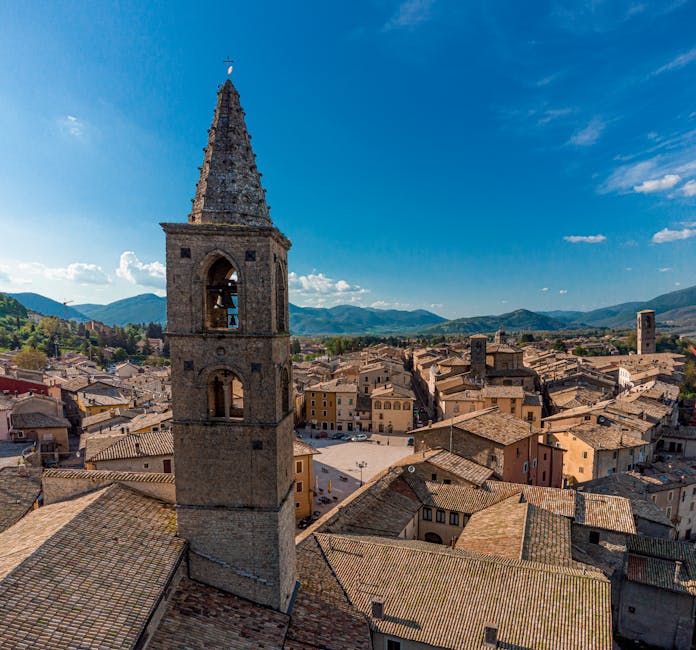
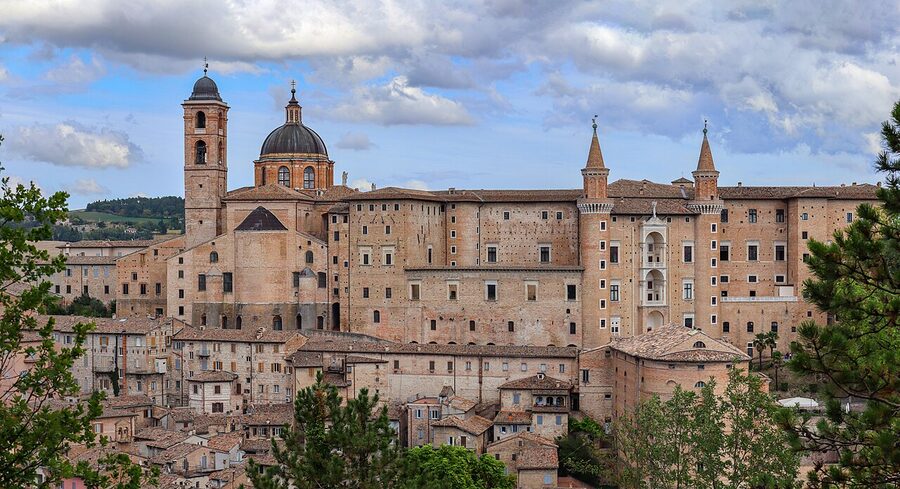
The town sits between the Metauro river and the Apsa, roughly 36 kilometres inland from the Adriatic and 500 metres above sea level. The historic centre is walled — you can walk around the outside of the walls in about an hour — and the street layout has been more or less unchanged since the 15th century. Inside the walls, the skyline is dominated by the two slender towers of the Palazzo Ducale; outside them, the Fortezza Albornoz sits on a second hill, built by a cardinal in 1367 as the local enforcement arm of the Papal States.
UNESCO inscribed Urbino as a World Heritage Site in 1998, under the name Historic Centre of Urbino, for criteria (ii) and (iv) — the exceptional testimony to 15th-century Italian Renaissance humanism. In practice this means the walled town is preserved more or less intact, no new building inside the walls is permitted without painstaking review, and the palace that Federico built still looks today very close to how it looked when Baldassare Castiglione set his Book of the Courtier in it in 1507.
There are four anchoring reasons to visit: the Palazzo Ducale, the Galleria Nazionale delle Marche inside it, Raphael’s birthplace, and the town itself. I’ll take each in turn.
Getting there
Urbino has no train station. The nearest is Pesaro on the Adriatic coast, 36 kilometres away on the Bologna-Lecce mainline (regular services from Bologna, Milan and Rome). From Pesaro station, Adriabus line 46 runs to Urbino roughly hourly in the daytime, takes about 55 minutes, costs €3.50 one-way. Buy tickets at the station newsagent before boarding; drivers can sell you one but the queue holds everyone up.
If you’re driving from the north or south, exit the A14 motorway at Pesaro-Urbino and follow the SS423 inland. There’s no parking inside the walls; use Parcheggio Santa Lucia or Parcheggio Mercatale below the town and take the escalator (yes, escalator) up through the hillside to Piazza del Rinascimento. Parking is €1.50 per hour, escalators are free and run 6am-midnight.
From further afield: Bologna airport is the practical arrival point (190 km, 2.5 hours by car, or train to Pesaro then bus). Ancona-Falconara is closer (80 km) but has less international traffic.
The Palazzo Ducale
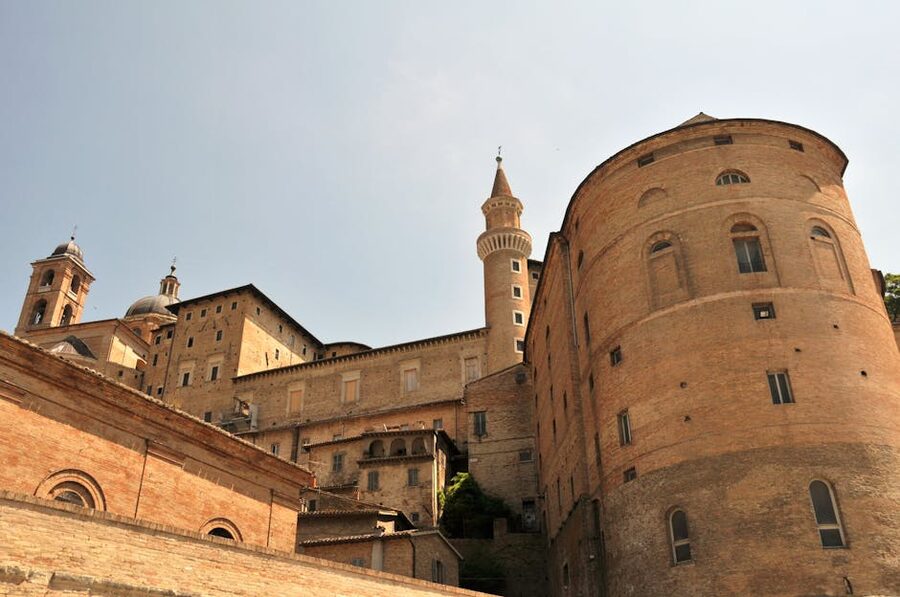
Federico began the palace around 1454 on the site of an older Montefeltro residence. The first architect was a Florentine, Maso di Bartolomeo. The second, more consequentially, was Luciano Laurana from Dalmatia, who gave the palace its distinctive west façade with the three stacked loggias and the two slender towers, and who designed the Cortile d’Onore — the inner courtyard that is the palace’s single best room. Laurana left Urbino in 1472, replaced by the Sienese Francesco di Giorgio Martini, who designed most of the palace’s engineering — staircases, stables, and the hydraulic system that brought water up the hill. A working model of Martini’s water mechanism is in the Museo della Città, and it still runs.
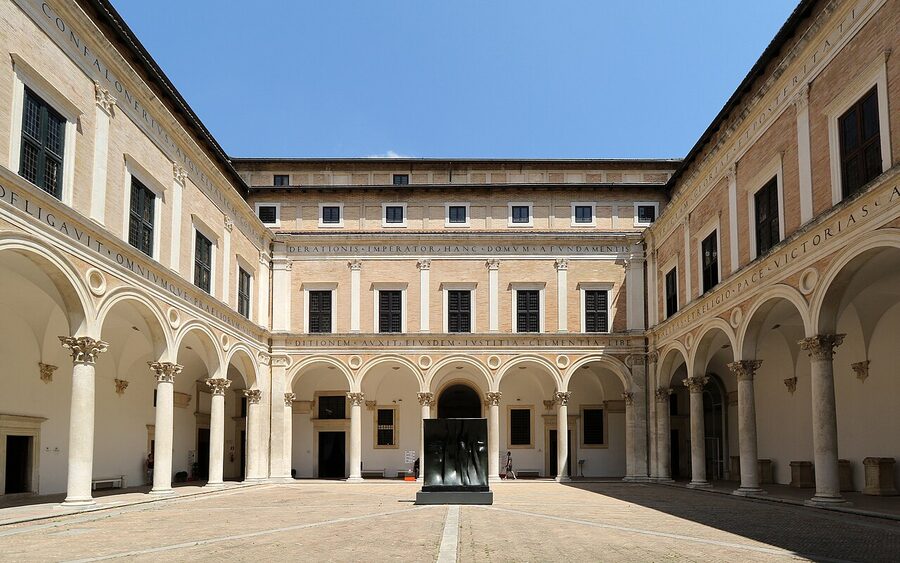

Inside, the palace contains roughly 250 rooms across four floors. The public tour takes in about forty of them — ducal apartments, reception rooms, the chapel, the library (emptied in 1657 when the collection went to the Vatican, but the room is still there), the kitchens, the underground stables, and the Galleria Nazionale delle Marche on the main piano nobile. Entry €8 regular, €10 combined with the Casa Raffaello. Open Tue-Sun, 8.30am-7.15pm. Closed Mondays. Allow at least three hours. Four is better.
The Studiolo
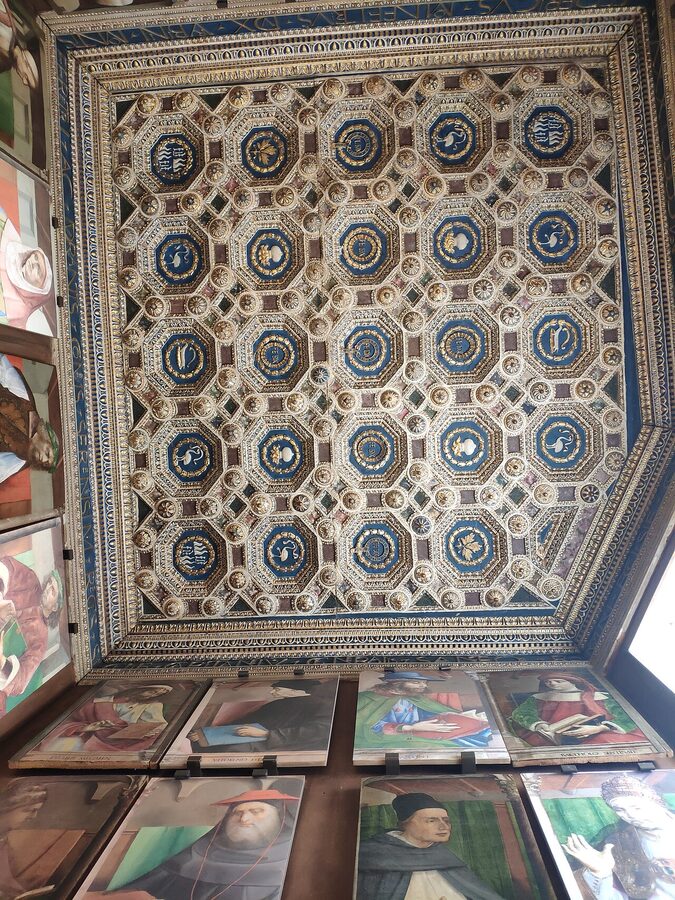

If the Cortile d’Onore is Laurana’s single best room, the Studiolo is Federico’s. It’s a small private study, 3.6 metres square, with walls inlaid in marquetry so detailed and so deliberately illusionistic that four hundred and fifty years later it still reads as trompe-l’œil rather than woodwork. The workshop was run by Baccio Pontelli on designs by Francesco di Giorgio and, some art historians think, Botticelli. Every panel has a meaning — a book, an astrolabe, an armillary sphere, a lute with one string broken, Federico’s personal emblem, a niche with his armour. Above the wood, a band of twenty-eight portraits depicts the duke’s intellectual ancestors — poets, philosophers, Church fathers and humanist scholars. Fourteen of them are now in the Louvre (Napoleonic confiscation, never returned); fourteen remain. You can still see the rectangular outlines of the missing fourteen in the frieze.
Inside: Galleria Nazionale delle Marche
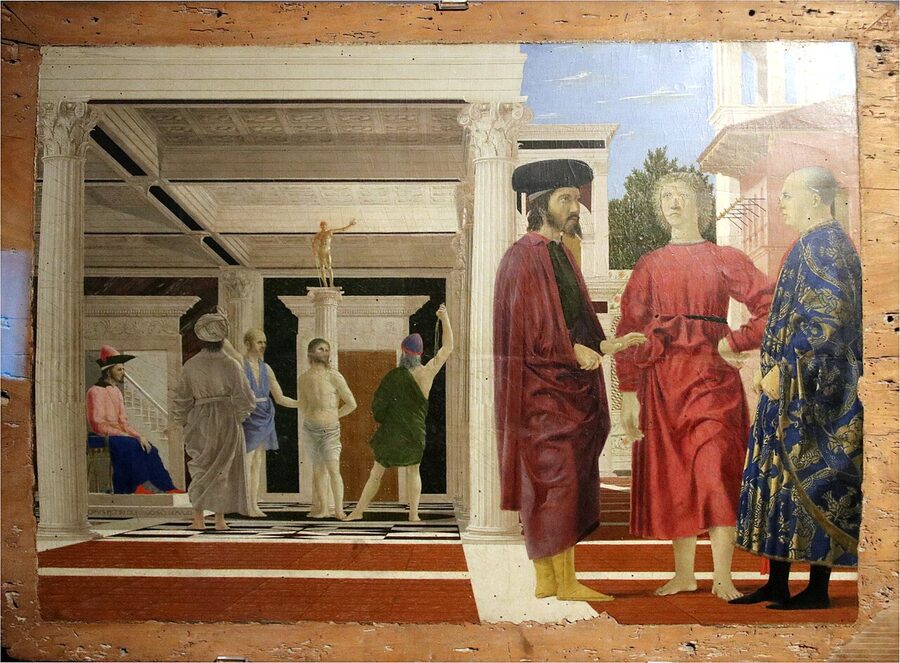
The art collection inside the Palazzo Ducale is the single best reason to visit Urbino. Half a dozen paintings in it would be career-defining anywhere else; here they’re in rooms on a single floor, and you could see them all in an afternoon.
Piero della Francesca’s Flagellation of Christ is the most famous and the most cryptic. Painted for Urbino around 1468, it’s 58 cm by 81 cm — small, for a panel that attracts the weight of commentary it does. Christ is scourged in a classical portico in the background; three apparently unconcerned men stand in the foreground looking past the viewer. Every generation of art historians has proposed a different identification for the three — Jewish elders, Ottoman ambassadors, mourners for Federico’s illegitimate son, Platonic philosophers. Pick your theory. The painting has the surface of a tempera miniature and the structural rigour of a geometry lesson, which is characteristic Piero.
Also Piero: the Madonna of Senigallia, on a neighbouring wall. Simpler composition (Madonna with child, two angels, a window with sky behind) but lit with a light that had never been painted in Italy before him — you can see the dust in the air behind the angels.
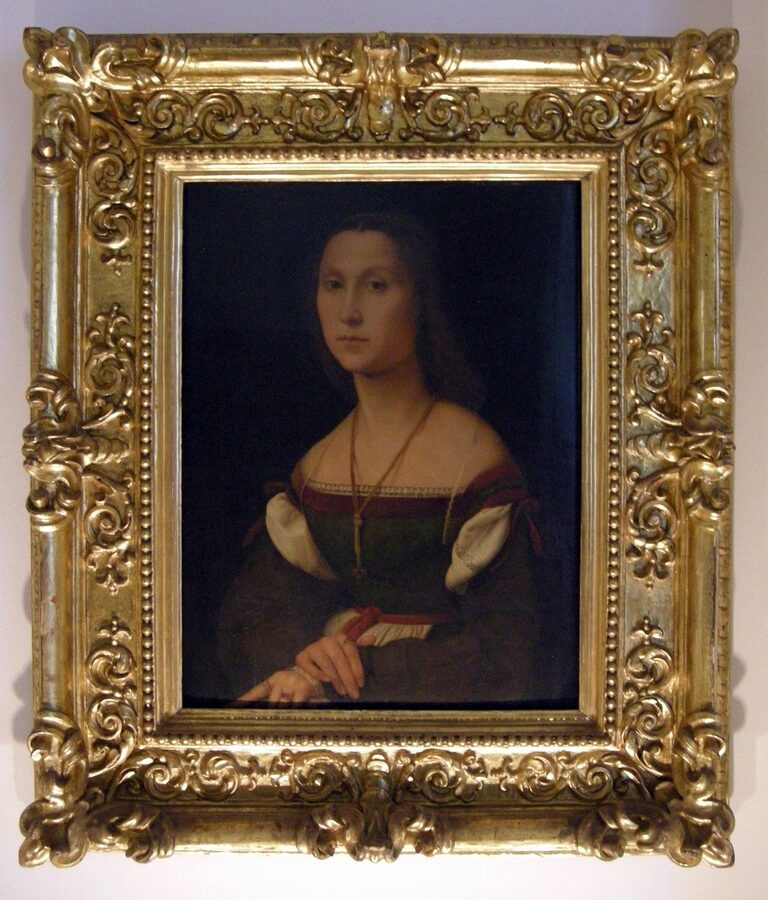
Raphael’s La Muta is the gallery’s other headline piece — a portrait of an unnamed woman in a dark dress, painted around 1507 when Raphael was twenty-four. It’s in Urbino because it was stolen in 1975, recovered in 1976, and has stayed close to home since. The original catalogue entry calls her the wife of a banker; modern scholarship isn’t sure. Either way, the portrait has the composure of everything Raphael would paint later, already present.
Two others worth stopping for: Paolo Uccello’s Miracle of the Profaned Host (a six-panel predella telling a deeply weird anti-Semitic Jewish miracle story in exquisite tempera — uncomfortable history, great painting) and Titian’s Resurrection. Also Federico Barocci’s Madonna of Saint Simon, and a small but worthwhile drawings room.
Casa natale di Raffaello
.jpg)
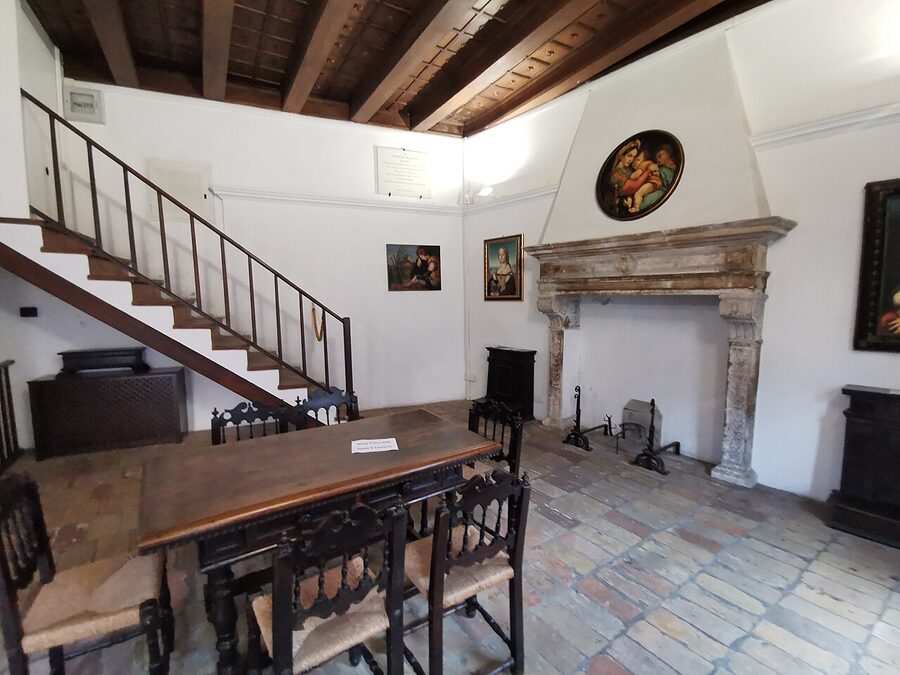
Five minutes uphill from the palace, at Via Raffaello 57, is the small sandstone house where Raffaello Sanzio was born on 6 April 1483. His father Giovanni Santi was a painter of the second rank at the Montefeltro court; his mother Magia died when he was eight, his father when he was eleven. Raphael stayed in Urbino until about seventeen, then went to Perugia to work under Perugino, and from there to Florence and Rome. He died in Rome, on his thirty-seventh birthday, after a short illness.
The house is now a small museum operated by the Accademia Raffaello. It has the family’s courtyard and kitchen still in place, Giovanni Santi’s workshop with a small early Raphael fresco (Madonna and Child, painted when he was about sixteen and already unmistakably his), and a room of portraits and documents. €4 entry, €10 combined with the Palazzo Ducale. Open daily, 9am-6pm in summer, shorter in winter.
The town
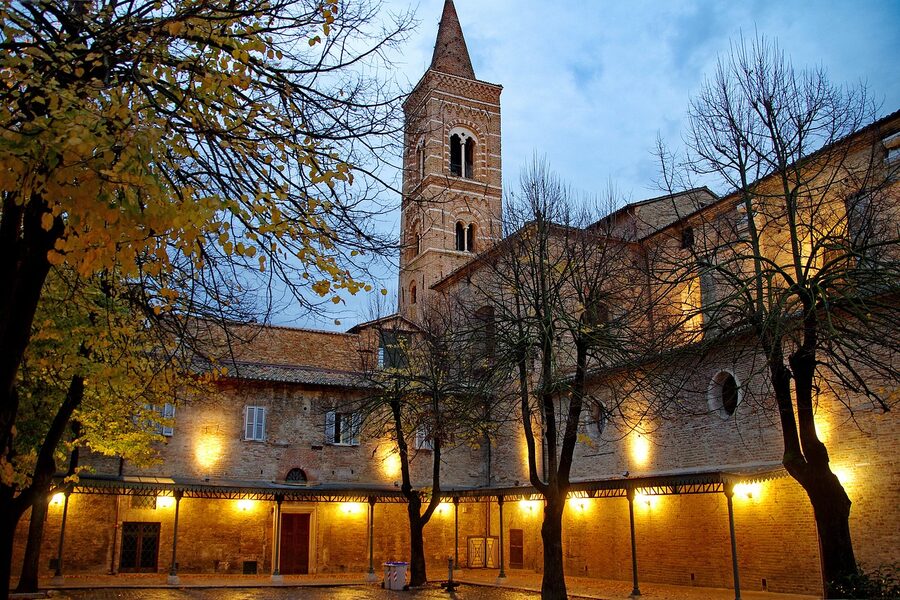
Beyond the palace and the Raphael house, Urbino rewards walking. The main axis is Via Raffaello, which runs from Piazza della Repubblica (the social heart, with cafés and the bus stop) uphill past the Casa Raffaello to the Fortezza Albornoz at the top. Turn off anywhere and you’ll hit something.
Worth specific detours:
Oratorio di San Giovanni Battista — a tiny 14th-century oratory on Via Barocci, frescoed in 1416 by the brothers Lorenzo and Jacopo Salimbeni with one of the best Late-Gothic cycles in Italy (Crucifixion on one wall, Life of John the Baptist on the other). It’s barely signposted. Knock if the door looks shut — usually there’s a guardian inside. €3.50 entry. Don’t skip this.
Duomo di Urbino — the Cathedral, rebuilt by Giuseppe Valadier in 1789 after an earthquake destroyed most of the earlier building. Neoclassical, slightly austere, but the Museo Diocesano Albani in the basement has a good Barocci (Last Supper) and a Titian Resurrection that used to be in the Palazzo.
Fortezza Albornoz — a fifteen-minute walk up from Piazza della Repubblica, the highest point in town. The fortress itself is closed to the public most of the time (occasional exhibitions), but the surrounding park is always open and free and gives you the postcard view: the Palazzo Ducale framed against the green of the Monti della Cesana. Come at sunset.

University of Urbino Carlo Bo — founded in 1506 by Pope Julius II, one of the oldest in the world. About 14,000 students today, almost as many as residents, which keeps the town alive through the academic year. The main building (Palazzo Bonaventura) is on Via Saffi, and during term time the bookshop on the ground floor and the library on the first floor are both worth visiting.
Eating and drinking in Urbino
The local food culture is distinctive enough to be worth coming for in its own right. Four things to try:
Crescia sfogliata — the Urbinate flatbread. Laminated, like puff pastry, cooked on a flat cast-iron testo, folded around prosciutto, cheese, sausage, or grilled vegetables. €4-5 from the handful of piadinerie scattered around Piazza della Repubblica. Eat it within five minutes of it coming off the heat; after that the lamination collapses.
Casciotta di Urbino DOP — one of Italy’s oldest cheeses, documented since the 15th century, PDO-protected since 1996. A mix of sheep’s and cow’s milk, aged briefly, semi-soft, mild. Michelangelo wrote a letter in 1554 asking his nephew to buy him casciotte di Urbino (the original letter is in the Casa Buonarroti in Florence). Any norcineria in town sells it by the half-kilo.
Tagliatelle al tartufo — black truffles grow in the hills around Acqualagna, 30 km south, which produces about two-thirds of Italy’s commercial black truffle. In season (September to February for the valuable black winter truffle, Tuber melanosporum), every restaurant in Urbino shaves them over fresh pasta. Expect to pay €18-28 for a plate that has real truffle on it.
Bianchello del Metauro — the local white wine, made from Biancame grapes in the Metauro river valley. Light, fresh, low-alcohol, DOC-protected. Not a serious wine, but the right wine with crescia or with mountain trout. €10-15 a bottle. Best producer to look for: Claudio Morelli.
For a meal with a view: Ristorante Vecchia Urbino (Via dei Vasari 3/5) does the traditional dishes with care and the dining room was a 15th-century stable before it was a restaurant. For something cheaper: La Trattoria del Leone on Via Cesare Battisti has a €14 set menu at lunchtime that is still the best value in town. For wine by the glass and a board of local salumi: Bucolino Urbino on Via Giovan Battista Garzoni, small room, excellent list.
Where to stay, and for how long
Inside the walls, the nicest option is Albergo San Domenico — a 15th-century convent directly opposite the Palazzo Ducale, quiet, well-restored, rooms from €120 in shoulder season. The Hotel Raffaello is next door and slightly cheaper. For a boutique option, Tortorina Country House is ten minutes outside the walls by car, in a converted farmhouse with a view across to the town — from €140. For budget: Ostello della Gioventù di Urbino (the youth hostel) has private rooms from €45.
One night gets you the palace and the Raphael house, rushed. Two nights is the right length — you can add the Oratorio, walk to the Fortezza for sunset, do a slow dinner, visit the Saturday morning market (Mercatale, below the walls, until about 1pm). Three nights if you want to use Urbino as a base for the wider north Marche — Pesaro, the Gradara castle, Fossombrone, Urbania.
When to come
May, June, September and early October are the obvious windows — 18-24°C, manageable crowds at the palace, good light for photography. July and August are warm (up to 32°C on the worst days, though Urbino’s altitude helps), the student population is down, and coach tours peak. The palace is emptiest between about 4.30pm and closing; go then if you can.
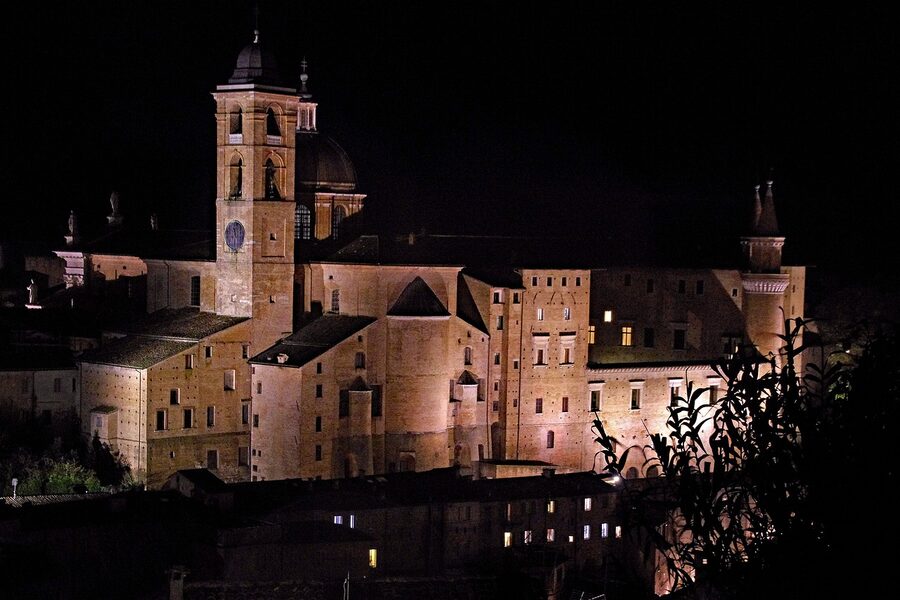
Winter is Urbino’s own season. The student term is in full swing, the tour buses are gone, the palace is cheap to get into, and the light low-angle sun on the terracotta and Istrian stone is its best. The one complication is the weather — Urbino gets fog, mist and occasional snow; pack proper shoes and a real coat.
Festivals worth planning around: the Festa del Duca (third weekend in August) — medieval pageant, costumed procession, crossbow tournament, good fun; the Urbino Jazz Festival in early August; and the Festa dell’Aquilone (kite festival) in the first Sunday of September, in a field outside the walls where the whole town comes out to fly handmade paper kites.
Is it worth the detour?
Urbino is not on the way to anywhere. The entire point of the place is that it rewards the decision to come specifically for it. If you are in Italy for five days, it will be a stretch. If you are in Italy for ten, put it on the list. If you are any sort of person who cares about Renaissance painting and architecture, put it at the top.
For broader context and the rest of the province, see the Marche hub and the Ancona guide.