
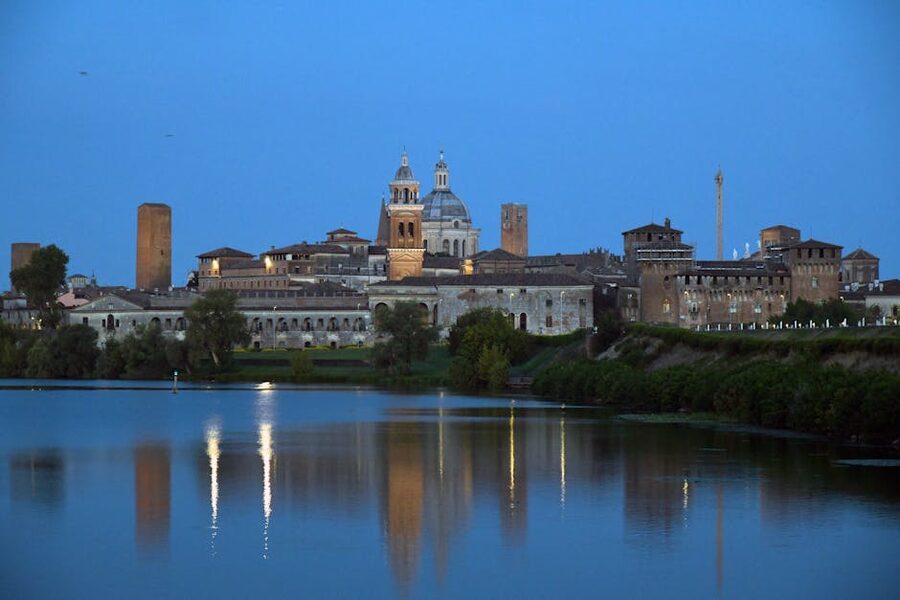
Mantova is a small city of 50,000 people on a bend of the Mincio river, surrounded on three sides by three artificial lakes. From any approach, the skyline — a cluster of red brick towers, pale stone duomos, the 500-room Palazzo Ducale stretching along the waterfront — rises out of the water as if the place had been built on a barge and moored there 800 years ago. Which, in a sense, it was: the Mantovans dammed the river in 1190 to create the defensive lake barrier and then built their Renaissance capital inside it. UNESCO added the city to the World Heritage List in 2008. The reason most travellers haven’t heard of it is that the Gonzaga family, who made it brilliant, died out in 1707 and the city stopped being a capital; the reason those who do come find it extraordinary is that nothing built since then has disturbed what the Gonzagas left.
The Gonzagas ran Mantova for 379 years — longer than the Medici in Florence. At its peak (roughly 1500-1630), the court was one of the great patronage centres of Europe, employing Mantegna, Giulio Romano, Leon Battista Alberti, Titian (briefly), Rubens (for years), and Claudio Monteverdi (who invented modern opera here). What survives is almost absurdly concentrated: Alberti’s Sant’Andrea, Giulio Romano’s Palazzo Te, Mantegna’s Camera degli Sposi, the 500-room Ducal Palace, the early medieval Rotonda di San Lorenzo. You can see all of it in two days, on foot, without hurrying.
In This Article
What Mantova actually is
Lombardia’s south-eastern corner, in the Po plain, 40 km south of Lake Garda, 150 km east of Milan. Population 49,000 within the comune, 200,000 across the province. The city sits on a low rise, almost an island, in the wetland plain created by the Mincio river as it drains from Lake Garda down to the Po. The three lakes around the old town — Lago Superiore, Lago di Mezzo, and Lago Inferiore — were engineered in 1188-1190 by a military commander named Alberto Pitentino, who dammed the river with the Diga di Masetti lock at the eastern end. The lakes were a defensive moat first, an ornamental landscape second; the system still works, and the city’s summer boat trips run the same courses they’ve run since Gonzaga galleys circled the walls.
Historically: Etruscan settlement, Roman town (called Mantua; Virgil was born in a nearby village called Andes in 70 BC and is Mantova’s oldest and most famous claim), Lombard, Holy Roman Empire, independent free commune, then Gonzaga rule from 1328 — consolidated by Ludovico I Gonzaga as vicar of the empire and then steadily elevated: Marquisate from 1433, Duchy from 1530. The family commissioned the palaces, employed the artists, collected one of the great Renaissance libraries (most of which was sold to Charles I of England by the cash-strapped late Gonzagas in 1627-30 and is now in the British Library and the Royal Collection). The War of Mantuan Succession 1628-31 — and the imperial sack of the city in 1630 — broke the court. The last Gonzaga Duke, Ferdinando Carlo, was deposed in 1708. Austrian rule until 1797, Napoleonic until 1814, Austrian again until 1866, then united Italy.
UNESCO added Mantova to the World Heritage List on 7 July 2008, in a joint inscription with nearby Sabbioneta, for “exceptional testimony to the urban, architectural and artistic realisations of the Renaissance, linked through the ideas and ambitions of the ruling family, the Gonzagas.”
Getting there
By train: Mantova station is on the Milan-Verona regional line. Frecciabianca from Milan: 2h change at Verona. Regional from Verona: 40 min. From Rome: high-speed to Bologna then regional change, about 3h30 total. From Venice: 2h via Verona.
By car: A22 Brennero motorway exit at Mantova Nord or Mantova Sud. About 2h from Milan, 1h from Verona, 1h15 from Bologna. The historic centre has a limited-traffic zone; park at the Parcheggio Palasport (just outside the walls) or the Parcheggio Campo Canoa on the lake, and walk.
By bike: Mantova is one of the flattest cities in Italy and is connected to Peschiera del Garda by a 45-km bike path along the Mincio river (the Ciclabile Mincio) — one of the great cycle routes in northern Italy. Bike rentals available at the station.
The Palazzo Ducale
Palazzo Ducale di Mantova — also called the Reggia dei Gonzaga — is not one building but a complex of connected palaces, courtyards, gardens and churches built cumulatively by successive Gonzaga marquesses and dukes from 1290 to the late 1600s. The final total: over 500 rooms, 15 courtyards and gardens, three connected churches. It’s the second-largest royal palace in Europe by room count, after the Vatican. From the outside, the compound wraps around the north-east corner of the old town, its 12th-century Castello di San Giorgio brick towers rising directly out of the Lago di Mezzo.
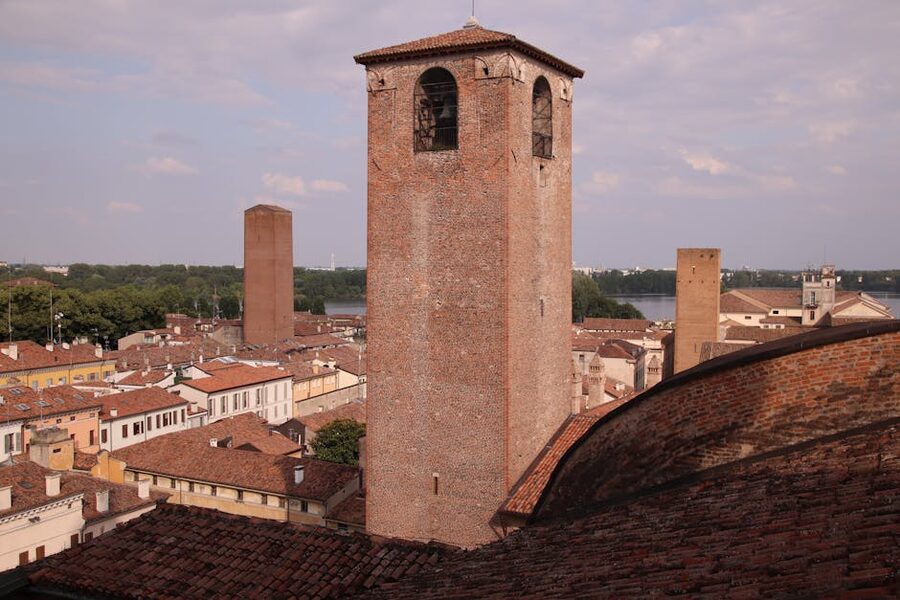
The visit covers about 40 of the rooms. The standard tour route includes:
- The Appartamento degli Arazzi (the Tapestry Apartment) — nine full-sized tapestries woven in Brussels after Raphael’s original cartoons, commissioned by Leo X for the Sistine Chapel in 1515-16, acquired by Mantua through an intricate set of royal-bribes;
- The Galleria degli Specchi — the long corridor where Monteverdi’s L’Orfeo was first performed in 1607, making Mantova the birthplace of modern opera;
- The Sala dei Fiumi — frescoed with the rivers of Gonzaga-controlled Italy;
- The Camera degli Sposi — the single most important room in the palace, and the reason most people come (see below);
- The Museo Archeologico — a small Etruscan and Roman collection, most of it from Mantova’s immediate territory;
- The gardens — the Giardino Pensile (hanging garden, 1579) and the larger Giardino dei Semplici herb garden.
€15 combined ticket, closed Mondays. Book online at mantovaducale.beniculturali.it; the Camera degli Sposi has a separate timed-entry slot that routinely sells out 2-3 weeks in advance in season. Allow 3 hours minimum.
The Camera degli Sposi
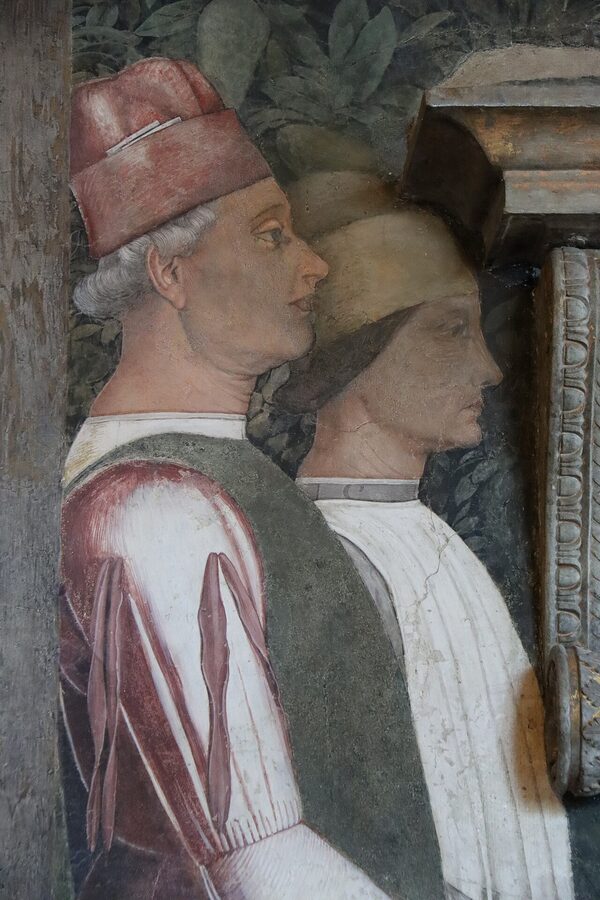

The Camera degli Sposi — “the Bridal Chamber”, also called the Camera Picta (Painted Room) — is a 26-square-metre room in the Castello di San Giorgio frescoed by Andrea Mantegna between 1465 and 1474. It is, for the history of Renaissance art, a room of extraordinary significance: the first fully illusionistic frescoed interior in the Renaissance tradition, the first fully developed di sotto in sù (ceiling-oculus) painting, and the first extensive painted family portrait of a contemporary ruling court.
What you see: the two wall frescoes show the Gonzaga court in an extended family portrait — Ludovico III, his wife Barbara of Brandenburg, their children, their household, their dwarves, their hunting dogs, their horses. On the north wall, Ludovico is shown receiving a letter; on the west, greeting his son Cardinal Francesco returning from Rome. The ceiling has an illusionistic oculus — a painted circular opening to the sky — around which putti, women, and a peacock look down into the room. This is the first-ever recorded use of ceiling-oculus illusionism, and every Baroque ceiling of the next 250 years follows from it.
The room’s viewing experience is tightly controlled: 25 people per 5-minute slot, no photography, attendants enforce the limits. Come prepared for it to feel rushed; the emotional weight of the room comes from what you’ve read about it as much as from what you can take in in the five minutes.
Palazzo Te

Palazzo Te — pronounced “tay” — is the 16th-century suburban villa commissioned by Federico II Gonzaga, Ludovico’s grandson, as a retreat for entertaining, hunting, horse-racing, and keeping his mistress Isabella Boschetti. The palace was designed by Giulio Romano (Raphael’s principal pupil) and built 1524-1534 on the site of the Gonzaga horse stables on the Isola del Te, a small island just outside the southern city walls.
The Palazzo Te is a Mannerist masterpiece — sometimes claimed as the first fully Mannerist building anywhere. Giulio Romano’s approach was deliberately destabilising: architecture that looks classical at first glance and then, on close reading, reveals deliberate “errors” — triglyphs that slip down out of place, keystones that drop, pediments that break. The effect is a building that calls its own conventions into question, which is a good synopsis of what Mannerism attempted.
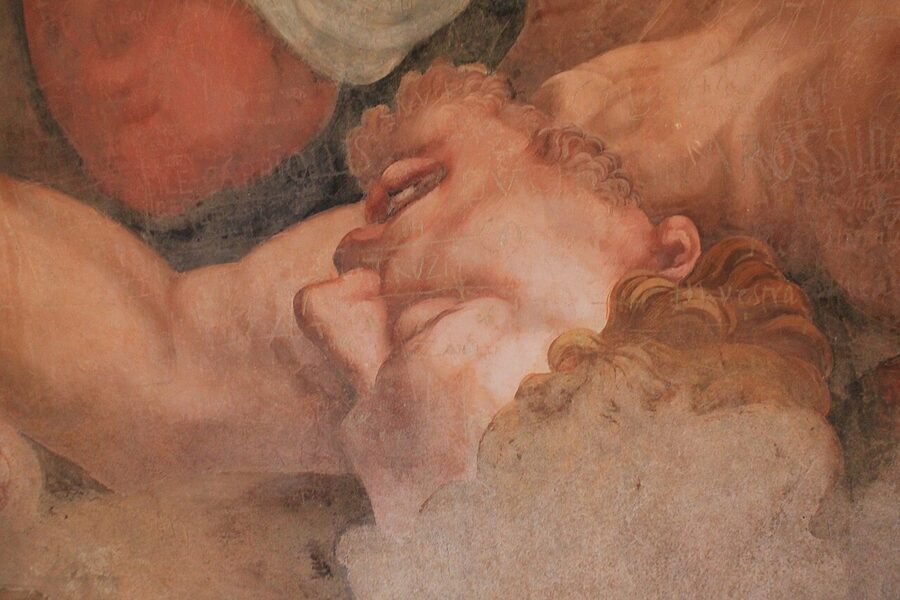
Inside, the rooms are frescoed with Giulio Romano’s workshop’s mythological scenes. The most famous is the Sala dei Giganti (Room of the Giants) — a room whose every surface (walls, ceiling) is painted with the collapsing Mount Olympus, Jupiter casting lightning at the rebellious Titans, and architecture toppling on top of human figures. Standing in the centre, the effect is close to disorienting; the room has a slight domed acoustic so that a whisper at the centre carries clearly to the walls.
Other rooms worth time: the Sala di Amore e Psiche (erotic Apuleian frescoes), the Sala dei Cavalli (life-sized portraits of Federico’s favourite horses), the Sala di Fetonte. €13 entry. About 90 minutes for a proper visit. From the old town, a 20-minute walk through Piazza Virgiliana or 5 minutes by bike.
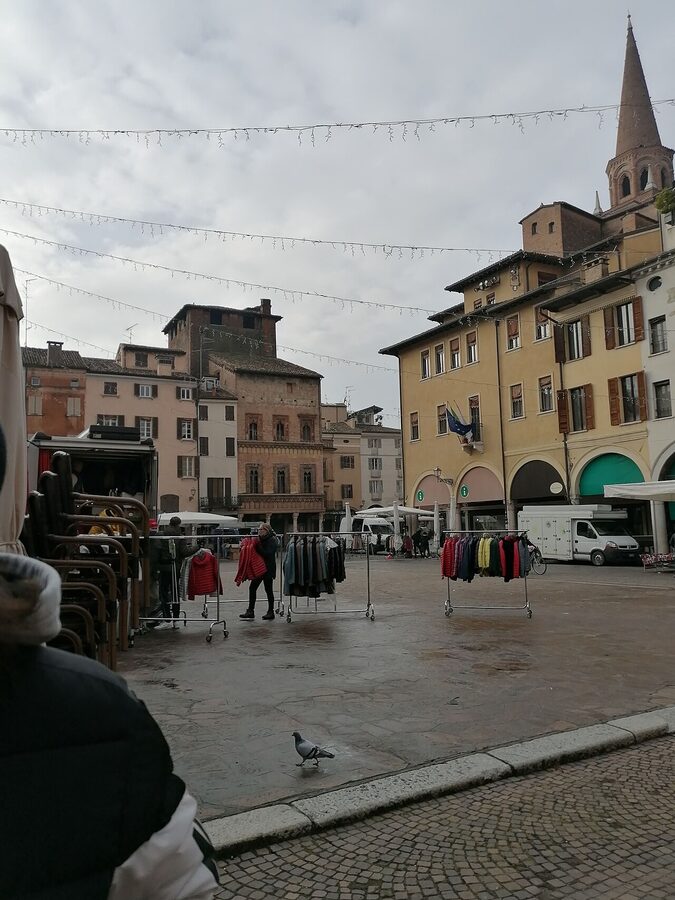
Piazza Sordello, Piazza delle Erbe, Piazza Broletto
.jpg)
The old town clusters around three connected piazzas:
Piazza Sordello — the ceremonial ducal square, directly in front of the Palazzo Ducale, with the Duomo on the west side and the Casa di Rigoletto (the 15th-century house used as the fictional residence of Verdi’s hunchback court jester) tucked in the north-west corner.
Piazza delle Erbe — the medieval commercial square, still hosting the Thursday morning market, dominated by the Palazzo della Ragione (the medieval city hall) and the Torre dell’Orologio, with its 15th-century astronomical clock.
Piazza Broletto — small, connecting the other two, with a 1227 statue of Virgil set into the wall of the Palazzo del Podestà (the oldest surviving likeness of Virgil, made 1,297 years after his death).
All three are walkable in 15 minutes. The spaces are more active at 7pm for the aperitivo and passeggiata than at any other time of day.
The Rotonda di San Lorenzo
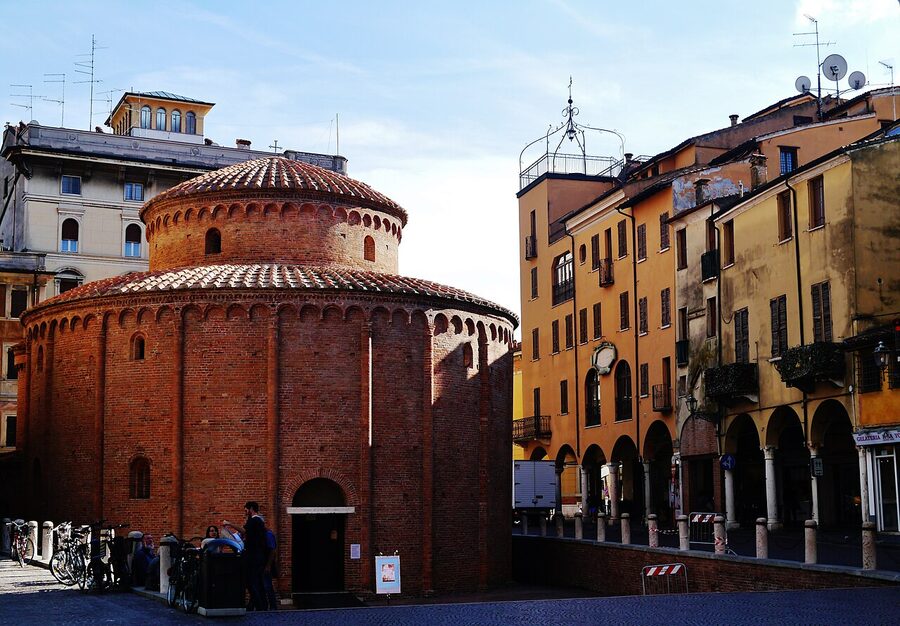

The oldest surviving building in Mantova, and one of the oldest surviving Romanesque rotundas in northern Italy: the Rotonda di San Lorenzo, built around 1082 on the model of the Holy Sepulchre in Jerusalem. The small brick church sits on Piazza delle Erbe. It was deconsecrated in 1579, buried under later construction, and turned into a warehouse and then into a wine cellar; it was only excavated and restored in 1908. Inside is a single circular nave with a ring of columns and traces of 12th-century frescoes high up on the walls. Free entry; closed some afternoons.
The Basilica of Sant’Andrea
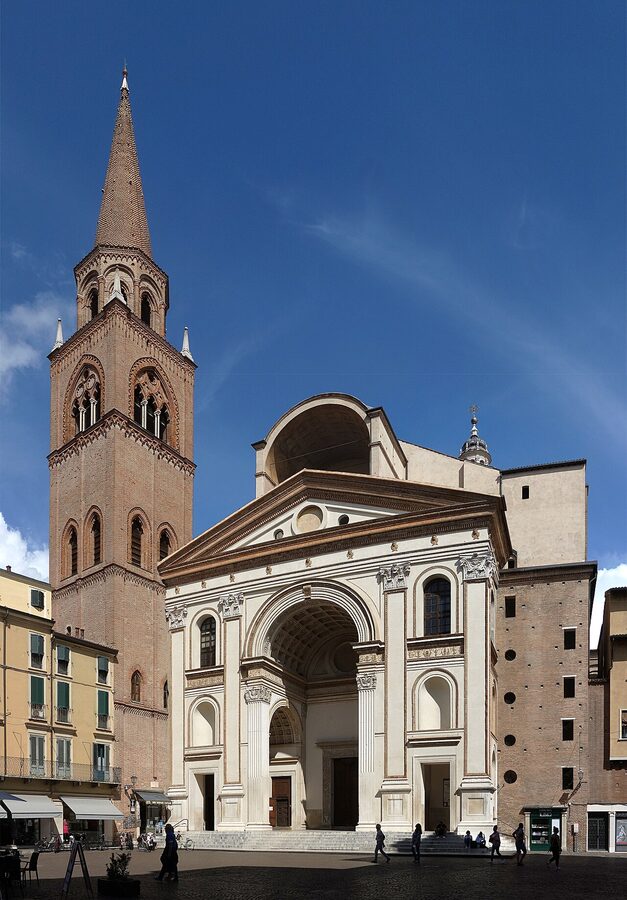

The Basilica di Sant’Andrea is Mantova’s major church and the late masterpiece of Leon Battista Alberti — theorist, architect, playwright, mathematician, and one of the most serious Renaissance minds. Commissioned by Ludovico III in 1470, begun 1472 (the year Alberti died), and built over the next three centuries by assistants following his plans. The façade is a fused Roman triumphal arch and temple front; the interior is a single huge barrel-vaulted nave, the largest unsupported vault built anywhere in Europe since Roman antiquity at the time.
Inside, the reason for the church: the Sacri Vasi — sacred vessels containing, according to Mantovan tradition, some of the Blood of Christ, collected by the Roman centurion Longinus (who pierced Christ’s side with his lance) and brought to Mantova. The two relics are displayed to the public once a year, on Good Friday, in a grand procession. Andrea Mantegna is buried in the first chapel on the left — his own tomb slab, his bust by the door, his funerary chapel frescoed by his workshop. Free entry; the church is genuinely used and hosts frequent services.
The Duomo and other churches
Cattedrale di San Pietro Apostolo (the Duomo) — the city’s main cathedral, reconstructed by Giulio Romano in the 1540s after a fire destroyed the earlier Gothic church. The interior is an unusual five-nave plan (Giulio Romano imitating Old Saint Peter’s in Rome). Free entry.
San Francesco — the Franciscan church, 14th century. Partially ruined by WWII bombing and rebuilt.
Santa Maria del Gradaro — small 13th-century church, worth finding for the fresco cycles.
Food
Mantovan cuisine is one of the most distinctive regional traditions in Italy — Po-plain peasant food elevated to court cuisine by the Gonzagas, then sustained essentially unchanged for three centuries. Signature dishes:
Tortelli di Zucca — the defining Mantovan pasta. Egg-dough tortelli stuffed with roasted butternut-style squash, amaretti biscuits crushed to a paste, Parmigiano, and mostarda mantovana (candied fruit in mustard). The sweet-savoury balance is particular to Mantua; no other Italian stuffed pasta combines this flavour set. Served with melted butter and sage. €12-16 a plate at good trattorie. Seasonal (autumn-winter primarily) but available most of the year now.
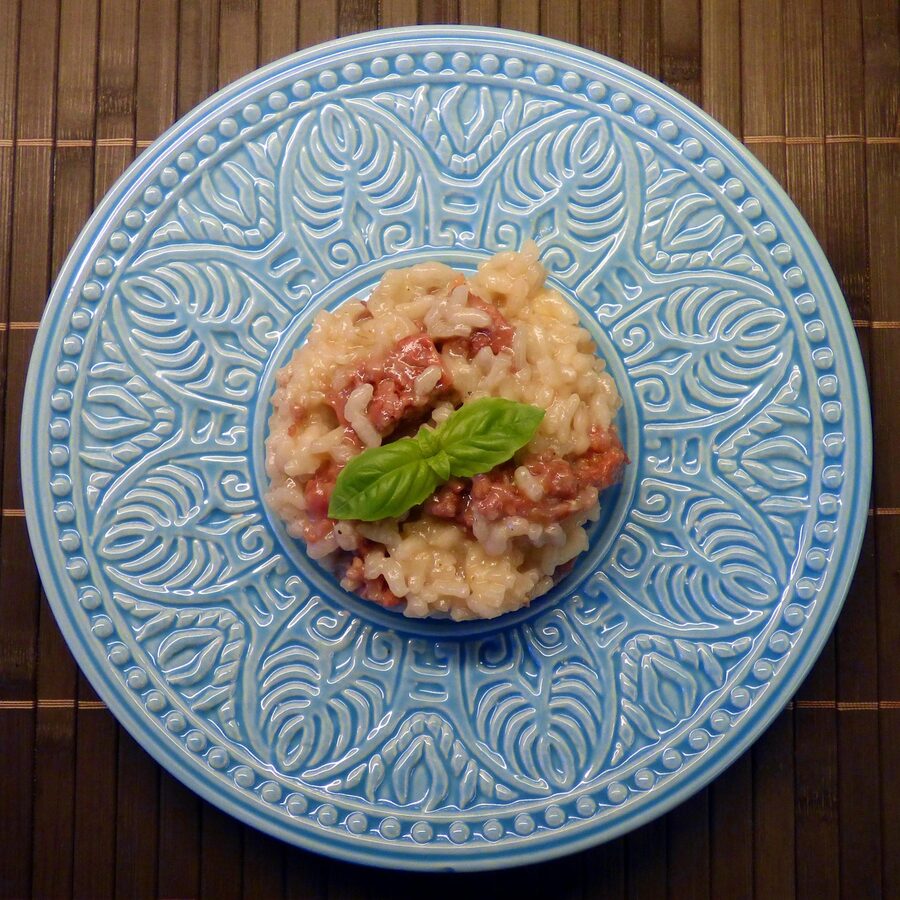
Risotto alla Pilota — the Mantuan answer to Milan’s risotto. Rice cooked by absorption (no constant stirring, unlike Milanese risotto), topped with crumbled salsiccia (pork sausage) and Parmigiano. Named for the 19th-century workers in the Mantovan rice mills (piloti) who ate it. A one-pot meal.
Agnoli in Brodo — tiny filled pasta squares stuffed with braised beef and eggs, served in meat broth. Usually a Christmas or Sunday-lunch dish.
Luccio in Salsa — poached freshwater pike served cold in a caper-and-parsley sauce. A Po-plain classic and the kind of dish most Italian regions have forgotten.
Stracotto di Asino — braised donkey meat, a peasant-tradition dish still on local menus. Not to everyone’s taste; I recommend it.
Sbrisolona — the Mantovan dessert. A crumbly almond cake, deliberately not cut with a knife but broken with the hands. Eaten at the end of a meal with a glass of Vin Santo or a local Lambrusco.
Lambrusco Mantovano DOC — the regional wine. Fizzy, dark, dry-ish (look for secco, avoid the sweet dolce versions unless paired with dessert). The best producers are in the countryside south of the city. €10-15 per bottle.
Recommended restaurants: Ochina Bianca (Via Finzi 2, traditional Mantovan), Il Cigno Trattoria dei Martini (Piazza d’Arco 1, upmarket but excellent), Fragoletta (Piazza Arche 5a, lively and good value), Osteria delle Erbe (Piazza delle Erbe 11, central and reliable).
Where to stay
Mantova is a compact walled city; anywhere inside the walls is fine and walking-distance to everything. Recommended:
Casa Poli (Corso Garibaldi 32) — a design boutique hotel in the centre, modern inside a 19th-century façade, from €130.
Palazzo Arrivabene (Via Arrivabene 22) — four suites in a 16th-century palazzo with a quiet courtyard, from €180.
C’era Una Volta (Corso Vittorio Emanuele 52) — small B&B, excellent breakfast, from €100.
Hotel Rechigi (Via Calvi 30) — larger four-star, central, reliable, from €120.
Two nights is the minimum. Three is the comfortable length — day one for the Palazzo Ducale, day two for Palazzo Te + a slow afternoon around the piazzas + Sant’Andrea, day three for a Sabbioneta day trip (30 km south) or a Mincio bike ride.
When to visit
Mantova is a four-season destination with two caveats: summer is very humid (the surrounding lakes produce mist and mosquitoes in July-August) and January-February can be foggy enough that you can’t see across the lakes. The optimal windows are April-June and September-November. Autumn has the added advantage of being truffle, pumpkin, and grape-harvest season — the food is at its best.
Plan around: Festivaletteratura (early September) — Italy’s biggest literary festival, five days of events across the city, international authors, book-signings, late-night piazza readings; Mantova Capitale del Libro and Leggere la Città events spread across the year; the Sacri Vasi procession on Good Friday; Mantova Fiera Cavalli (April) — one of Italy’s oldest horse fairs, 400 years old.
Is Mantova worth the trip?
For first-time Italian visitors with 7-10 days, no — there are better, more iconic stops. For second-time visitors, repeat visitors, or anyone building an itinerary around Renaissance art and architecture, yes, unreservedly. The combination of the Camera degli Sposi, Palazzo Te, Sant’Andrea, and the UNESCO old city is hard to match. The food is excellent and distinctive. The city is small, walkable, uncrowded, and (relative to Venice, Florence, Milan) cheap.
Easiest combination: Mantova + Ferrara + Bologna on a 5-6 night Emilian loop. Or Mantova + Verona + Sirmione for a Lombard-Veneto long weekend. For broader context see the Lombardia hub.