
San Marino
San Marino is the world’s third-smallest country. It is also its oldest republic, its last walled medieval city, and one of the very few sovereign states where you can stand in the middle of the capital and see, on a clear day, the entire national territory from the front door to the coastline. It occupies sixty-one square kilometres of hill country forty-five minutes south of Rimini. The Adriatic is visible from the battlements. The flag flies over three medieval towers. Italy surrounds it on every side.
I had put off visiting for years. I assumed it was a gimmick — a castle-topped hill with a gift shop and a border crossing for people who wanted their passport stamped with something weird. I was wrong. San Marino is serious. It’s 1,724 years old and it has never stopped running its own affairs, which is itself almost unbelievable when you look at what has happened to the rest of Europe since AD 301. Napoleon respected it. Garibaldi hid in it. The Italian state has tried, and failed, to absorb it twice. Today it has its own currency (it uses the Euro by agreement), its own stamps, its own internet domain, its own Olympic team, and a constitution dating to 1600 that is still in force. It’s the only walled medieval capital in Europe that is also a living capital city.
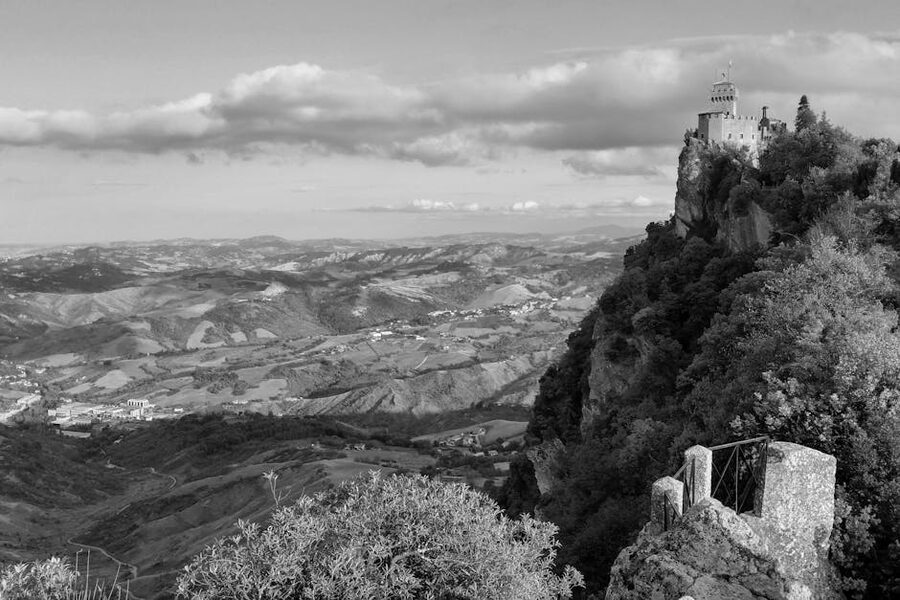
What San Marino actually is
The founding story is as follows. A Christian stonemason named Marinus fled the persecutions of Diocletian, walked inland from the Dalmatian coast, and settled with a small community on top of Monte Titano in the year 301. When he died in 366 his reputed last words were relinquo vos liberos ab utroque homine — I leave you free from both men, meaning the emperor and the pope. Whether or not the words are historical, the sentiment stuck. San Marino has spent the subsequent seventeen centuries taking it literally. It is not in the European Union. It is not in NATO. It has, at various points, been the refuge of choice for Italians fleeing wars, inquisitions and regimes, including over a hundred thousand refugees during the Second World War — a population increase of roughly tenfold.
Politically it is a parliamentary republic. Every six months the Grand and General Council elects two Captains Regent (Capitani Reggenti) who share the head-of-state job on a rotating basis. One is usually from the left, one from the right. They wear ceremonial robes, they swear in on 1 April and 1 October, and when their term ends the public is permitted to make formal complaints against them for three days. It’s an ancient system and it still works. San Marino has had 4,200 Captains Regent in its history; Italy has had about seventy prime ministers.
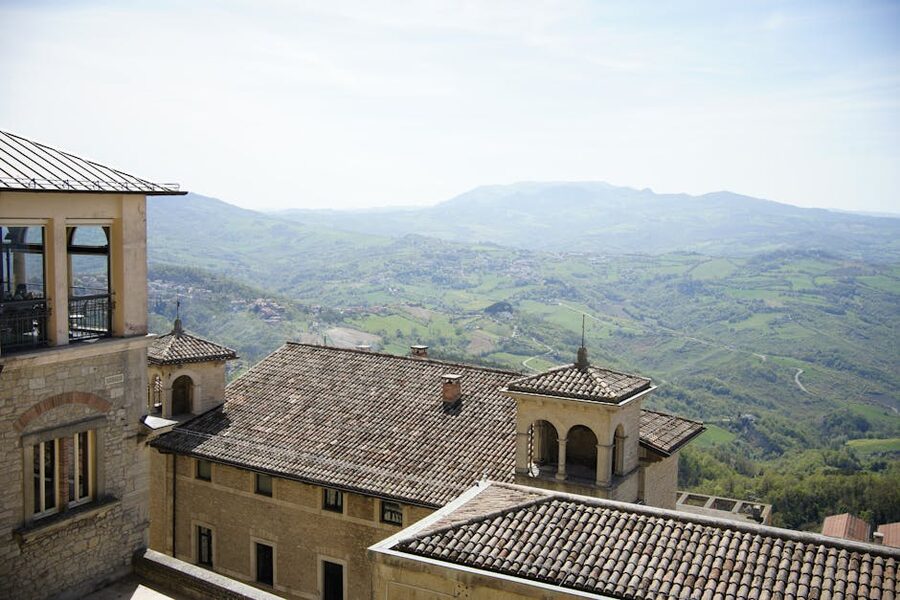
The country has a population of around 33,600. It has nine municipalities, called castelli — the old medieval term for a fortified town with its surrounding hinterland. The capital is one of them. The others are Acquaviva, Borgo Maggiore, Chiesanuova, Domagnano, Faetano, Fiorentino, Montegiardino and Serravalle. Serravalle, at the foot of the hills, is actually larger than the capital by population; it’s where a lot of the banking and light industry happens. The capital, on top, is for history, government, and tourism.
Getting there
San Marino has no airport and no train station. You arrive by bus, by car, or on foot if you are very committed. The practical route for most visitors is from Rimini: 24 kilometres up the road, a Bonelli Bus Express from the train station that takes forty-five minutes and costs about €5 each way or €10 return. The bus drops you at Piazzale Calcigni in Borgo Maggiore and a cable car (funivia) takes you the rest of the way up to the old town for €4.50 return. If you drive, you park in one of the parcheggi — most people use P7, P9 or P10 and walk in. Do not try to park inside the historic centre; you will not succeed. Nearest airports are Bologna (about 110 km, under 1.5 hours) and Federico Fellini at Rimini (20 km, though rarely used by international carriers). For most itineraries, San Marino is a day trip from Rimini or a two-day detour if you stay the night, which I strongly recommend — more on that later.
There is no border control. You walk across and Italy becomes San Marino and nothing happens. If you want a passport stamp — and you should, because they’re rare — take your passport to the Ufficio di Stato del Turismo in Contrada Omagnano and pay €5. It’s one of the few places in Europe where you can collect a real, legal, sovereign-state stamp without needing to fly anywhere.
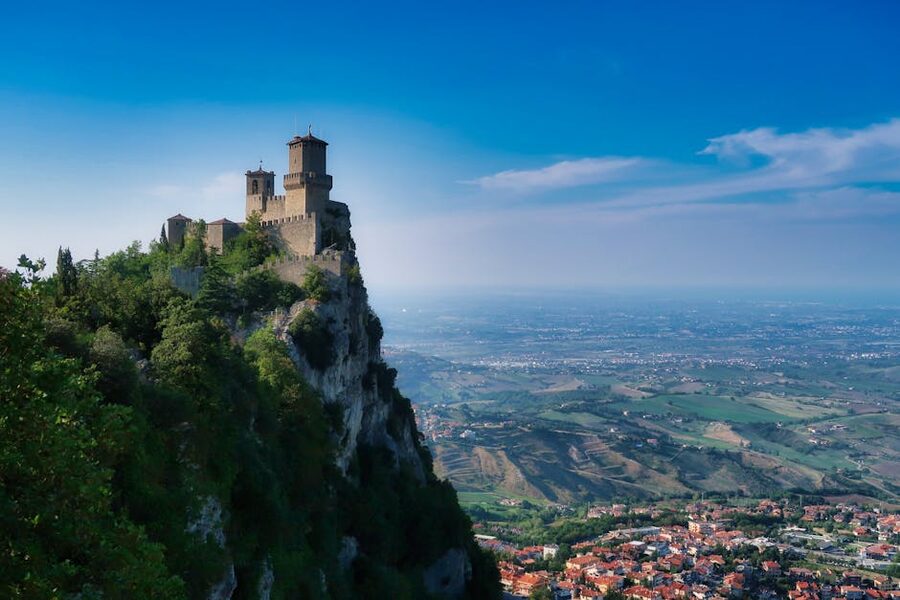
Monte Titano and the Three Towers
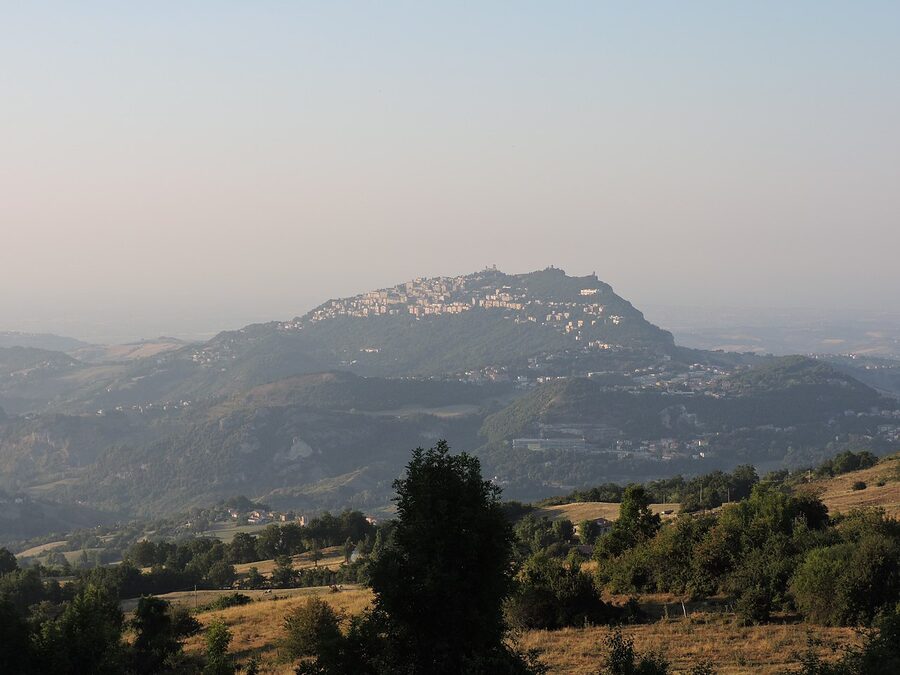
Monte Titano is the reason San Marino exists. At 739 metres it is the highest point in the country and the only real defensive feature on the entire peninsula between the Po valley and the Marche coast. The Romans ignored it. The medieval era made use of it. Three separate towers were built along the ridge across four centuries, and the resulting fortified system — along with the historic centre that grew up around it — was inscribed as a UNESCO World Heritage Site in 2008 under the title San Marino Historic Centre and Mount Titano.
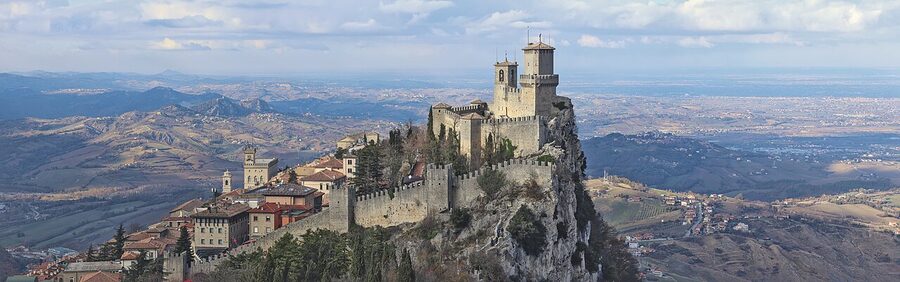

The three towers, in order along the ridge, are:
La Guaita — the first and oldest, built in the 11th century, the one you see on the national flag. It’s the classic shot: a squat stone keep on an exposed rock, wrapped in two concentric walls. Inside there’s a small collection of medieval weapons and a cell that served as a prison until the 1970s. The view from the top, on a clear day, runs from the Apennines behind you all the way to Croatia on the far side of the Adriatic. €3 to enter, or €6.50 for a combined ticket with the second tower.
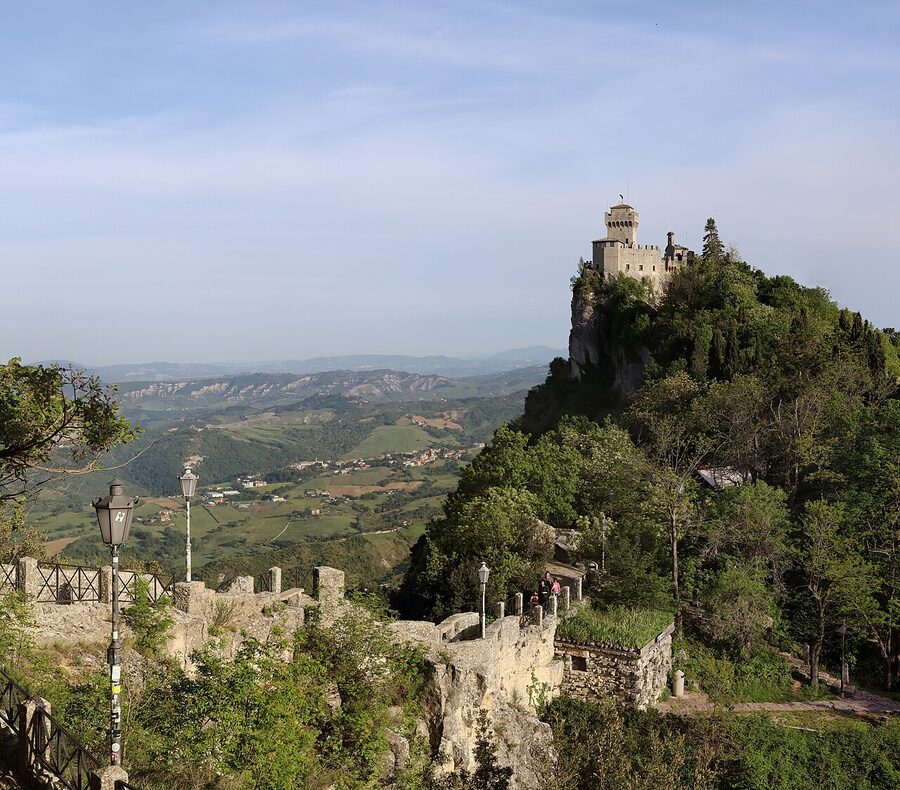
La Cesta (also called La Fratta) — the second tower, built in the 13th century, about a ten-minute walk south along the ridge. It’s the tallest point on Monte Titano and houses the Museum of Ancient Weapons, which is better than it sounds — a collection of 535 mostly medieval pieces, including crossbows that are still used today by the Federation of Sammarinese Crossbowmen. You’ll see them in costume if you visit on 3 September (Feast of San Marino) or 25 March (founding anniversary).
La Montale — the third and smallest, 14th century, closed to the public. You can walk up to the base and peer over the walls but there’s no entrance. It’s still privately held by the state as a watchtower.
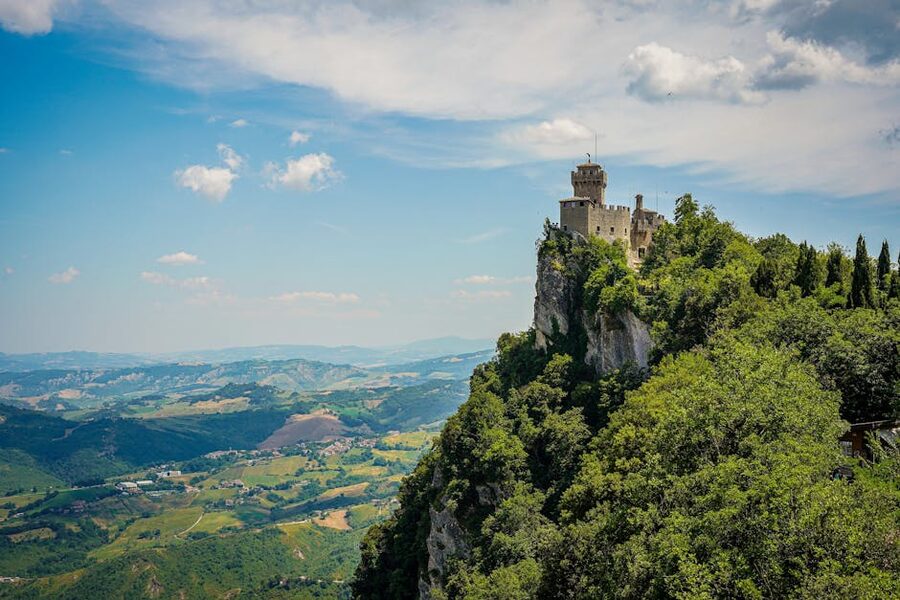
The trail connecting the three towers is called the Passo delle Streghe — the Witches’ Pass — and it’s one of the best short walks in Italy. Maybe thirty minutes end to end if you don’t stop for photos, which of course you will. The path clings to the east face of the ridge with a near-vertical drop to your right and the Apennines in every direction. If you have time for one thing in San Marino, it’s this walk.

Piazza della Libertà and the Palazzo Pubblico
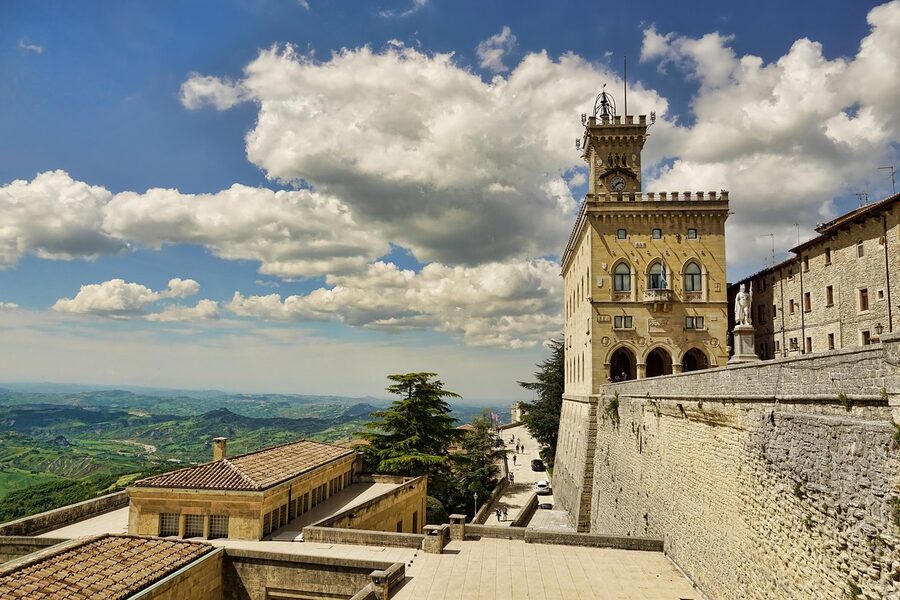
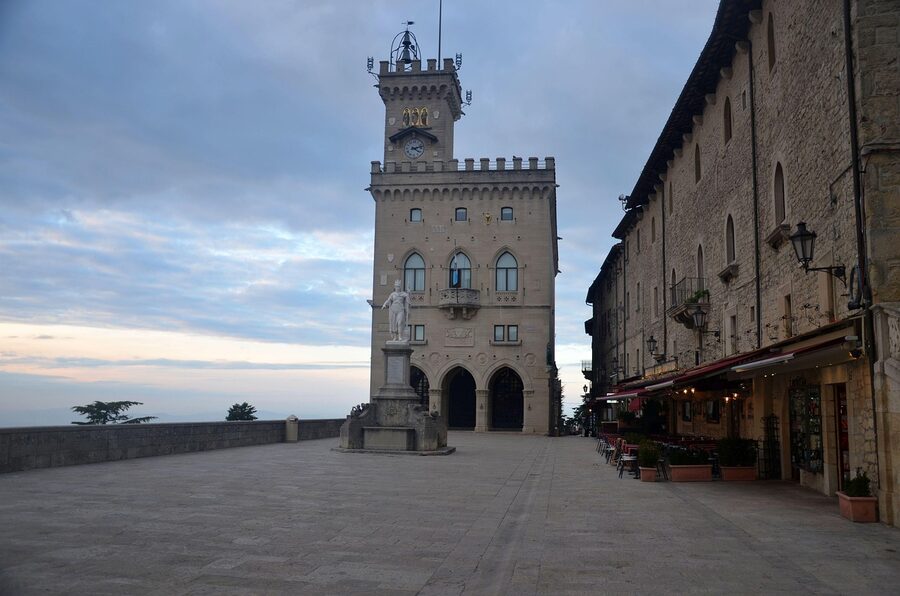
The political heart of the country sits a few minutes’ walk downhill from the Guaita, in the main square: Piazza della Libertà. Here you’ll find the Palazzo Pubblico — the 1894 neo-Gothic town hall, designed by the Roman architect Francesco Azzurri and built in local stone. The statue in the middle of the square is the Statua della Libertà, donated in 1876 by a German countess named Otilia Heyroth Wagener, who was fond of the republican principle. The façade of the Palazzo Pubblico carries the coats of arms of the nine castelli, and above them, the coat of arms of the Republic itself — the three towers, the crown, the oak and laurel branches.
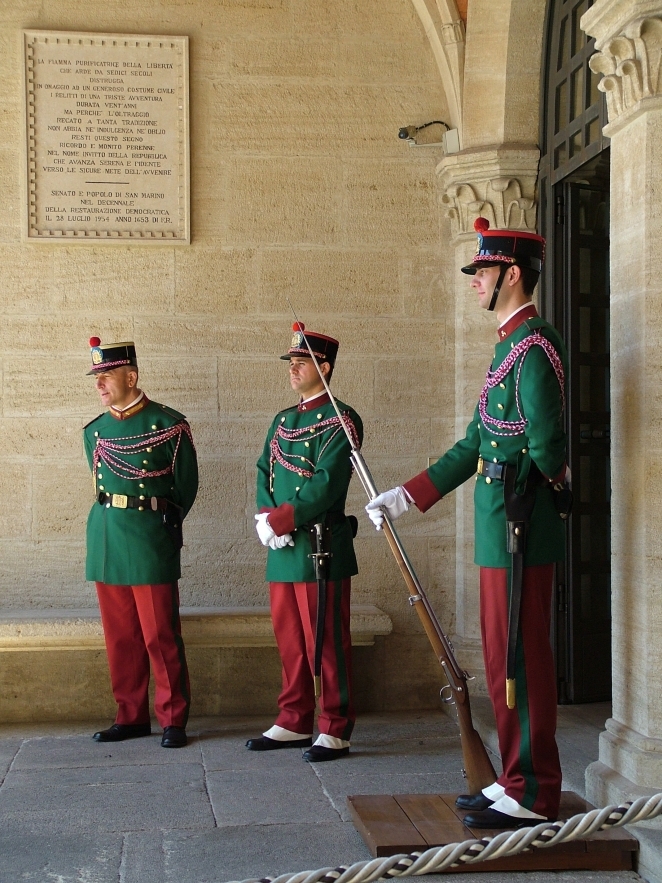
The Changing of the Guard is genuinely worth catching. Two members of the Guardia di Rocca in full ceremonial uniform — green jackets, red plumes, tall white hats — do a short synchronised drill with bayoneted rifles. It lasts about five minutes, it’s not a big show, but there’s something genuinely dignified about it. No crowd barriers. No ropes. You stand a couple of metres from the guards and watch. The first one of the day is always well attended; the ones at lunchtime or mid-afternoon are often just you and a handful of other people.
Inside the Palazzo Pubblico is the council chamber where the Grand and General Council meets. It’s open to visitors — €4.50 gets you into the building, or €10.50 for a combined ticket with the two towers, the State Museum and the St. Francis Museum. Worth buying the combined ticket if you have more than a couple of hours.
Walking the historic centre
Città di San Marino is small. You can walk the whole of the walled centre in an hour if you don’t stop, and three hours if you do. The streets — Contrada Omagnano, Contrada del Collegio, Contrada Ombrellari — follow the contours of the hill, so you’re always either going up or down. There are no cars inside the walls. There are cats, on every doorstep, and they are unfazed by tourists.
The two main sights after the towers and the Palazzo are the Basilica and the State Museum. The Basilica di San Marino, finished in 1838, sits halfway between Piazza della Libertà and the Guaita. It’s neoclassical, by the Bolognese architect Antonio Serra, and it replaced a much older Romanesque church on the same spot. Under the high altar are the relics of Saint Marinus himself — the stonemason who started all of this. Free entry, quiet inside, worth twenty minutes for the Empire-style interior.
The Museo di Stato — the State Museum — is in the old Palazzo Pergami-Belluzzi. Three floors of Sammarinese history, from Neolithic flint tools up to independence and modern statehood, plus a small collection of ancient Egyptian artefacts donated in 1965. It’s thorough and well-laid-out. If you’re interested in the constitutional history — how a republic survives for 1,724 years — this is the place to spend an hour.
Other curiosities: there’s a Museo delle Curiosità (a cabinet-of-curiosities type place — gimmicky), a Museo della Tortura (medieval torture instruments, also gimmicky, frequently packed with teenagers), and a small Museo di Stato delle Armi Antiche in the Cesta Tower (already mentioned above). My honest advice: the serious museum is the State Museum; skip the kitschy ones unless you’re travelling with kids who need a break from the ramparts.
The nine castelli
Most people visit only the capital and think they’ve seen the country. They haven’t. The nine castelli each have distinct character and most of them are worth at least an hour. If you’re staying overnight, hire a car for the second day and do a slow loop.
Borgo Maggiore — directly below the capital, at the base of the funivia. It’s the market town; the weekly Thursday morning market is the best place to buy local cheese, cured meats, and mieli (the Sammarinese honey, which is excellent). The Sanctuary of the Beata Vergine della Consolazione sits on the edge, with a broad view down the valley.
Serravalle — the largest by population (10,000+), at the foot of the hills near the Italian border. It’s where most Sammarinese actually live and work. The San Marino football stadium is here, as is the annual film festival.
Domagnano — in the middle of the republic, on a low hill. Known for its ceramics tradition. There’s a small cluster of artisan workshops worth visiting if you want to bring something home that isn’t a snow globe.
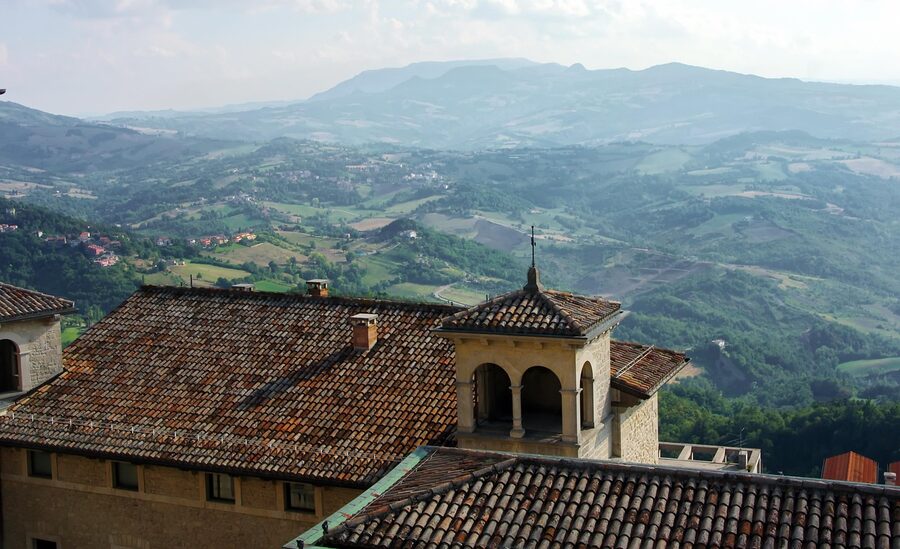
Fiorentino, Montegiardino, Faetano, Chiesanuova, Acquaviva — smaller villages, quieter, each with a central church and a bar and a view. None of them has a major sight, but collectively they’re what San Marino is like when the tour buses aren’t there. If you have a car and a half-day, drive through them with a paper map. The hills are gentle, the roads are empty, and you’ll probably end up somewhere with a lunch you didn’t plan on.
Food and wine
Sammarinese food is Romagnola food with a few local variations. It’s not precious; it’s the food of a hill country that has always been poor, and it hasn’t tried to dress itself up since prosperity arrived. Two things you should eat and one you should drink:
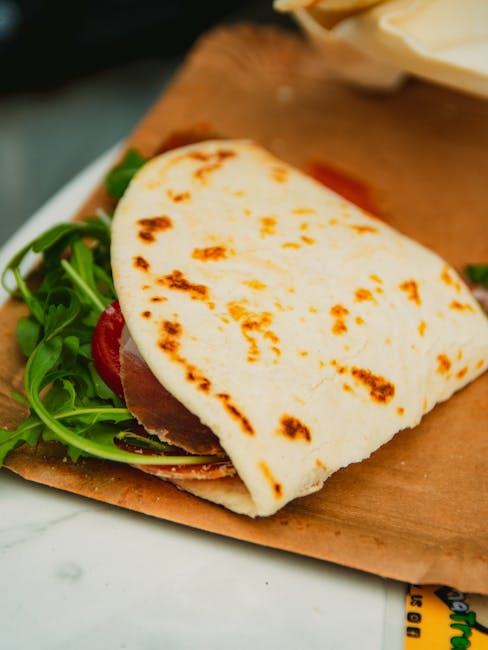
Piadina — the flatbread of Romagna and San Marino. Made with flour, water, lard (or olive oil), and salt. Rolled thin, cooked on a terracotta plate for ninety seconds, folded around a filling. Classic fillings: prosciutto crudo and squacquerone cheese; salsiccia with grilled onions; in autumn, funghi porcini. A piadina stand — they’re called piadinerie — sells them for €4-5. The best one in the capital is on the way down from the Guaita, near Piazza Garibaldi; ask anyone, they’ll point.
Torta Tre Monti — the three mountains cake. Layers of thin wafer biscuits held together with chocolate and hazelnut cream, topped with more chocolate. It was invented in 1941 by a confectioner named Paolo Rossini, and it’s everywhere. Buy one in a proper pasticceria, not a tourist-trap boxed version. Lasts two weeks if you keep it cool. Good souvenir.
Local wine — San Marino has its own DOC wines. The white is Biancale, the red is Brugneto and Tessano, and the sweet is Moscato di San Marino. You won’t find them outside the republic, which is part of their charm. A bottle costs €8-15 from Consorzio Vini Tipici di San Marino. The Moscato is the easiest gift to take home.
Stamps, coins, and what else to buy
San Marino’s philatelic tradition is serious. The republic has been printing its own postage stamps since 1877 — the early editions are valuable. Modern issues are designed as miniature artworks: each series is themed (history, art, football, space exploration) and every piece is legally valid postage. If you send a postcard home from the post office on Piazza Garibaldi, you’ll be using one. The collectors’ centre is the Azienda Autonoma di Stato Filatelica e Numismatica, which sells annual sets, proof sets, commemorative coins, and first-day covers.
Coins are the same story — San Marino mints its own Euro coins (part of the agreement that lets it use the currency without being an EU member), and they’re prized by collectors because the mintage runs are deliberately small. A one-off commemorative €2 coin from San Marino can be worth €20-50 second-hand.
Other things worth buying if you have room in the suitcase: crossbows (ceremonial ones, not functional) from the workshops near Piazza della Libertà; ceramics from Domagnano; liqueurs — Mistrà and Tilia, if you can get them. The duty-free shopping story is largely historical; Italy joined the EU and the price advantage mostly evaporated. Don’t come for the electronics deal.
When to visit
The tourist season runs Easter to October with a second push around Christmas. The absolute peak is July and August — Italian families on holiday from the coast, fully booked restaurants, queues at the Guaita. May, June and September are my recommended windows. Temperatures are mild (18-25°C), the light is good, the crowds are manageable. October is beautiful but some of the smaller museums start to cut their hours. Winter is quiet and cold, with fog that rolls in up the valley and wraps the towers in a way that’s dramatic if you don’t mind not seeing the view.
Two annual events to plan around if you want to see the country at its most ceremonial: 3 September — the Feast of San Marino, with a full parade, crossbow tournament, and medieval pageant that shuts down the old town for the afternoon. And 1 April and 1 October — the swearing-in of the new Captains Regent, with the full ceremonial uniform, the Banda della Repubblica playing in Piazza della Libertà, and speeches you don’t need to understand to find moving.

Is it worth the detour?
If you’re on the Adriatic coast anywhere between Ancona and Ravenna, San Marino is a half-day trip that is essentially free — a €10 bus ride from Rimini. In that case, the answer is straightforward: go. You will spend a morning in the oldest republic in the world, walk a ridge that overlooks four Italian regions, and come away with a passport stamp from a country that’s a sixteenth of the size of London. It’s the best short detour on the east coast of Italy.
If you’re making a special journey from Rome or Milan, the calculus is different. Three hours each way for a single afternoon is a lot. But combine it with a two-day swing through Emilia Romagna — Bologna, Modena, Ravenna’s mosaics, a night in Rimini, and then up the hill — and it becomes the crown of a trip rather than an interruption to one. That’s how I’d do it if I were planning it again.
However you come, stay overnight if you can. The day-trippers leave by six, the restaurants refill with locals, the towers light up, and the old town becomes the thing it actually is — a small city on top of a mountain that’s been running itself since the Roman Empire fell. Not a gimmick. Not a border-crossing novelty. A real place, still here, still free, as promised in 366.