

Castellammare del Golfo is a small fishing town halfway between Palermo and Trapani on the north-west coast of Sicily. It has a population of 15,293, a 10th-century castle built out into the sea, a natural bay with three kilometres of sand beaches on one side and thirty kilometres of white-cliffed nature reserve on the other, and a working fleet of about forty fishing boats that still come in every morning around 6am with whatever they caught overnight. It is also, for reasons that are historical rather than current, the town where more than half of the Prohibition-era American Mafia was born, and where the current President of the Italian Republic, Sergio Mattarella, spent the first twenty years of his life before moving to Rome for law school.
The castle is called the Castello Arabo-Normanno. The town at its foot is built as a grid of steep limestone stairs, because the Arabs who built the castle in the ninth century called the place Al Madarig — “The Steps” — and the Normans who enlarged it two hundred years later inherited the name and the shape. You arrive at Castellammare for one of three reasons: you have been in Palermo for three days and want a day on a proper beach; you are on your way to the Zingaro nature reserve or the tonnara at Scopello and this is the natural base; or you are doing a western-Sicily loop and Castellammare is the most scenic of the stops between Palermo and Trapani. Whatever the reason, you stay longer than you planned.
I came here the first time in 2012 for a single overnight, en route from Palermo to a wedding in Trapani. I stayed three nights, moved the wedding flight, came back for a week the following summer, and have been coming back roughly every second year since. Of all the small seaside towns in Sicily, this is the one I would live in — and of the small seaside towns in Italy full stop, I would put it alongside Maratea on the Basilicata Tyrrhenian as one of the two most underrated.
In This Article
- Castellammare del Golfo in one paragraph
- Getting there
- The castle and the Cala Marina
- The 1718 legend and the Madonna del Soccorso
- Walking the old town — steps, the corso, and the three churches
- Scopello, the Tonnara, and the Faraglioni
- The Riserva Naturale dello Zingaro
- The beaches: La Plaja and Guidaloca
- The other story — the American mafia
- Food — fish, couscous, and Mattarella’s cafe
- Nearby — Segesta, Erice, Trapani, San Vito Lo Capo
- When to visit
- Before you go
Castellammare del Golfo in one paragraph
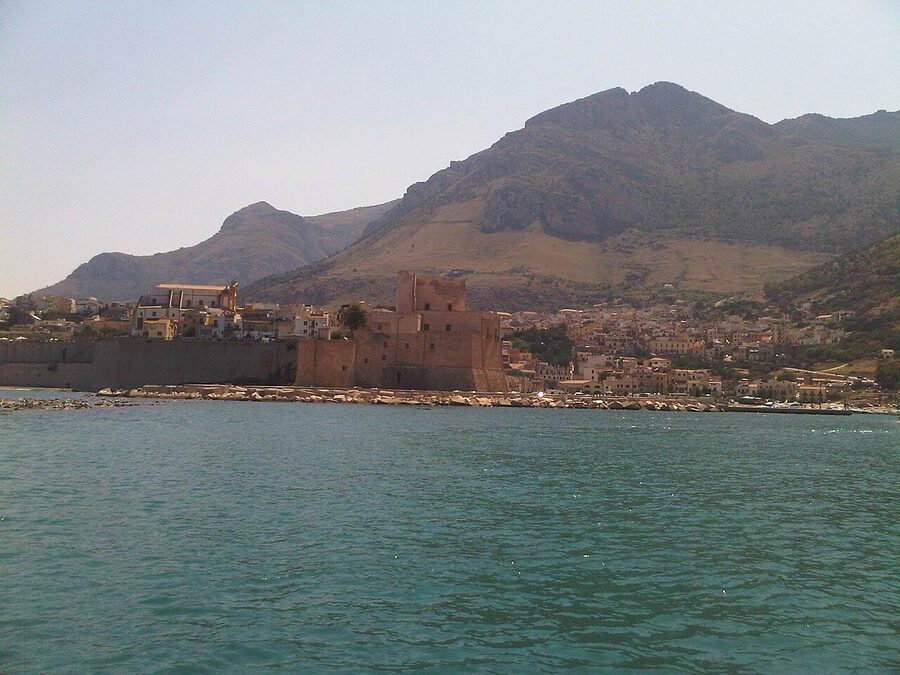

A coastal town and comune at 26 metres elevation, 127 square kilometres of municipal territory (most of it mountain and nature reserve), 15,293 residents. Provincia di Trapani. Latin name Emporium Segestanorum — the port of the nearby Greek city of Segesta. Arab name Al Madarig (“the steps”) from 827 AD. Norman rebuild from 1064. Part of the Kingdom of Sicily until 1860. Patron saint Maria Santissima del Soccorso; saint’s day 21 August, with a biennial maritime procession that is one of the two most photographed religious events in western Sicily (the other is the Easter procession at Trapani). Demonym: Castellammarese. Sicilian name: Casteḍḍammari. The Gulf of Castellammare — the larger body of water — takes its name from the town rather than the other way round, which is the sort of small detail that tells you something about the town’s historical importance.
Getting there
Two airports are roughly equidistant: Palermo (PMO), 43 km east, about 32 minutes by car; and Trapani (TPS), 56 km west, about 41 minutes. Palermo has more flights; Trapani is cheaper for Ryanair. If you’re coming from outside Italy, check both when booking.
From Palermo airport without a car: take a Prestìa-e-Comandè bus into Palermo Centrale station (€7, 45 minutes, every half hour), then the regional train on the Palermo–Trapani line to Castellammare del Golfo station (€6.50, 60 minutes). The train station is 2 km outside the town proper at the east end of the La Plaja beach — a 25-minute walk, or a €10 taxi. Autoservizi Russo also runs a direct bus from Palermo Centrale to Castellammare (€7.50, 75 minutes, three a day).
From Trapani airport without a car: AST bus to Trapani city (€5, 40 minutes), then a second AST bus to Castellammare (€5, 55 minutes, five a day). The train route from Trapani goes via Alcamo and is usually slower than the bus.
By car, Castellammare sits on the A29 Palermo–Mazara del Vallo motorway at the Castellammare del Golfo exit. The drive from Palermo is scenic along the coast; the drive from Trapani is through rolling vineyard country. Parking in town in summer is difficult — most street parking is paid and full by 10am. The Parcheggio Cerri Caleca on Via Peppino Impastato is the most reliable paid lot (€10 for the day).
If you’re making a single base in western Sicily, I would argue for Castellammare over Palermo, over Trapani, and over San Vito Lo Capo, in that order. Palermo is its own thing and too big to be a base. Trapani is a working city and a ferry port to the Egadi — practical but not particularly beautiful. San Vito Lo Capo has the famous beach but very little off-season and very expensive in July-August. Castellammare has the castle, the ferry to the Zingaro, the tonnara at Scopello, and a working fishing harbour with restaurants that are open year-round. Two weeks here and a hire car will show you more of the region than two weeks in Palermo.
The castle and the Cala Marina
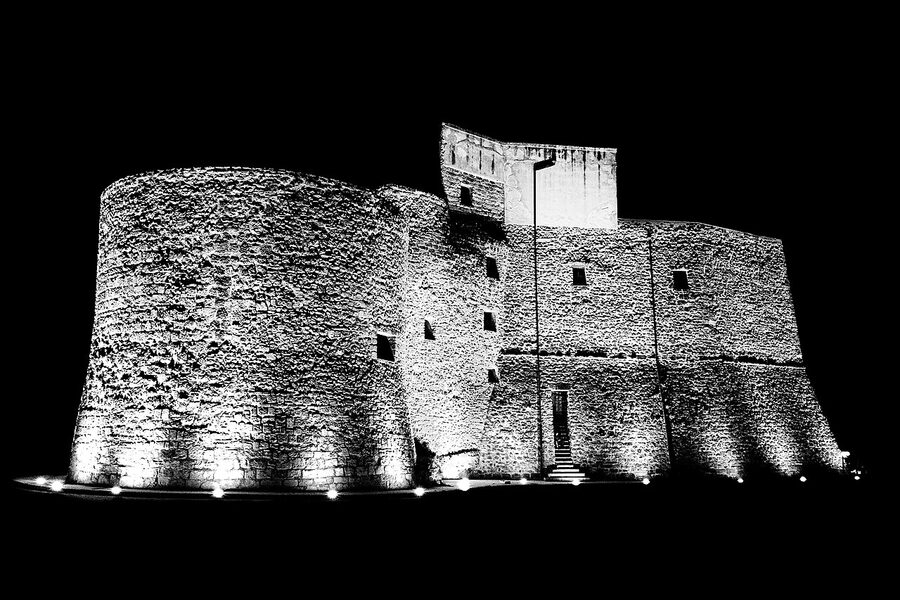

The Castello Arabo-Normanno is the reason the town has its name. It sits on a small rocky promontory that used to be almost an island — the water came right up on three sides, with a short tidal isthmus connecting it to the mainland. The Arabs built the first castle here in the tenth century as a defensive tower for the Al Madarig port. The Normans took it in the 1060s and enlarged the walls. Frederick II’s Swabians added defensive towers and outer walls in the thirteenth century. The wooden drawbridge they built across the isthmus was replaced with a stone bridge in the early modern period; the sea has since retreated enough that you walk across on solid ground today, but if you look down you can still see the stone-paved bed of the old channel.
The castle is now municipal property and open as the Polo Museale: four small museums inside the old bastion cover the region’s history — a section on medieval water-mills and cisterns, one on the local productive arts (tuna, coral, wine), one on regional archaeology, and one on the fishing economy that kept the town alive for most of its existence. The main exhibit is called La Memoria del Mediterraneo. Opening hours are Monday to Saturday 9-1 and 3:30-7:30, entry is free, and you need about two hours to do the whole thing properly.
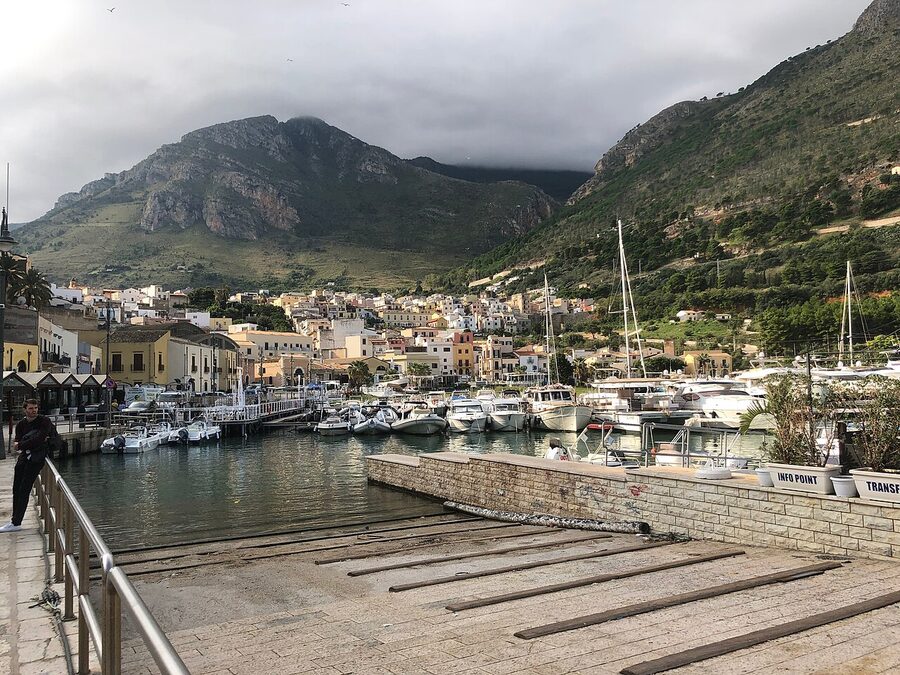
Directly below the castle, tucked into the natural cove, is Cala Marina — the working fishing harbour, a crescent of two hundred metres of mostly still-used docks ringed by twenty restaurants and bars. This is the heart of the town’s evening. The fish market is at the east end of the crescent and opens at 6am when the boats come in; by 8am the morning’s catch is laid out on ice, and by 10am it is gone. The fishmongers here still speak primarily Sicilian to each other and Italian to tourists, which is a linguistic situation rarer in modern Italy than you might think.

Directly below the castle on the sea side is what was historically called the Vasca della Regina — the Queen’s Pool — a natural rock-bound tidal pool formed between the castle bluff and an offshore rock. Local tradition says it was reserved as a private swimming area for the medieval queens of Sicily. Whether that’s true or the kind of thing municipal tour guides invent, the pool itself is real and still there, and accessible by a short scramble down from the castle terrace at low tide.
The 1718 legend and the Madonna del Soccorso
Every Sicilian town has a founding miracle. Castellammare’s is unusually well-dated. On 13 July 1718, in the middle of the War of the Quadruple Alliance, a Spanish frigate being pursued by British ships of the line in the Mediterranean took refuge in the Gulf of Castellammare. The townspeople, traditionally pro-Spanish, helped hide the ship in the inner harbour. The British commanders, angered, prepared to bombard the town. At the critical moment — according to the tradition — the Madonna appeared above the castle, the British ships ran aground in an unaccountable sudden shallowing of the gulf, and the attack was called off.
This is the kind of story that you expect in a medieval chronicle. What makes Castellammare’s version unusual is that the event is documented in British Admiralty records from the same month and year, recording a frigate chase that was indeed called off at Castellammare without engagement. The Madonna intervention is Sicilian historiography; the calling-off is British. Both sides agree something happened on 13 July 1718.
The Santuario di Maria Santissima del Soccorso, just up from the port on Corso Garibaldi, was built in 1726 to commemorate the miracle — eight years after the event, which is fast by Catholic standards. It is the town’s principal church. Three naves, eight side chapels, a large Baroque façade in golden limestone, the high altar topped with a sixteenth-century painted wooden crucifix recovered from an earlier church on the same site. Inside, the devotional focus is a seventeenth-century carved wooden statue of the Madonna holding the Child, dressed in the red-and-gold fabric that the town’s women’s guilds have commissioned anew every fifty years since 1726. Free, open during daylight hours, allow thirty minutes.
Every two years — odd years, specifically — the statue is brought down to the port on the morning of 21 August for the Festa della Madonna del Soccorso. It is then taken by boat in a maritime procession around the gulf, with decorated fishing vessels following, and returned to the church at sunset for a fireworks display over the castle. This is the town’s big festival. Accommodation on 20-21 August books up six months ahead. If you can, go: it is one of the great Sicilian feste and not at all staged for tourists.
Walking the old town — steps, the corso, and the three churches
The town itself climbs the slope behind the castle in a grid of stone stairs, which is the Arab urban plan still visible. Walk up from the Cala Marina via the Discesa Marina — about 180 steps, a dozen small pubs and bars embedded in the staircase itself, a low stone archway halfway up where by tradition you pause for breath, and a small square at the top called Piazza Petrolo where the old men of the town still drink grappa at 7am. The bar to sit at is Picolit, on the staircase itself — a cool, cave-like interior with good local wines by the glass and a decent pasta lunch.
From Piazza Petrolo, the main pedestrian street is Corso Garibaldi, running roughly east-west for about a kilometre. This is the evening passeggiata route: from 7pm in summer, and earlier in winter, the entire town walks up and down it between dinner and bedtime. The gelato shops — Gelateria Rocco at no. 45 and Caffè Don Paolo at no. 82 — are the two canonical stops. Don Paolo was Sergio Mattarella’s family café, which sells a lot more gelato now that the son of the original owner has become head of state.
Beyond the Santuario above, two other churches are worth a ten-minute stop each. The Chiesa della Madonna della Scala, at the seaward end of town just off the port, is built into the side of a rocky cliff around a small grotto where a fourteenth-century shepherd girl was reportedly found after disappearing in a storm — the grotto is the original chapel, the stone Baroque façade was added in 1784. And the Palazzo Crociferi, on Corso Garibaldi, is the former Crociferi convent from 1659, now the town hall. In summer, the old cloister in the back of the palazzo becomes an open-air cinema, and you can watch Sicilian film classics projected against the wall where Carmelite monks used to walk.
Scopello, the Tonnara, and the Faraglioni
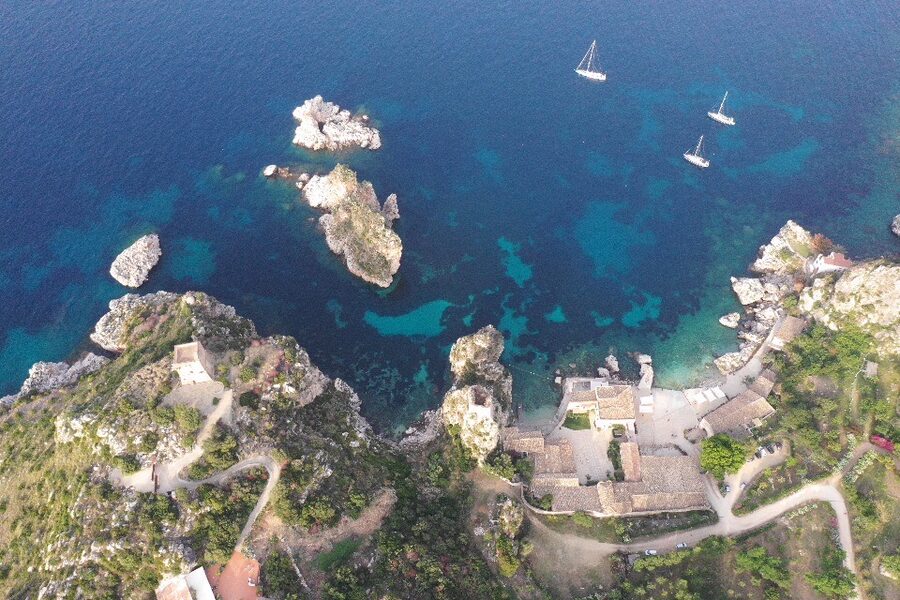

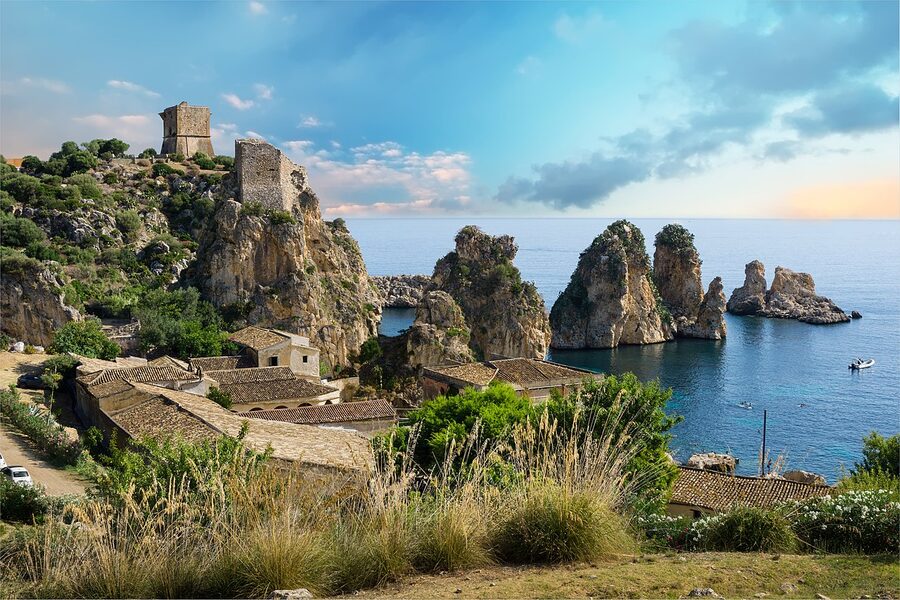
Fifteen kilometres west of Castellammare, the road climbs a headland and drops down into a tiny stone hamlet on a clifftop called Scopello. Population: 80. It has one piazza (with a single medieval stone trough still in use as a drinking fountain), one unmarked church, one butcher, two paninerie that do the single best panini con pane di tumminia in western Sicily, and a stone gateway called the Baglio that leads into a fortified 17th-century courtyard, the ancient centre of the local tuna industry. Walk through the gate and you are in what was, until 1984, one of the three most productive tuna-processing stations in the Mediterranean.
_-_Trapani,_Sicily_-_Italy_-_(1).jpg)
The Tonnara di Scopello was the local tuna-fishing facility. Tunas — primarily Atlantic bluefin — migrate every spring from the Atlantic through the Strait of Gibraltar, along the north African coast, into the Mediterranean, past Sicily’s west coast where they breed, and then out again in the autumn. The tonnara’s job was to intercept them on the way in. A complex of long nets — called a tonnara in Sicilian — was set into the sea from late April to June each year, herding the tunas into progressively smaller chambers and finally into a central holding pen, the camera della morte. On the appointed day, the nets were raised by hand, the fish were harpooned by men in boats — the mattanza — and the catch was hauled ashore and processed. The boss of the operation was called the rais, an Arab-origin title kept unchanged from the Al Madarig era.
The Scopello tonnara operated from at least 1274, when it first appears in documentary records, until 1984, when the Mediterranean bluefin tuna stock collapsed and the Italian government suspended the practice. The buildings are now a small museum with restored processing rooms, the old barracks where the tonnaroti (the net-hauling men) slept during the three-month season, and a tower terrace overlooking the bay. Entry €4, open 9-19 in summer, 10-17 in winter, closed in January.
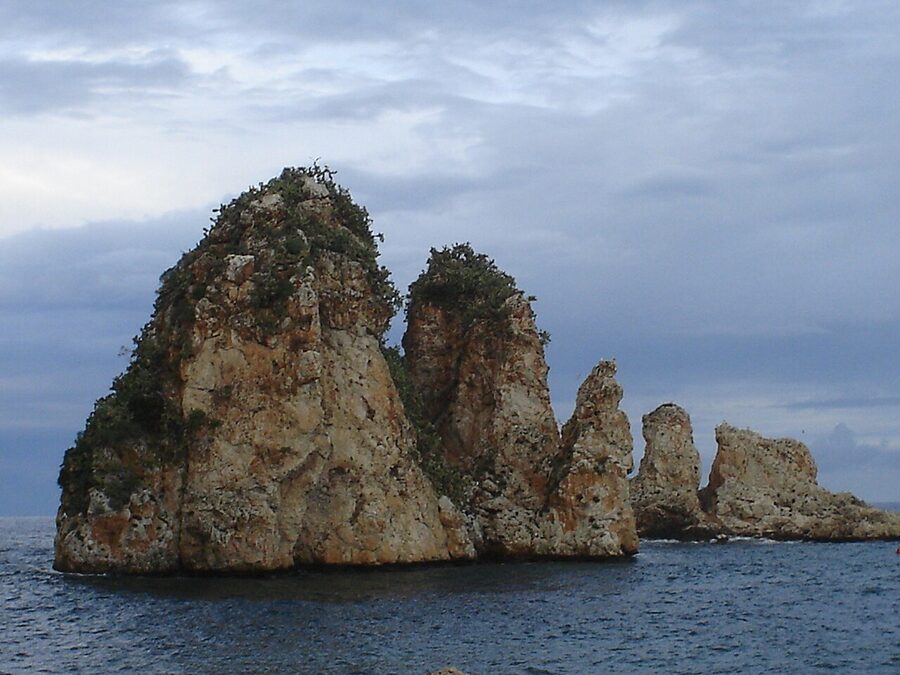
Down at the base of the cliff, a short staircase cut into the rock leads to the Spiaggia dei Faraglioni — a tiny pebble beach, maybe forty metres long, ringed by the three sea stacks (faraglioni) that rise from the Tyrrhenian like teeth. This is one of the most photographed beaches in Sicily. Entry is €5 per day, space is capped at about 200 people, and in August you should arrive by 8am to get in. The snorkelling immediately offshore is exceptional — clear to about eight metres and full of the anchovies that used to feed the tuna.
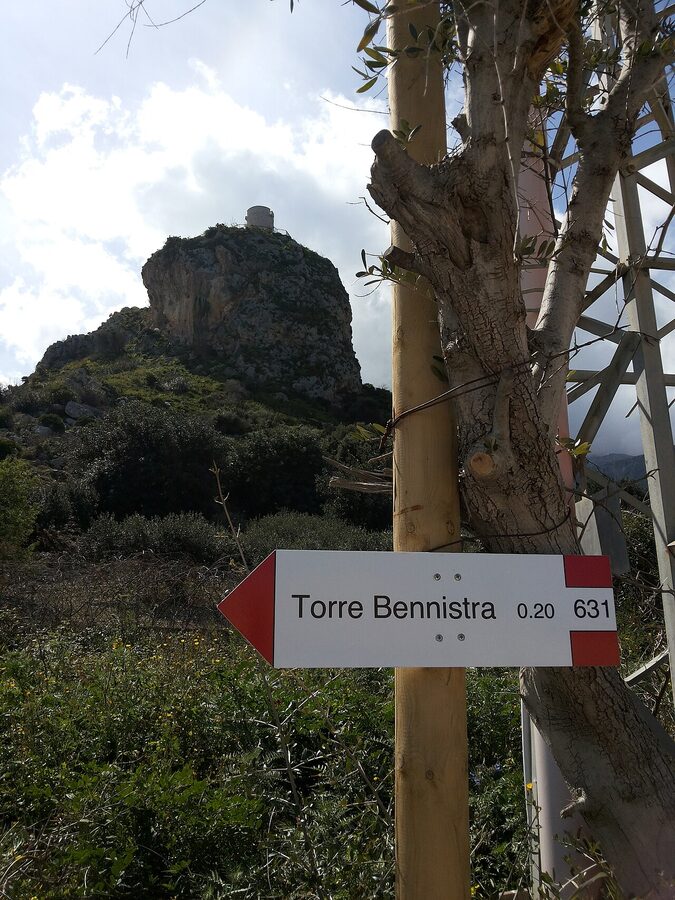
Above the tonnara, accessible by a ten-minute climb on a well-marked path, is the Torre Bennistra — one of a chain of Spanish-period watchtowers built in the sixteenth century to spot Barbary pirate raids. Free to visit, open continuously, and the best panoramic view in the whole gulf. Go at sunset.
The Riserva Naturale dello Zingaro
.jpg)
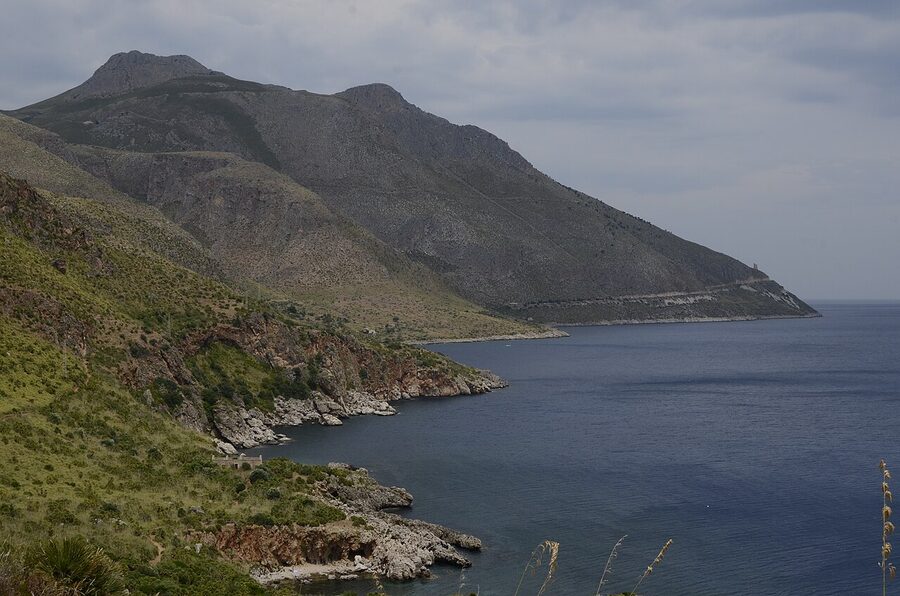
Beyond Scopello, the road is blocked by a gate. Past the gate is the Riserva Naturale dello Zingaro — Sicily’s first regional nature reserve, established in 1981 after a popular march of five thousand Sicilians prevented a planned coastal road that would have connected Castellammare to San Vito Lo Capo. The law that created the reserve was passed three weeks after the march. It protects seven kilometres of coastline between Scopello in the east and the Tonnara dell’Uzzo in the west, is crossed only by a single footpath, contains five named small beaches (Cala Capreria, Cala del Varo, Cala della Disa, Cala Beretta, Cala Marinella), and has been categorically off-limits to vehicles, new construction, and motorboats for forty-five years.
Entry is at either the south gate (at Scopello, 20 minutes’ drive from Castellammare) or the north gate (at San Vito Lo Capo, an hour’s drive). €5 per adult, €3 reduced, free for under-10s and over-65s. The path from south to north is 7.5 km one way, mostly flat, with steep short detours down to each beach. Full traverse is a 4-5 hour walk with time to swim. Most visitors turn around at Cala della Disa (the middle beach, 3 km in) and come back. Bring water and lunch — there are no facilities inside the reserve other than the two gatehouses.
The reserve is also the best place in Sicily for birdwatching. Forty-three species have been documented, including Bonelli’s eagle, peregrine falcon, and European shag. The reserve staff run guided walks in spring and autumn (€15, book at the gatehouse); these are the trips to take if you care about the flora, which is unusual — over 700 plant species in seven kilometres, including the endemic dwarf palm Chamaerops humilis, Sicily’s only native palm.
The beaches: La Plaja and Guidaloca
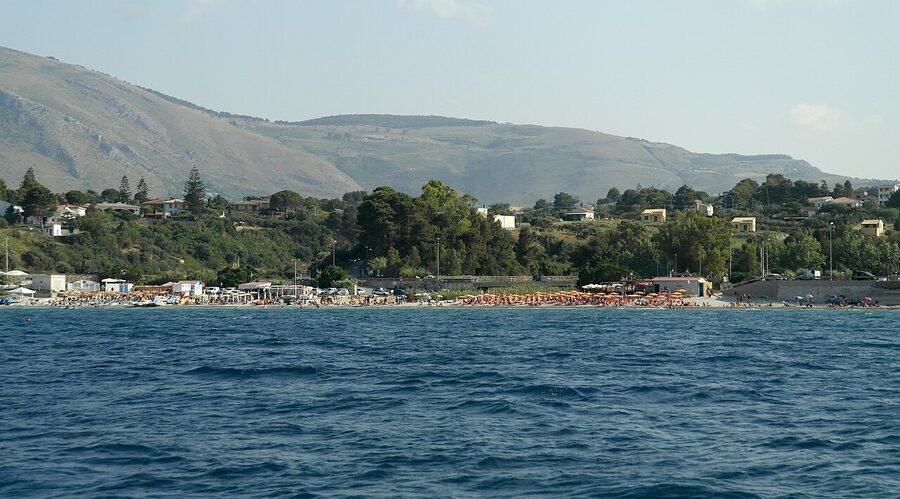

The main town beach is La Plaja — a three-kilometre strip of fine yellow sand starting 2 km east of the town centre (near the train station) and running east towards Alcamo. It is the easy beach: accessed directly from the coast road, with public free sections and paid lidi (beach clubs with umbrellas and chairs for about €15-25 a day), and shallow enough that children can wade out fifty metres before it’s waist-deep. In July and August it’s packed; in June and September it’s genuinely pleasant. The best lido is Lido La Plaja at the east end — good restaurant, fair rental prices, and the kind of Sicilian-family business where the owner’s grandmother is often in charge of the cash box.
Guidaloca, 6 km west of town on the road to Scopello, is the better beach for a more specific kind of trip. Pebble rather than sand, ringed by a 100-metre crescent of low cliff, gentle water, no tour buses. Free access; no lido. Two beach bars, a seasonal beach disco at the south end (Bora Bora Bay, open May-September, €20 cover on Saturdays). Walk fifteen minutes up the cliff path at the north end of the beach and you get a view of both Scopello and Castellammare in the same frame.
Between Guidaloca and Scopello, the road passes two smaller coves — Cala Mazzo di Sciacca and Cala Bianca — which are technically beaches but functionally rocky swimming spots for locals who don’t want to pay for the Faraglioni. Parking is along the road. No facilities. Go at dawn.
The other story — the American mafia
_01.jpg)
Half of what you read about Sicily — the whole Mario Puzo and Sopranos mythology — has its historical origin in a town of fifteen thousand people. That town is Castellammare del Golfo. Between 1890 and 1925, a large number of its young men emigrated to New York: first to Elizabeth Street in Little Italy, then to Italian Harlem, then progressively outward to Bushwick, Carroll Gardens, Gravesend, Bensonhurst, and Bensonhurst’s eastern suburbs. After World War II, another wave followed to Staten Island and the Bronx. The diaspora is larger, per capita, than any other Sicilian town’s.
Within the New York Italian-American criminal networks of the 1920s, the Castellammarese formed a tight cluster. Salvatore Maranzano founded what became the Bonanno crime family; his war against Giuseppe “Joe the Boss” Masseria in 1930-1931, known as the Castellammarese War, is the event that historians date as the beginning of the modern American Mafia’s structure. Among the Castellammarese bosses who emerged in that war: Joseph Bonanno, Stefano Magaddino (who ran Buffalo for forty years), Joseph Barbara, Salvatore Sabella (founder of the Philadelphia family), Vito Bonventre, and Sebastiano DiGaetano. Puzo’s Don Corleone is based, in part, on Joseph Bonanno. Francis Ford Coppola cast his own grandfather, a Castellammarese emigrant, as an extra in the 1972 film.
All of this happened in New York, not in Castellammare. The town itself has had a mafia problem only to the extent that every Sicilian town of its size has one. But the historical association is strong enough that several local operators run guided mafia-history walks — the original Castellammarese streets where the future bosses grew up, the Emigrants’ Café where they said goodbye, the old US consulate building that processed their visas. If you’re interested, book through the town’s tourist office; the walk is €15, takes 90 minutes, and does not sensationalise. The guide is a retired teacher called Giuseppe Segesta — yes, that really is his surname — who grew up next door to a Bonanno cousin.
The local current view of all this is complicated. Most Castellammaresi have a cousin in Brooklyn, which means the American mafia story is family history rather than abstraction. Nobody is proud of it; nobody denies it; it is what happened. One local joke: “We gave America pizza, pasta, and the Bonannos — two out of three is a good export record.” Ask for the mafia walk if you want it; don’t expect the townspeople to bring it up unprompted.
Food — fish, couscous, and Mattarella’s cafe
Castellammare has three food identities: a fishing-town identity (swordfish, anchovies, sardines, tuna), a Trapani-region identity (couscous, busiate, pesto alla trapanese), and an Arab-survival identity (the sweets). All three are worth separate meals.
Fish. The Cala Marina restaurants are the obvious place. La Tonnara at Via Don L. Zangara 29 (€30 per person, 0924 32443) is the most reliable — a fish-only menu, a view of the castle, and a kitchen that genuinely gets the morning catch. The house antipasto is a sampling plate of six small preparations (marinated anchovy, tuna tonnato, grilled octopus, swordfish carpaccio, seafood salad, stuffed sardine) and is worth ordering at the start even if you’re eating alone. Ristorante Da Laborio (Via Rosario Livatino, €30, 0924 040699) is the other classic — less fish-specific, more cucina casereccia, and good on meat dishes if fish starts to feel repetitive.
Busiate and couscous. The Trapani-region pastas and the couscous are better at the inland restaurants than at the seafront. I Sapori Siciliani (Via G. Saragat 25, €20, 0924 31352) does busiate al pesto trapanese — a hand-rolled corkscrew pasta with a raw sauce of almond, garlic, basil, and fresh tomato — that is the best version I have had outside Trapani proper. For fish couscous, the place is actually in Scopello: La Tavernetta (Via Armando Diaz 3, Scopello, €25, 0924 541129) makes the classic Trapani-style couscous with fish broth, without the tourist-menu shortcuts.
Pizza. Pizzeria La Plaja (Contrada Spiaggia Plaja 14, €20, 0924 30177) is the local cult pizzeria — wood oven, Neapolitan-Sicilian hybrid crust, sits on the beach itself at La Plaja. Book on Friday and Saturday nights in summer or you won’t get a table.
Caffè Don Paolo, on Corso Garibaldi 15, was Sergio Mattarella’s family café — the current President of the Italian Republic grew up in the apartment above it. His grandfather opened it in 1923, his father ran it through the war, and his nephew runs it now. The cannoli are good; the granita with brioche is better. Expect a portrait of Mattarella on the back wall and, if you’re lucky on a weekday morning, some regulars who went to primary school with him.
For a drink after dinner: Picolit on the Discesa Marina staircase is the atmospheric pub-in-a-stairway; Vogue Bar (Via Don L. Zangara 61) is the cocktail option; Cantina Aurelia (Corso Bernardo Mattarella) is the informal trattoria-plus-music spot with live Sicilian folk on Friday and Saturday. In July and August, Bora Bora Bay at Guidaloca is the beach disco. Not my scene, but the kids go.
Nearby — Segesta, Erice, Trapani, San Vito Lo Capo

Day trips from Castellammare by car:
Segesta, 20 minutes south. The almost-intact Doric temple of the Elymians (5th century BC) plus the Greek theatre above on the hillside — where open-air concerts still happen in July and August. This is the site that gave Castellammare its Latin name (Emporium Segestanorum, the port of Segesta) and is the one ancient Greek site in western Sicily that should not be missed. Entry €8, allow three hours.
Erice, 50 minutes west. The medieval mountain town above Trapani, reached by a six-minute cable car from the valley below. Norman castle, medieval cathedral, Maria Grammatico’s almond pastry shop (the classic Sicilian genovese is here). Allow half a day.
Trapani, 55 minutes west. Baroque centre, fishing harbour, the tuna-salting museum, the working salt flats (Saline di Trapani) south of the town with their red sunsets and slow-turning windmills, and — from the port — ferries to the Egadi Islands. Favignana, the largest Egadi, is a 30-minute hydrofoil and is the best day-trip of the whole western Sicily region.
San Vito Lo Capo, 55 minutes west via the inland road (you can’t drive along the coast — the Zingaro blocks it). Famous beach, famous couscous festival (late September), better-than-expected fish restaurants, and a handful of nice hotels. A day trip is enough unless you’re specifically going for the beach.
Palermo, an hour east. Worth a day — start at the Palatine Chapel, take a long walk through the Ballarò market, have lunch at Franco u’ Vastiddaru, see the Cathedral, walk up to Monreale if you have the energy, and be back in Castellammare for dinner at 9pm. Ambitious but doable.
When to visit
Late April through June and September through October. The sea is swimmable from mid-June to mid-October. The nature reserve is at its best in May (wildflowers) and October (stable weather, fewer ticks in the scrub). The tonnara and castle museums are open year-round but close earlier in winter.
Avoid mid-July to late August if you can. Castellammare is a primary Sicilian summer destination for Palermo and Trapani families; in August the population roughly triples, prices double, and the better restaurants are booked a week out. The Zingaro entry queue at the south gate in August starts at 7:30am and the trails become a line of walking families by 10am. The beaches are heaving.
If you are going in August, go for the Ferragosto fireworks over the castle (14-15 August) — the single best view of Ferragosto in western Sicily — and the Festa della Madonna del Soccorso on 21 August in odd years. Both justify the crowds. Book accommodation by March.
Winter (November through March) is quiet, cheap, and pleasant for walkers. You will get some rain; the sea is cold but the mountains are green. About two-thirds of the restaurants stay open. The Zingaro reserve is genuinely beautiful in February when the dwarf palms start to flower. This is the time I would personally come if I were planning a longer solitary trip.
Before you go
Castellammare del Golfo works well as a four-night base from which you drive out every morning — Palermo one day, Trapani another, Segesta one afternoon, the Zingaro for a full day, Scopello for a half-day, and two days dedicated to sitting on the beach or doing nothing on the port. It also works well as a single overnight on a loop — the middle stop of a Palermo-to-Trapani drive with a castle and a beach built in.
The one thing I would not do is come for a day trip. The town makes sense in its own rhythm — the 6am fish market, the morning walk up to the castle, the mid-afternoon swim, the 7pm passeggiata, the late dinner on the quay. A single afternoon gets you the castle and maybe a look at the port; it misses the town, which unfolds over the evening. Stay a night at minimum. Stay three if you can.
For wider regional context, see the Sicily hub. For northern Italy’s version of the Tyrrhenian coast, the Cinque Terre and Genoa are the nearest equivalents on this site. And if this is part of a wider Italy trip — which it should be — combine with an Adriatic medieval hilltown like Urbino or a water-town like Nocera Umbra to feel the north-south range of what the Italian peninsula is.