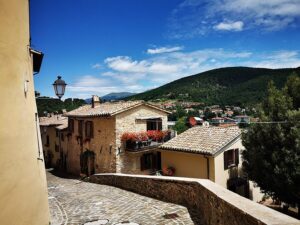
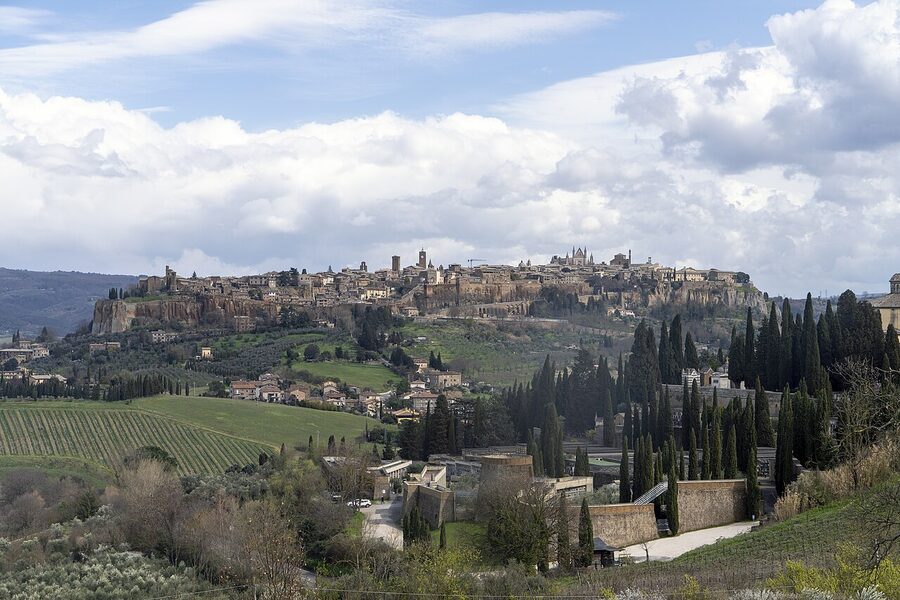
Orvieto sits on top of a cliff. The cliff is a single block of volcanic tufa, 300 metres across, rising 150 metres above the surrounding countryside with nearly vertical sides. The Etruscans built a city on the flat top in the 9th century BC because the cliff made it defensible. They made it so defensible that the Romans needed 800 days in 264 BC to take the place, after which they largely destroyed it. The medieval Orvietans rebuilt, and the Popes used the town repeatedly in the 13th and 14th centuries as the place they fled to when Rome got difficult. The one-kilometre-long old town on top of the plateau is essentially unchanged since then.
There are two reasons to come. The first is the Duomo, which has one of the four most important mosaic façades in Italy and contains one of the single greatest fresco cycles of the early Renaissance. The second is the underground — the Etruscan city beneath the medieval city, 1,200 recorded caves and tunnels dug into the tufa over 2,500 years, much of it still being excavated. You can see both in a long day. Two days is better.
In This Article
What Orvieto actually is
Population about 20,000 today, of whom maybe 3,500 live in the walled hill town on top and the rest in the modern Orvieto Scalo suburb at the foot of the cliff. The town is in the province of Terni, at the western edge of Umbria, on the border with Lazio. The Rome-Florence mainline passes through the Scalo station, which is why Orvieto is the most accessible of the Umbrian hill towns from both ends: 75 minutes by train from Rome, 105 from Florence.
The Etruscan city up here was called Velzna — one of the twelve cities of the Etruscan League. The Romans renamed it Volsinii after sacking it. The medieval name Urbs Vetus — “old city” — is where today’s Orvieto comes from. The town was papally owned from the 11th century, became a refuge for popes fleeing Rome in the 13th (Urban IV, Gregory X, Martin IV, Nicholas IV, Boniface VIII all held court here for stretches — the Papal Palace next to the cathedral was their residence), and was a minor cultural centre through the Renaissance. The Duomo’s construction spanned three centuries and attracted almost every major Italian artist of the 13th-16th centuries at some point.
Getting there
Train is the obvious answer. Orvieto Scalo station is on the Rome-Florence mainline (the non-high-speed route). Regional trains from Rome Termini take 75-90 minutes, €9. From Florence Santa Maria Novella, 2 hours, €13. From Milan, change at Florence, about 4 hours total. A few Frecciarossa high-speed trains also stop, cutting Rome to 55 minutes.
Scalo station is at the foot of the cliff. To get up to the old town, take the funicular — €1.30 one-way, departs every 10 minutes from 7.15am to 8.30pm. It climbs the cliff face in 90 seconds and deposits you at Piazza Cahen at the eastern end of the hill town. From there, either walk (10 minutes to the Duomo) or take the orange shuttle bus (line A, also €1.30, included in a €2.40 combined funicular-plus-bus ticket).
By car, exit the A1 Autostrada del Sole at Orvieto and follow signs. Parking is not allowed in the old town; use Parcheggio Campo della Fiera at the base of the cliff (€1.50/hour, with a dedicated escalator and elevator up to the old town) or Parcheggio ex-Caserma Piave just inside the eastern walls.
The Duomo
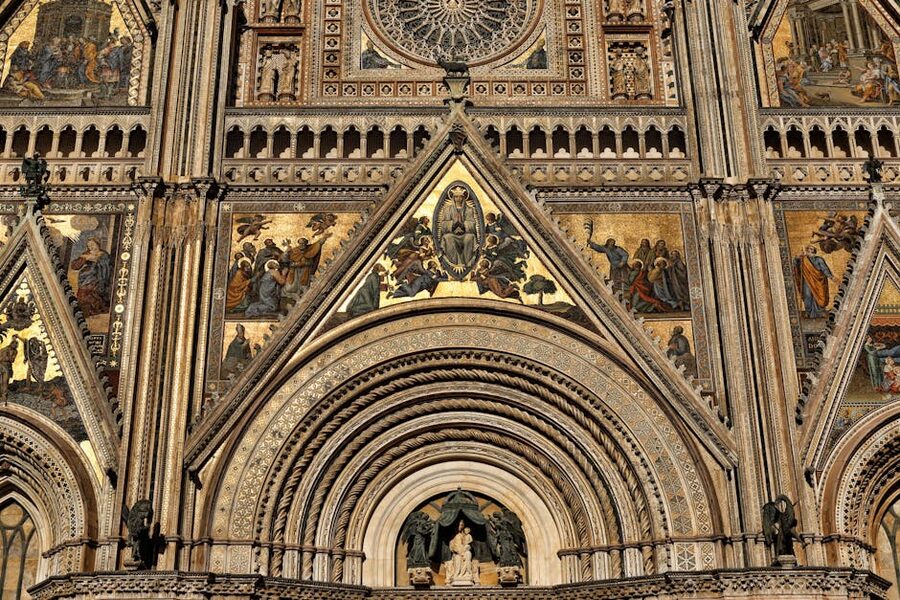
The Cattedrale di Santa Maria Assunta is the single most important reason Orvieto is on anyone’s itinerary. Begun in 1290 on the orders of Pope Nicholas IV, finished in its essentials by 1591. Three architects mattered: Arnolfo di Cambio (the first), Lorenzo Maitani (1308-1330, the one who designed the façade), and Andrea Pisano (1347-1349, who worked on the marble reliefs). The façade is the centrepiece — alternating black basalt and white travertine bands, four Gothic pinnacles with rose windows between, and, most remarkable, the four marble reliefs carved by Maitani and assistants on the four lower piers.
The four reliefs are one of the great works of early 14th-century sculpture, comparable to Giotto in painting. From left to right: Creation of the World and the Fall, Tree of Jesse and Old Testament Prophecies, Life of Christ, and the Last Judgement. The last one — saints and the saved going up to the right, damned going down to the left in a writhing heap of bodies — is the most famous, and was studied by Michelangelo (who drew from it for his Sistine Last Judgement) and by Signorelli (who copied the motifs into the San Brizio Chapel inside the cathedral, see below).
Above the reliefs are four mosaic panels. The originals from the 14th-16th centuries are largely gone — what you see today is mostly a 17th-century re-laying after the Maitani-era mosaics fell. The central pointed gable mosaic is The Coronation of the Virgin, which is original 1358 and by a team led by Cesare Nebbia.
Cathedral entry is €5 regular. Open 9.30am-7pm, reduced winter hours. Allow at least an hour; more if you’re stopping at the two chapels inside.
The San Brizio Chapel
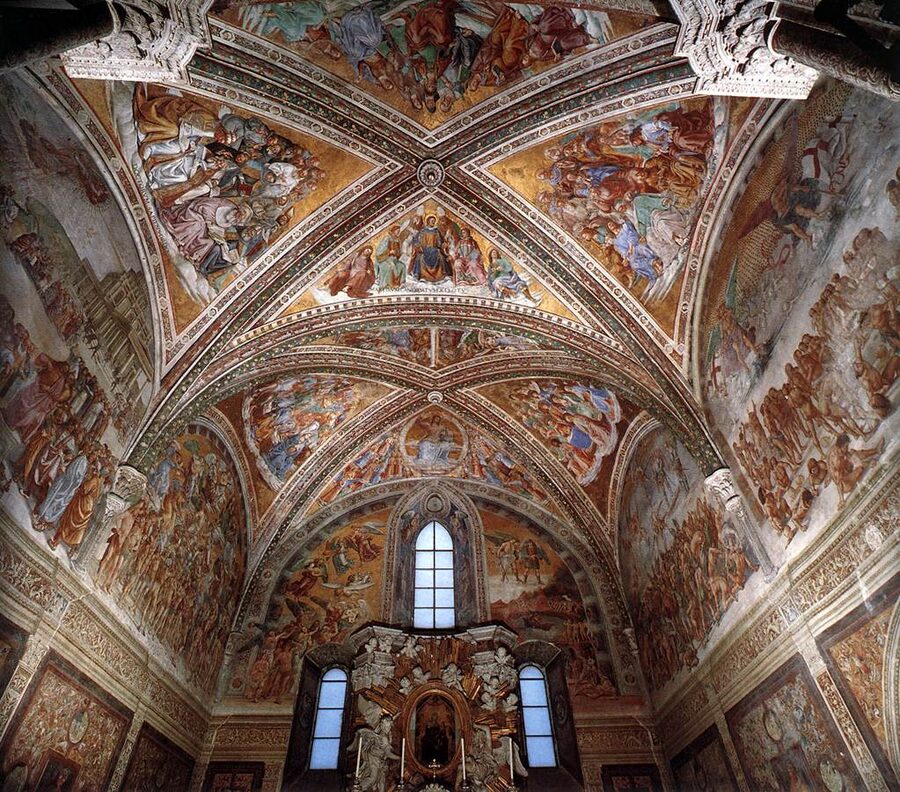
Inside the cathedral, on the right side of the transept, is the Cappella di San Brizio — the private chapel of the Orvietan Corporation, frescoed 1447-1502 by Fra Angelico (who started the ceiling) and Luca Signorelli (who finished everything else). The Signorelli cycle is the reason to come: eight enormous frescoes on the walls of the chapel, depicting the End of Days — the coming of the Antichrist, the apocalyptic earthquakes, the resurrection of the dead, the damned being dragged to hell, the blessed entering paradise. It was painted 1499-1502. Michelangelo came up from Rome to study it in 1508, in the middle of his Sistine Chapel work, and the anatomical rigour and writhing movement of the figures visibly influenced what he did next.
The chapel requires a separate ticket: €5 for the chapel alone, €8 for a combined ticket with the cathedral proper. Numbers are limited to about 25 visitors at a time. No photography (the flash is bad for the frescoes, and the attendants will enforce it). Saturday afternoons are quieter than mornings in general.
The Cappella del Corporale
Opposite the San Brizio, in the left transept, is the Cappella del Corporale — the chapel built to house the Corporal of Bolsena. This is a bloodstained altar cloth, preserved in an elaborate silver-gilt reliquary by Ugolino di Vieri (1338), said to have been stained miraculously in 1263 during the Mass of a Bohemian priest who was doubting the doctrine of transubstantiation (the bread and wine literally becoming the body and blood of Christ). Pope Urban IV, who was in Orvieto at the time, received the cloth and a year later instituted the feast of Corpus Christi. The reliquary is paraded through Orvieto’s streets each Corpus Christi in June — one of the most elaborate surviving religious processions in Italy.
The chapel is also frescoed, by Ugolino di Prete Ilario and other Orvietan painters (1357-1380). Worth a look after the Signorelli, but shorter in holding power.
The Pozzo di San Patrizio
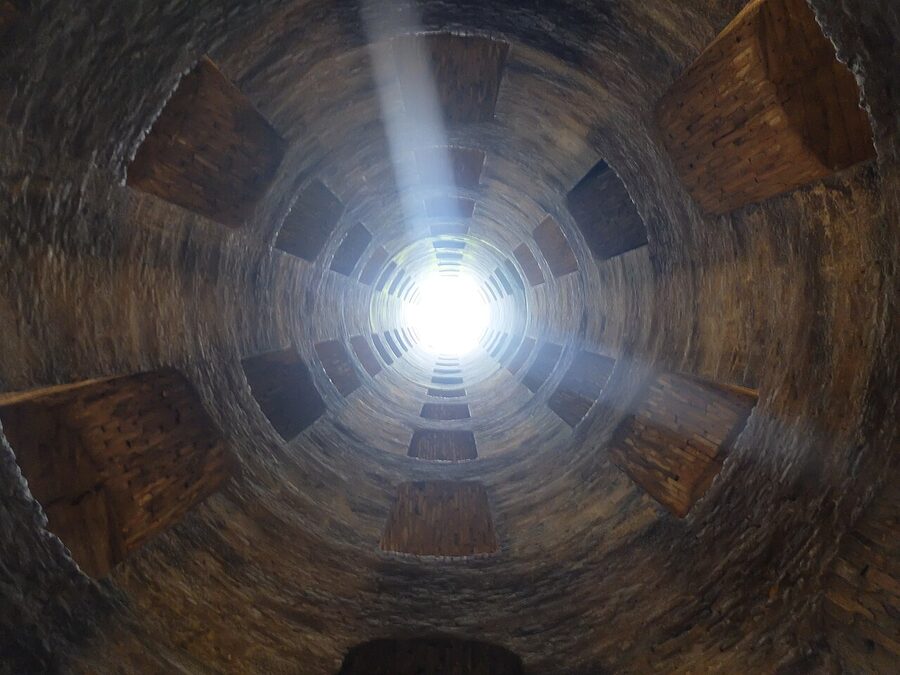
At the eastern end of the old town, next to the funicular top station, is the Pozzo di San Patrizio — one of the strangest pieces of Renaissance engineering in Italy. In 1527 Pope Clement VII fled from the Sack of Rome to Orvieto and, worried that the town could be besieged, commissioned a new water supply. The architect Antonio da Sangallo the Younger drilled a 62-metre-deep well through the tufa down to the aquifer below, and built two concentric spiral staircases around the shaft — one for pack mules going down with empty jars, one for mules coming back up full — so that the traffic never crossed. Each helix has 248 steps. 72 windows let light in from the shaft. The well took ten years to dig.
The name comes later. In Ireland, a cave on Station Island in Lough Derg was known as Saint Patrick’s Purgatory, a traditional pilgrimage site supposedly revealed by Saint Patrick as a literal entrance to Purgatory. The Pozzo’s extraordinary depth led Orvietans to start calling it the Pozzo di San Patrizio — “deep as Saint Patrick’s Purgatory.” The name stuck. It’s now an Italian idiom: un pozzo di San Patrizio means a bottomless resource.
€5 to enter and walk down. Allow 45 minutes for the full climb down and back. Open 9am-7pm in summer, shorter in winter.
Orvieto Underground
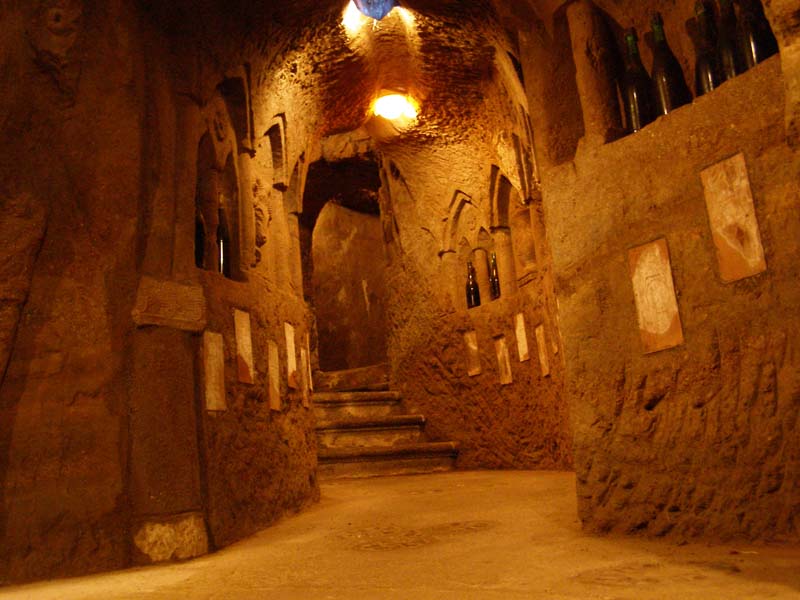
Beneath the old town, cut into the soft tufa, is a second city. The Etruscans began digging around the 8th century BC — wells, cisterns, ritual chambers — and every subsequent generation added more. By the Middle Ages, essentially every noble family in the town had its own private cellar complex cut into the rock below their palazzo, and some of them went down four or five storeys. 1,200 separate caves have been mapped so far, plus an unknown number that are inaccessible or privately owned.
Two organised tours exist:
Orvieto Underground (Orvieto Sotterranea) — the larger operation, based at Piazza del Duomo. €8, 75-minute guided tour, Italian and English. Covers an Etruscan cistern, a medieval olive mill, and the Renaissance colombai (pigeon-breeding niches) cut into the cliff face, whose openings you can see from outside the city. Multiple tours per day.
Pozzo della Cava — a smaller and more atmospheric visit, at Via della Cava 28. €4, self-guided (with good printed English explanations) through a private cave network under a single medieval house, including a deep Etruscan well and a 16th-century kiln. Less organised, more immersive.
Do both if you can. They cover different eras.
The quarters of the old town
The hill town divides into four quarters — Quartiere del Corso, Quartiere Olmo, Quartiere Santa Pace and Quartiere Serancia — each with its own small church, its own set of Renaissance palaces, and its own dialect eccentricities. The main axis, Via del Duomo, runs west from the cathedral to Piazza della Repubblica at the geographic centre. South of Piazza della Repubblica is the oldest part of the town, a tangle of medieval lanes running down to the edge of the plateau.
Three things to see away from the cathedral:
Museo Claudio Faina (Piazza del Duomo) — the Etruscan archaeological museum, in an old noble palace directly opposite the cathedral. Superb collection: the Venere di Cannicella (a 6th-century BC terracotta goddess), Attic black-figure vases, Etruscan bronzes, and the Golini I tomb murals, which were lifted whole from the necropolis below the cliff and reinstalled here. €7. Open Tue-Sun.
Necropoli del Crocifisso del Tufo — the Etruscan necropolis at the base of the north cliff, a 15-minute walk down the funicular road from Piazza Cahen. A grid of small chamber tombs, 6th-5th centuries BC, each tomb with its owner’s name carved above the door in Etruscan. Unusual and moving to walk through. €5.
Torre del Moro — the medieval civic tower at Piazza della Repubblica, climbable for a €2.80 ticket. 236 steps up. Best view of the whole hill town and the surrounding country.
Food and wine
Orvieto’s food is Umbrian inland food with a distinctive local list:
Ombrichelli (or umbricelli) — the local hand-rolled thick spaghetti, a cousin of Lazio’s pici, eaten most often all’arrabbiata (with spicy tomato and pork), or al tartufo nero (black truffle) or al sugo d’oca (with a goose ragu — Orvieto’s specialty).
Piccione all’Orvietana — pigeon stuffed with its own liver and roasted, a dish with medieval pedigree.
Cinghiale alla Cacciatora — wild boar stewed with red wine, tomatoes, olives and herbs. Heavy; good in winter.
Lumache al Pomodoro — snails in tomato sauce, a local tradition, available at most good trattorie in summer.
Orvieto Classico DOC — the white wine that made Orvieto famous outside Italy. Made principally from the Grechetto and Procanico (Trebbiano) grapes grown on the tufa hills west of the town. Dry and minerally in its modern version; historically made slightly sweet (Orvieto abboccato) and used at the Papal court. Best producers: Castello della Sala (Antinori’s flagship Umbrian estate), Decugnano dei Barbi, Palazzone. A Classico costs €10-15; the single-vineyard versions can run €25+. The Antinori Muffato della Sala — a noble-rot sweet wine — is in a class of its own.
For a meal: Trattoria La Grotta (Via Luca Signorelli 5, right by the cathedral) for authentic local food in a cave dining room; I Sette Consoli (Piazza Sant’Angelo 1/A) for fine dining with local sourcing; Enoteca Regionale (Piazza del Duomo) for wine tasting and light meals.
Where to stay, and for how long
Most tourists treat Orvieto as a day trip from Rome. This is a mistake. The town is best after 5pm, when the day-trippers have left on the funicular and the old streets go quiet. Stay overnight. Good options:
Hotel Duomo (Vicolo di Maurizio 7) — a 15-room boutique in a 19th-century palazzo, around the corner from the cathedral, from €130.
Hotel La Badia — a converted 12th-century abbey three kilometres outside the town, with a view back toward the cliff and a swimming pool. From €180. Best for a car-based trip.
Locanda Palazzone — a 13th-century tower-house on a vineyard estate, 4 km north of Orvieto, with 7 rooms and dinner served on request. From €220. My favourite.
One night gets you the cathedral and one of the two underground tours. Two nights does the cathedral plus the Pozzo plus both undergrounds plus a half-day at the Faina museum and the necropolis, with time for a long dinner. Three nights lets you add day trips — the Castello della Sala vineyard to the west, the Lago di Bolsena to the south (over the Lazio border, but worth the drive), or the Etruscan necropolis at Tarquinia.
When to visit
Orvieto works year-round. Summer is busy — Italians on holiday — and the tufa heats up in August (avoid midday). Spring and autumn are the sweet spots: cool mornings, long evenings, the vineyards at their most photogenic (May for blossom, October for harvest). The feast of Corpus Christi (June, moveable) brings the Corporal procession and is a spectacular occasion, but also the single most-booked weekend of the year — plan months ahead. Winter is lovely and cheap; the restaurant scene narrows, but the places that stay open are the best ones.
For regional context see the Umbria hub and the city guides for Bevagna and Nocera Umbra. Further guides to Spello and Foligno are in preparation.