
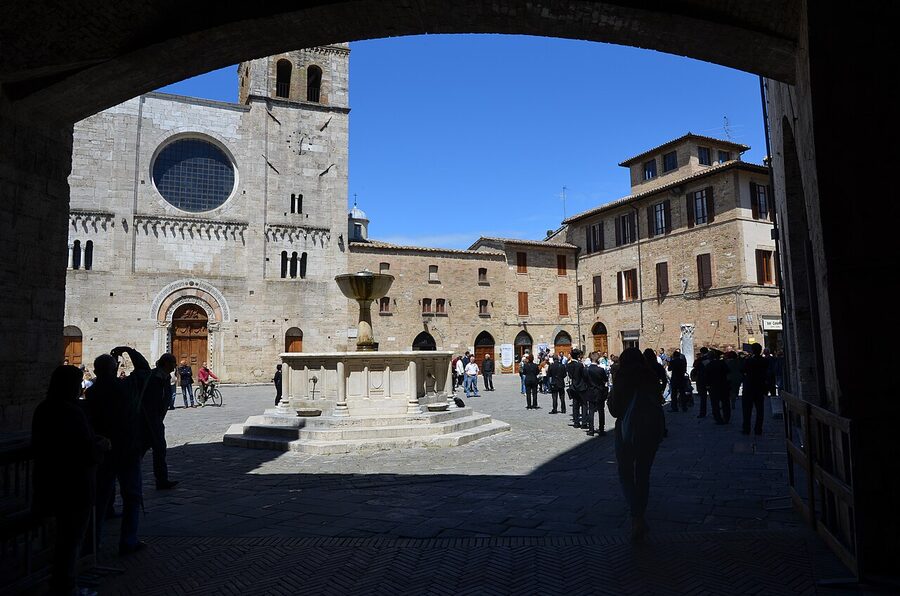
Bevagna is a walled town of five thousand people twenty kilometres south of Assisi, on the flat of the Valle Umbra. It does not appear in most international guidebooks. It has never had a railway station. It has one traffic light. It also has what is, arguably, the single most beautiful town square in central Italy — a medieval piazza with two Romanesque churches facing each other across the space, a Gothic town hall, an 1886 opera house the size of a living room, and, beneath all of it, a full Roman bath complex from the 2nd century AD. If you’ve got a spare afternoon in Umbria and you’re between Assisi and Spoleto, Bevagna is the one to stop for.
The town sits on the old Via Flaminia, the Roman consular road that ran from Rome to the Adriatic. The Romans called it Mevania. Propertius, the elegiac poet, was born here in around 50 BC. The town was Christianised in the 3rd century (Bishop Vincentius, martyr), walled properly in the 13th century, and has kept the medieval plan more or less unchanged since. The current population is lower than it was in 1300. Almost nothing has been built inside the walls in the last two hundred years.
In This Article
Getting there
Bevagna is 25 km south of Assisi and 35 km north of Spoleto, off the SS3 Via Flaminia. There’s no railway station in Bevagna itself; the nearest are at Foligno (9 km away, on the Rome-Ancona mainline) and Spello (12 km). From either, it’s a 15-minute drive or an Umbria Mobilità E102 bus (hourly-ish, €2). If you’re driving Umbria generally, which is what I’d recommend, exit the E45 expressway at Foligno and follow signs for Bevagna-Cannara.
There’s free parking just outside the eastern wall at Piazzale Santa Maria. Park there and walk in through Porta Foligno; the town is 600 metres end to end and everything is inside the walls.
Piazza Silvestri
The main square is the whole point of the visit and, as town squares go in central Italy, it’s exceptionally symmetric and exceptionally complete. Three medieval public buildings face each other across the single paved space, built over a span of about fifty years in the late 12th and 13th centuries, by architects and masons drawing on Umbrian Romanesque forms and the then-fresh influence of Cistercian Gothic.
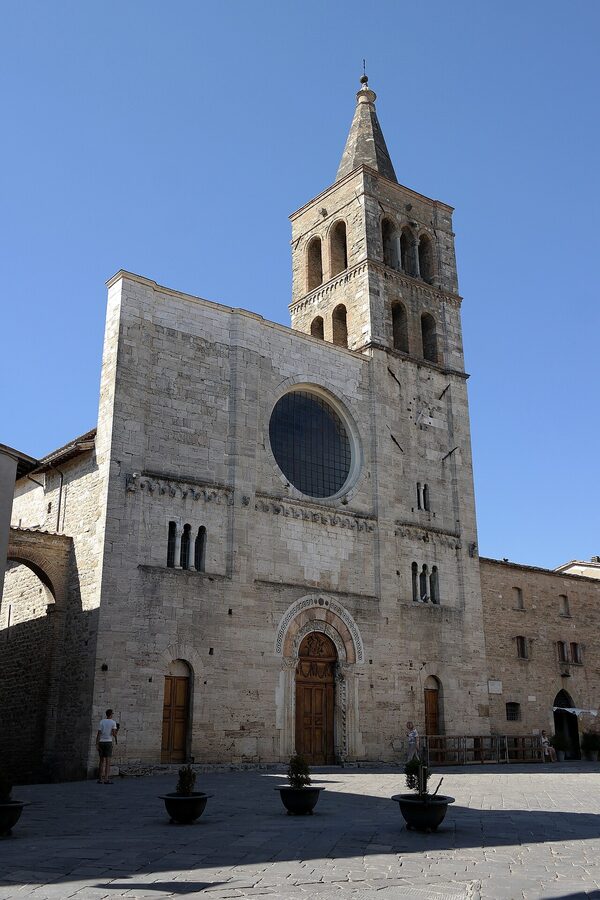
San Michele Arcangelo — consecrated 1195, the parish church, on the right side of the square as you enter from the east. The façade has a three-arched central portal with Cosmatesque marble inlay, a rose window, and two flanking stone reliefs of griffins (the town’s emblem). Inside it’s plainer than the façade suggests — a single Baroque overlay on the 12th-century structure — but the 13th-century ciborium over the altar is original and the crypt (7th-century, from an earlier Lombard church) is worth the small detour.
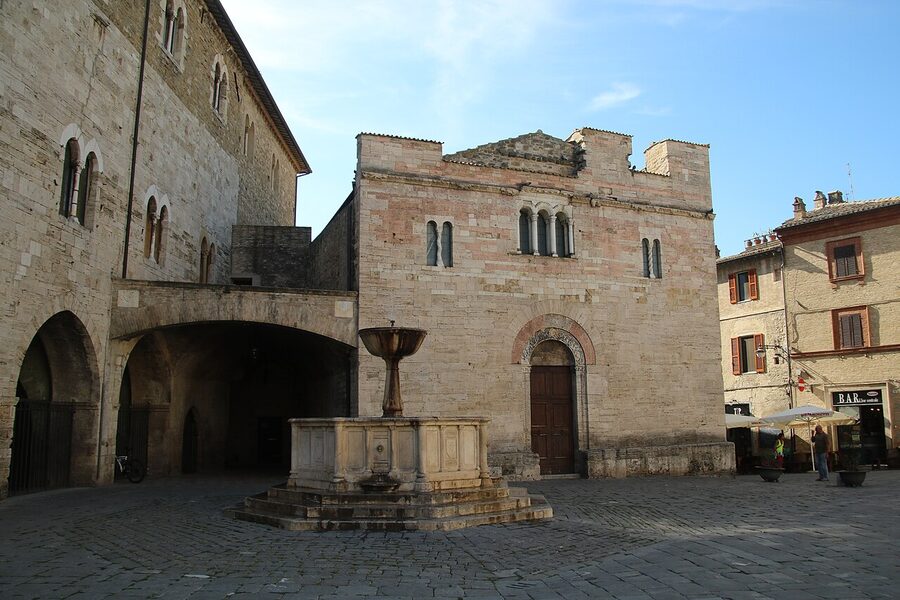
San Silvestro — finished 1195, directly opposite San Michele, built by Master Binello and his assistant Rodolfo (both of whom signed their work on the architrave in Latin — a rare medieval self-identification). The façade is travertine and was never finished; the upper level is in a different stone and clearly stops halfway. The interior, however, is one of the purest Romanesque spaces in Umbria — three naves, a crypt under the apse, no later Baroque intervention. In the summer the church is sometimes used for Gaite festival events. Otherwise it’s usually locked; ring the bell at the parish house next door during opening hours.
Palazzo dei Consoli — closing the north side of the square, the 13th-century town hall, a three-storey brick block with a loggia on the ground floor and a grand external staircase to the first. Built 1270 by the Free Commune of Bevagna during the brief period when the town was independent of both the Papal State and the Duchy of Spoleto. The top floor contains one of Umbria’s odder small curiosities:
Teatro Francesco Torti — a miniature 19th-century opera house, tucked inside the Palazzo dei Consoli, built 1886 for a town that had about 3,000 residents at the time. Two tiers of boxes, about 150 seats, painted ceiling with neoclassical allegories. It still operates — the Bevagna amateur dramatic society uses it for productions, and there are occasional touring chamber operas in summer. You can tour it for €3 when the ticket office is open (usually 10.30am-1pm, 3-6pm, Tuesday-Sunday). Ask at the Palazzo Lepri tourist office across the square.
The Roman remains
Bevagna’s Roman layer is just below the modern surface and in two specific places:
Mosaico delle Terme Romane (Via Porta Guelfa) — the floor mosaic of a 2nd-century AD Roman public bath complex, preserved in situ beneath a purpose-built cover. The mosaic depicts marine creatures — dolphins, octopuses, lobsters, fish — all in black-and-white tesserae, and is one of the best-preserved provincial Roman bath mosaics in central Italy. The bathhouse itself covered about 600 square metres; only a portion is visible. Combined with a small Roman-themed display. €3. Open daily 10.30am-1pm, 3.30-6pm (shorter in winter).
Roman Theatre (Via del Teatro Romano) — remains of a 1st-century AD theatre, about 80 metres across, partially incorporated into the medieval street grid. The semicircular shape is still visible from the air and in the curve of Via del Teatro. Outside buildings are open access; the tunnels under the cavea (seating bank) can be seen from inside the private courtyard of a café that sometimes lets visitors in.
A small Museo Civico in Palazzo Lepri on the main square holds Roman votive objects, bronzes, and medieval ceramics. Combined ticket for all three sites: €7.
Le Gaite and the Mercato delle Gaite
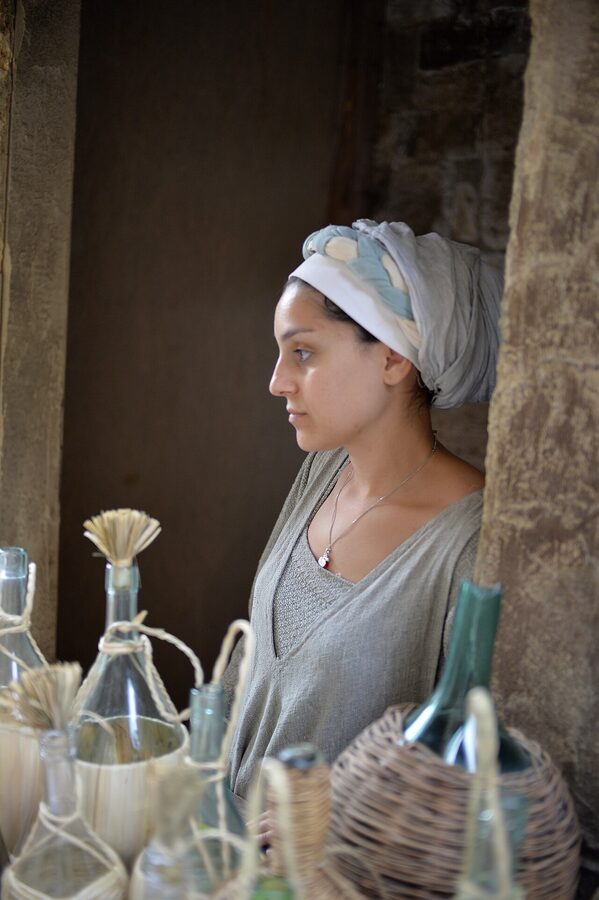
The medieval town of Bevagna was divided into four gaite (quarters) — Santa Maria, San Giorgio, San Giovanni, San Pietro — each of which had its own tax roll, its own mayor, its own church, and its own craft workshops. The division is still live: for ten days every June, the town celebrates the Mercato delle Gaite — one of the most serious medieval re-enactments in Italy. The four gaite compete against each other in five traditional crafts (paper-making, silk-weaving, coin-minting, candle-making, and an archery tournament), in a cookery contest using only 14th-century recipes, and in a market of reconstructed medieval goods sold in period-accurate currency.
What makes Bevagna’s re-enactment different from the dozens of others in central Italy is that the workshops are permanent. Four of them — the cartiera (paper mill), the setificio (silk workshop), the cereria (chandler), and the zecca (mint) — are set up year-round in restored medieval buildings and can be visited for about €3 each, by appointment at the tourist office. Each uses only period-accurate tools and techniques. The paper mill produces sheets of handmade rag paper; the mint strikes reproduction 14th-century silver coins; the silk workshop produces small quantities of dyed silk thread using madder, woad and saffron. If you’re interested in historical crafts, this is probably the best small-town example of the living trades in Italy.
The festival itself runs from the third Friday in June to the following Sunday (so 9-10 days, exact dates vary year to year). Accommodation in Bevagna during Gaite is fully booked six to nine months ahead; try the neighbouring villages (Cannara, Montefalco, Foligno) if you’re deciding late.
Walking the walls
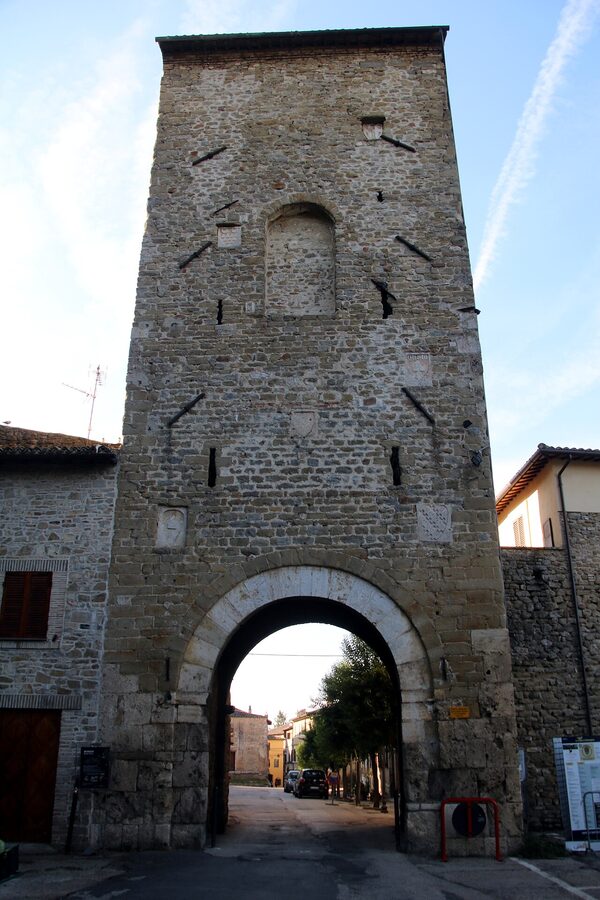
Bevagna retains its full 13th-century walls and three of the four original gates: Porta Foligno (east), Porta Cannara (north-east), Porta Guelfa (south), and the lost Porta Molini (west). The circuit is about 2 kilometres and takes 45 minutes at a walking pace; most of it is accessible from the outside via the ring road. Inside the walls, the medieval street plan runs along a single main axis (Corso Matteotti) with a dense network of small lanes running off it. The main piazza, Silvestri, sits near the centre. The rest is residential, with scattered small churches and artisans’ shops.
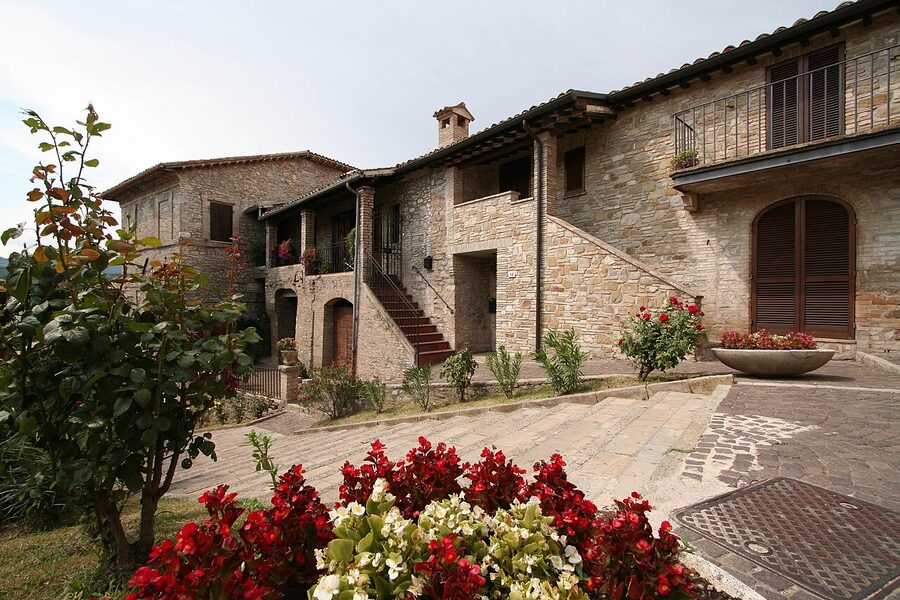
Worth finding while you walk:
- Chiesa di Santi Domenico e Giacomo — a 13th-century Dominican church on Via Crescimbeni, with frescoes by Andrea Camassei and a small cloister.
- Chiesa di San Francesco — slightly above the main piazza, rebuilt in the 17th century but with a medieval foundation; a foot of Saint Anthony of Padua is venerated here as a relic.
- Palazzo Bartoli — an 18th-century palazzo on Corso Matteotti, home of the Bartoli family who produced the Cardinal Archbishop of Perugia in 1800; now partly open as a small cultural centre.
Food and drink
Bevagna is at the centre of a well-defined food micro-region. The surrounding hills produce some of the best black truffles in Umbria, the nearby town of Montefalco (6 km) makes the great Sagrantino red wine, and Bevagna itself has a couple of excellent local restaurants. Four things to eat and one to drink:
Tartufo Nero — local black truffle, in season November-March. Grated over fresh pasta, scrambled eggs, or on a bruschetta with Umbrian olive oil. The Fiera dell’Antiquariato del Tartufo — the truffle antique fair — in early December is a small but serious event.
Strangozzi al Tartufo — the Umbrian thick hand-rolled pasta, black-truffled. The classic Bevagna version.
Cinghiale in Umido — wild boar stewed with red wine (ideally local Sagrantino), tomatoes, olives and juniper. A winter dish.
Porchetta — the central Italian roast pork tradition, strongly represented at the Saturday morning market in Piazza Garibaldi. €4 for a stuffed roll.
Sagrantino di Montefalco DOCG — the great red wine of the nearby hills. Heavy on tannin, needs ten years in the cellar, pairs perfectly with cinghiale and aged pecorino. Best producers (Arnaldo Caprai, Tabarrini, Romanelli, Perticaia) all offer tastings and are 10-20 minutes’ drive from Bevagna.
For a meal: Redibis (Piazza Silvestri 1) does a serious modern Umbrian menu in the arcades of the old pharmacy — book ahead, especially on weekends; Ottavius (Via del Gonfalone 4) is a family trattoria with a €22 three-course tasting menu and an excellent wine list; Enoteca Piazza Onofri is the wine bar to try if you only want a glass of Sagrantino and a plate of local cheese.
Where to stay
For overnight accommodation in Bevagna itself:
Palazzo Brunamonti (Corso Matteotti 79) — a small, well-restored palazzo-hotel on the main street, from €120. Most convenient base.
L’Orto degli Angeli — a private garden-hotel in a 17th-century palazzo, Piazza Garibaldi 4, with one of the better Umbrian restaurants inside, from €180. The best option for a special night.
Agriturismo Prato Barone — an agriturismo on the hills just outside Bevagna, with vineyards and a pool, from €150. Ideal if you have a car and want to be 5 minutes out of town.
Bevagna is a half-day town as a detour. If you’re using it as a base for the wider region, two to three nights gives you time for Montefalco, Spello, Assisi, and a detour to the nearby Fonti del Clitunno (the springs that inspired Carducci, Pliny and Virgil in turn).
When to visit
Spring (April-May) and autumn (September-October) are the sensible windows — mild temperatures, the region’s wildflowers in bloom, the vineyards either flowering or harvesting. Late June is the Gaite festival, which is spectacular if you can get a room but makes the town briefly busy. Winter is quiet and atmospheric, and the black truffle is at its best. August is warm and reasonably empty; Italians on holiday are usually at the coast.
For regional context see the Umbria hub, Orvieto, and Nocera Umbra — the last being a small hill town 45 km north of Bevagna with a Lombard necropolis and a dead spa. See also the Saint Francis across Umbria guide — the sermon to the birds at Piandarca happened a few kilometres north of town, on the walk to Cannara. Forthcoming: Spello and Foligno.


_01.jpg)
