

If you have ever drunk bottled water in an Italian train station, there is a reasonable chance the label said Nocera Umbra. The Flaminia spring has been pumped out of the ground below this small hilltown in the Perugia province since the mid-nineteenth century, bottled at Nocera Scalo, and trucked to half the supermarkets of central Italy. The town itself — perched five kilometres uphill, on a rocky spur over the Topino valley — sees almost none of the people who drink it.
That is the first thing to say about Nocera Umbra. The second is that the water is only the smallest part of the story. This is a town that the Lombards buried their dead outside for a hundred years; that Frederick II burned down in 1248; that produced a Greek scholar who taught the future Pope Leo X; that was reduced to a red zone for two years after the 1997 earthquake; and that has, quietly and without a lot of tourist-industry noise, put itself back together. It has five and a half thousand people now, one of the largest municipal territories in Umbria, three mineral springs, two working city gates, one resurrected medieval tower, and the full Italian small-town certification set: I Borghi più belli d’Italia, the Bandiera Arancione from the Touring Club Italiano, and more recently a Borgo Green label for the walking trails in the hills behind.
I came here the first time as a detour from Assisi, expecting a minor sideline — the sort of stop you make because it is on the way — and left convinced it deserved more than the afternoon I gave it. If you are putting together an Umbria trip around Orvieto, Perugia, and Assisi, and you have a free day, go to Nocera.
In This Article
- Nocera Umbra in one paragraph
- Getting to Nocera Umbra
- La città delle acque — the water that made Nocera famous
- The Campanaccio and the ghosts of the rocca
- The Duomo, Saint Raynald, and the first martyrs of Umbria
- The Pinacoteca, Alunno’s polyptych, and a Lombard necropolis
- Piazza Caprera, and walking the rest of the town
- The three gates
- The borgo piccolo and the camminata
- Older Nocera — Via Flaminia, Frederick II, and the 1997 earthquake
- Food: biscio, ciaciette, and the pilgrim roll
- Festivals — the Palio dei Quartieri and the Cavalcata di Satriano
- Where to combine Nocera — Assisi, Foligno, Gualdo Tadino, Monte Pennino
- When to visit
- Before you go
Nocera Umbra in one paragraph
A medieval hill town at 520 metres, population 5,506, one of the largest comuni in Umbria by area (157 square kilometres), fifteen kilometres north of Foligno, on the old Via Flaminia between Rome and Ancona. The historic centre is arranged vertically, with concentric lanes climbing to a fortress tower and a Romanesque cathedral at the top. Famous in Italy for its mineral water and, before that, for three centuries of spa tourism at the Bagni di Nocera on the road to the springs. Famous locally for Saint Raynald, patron of the diocese, whose incorrupt body still lies under the high altar of the cathedral. Patron saint’s day, 9 February. Demonym, Nocerini.

Getting to Nocera Umbra
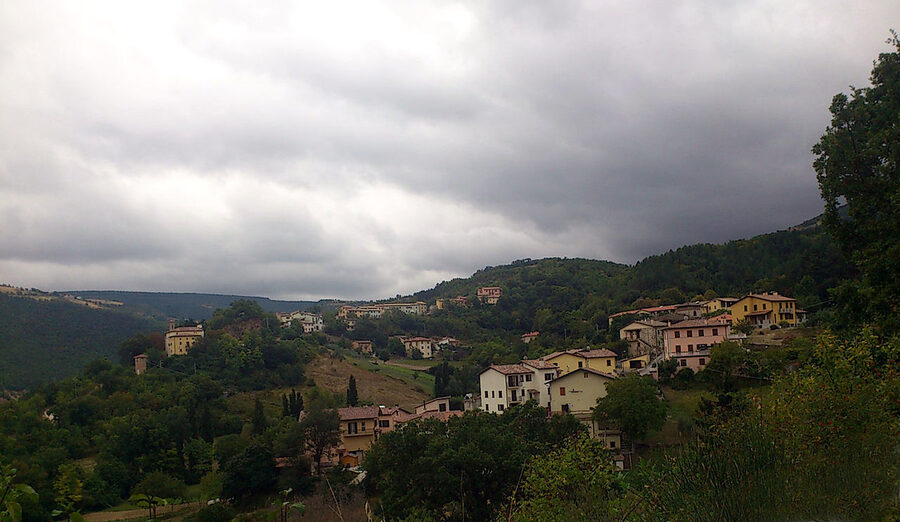
The simplest approach is by car. The SS3 Flaminia — the modern road that traces the Roman Via Flaminia — runs along the valley floor, with a junction at Nocera Scalo (the modern lower town, where the station and the bottling plant are). From there it is about five kilometres up a well-signposted road to the historic centre. Coming from Rome, allow two hours; from Perugia, about 45 minutes; from Assisi or Foligno, 20 to 30 minutes.
By train, the line is the old Roma–Ancona, which also serves Foligno, Spoleto, and Terni. Trains stop at Nocera Umbra station — actually in Nocera Scalo, 5 km from the historic centre — several times a day. From the station there is a local bus up to the town, but the schedule is a scolastica (school-timetable) one, and unless you time it exactly, a taxi is a reasonable shout. If you are making a day trip, a car is easier.
You can also arrive on foot, for what it is worth. The town sits on one of the inland variants of the Via di Francesco, the Franciscan pilgrim route from La Verna to Assisi and Rome, and on the Via Lauretana to Loreto. I have met pilgrims in the square who walked in from Assisi that morning — 28 kilometres of hills — and were planning to carry on to Foligno the next day. If you are doing one of the Franciscan trails, Nocera is a natural overnight.
La città delle acque — the water that made Nocera famous
Three springs rise in the municipal territory. The Angelica is the oldest; the Flaminia is the one you have probably drunk; the Cacciatore, near the hamlet of Schiagni, is the most recently developed and, according to the municipal plans, the one targeted for a new thermal centre.
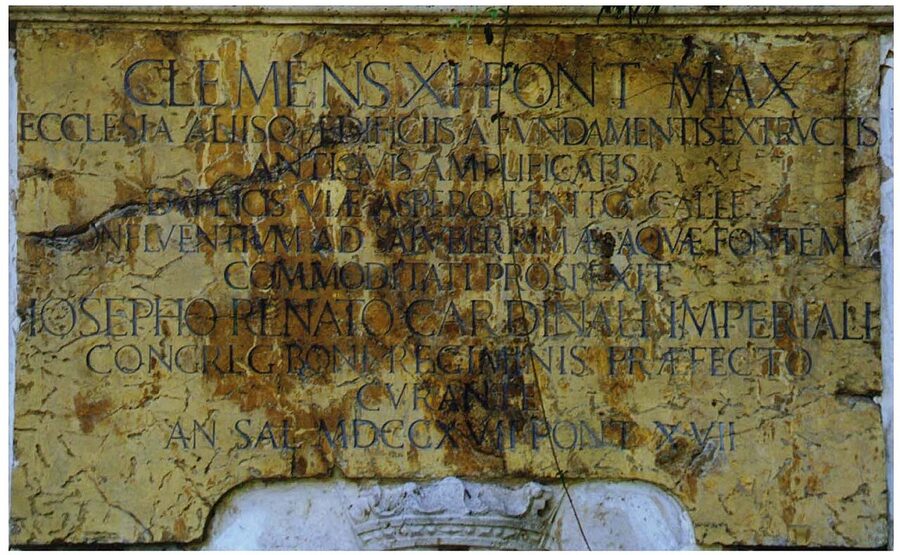
The Angelica has been used therapeutically since at least 1500. By the seventeenth century it was a recognised destination for the nobility and clergy of the Papal States, and a set of palaces was built at the site — about five kilometres southeast of the town, on the mountain flank where the spring emerges. One inscription on the older palace records that it was constructed in 1611 under Pope Paul V, on the initiative of Monsignor Domenico Marini, governor-general of Umbria. A red stone plaque records a second building commissioned by Alexander VII in 1665. In 1717 Clement XI expanded the complex again — that inscription is still there, bearing the Albani family coat of arms.

The water’s reputation travelled. A character in one of Francesco Redi’s poems calls for Nocera water as a remedy. In September 1805, Alexander von Humboldt and Gay-Lussac came up the valley specifically to analyse its mineral composition. By then the spa had already begun to decline — the grand tour was moving on, and the nineteenth century would bring both railways and a brutal rebalancing of the European spa economy towards Bohemia, the Rhine, and the French Pyrenees.

What happened instead, starting in the nineteenth century, was that the water went industrial. The old thermal station was gradually converted to a bottling plant. The Flaminia spring, which rises a few kilometres away at Le Case, was tapped for the commercial bottled-water business, and the bottling happens today at the Nocera Scalo plant. The water you buy in the supermarket is almost entirely bicarbonate–calcium mineral water, moderately mineralised, alkaline; the local clay at the same spring is still sold for mud therapies.
The current state of play at the Bagni: it is not a functioning spa. The palaces are there, the inscriptions are there, the spring is there, the mountain scenery is remarkable — but the hotel is closed, the treatment rooms are shut, and you go for the history and the walk rather than the dip. The town has been talking for years about reopening a thermal centre, most seriously around the Cacciatore spring. I would not plan a trip around it yet, but I would not be surprised if in five years the answer is different.
The Campanaccio and the ghosts of the rocca
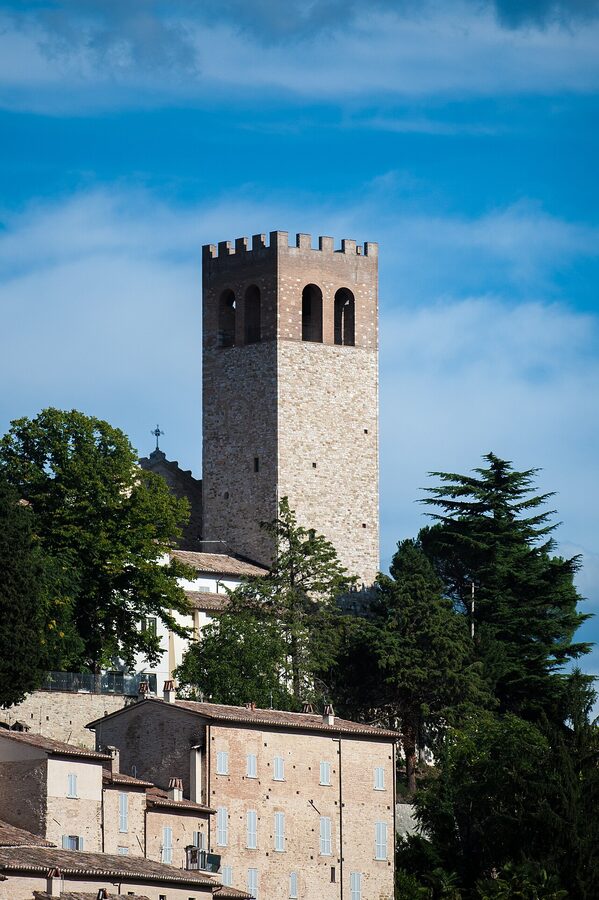
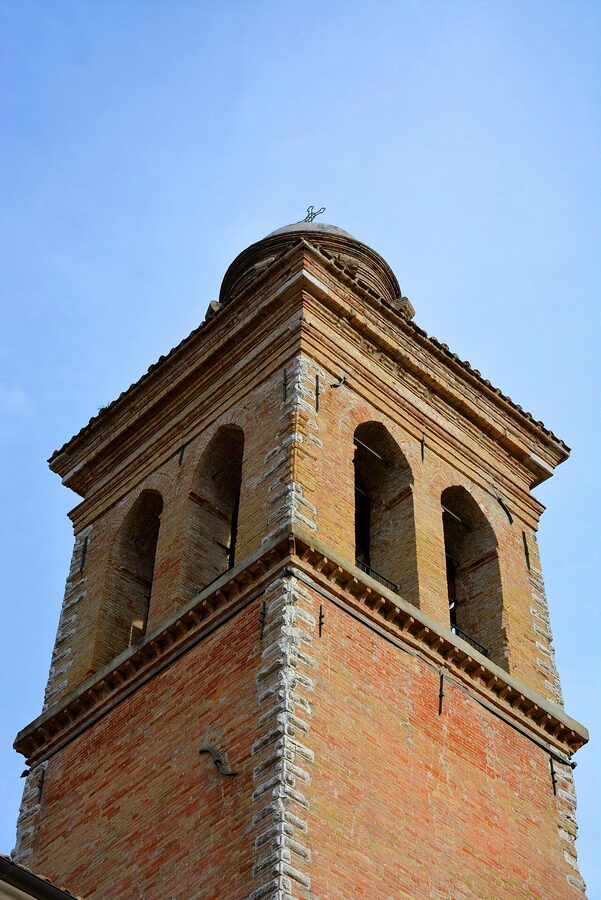
The most-photographed single object in Nocera is the Campanaccio — the civic tower that rises above the cathedral at the top of the hill. It is what you see first on the approach from the valley, and what you see last on the way down. It is also the newest thing in the historic centre, in the peculiar sense that it has been almost completely rebuilt.
.JPG)
The tower is eleventh-century in its foundations. It was the bell tower of the old rocca, the fortress of the counts of Nocera, and then of the castellans who held the town for the Trinci family of Foligno and, later, the Papal States. By the twentieth century it was the last substantial remnant of the fortress — the rest had been demolished, replaced, or incorporated into the cathedral.
On 26 September 1997, the Umbria-Marche earthquake hit. The Campanaccio took heavy damage — by some accounts only one side remained standing — and the entire historic centre was declared uninhabitable, a zona rossa, for more than two years. The tower you see now is a careful reconstruction from the surviving fabric, completed as part of the long restoration cycle that officially wrapped up only in 2016.
There is a specific story attached to the tower that the locals tell and that explains, in part, why the rocca disappeared. In 1421, Pietro di Rasiglia was the castellan of Nocera for the Trinci family. He became convinced that his wife was having an affair with Niccolò Trinci, the lord of Foligno. He invited Niccolò and his brother Bartolomeo to a party at the fortress, murdered his own wife along with both guests, and set off a clan war. Niccolò and Bartolomeo’s younger brother Corrado escaped the trap, returned with forces, and eventually retaliated. The fortress’s reputation did not survive the episode. Within a few decades the Papacy had installed Francesco Sforza in Nocera, the rocca had lost its function, and the slow demolition began.
You can climb the tower for a small fee (opening times are seasonal — check at the infopoint in Piazza Caprera). The view from the top covers the whole Topino valley, Monte Pennino to the east, and on a clear day the Apennine spine all the way to Gualdo Tadino.
The Duomo, Saint Raynald, and the first martyrs of Umbria
The cathedral — the Duomo di Santa Maria Assunta — sits just below the tower, on the summit of the hill, where the fortress chapel used to be. Local tradition says there was a Roman temple to the goddess Favonia on the same site, converted to a Marian church in the fifth century, when Nocera got its first bishop. Like almost everything else at this altitude, it has been reduced to rubble and rebuilt more than once.

The Romanesque portal on the left-hand side of the cathedral survives from the tenth-century rebuild and is worth the walk around — vines and animals carved along the archivolt in that stylised, slightly wonky Umbrian way. The interior is not Romanesque; it is early nineteenth-century neoclassical, with a single nave, pilasters, plaster vaults, and a semicircular apse. If you are coming from an Assisi-Orvieto-Todi sort of itinerary, braced for fresco cycles, that is useful to know in advance. This is not the main attraction.
What makes the Duomo worth going in for is, first, the sacristy, which has a majolica-tiled floor; and, second, a 1483 Nativity altarpiece by Niccolò da Foligno — also known as L’Alunno, the same painter whose 1483 polyptych hangs in the Pinacoteca two streets downhill. Alunno is one of the more interesting Umbrian Renaissance names: a contemporary of Perugino, active mostly in Foligno and the surrounding hill towns, harder-edged and more Gothic in feel than the Perugino-Raphael Umbria that tourists tend to know.
The cathedral is dedicated to the Assumption, but the altar underneath holds the body of Saint Raynald, who has been the object of local devotion for eight centuries. Raynald was bishop of Nocera from 1213, appointed after he had served his predecessor Ugo as a diocesan substitute. He died on 9 February 1217. His successor, Bishop Pelagius, had him embalmed and proclaimed a saint within a few months. His body has been in a decorated urn under the high altar ever since. Raynald was a personal friend of Saint Francis — the same Francis who, nine years after Raynald’s death, spent the last summer of his life in the hills above Nocera before being carried back to Assisi to die. If you care about the Franciscan geography of Umbria, this town is more central to it than its billing suggests.
Raynald’s feast day is 9 February. Two other saints share the high altar: Felice, a priest, and Costanza, a widow, considered the first Christian martyrs of Umbria, persecuted under Nero. Their bones have been recognised in the cathedral since at least the sixteenth century. Their joint feast is 19 September. If you happen to be in town on either date, the processions are worth seeing.
The Pinacoteca, Alunno’s polyptych, and a Lombard necropolis
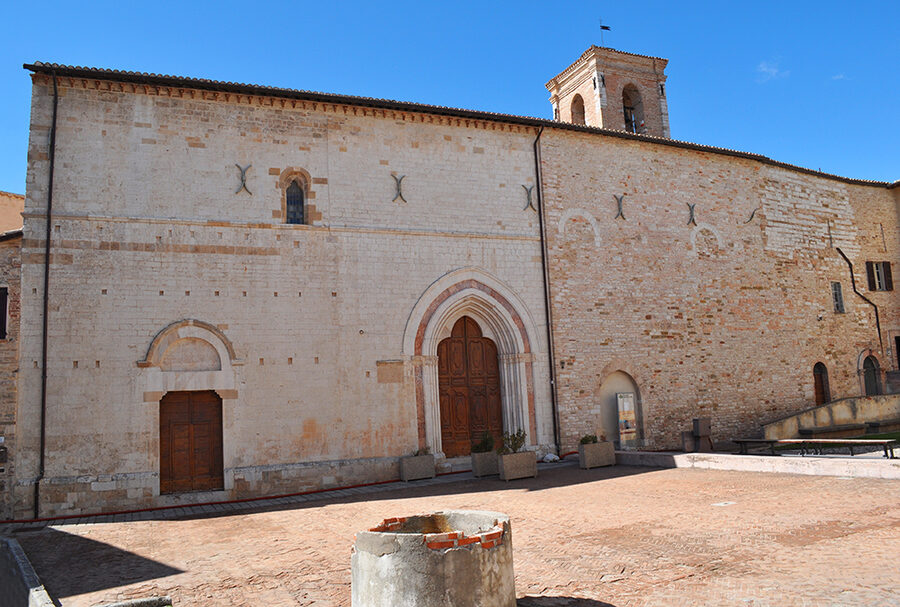
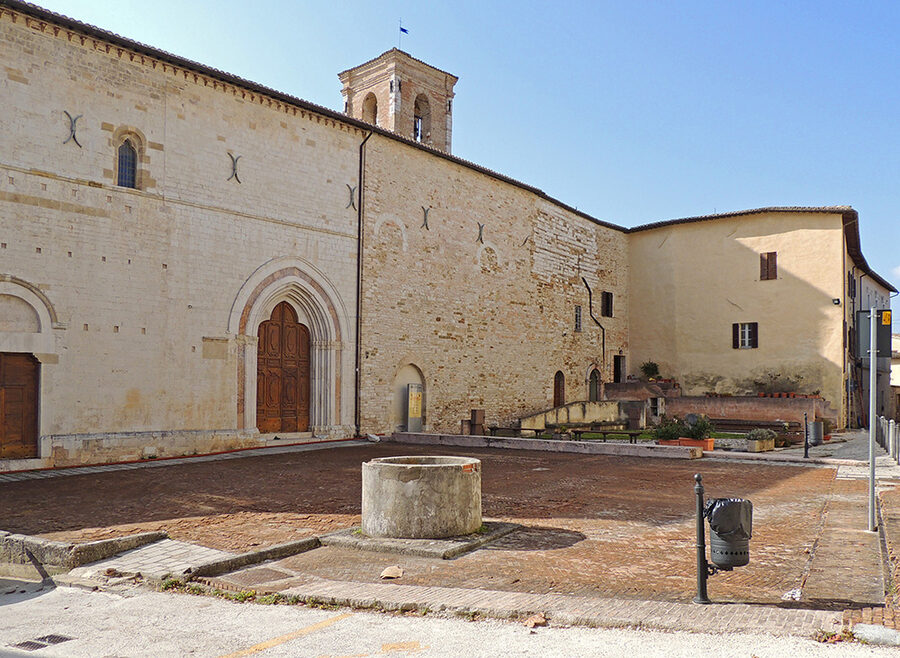
Two streets below the Duomo, Piazza Caprera opens out in front of a large Gothic church. This is the Chiesa di San Francesco — built between the 14th and 15th centuries, used as a Franciscan convent church for four hundred years, emptied by the Napoleonic suppression of 1809, and reopened in the 1950s as the Pinacoteca Comunale and Museo Civico. It is the single richest room in town.

The single thing to see is the 1483 polyptych by Niccolò di Liberatore, L’Alunno — a painted wooden altarpiece with gold-ground saints, a central Madonna, and the sort of tightly modelled, hard-contoured faces that you find in the late Umbrian Gothic. If you have seen his work in the Pinacoteca of Foligno or in the National Gallery in London, you know the register. It has been cleaned recently and the colour is back where it should be.
Around it, on walls that were once the outer arches of the church, there are fifteenth-century frescoes by Matteo da Gualdo, the best painter ever produced by Gualdo Tadino, half an hour up the road. There is a thirteenth-century wooden crucifix, a stone altar from the thirteenth century, a Madonna with the faithful gathered under her cloak, and various panels and fragments brought in from abandoned churches across the diocese — including work by Pierino Cesarei, Ercole Ramazzani, and the same Giulio Cesare Angeli whose 17th-century cycle you saw in the cathedral upstairs. Expect to spend an hour minimum.
The same building houses a Roman section with artefacts from the municipal territory — a milestone from the Via Flaminia, a third-century memorial stone, a female portrait, mosaic fragments, and a remarkable funerary monument carved with four Greek inscriptions by a local sixteenth-century scholar, Varino Favorino da Camerino. Favorino taught Greek at the University of Rome, published one of the first printed Greek dictionaries in Basel in 1541, and tutored the future Popes Leo X and Clement VII. A copy of his dictionary is shelved in the Piervisani Library, also inside the town, which holds 35,000 volumes of varying rarity.
The other section to look for is the Lombard one. The Portone necropolis, discovered in 1898 just north of town along the Via Flaminia, is one of the single most important Migration Period burial sites in Italy. 168 tombs were excavated, arranged in family groups along an east-west axis, most of them intact. The men were warriors, many cavalry, buried with their weapons. The women were buried with gold, silver, amber, amethyst, rock crystal, and pearls — sometimes a single Lombard jewellery assemblage worth more than the entire contents of a comparable Roman-era grave. The earliest burials, around 570 AD, show Lombards in full Lombard dress; the latest, a hundred years later, show the descendants of those same families adopted into Gallo-Roman costume. The grave goods were taken to the Museo dell’Alto Medioevo in Rome for study in the 1910s. A smaller set of finds was eventually returned to Nocera, and you see them in the archaeological section here and in the Palazzo Vescovile’s small museum next door.
If you are interested in the story of the early medieval north — the seam between Roman Italy and the incoming Lombard kingdoms — Nocera is one of the places where that seam is documented most clearly.
Piazza Caprera, and walking the rest of the town
Piazza Caprera is not big. It is a shoulder of the hill where the main lane widens out, bordered on one side by the Franciscan church and on the other by a short colonnade. There are two cafés on the square and an infopoint at number 4. It functions as the social heart of the town — this is where the infopoint staff tell you to start, where locals who don’t live in the immediate centre come to have a coffee, and where the evening passeggiata assembles.

From Piazza Caprera, a 17th-century porticoed lane — the camminata dei portici — climbs to Piazza San Filippo, a smaller square named for the neo-Gothic Chiesa di San Filippo that fills the upper end. The church was built between 1864 and 1868 to a design by Luigi Poletti, who was commissioned to echo, at small scale, the upper Basilica of San Francesco in Assisi. The rose window is flanked by the symbols of the four evangelists — eagle, angel, lion, bull. Inside the high altar holds a painting of the death of Saint Philip by Francesco Grandi. It is a curious example of a mid-nineteenth-century attempt at medieval revival that comes off as slightly more convincing than most, partly because the stonework was done by the same masons who were still repairing the genuine medieval buildings a hundred metres up the hill.
The three gates
The walls had several gates in their medieval configuration. Three are still in use and easy to find on foot.
.jpg)
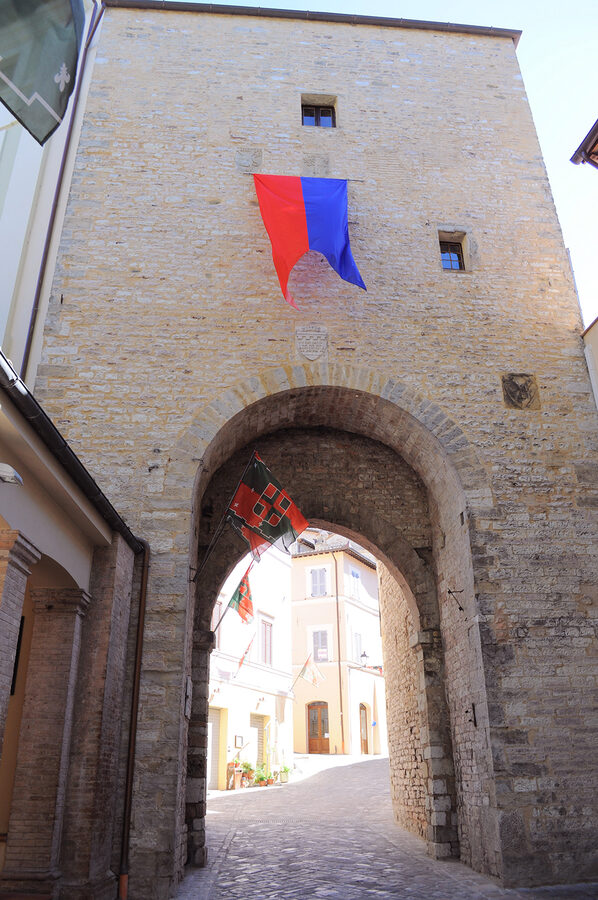
Porta San Francesco, also called Porta Vecchia, is the old gate on the south side, the one pilgrims and traders would have used. It still carries damage from an episode in the War of the Austrian Succession: in 1744, after a joint Spanish-Neapolitan victory at Velletri, an Austrian squadron retreating across central Italy was billeted here. A Spanish force under the Comte de Gages attacked Nocera with heavy artillery and forced the Austrians to surrender. The assault ended on 19 November, the feast day of the Blessed Tomasuccio, and the town gave thanks to him for being largely spared. The tower at Porta San Francesco took the worst of the cannon; the pitting on the stonework is authentic.
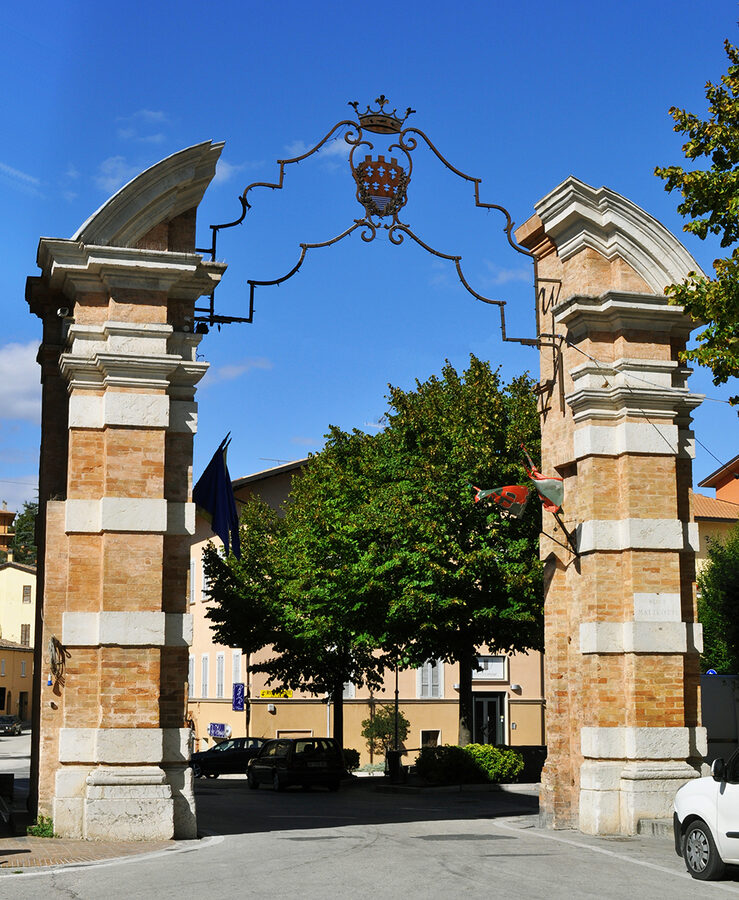

Porta Nuova, the “new” gate, is actually a few centuries old itself — it was cut through the wall to allow easier access after the medieval siege-era priorities had lapsed. It is the gate most visitors enter through today, because the bus and the main car park are both on that side. The name is a relative thing.
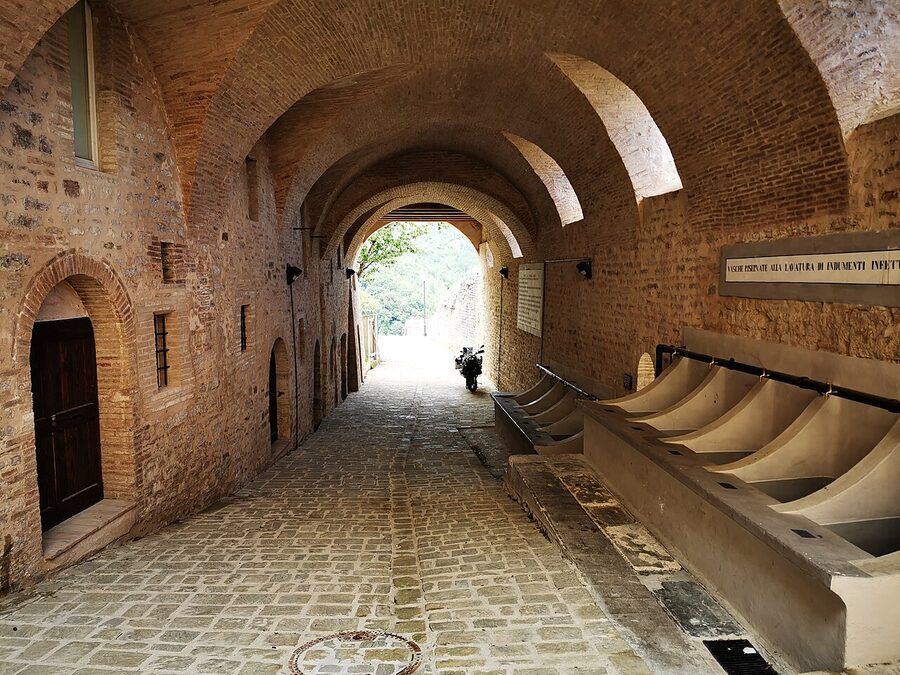
Porta San Martino, on the east side, leads out to what is, for me, the best small surprise of Nocera. A few metres past the gate, set into the wall itself, are the old lavatoi — medieval washing basins, still supplied by the same spring system that feeds the town fountains, with a pair of stern early-twentieth-century inscriptions above them instructing the townswomen how to behave while doing the laundry. They are the sort of thing you would walk past without looking twice if you didn’t know what they were, and they are oddly moving once you do.
The borgo piccolo and the camminata
If you turn off the main street halfway up, you find the borgo piccolo — a parallel lane with a small, carefully kept piazzetta at the end of it, and, beyond that, sudden openings onto the mountains opposite. This is the bit to wander without a plan. Flowers on the windowsills, exposed brick, stray cats, a terracotta potter’s sign that may or may not lead you to an open workshop. Give it half an hour and don’t worry too much about which direction you’re headed.
Older Nocera — Via Flaminia, Frederick II, and the 1997 earthquake
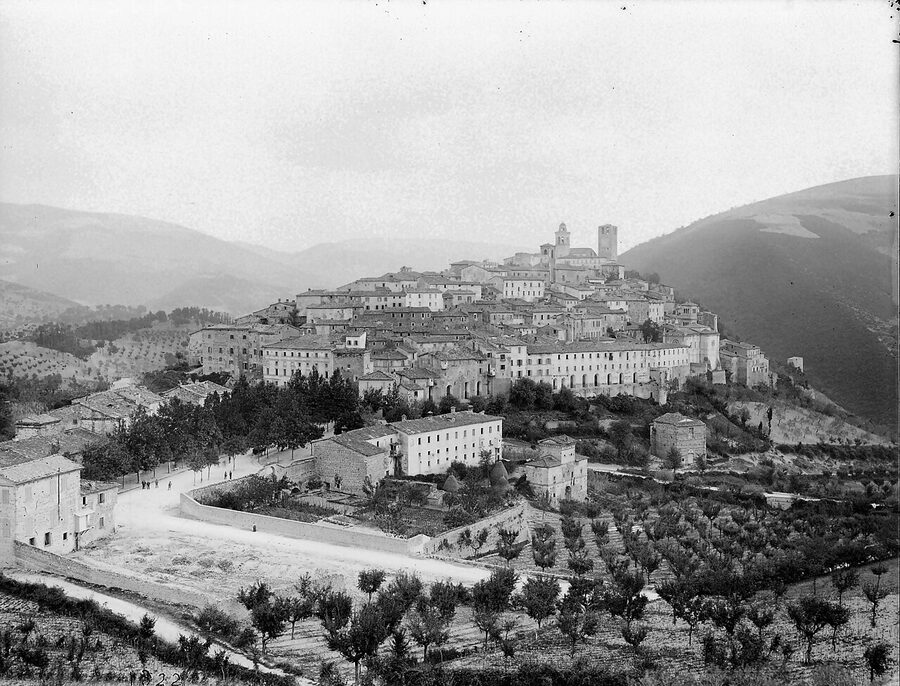

Nocera is old. The hill has been settled since at least the late eighth century BC, when an Umbrian community was living on it — the name nuvkri, on one surviving Umbrian inscription, is where the town’s later Latin name comes from. After the Battle of Sentinum in 295 BC and the opening of the Via Flaminia in 220 BC, the settlement turned Roman. It became a municipium in Regio VI, with a population split into two recognised groups — the Nucerini Camellani and the Nucerini Favonienses. Strabo mentions it as a populous town of importance because of the road; Ptolemy lists it among the colonies set up under Augustus. The Romans also knew Nocera for the wooden vessels and domestic utensils made here, a small-scale craft industry that the forested Apennines kept alive well into the medieval period.
After the empire came the barbarian invasions. Alaric’s army sacked the place in 410 on its way north from Rome. Totila levelled it in 552. Then came the Lombards, from 570 onwards, who built what became one of the most important burial sites of their kind in Italy — the Portone necropolis described above.
The medieval story is about the Via Flaminia, again. Because the road ran right past, the town mattered far more than its size should have allowed. In 824, under the Carolingians, it became a county. Around 1100 it was a self-governing commune. It joined the Guelph league in 1154, against the Ghibellines of the Marche. In 1202 it submitted to Perugia; in 1226 Emperor Frederick II backed Berthold of Spoleto’s occupation; in 1248 Frederick II confirmed possession, and the town was sacked. In 1251, after Frederick’s death, Nocera re-submitted to Perugia.
The fourteenth century was Perugian-Guelph versus Trinci-Ghibelline; the Trinci of Foligno took the town in 1392 and held it until the 1421 massacre. After that the papacy intervened. Francesco Sforza occupied Nocera for several months on behalf of the Pope. In 1439 it passed definitively to Church rule, and stayed Papal until Italian unification in 1860.
Then on 26 September 1997, the Apennines moved. The Umbria-Marche earthquake hit Assisi, Foligno, Nocera, and dozens of smaller hill towns. The Campanaccio collapsed almost entirely. Half the Duomo’s plaster fell off. The historic centre was a zona rossa — a closed red zone — for more than two years. The restoration took nineteen. It was finally declared complete in 2016. The town you see today is that restoration. It is not a reconstruction in the sense of an entire quarter rebuilt from a blank slate — the Italian post-earthquake conservation rules are stricter than that — but it is a carefully consolidated, quietly strengthened, patiently rebuilt version of the town that stood here in 1907, with the seams and retrofits visible to anyone who looks.
Food: biscio, ciaciette, and the pilgrim roll
You are in the Apennine part of Umbria, which eats differently from the lower Tuscan-border Umbria around Todi and Orvieto. The food here is mountain food. Heavier than in southern Italy, lighter than in Emilia. Built on spelt (farro), legumes (lentils, cicerchie — the rediscovered grass-pea), mushrooms from the surrounding forests, truffles from the neighbouring Valtopina, honey from the hills.
The dish to try is biscio. It is a local specialty, savoury — a thin sheet of egg pasta rolled around a stuffing of sautéed leaf greens, crumbled sausage or chopped salumi, and ricotta, then coiled so the finished shape looks like a snake, baked in the oven, and sliced crosswise to serve. The name is local dialect for the shape. The origin is supposedly Longobard: tradition holds that it was the travelling food of pilgrims on the Via Francigena, because it kept for a day, travelled well, and fed one person for most of the afternoon. You can take the Longobard origin story or leave it — most food origin stories should be held to a low evidentiary standard — and the dish itself is genuinely unusual. Three restaurants in town serve it. Ask at the infopoint who is doing it well that week.
Ciaciette are the other local dish to look for. They are small savoury or sweet fritters — dough fried in hot oil, served either with cheese and salumi and sautéed greens (savoury) or with honey and sweet creams (sweet). They turn up during the Palio dei Quartieri in summer, sometimes in the form of a whole dinner.
Beyond the two local specialties, the menus tend to include: red-potato gnocchi (the red variety of potato grown in the hills above Colfiorito), stacciola (a cardoon-based dish), stewed or roast mutton, baccalà on certain feast days, and the Umbrian standards like stringozzi with truffle or wild boar ragù. The sweets are rocciata (a long coiled pastry of apples, walnuts, and raisins) and pozza pasquale (an Easter sweet bread). The local olive oil belongs to the DOP Umbria “Colli Assisi-Spoleto” zone — strong, peppery, lower-yield, a good match with the bean dishes.
What I’d do about food: book a small family trattoria rather than anything that brands itself as a restaurant, and ask specifically whether they are doing biscio that day. If they are not, ask where in town is. The town is small enough that everyone knows.
Festivals — the Palio dei Quartieri and the Cavalcata di Satriano
Nocera has two festivals I would plan a trip around.
The Palio dei Quartieri runs across the end of July and early August. The town splits into two historical quarters, each dresses up in fifteenth-century costume, and they compete through a mix of historical pageants, archery, crossbow, and horse-related games. It is a small palio by Italian standards — you will not find the crowds of Siena or Assisi — and that is precisely the point. You can stand two metres from the archers. The ciaciette stand will be running. The Festa delle Acque, the town’s water festival, often overlaps — the two events slightly blur together into what is, in effect, Nocera’s summer week.
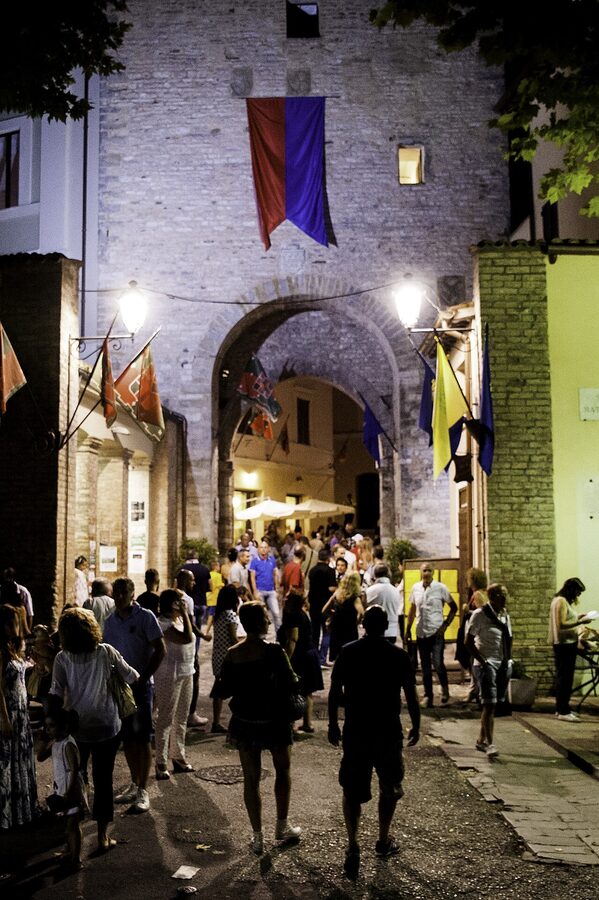

The Cavalcata di Satriano, held on the first weekend of September, is the one to see if you can only do one. It is a historical re-enactment of Saint Francis’s last journey — in 1226, gravely ill, he was carried from Nocera back to Assisi, where he died a few weeks later. A cavalcade of horsemen in period costume rides the route in reverse, departing from Piazza Caprera in the morning, making the 28-kilometre crossing through Valtopina and the Assisi foothills, and arriving at Santa Maria degli Angeli by evening. It is, so far as I know, the only annual re-enactment of a precisely datable event in medieval Italian religious history. If you are already staying in Assisi and wondering what to do on a September Saturday, the answer is to be in Piazza Caprera at eight in the morning.
The other dates worth knowing: 9 February (Saint Raynald), 19 September (the joint feast with Saints Felice and Costanza, the Roman martyrs), and the Marian processions around 15 August. None of these bring major crowds; all of them are genuine.
Where to combine Nocera — Assisi, Foligno, Gualdo Tadino, Monte Pennino
Nocera works best as a half-day or a one-night stop inside a wider Umbria itinerary. On a single driving day you can combine it with:
Assisi, 30 minutes southwest. The obvious big-name pairing. If you are doing Assisi proper and then want something quieter in the afternoon, Nocera is the natural move. There are also inland variants of the Via di Francesco that connect the two on foot — roughly six to seven hours’ walking.
Foligno, 15 minutes south. Larger, less beautiful, but with a strong Pinacoteca of its own (which also has an L’Alunno polyptych — it is worth seeing both) and the cathedral of San Feliciano. Foligno is also where you change trains in most rail itineraries.
Gualdo Tadino, 20 minutes north on the Via Flaminia. Matteo da Gualdo — whose frescoes you just saw in the Nocera Pinacoteca — was the hometown painter; his best work is in the Church of Santa Maria dei Raccomandati there. The town was part of the same diocese as Nocera from 1006, and was known as Gualdo di Nocera for a while.
Bevagna, 40 minutes south across the valley. A flatland hill town with arguably the most harmonious main square in Umbria — see the Bevagna article for the full story.
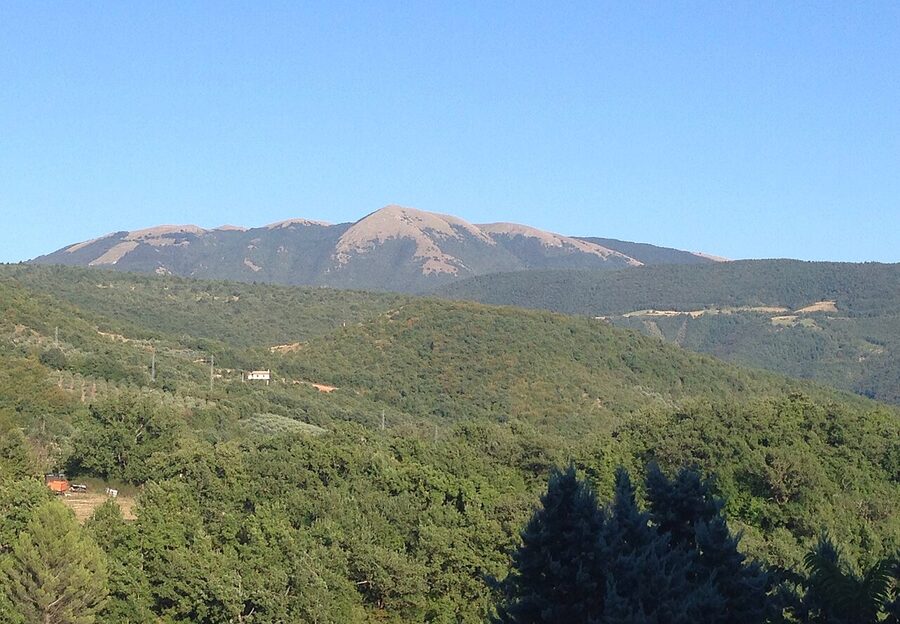
Monte Pennino, 20 minutes east. The 1,571-metre peak that closes the Topino valley. Hiking trails leave from the Bagni road. In winter it supports a small ski station at Colfiorito. On a clear day you can see the Adriatic from the summit.

Rasiglia, 25 minutes south — the so-called borgo dei ruscelli, a minute village where the mountain streams cross the main street. A photography-first stop, crowded on summer weekends, empty on weekdays.
Valtopina, 10 minutes south. The truffle centre of this stretch of the Apennines. If biscio got into your head, Valtopina is where you buy the truffle to add to yours at home.

When to visit
My preferred months are late May to mid-June, and again from early September through mid-October. The town is 520 metres up and feels it: July and August are warm, not Sicilian-warm, but warm enough that walking from Porta Nuova up to the Duomo in midafternoon is not what you want to be doing in sandals. August also coincides with the Ferragosto shutdown, when many family restaurants close for two weeks. The upside of August is the Palio dei Quartieri and the water festival; if that is what you are coming for, accept the heat.
Winter is cold and quiet. The Apennines pick up weather. The town is not set up for winter tourism, but the Duomo and the Pinacoteca stay open and the pace is unhurried. If you want an authentically empty Umbrian town in February, Nocera is as good as any. Pack for real cold; 10 below at night is normal.
Before you go
Nocera is not the Umbrian town to put first on a short trip. Assisi, Orvieto, and Bevagna all demand more of your time, and their histories are more famous. If you have three days in Umbria, use them there.
What Nocera is the town to do, eventually, is on a fourth or fifth day, when you have recovered from the high culture of the Giotto frescoes and want to see a place that has had most of the same things happen to it and come out quieter. A Roman road, a Lombard cemetery, a martyr’s body under an altar, a Frederick II sacking, a Papal lockdown, a three-century spa economy, a late-Victorian bottling plant, a 1990s earthquake, and nineteen years of restoration that finished in 2016. The town wears it lightly. If you walk up to the Campanaccio in the late afternoon, sit on the wall below the tower, and watch the light hit Monte Pennino, you will understand what the Umbri got out of picking this particular rock to settle on, three thousand years ago.
Plan for a night. The Umbria pages on this site have more suggestions for how to build the rest of the trip.