

Saint Francis of Assisi died on the evening of 3 October 1226, lying on the bare earth floor of a small hut next to a reed chapel called the Porziuncola, about a kilometre downhill from the town he had grown up in. He was forty-four. He had asked to be stripped of the Franciscan habit because he had made a private vow, twenty years earlier, to own nothing — not even the clothes he died in — and he wanted to be buried by the standards of the vow rather than by the standards of his growing order. Brother Elias, the man running the order at that point, overrode him; Francis was clothed again within minutes of his death, and buried, formally, in Assisi four days later.
Eight hundred years later — the centenary is being marked across Umbria and Italy through 2026 — most of the places where Francis actually lived, prayed, walked, and died are still there, and most of them are still recognisable. A few are famous. Most are not. You can do the big set pieces from a long weekend based in Assisi; you can do the full circuit of Umbrian and Tuscan and Lazio sites in a slow two-week drive; or you can walk the Via di Francesco, a network of paths retracing his movements, in anywhere from three days to a month.
This is a guide to the places, not a spiritual biography. I am not Catholic and I am not here to persuade you that the crucifix at San Damiano really spoke to a twenty-four-year-old ex-soldier in 1205. I am here to say that once you have stood in the chapel where he received the stigmata, sat in a cave on Monte Subasio where he slept for weeks at a time, looked at Giotto’s frescoes in the upper basilica of Assisi, and driven through the unchanged agricultural flatland at Piandarca where he preached to the birds, you come away with an idea of the man that is more specific and less sentimental than the one you start with. And you also come away having seen some of the most quietly remarkable landscape and architecture in central Italy. The two things travel together, which is the point of this piece.
In This Article
- Who Francis actually was, in one page
- Assisi — the set pieces
- San Damiano — where the voice spoke
- The Porziuncola — where he started and where he died
- The Eremo delle Carceri — the hermitage on Monte Subasio
- Piandarca and the sermon to the birds
- Gubbio — the wolf and the cloak
- Montefalco — the painted life
- La Verna — the stigmata
- Greccio — the first Christmas creche
- The edges — Spoleto, Nocera, Piediluco, Scarzuola
- Walking the Via di Francesco
- 2026 — the eight hundredth year
- Before you go
Who Francis actually was, in one page
Giovanni di Pietro di Bernardone was born in Assisi in 1181 or 1182, the son of a cloth merchant called Pietro and a French woman called Pica. His father was away on business in France when he was born, and his mother had him baptised Giovanni — John. When his father returned, he changed the name to Francesco — “Frenchman” or “Frenchy,” possibly a nickname that stuck, possibly a nod to Pietro’s French business links. The child was trained for a life in the cloth trade and, more ambitiously, for a life as a knight: Assisi was a commune, technically free, repeatedly in military conflict with its larger neighbours, and a rich merchant’s son who could fight on horseback was exactly the sort of young man the commune needed.
In 1202 he fought in a war against Perugia. Assisi lost. Francis spent most of the next year in a Perugian prison, and came home ill. In 1205 he set out again to join papal forces being assembled in southern Italy under Gualtiero da Brienne — this was his shot at the international stage — and got as far as Spoleto, where he had a vision or, depending on who you believe, a fever dream or a panic attack, telling him to go home and wait for instructions. He went home. He was twenty-three.
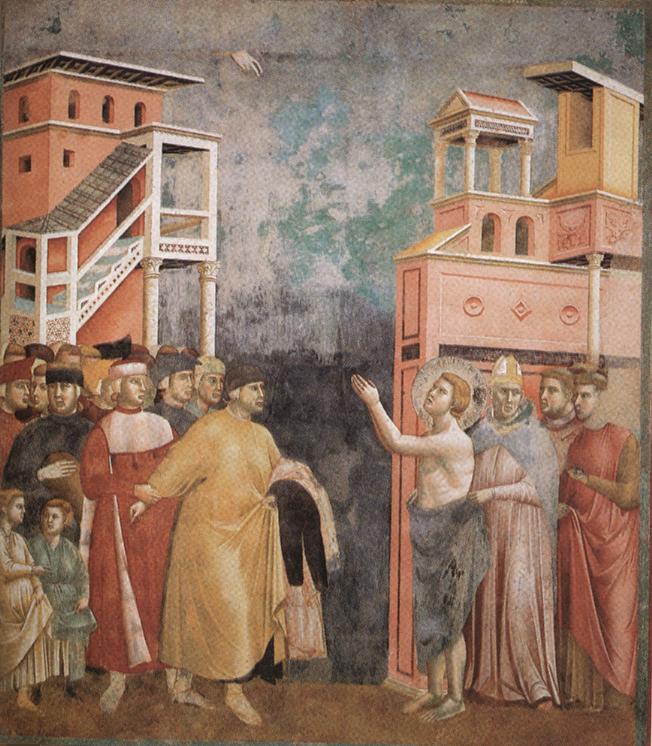
The next two years are the conversion. He started giving away his father’s money to the poor. He began repairing derelict churches, starting with the little tenth-century chapel of San Damiano just outside the town walls, where he said a painted crucifix had spoken to him. His father had him dragged before the bishop and the city consuls to demand the money back and disinherit him. In the middle of that hearing, in front of the whole commune, Francis took off his clothes — everything — folded them, handed them back, and said that from now on his only father was “Our Father who is in Heaven.” This is the scene Giotto painted. It is also the scene at which every Franciscan begins.
From 1208 he had followers. In 1209 the first small brotherhood walked to Rome and got verbal papal approval from Innocent III for a new religious rule based on poverty. In 1212 Clare, the eighteen-year-old daughter of a noble Assisi family, ran away from home to join him; she became the first Poor Clare. From then on, for seventeen years, Francis walked. He walked Umbria; he walked to Rome more than once; he walked up to La Verna in Tuscany; he crossed the Adriatic and visited the Sultan of Egypt in 1219. In September 1224, at La Verna, while praying in a cave on the mountain, he said he saw a seraph with six wings in the shape of a crucified Christ, and that the vision left five wounds on his body matching those of the crucifixion. A companion called Brother Leo was with him and left the first clear written account of what is now called the stigmata.
He was not well after that — the stigmata had left physical marks — and his eyesight, damaged by trachoma picked up on the Egypt trip, was almost gone. He spent his last summer in the hills above Nocera Umbra in 1226, hoping to rest. His followers brought him back to Assisi in the autumn when they realised he was dying. He died on 3 October 1226, aged about forty-four. Pope Gregory IX canonised him two years later on 16 July 1228. His feast is 4 October. His written Canticle of the Creatures — “Laudato si’, mi’ Signore, per sora nostra matre terra” — is the first literary work in Italian, a little over a century before Dante.
Assisi — the set pieces
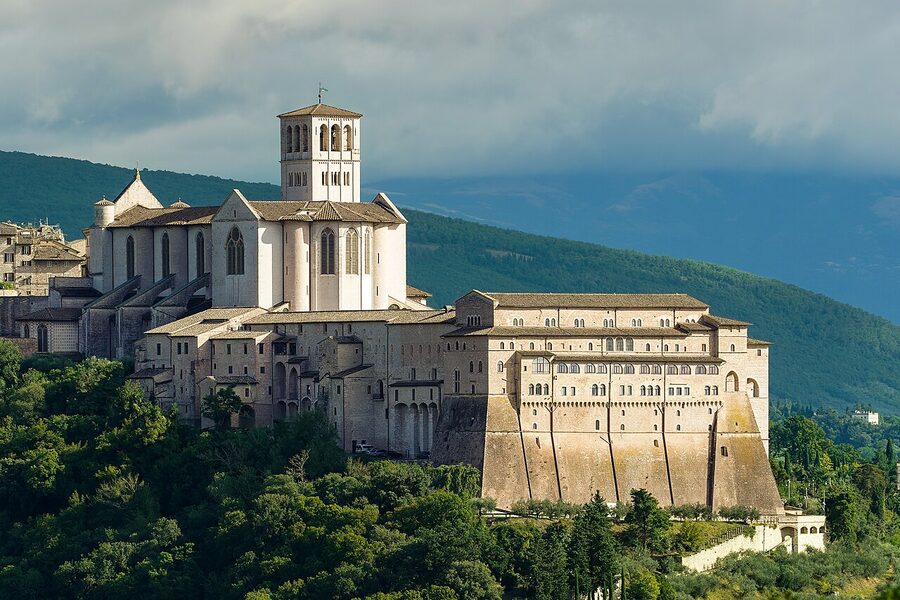

Assisi is where you start. It is the town he grew up in, the town where he had his conversion, the town that exiled him, the town that buried him, and the town that has been, for eight centuries, the administrative centre of an order that at its height had fifty thousand members across four continents. You can cover the main Franciscan sites in a single long day if you are efficient and brutal about it. Two days is more realistic. Three days lets you add the hermitage up on Monte Subasio and the peripheral sites.
The Basilica of San Francesco is the one everyone comes for. Construction started within two years of the canonisation — Pope Gregory IX laid the foundation stone on 17 July 1228, the day after he canonised Francis — and what you see is mostly thirteenth-century, with the upper church dedicated in 1253. The building is genuinely two churches, one stacked on top of the other, with the crypt containing the tomb lying under both. The lower basilica is the one to spend time in: twenty minutes inside it, sitting on a side bench, are worth more than a hurried pass through the whole complex. It has frescoes by Cimabue, by Giotto, by Simone Martini, and by Pietro Lorenzetti — the four painters who between them more or less invented the Italian fourteenth century. The upper basilica has the twenty-eight scenes of the Legend of Saint Francis, attributed to Giotto, painted c. 1297-1299. The attribution to Giotto is still argued about by specialists, and the 1997 earthquake did significant damage that was painstakingly restored; the cycle itself, however, is the closest thing Western painting has to a narrative film of Francis’s life.
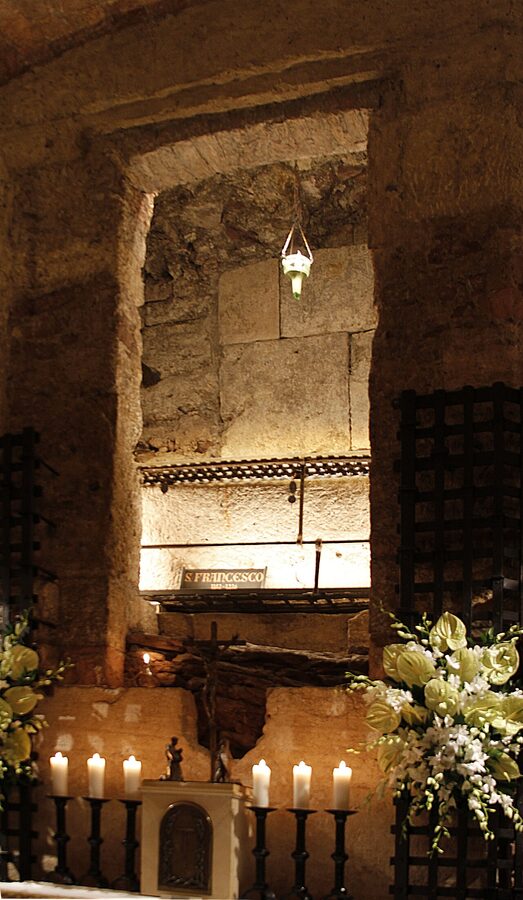

The crypt is worth the wait. It is not large. The tomb itself is a simple stone sarcophagus under an iron grille, surrounded by the tombs of four companions (Brothers Leo, Masseo, Rufino, and Angelo) who asked to be buried near him. Services happen here several times a day. If you are coming during the centenary year — between 22 February and 22 March 2026, as part of the 800th-anniversary programme — the body is moved from the crypt to the Lower Basilica for public ostensione, which means a longer queue but a closer look at the reliquary. Booking is required through sanfrancescovive.org.
Beyond the basilica, three other Assisi sites belong on any itinerary: the Cathedral of San Rufino, where Francis and Clare were both baptised, with a Romanesque façade that is arguably the best Romanesque façade in Umbria; the Basilica di Santa Chiara, the 1260 church built to house Clare’s tomb and the very crucifix from San Damiano that Francis said had spoken to him; and the Chiesa Nuova, built in 1615 on the site of the Bernardone family’s house — the small storeroom where his father locked him up for a month in 1207 is preserved in the crypt.
San Damiano — where the voice spoke
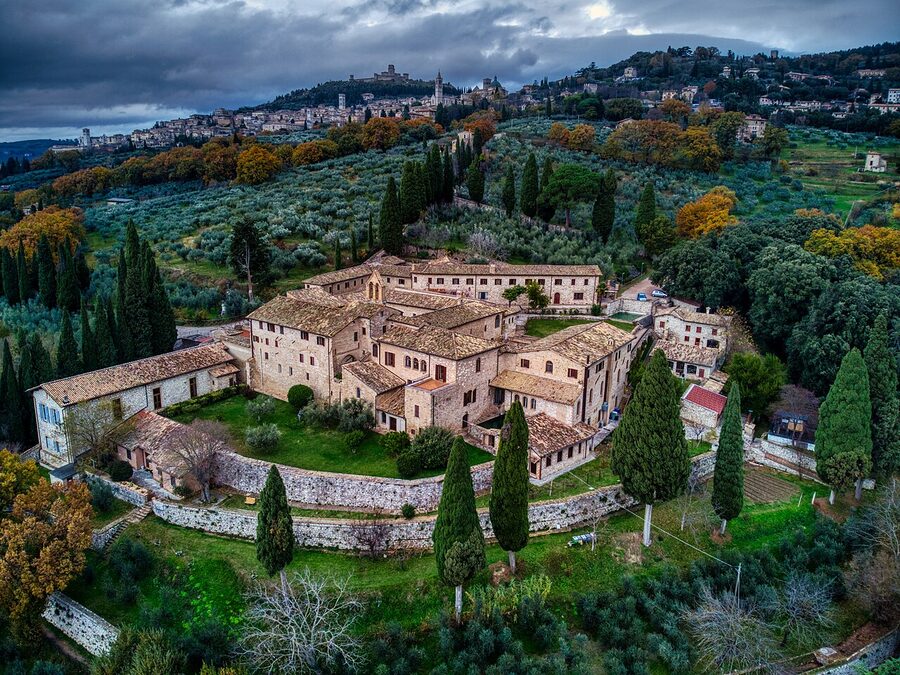

About ten minutes’ walk downhill from the south gate of Assisi, cut into an olive terrace, stands a small stone church called San Damiano. This is where the conversion actually begins. According to Thomas of Celano, Francis’s earliest biographer, it was in this church in 1205 that Francis, praying in front of a Romanesque crucifix, heard a voice from the cross saying Francesco, va’ e ripara la mia chiesa che, come vedi, è tutta in rovina — “Francis, go and repair my church, which as you see is in ruins.” He took the instruction literally, spent months repairing the building’s masonry with his own hands, and only later understood the voice to have meant the institutional church.
The original crucifix is no longer at San Damiano. It is now preserved in the Basilica di Santa Chiara in Assisi — the Poor Clares moved it there in 1257 when they moved out of San Damiano. The copy that hangs in the church today is faithful but is a copy. That slight disappointment aside, San Damiano is the single most atmospheric Franciscan site in Umbria. Clare of Assisi lived here from 1212 to her death in 1253, as abbess of the first Poor Clare convent. The choir stalls she and her sisters used are still in place. The small cloister and garden are still in use. The view over the Umbrian plain through the unglazed arched windows has not materially changed since the thirteenth century.
The walk down from Assisi is an attraction in its own right. Take Porta Nuova and follow the signposts. Allow about forty-five minutes there and the same back up; bring water in summer. The church is open roughly 10:00-12:00 and 14:00-18:00, with the caveat that Franciscan opening hours are more guideline than promise.
The Porziuncola — where he started and where he died
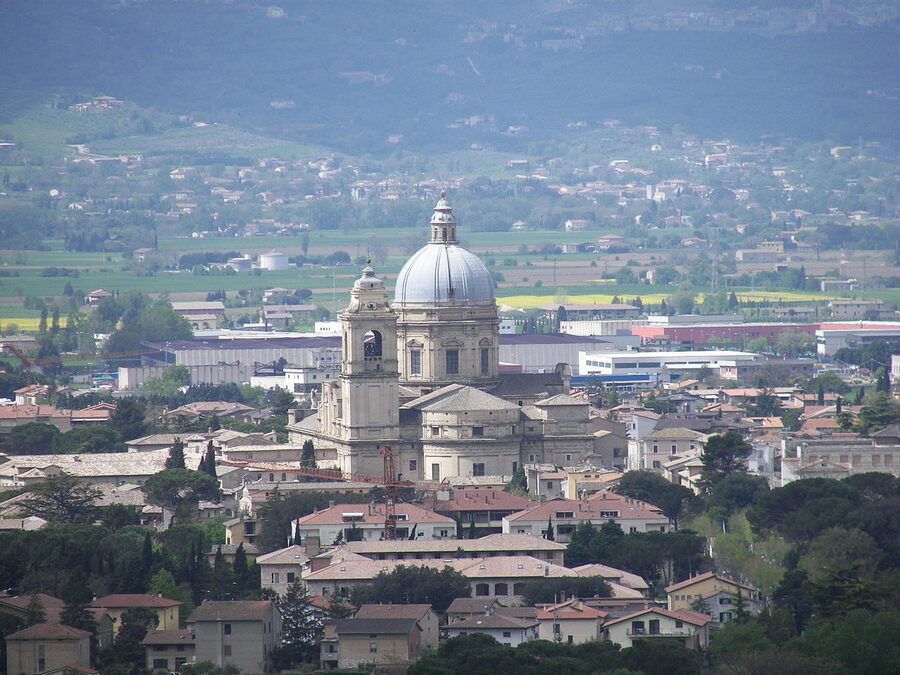

Six kilometres down the hill from Assisi proper, on the valley floor, is the Porziuncola — a small twelfth-century chapel originally in the middle of a wooded plot (the “little portion” of ground, hence the name). Francis restored it after San Damiano. He based his first community here; he wrote his rule here; he took Clare’s profession here on Palm Sunday 1212; and he died here, seventeen years later, on 3 October 1226.
You can still go inside the original chapel. It is now enclosed inside a colossal 16th-century basilica — the Basilica di Santa Maria degli Angeli, designed by Galeazzo Alessi in 1569, with a façade that was later replaced in the 1920s — and the visual shock of walking into that basilica and finding a tiny stone Romanesque chapel inside it like a doll’s house in a ballroom is the single strongest architectural moment on this whole itinerary. The interior of the Porziuncola is decorated with frescoes, mostly 14th- and 15th-century, including an Umbrian Annunciation. Behind it is the Cappella del Transito — the hut where Francis died — also preserved inside the larger basilica, with Francis’s bloodstained habit and cord shown in a reliquary.
Most visitors spend twenty minutes here and move on. I would allow an hour. The scale contrast alone is worth the time, and the Cappella del Transito is where the actual event happened. The basilica is in Santa Maria degli Angeli, the modern valley-floor town, and has its own railway station on the Foligno-Terontola line, so you can reach it by train if you are not driving.
The Eremo delle Carceri — the hermitage on Monte Subasio
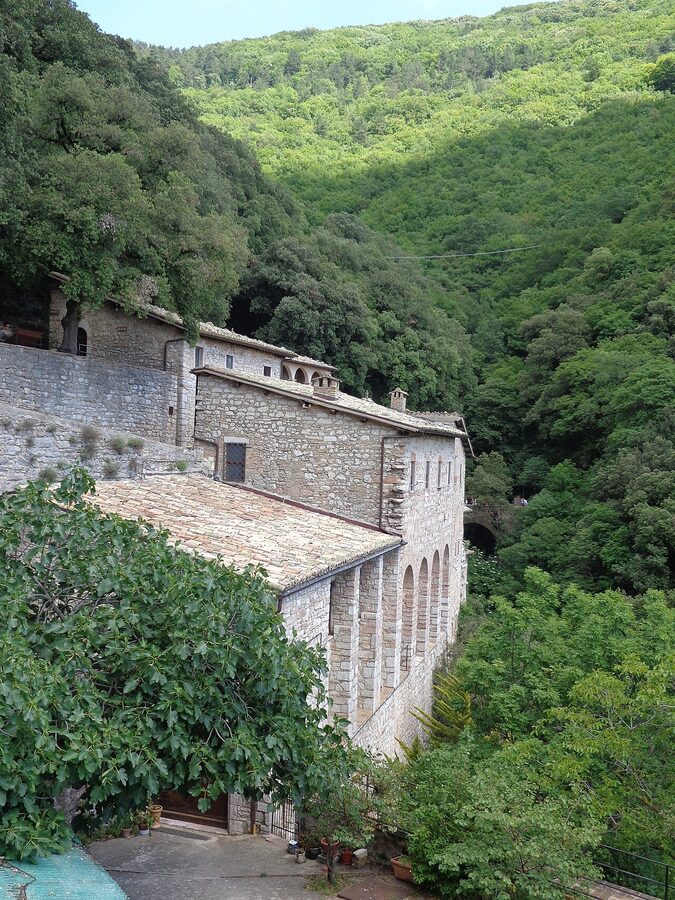

Monte Subasio is the 1,290-metre limestone massif that closes the view east of Assisi. Four kilometres up from the town, half-built into the cliff face and half-buried in a dense oak wood, is the Eremo delle Carceri — “the prison” or, more accurately for the word’s medieval sense, “the confined place.” Francis would come up here for weeks at a time to be alone. The oldest cell, dating from before Francis himself, is the one he used; it is a small limestone cavity you reach down a short flight of steps, set behind a wooden railing so that visitors can look but not enter. A holm oak in the courtyard, supposedly the tree where he preached to the birds — though Piandarca, described below, also claims the event — is held up by iron braces and is, by dendrochronology, actually pre-Franciscan. Whatever you believe about the specific tree, it is a plausible setting.
The current friary dates from the 1400s, built by San Bernardino da Siena around Francis’s original cell. A small Franciscan community still lives here, and the place is quiet in a way that the valley-floor sites are not. Park at the small car park below, take the short walk up (about fifteen minutes), and plan to spend an hour. It is worth doing in the late afternoon when the valley light comes sideways through the oak canopy.
If you are walking, there is a footpath from Assisi up through the woods to the Eremo — about ninety minutes uphill, one way, steady gradient. In summer, do it early. The mountain holds heat and there is no shade on the upper reaches.
Piandarca and the sermon to the birds
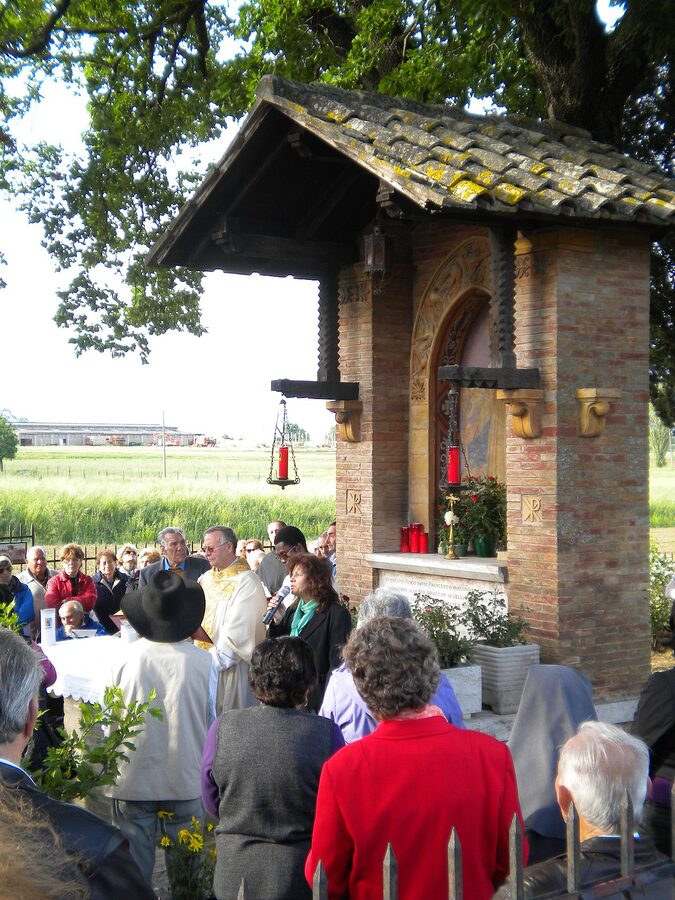

Eight kilometres south of Assisi, just past Cannara, is a flat agricultural plain called Piandarca. It is croplands, olive rows, a handful of stone farmhouses, and one scrubby stretch of ditch bordering an unpaved lane. According to the Franciscan tradition, this is where the sermon to the birds happened — Francis on his way from Bevagna to Cannara, interrupted by a flock of doves and crows, stopping to address them. A small edicola — a wayside shrine the size of a phone booth, with a painted altar niche — marks the spot, put up in the 1960s on the basis of local tradition going back at least to the fourteenth century.
You will not see most of this from the road. Park in Cannara, walk east on the signposted path — Piandarca is a named point on the official Via di Francesco — for about twenty minutes, and you arrive. The landscape is, by Italian standards, extraordinarily intact: the field pattern, the olive terraces, the drainage channels, and the farmhouses are what you would have found had you walked out here with Francis in 1213. You do not get many chances in modern Italy to look at a medieval scene in its original setting.
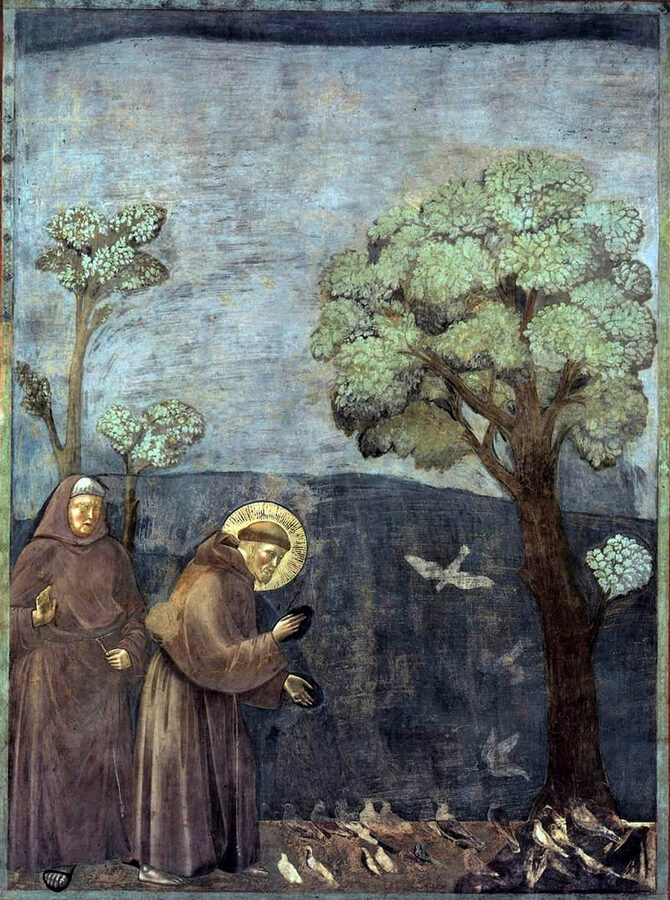
Giotto’s Sermon to the Birds is scene 15 of the Assisi cycle. Worth looking at the fresco first, then visiting Piandarca, then returning to the fresco — the relationship between the two becomes one of the more touching payoffs of an Umbria trip. Francis’s point, for what it is worth, was theological rather than sentimental: if birds listen to a man, why do men not listen to God? But it is a nice field.
Gubbio — the wolf and the cloak
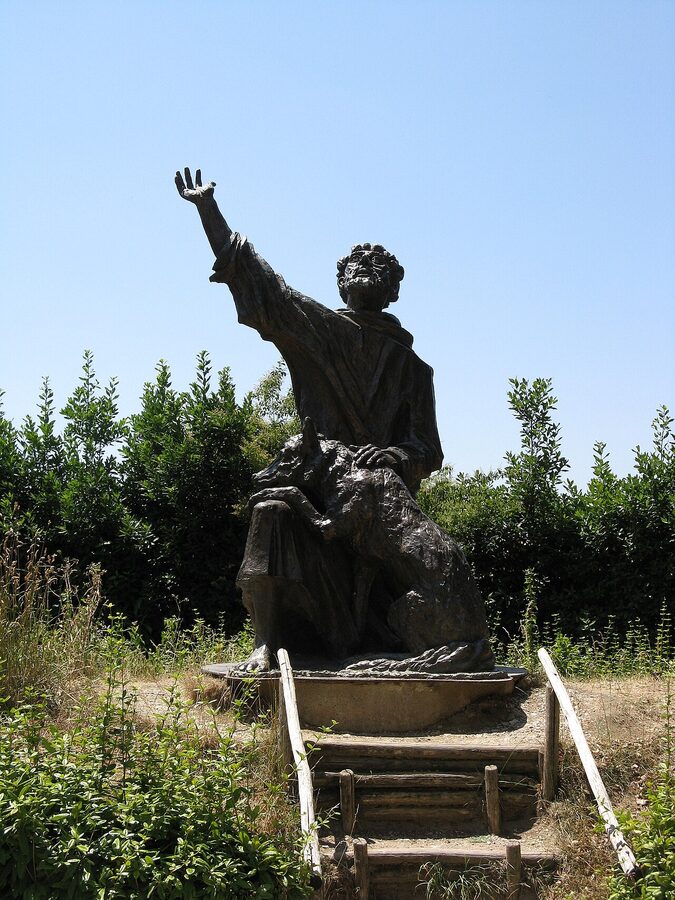

Gubbio is forty kilometres north of Assisi, across the mountains. When Francis fled his father in 1206 — after the nakedness scene in front of the bishop — he walked to Gubbio, which was outside the jurisdiction of the Assisi bishopric and so a safer place to lie low. The Spadalonga family, who knew his father and were wool merchants themselves, took him in. They gave him a grey tunic. He used that tunic as the prototype for the Franciscan habit. The house where the Spadalonga lived is now the Chiesa di San Francesco, on Piazza Quaranta Martiri, a large thirteenth-century Gothic church whose second chapel on the right preserves what the friars say is the original Spadalonga dining-room wall.
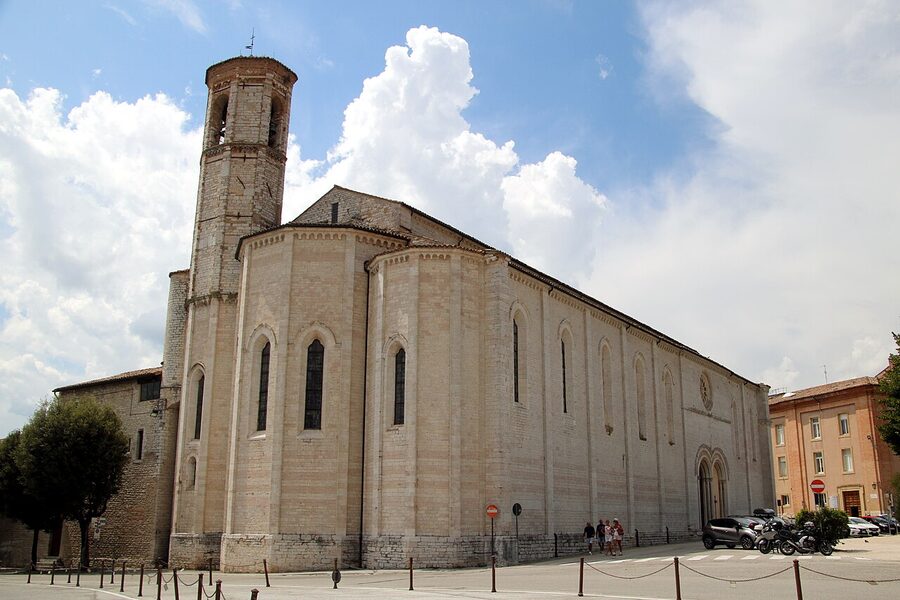
,_esterno_01.jpg)
The wolf story is the one everyone knows. A wolf was terrorising the town — eating livestock, eating the occasional human. Francis went out, met the wolf on the road, asked it to stop, promised that the townspeople would feed it if it did. The wolf nodded, stuck out a paw, and followed him back into town, where the deal was formalised in front of witnesses. The wolf lived out its days in Gubbio, fed daily by the townspeople, and was buried with honours. A skeleton of a large canid was found under the floor of a Gubbio church in 1873, which is either the wolf or a large domestic dog. You can view the bones in the Chiesa di San Francesco della Pace, off the main piazza. The meeting itself is traditionally placed at the small thirteenth-century Chiesa della Vittorina, just outside the old walls, with the modern bronze statue of Francis and the wolf now marking the spot.
Whether or not you believe a specific wolf made a specific deal, Gubbio itself is one of the most atmospheric small cities in central Italy. Steep limestone streets, a pair of huge medieval public palaces (the Palazzo dei Consoli and the Palazzo Pretorio) facing each other across a hanging piazza, a Roman theatre at the bottom, and a funicular that takes you up to the mountaintop monastery of Sant’Ubaldo. Assume a full day. Assume a second if you can spare it.
Montefalco — the painted life
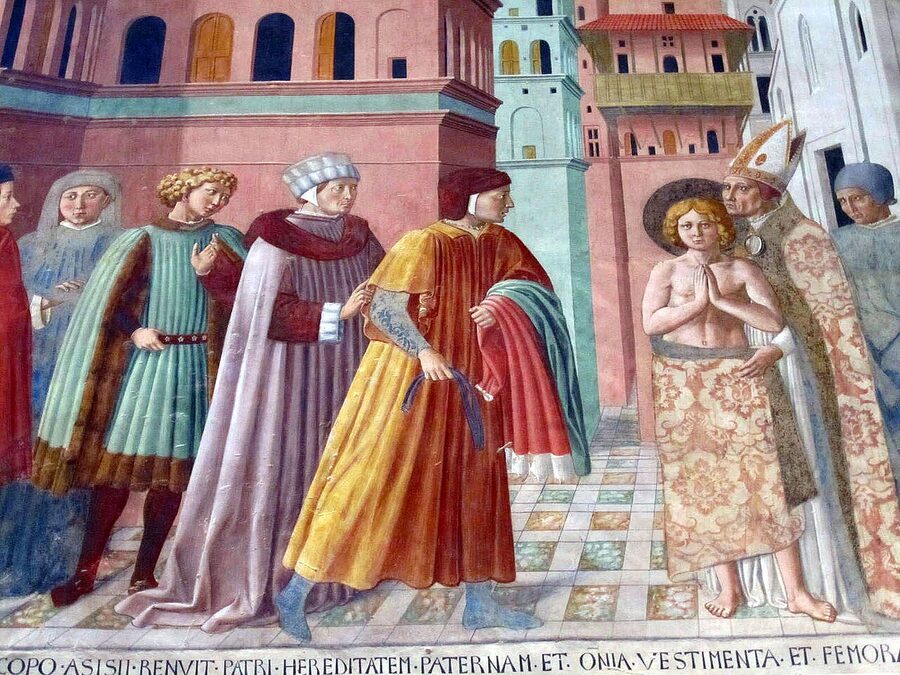

If you see only one place after Assisi for Franciscan art, make it Montefalco. The former Chiesa di San Francesco in the hilltop town is now the Museo di San Francesco, and the apse of the church is covered, floor to ceiling, with a twelve-scene fresco cycle of the Life of Saint Francis painted by Benozzo Gozzoli in 1450-52. Gozzoli was a former assistant of Fra Angelico, still in his early thirties, still working out his own style. The cycle in Montefalco is his first major independent commission. It is, frame for frame, one of the most readable narrative fresco cycles of the Italian 15th century, and because Montefalco is not Florence and not Assisi, you can usually have the apse to yourself.
The interest is partly the art — Gozzoli is a more careful portraitist than Giotto, a better landscape painter, and genuinely interested in local detail (Assisi itself is painted in the background of several scenes with recognisable buildings) — and partly the way Gozzoli brings Francis into the 15th century. The 1452 Francis is not Giotto’s 1297 Francis. The world around him is dressed in 1450s Florentine fashion, the architecture is quattrocento, and the feeling is that of a living tradition updating its founder for its own time. If you want to watch the interpretation of Francis evolve across 150 years of painting, Giotto to Gozzoli to Botticelli to Caravaggio, Montefalco is the single best stop.
Montefalco is also the centre of the Sagrantino wine region. Do not come here without tasting Sagrantino — the late-harvest dark red that Arnaldo Caprai and Romanelli have, between them, rescued from near-extinction in the 1980s and turned into one of the more serious Italian wines. A tasting at Caprai, five minutes out of town, is about €35 and takes two hours. The museum, the main square, the walls, and a vineyard: one very full afternoon.
La Verna — the stigmata
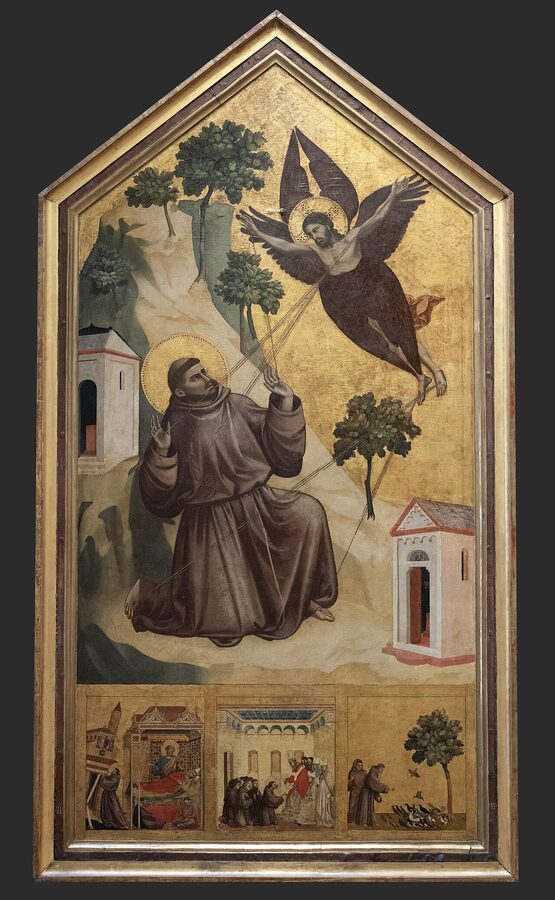
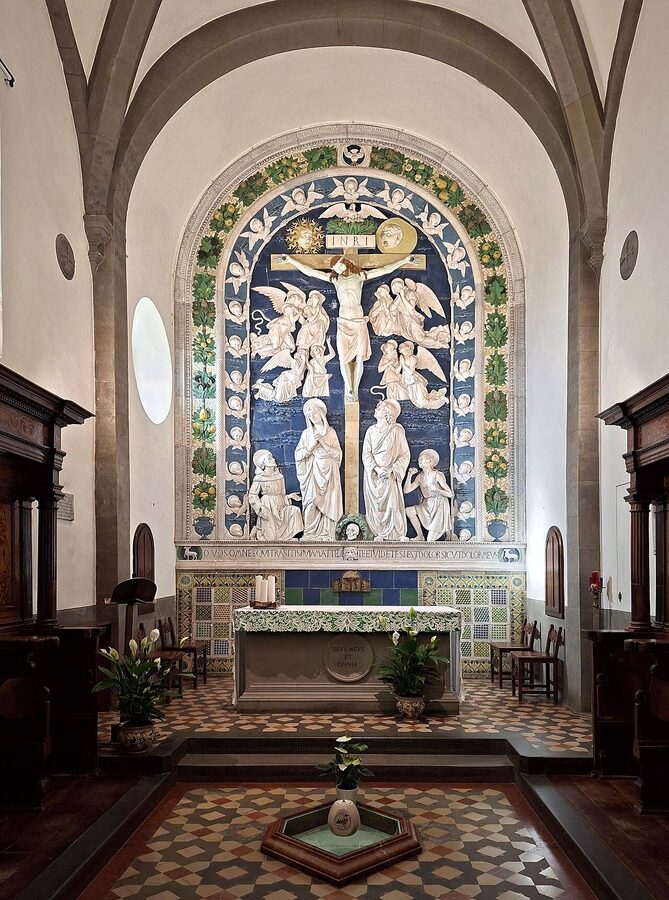

La Verna is in Tuscany, not Umbria, which is why it often gets left off Umbrian itineraries. It shouldn’t be. La Verna is the pivot point of Francis’s biography. In September 1224 he climbed this mountain — a steep limestone cliff about 80 kilometres east of Florence, on the Tuscan-Emilian Apennine ridge — with a small group of followers, and spent forty days in a cave. On the morning of 14 September, while praying, he reported the seraphic vision. When he came down, his hands, feet, and side carried the wounds of the crucifixion, which bled intermittently until his death two years later. Brother Leo was with him and left the first written account of the phenomenon — the earliest clearly documented case of stigmata in Christian history.
The mountain was a gift. Count Orlando Catani of Chiusi della Verna had given it to Francis in 1213 to use as a retreat — which is, incidentally, a lovely bit of medieval documentation: the transfer deed, a single parchment sheet, still exists. The present complex — the upper sanctuary with the Cappella delle Sacre Stimmate, the Della Robbia Annunciation, the Chiesa Maggiore, and the small community of Franciscans who still live on the mountain — grew up around that gift. The Cappella is built directly over the cave where the vision happened. Inside is a Della Robbia glazed terracotta crucifixion, as remarkable as any of his Florentine works.
Practical notes. La Verna is 80 kilometres by car from Florence, 100 from Assisi. The road up from Chiusi della Verna is steep, well-marked, and has limited parking at the top; in high season, arrive before 10 AM. There is a twice-weekly processione through the sanctuary buildings — following Francis’s path from the main convent to the chapel of the stigmata — which you can join for free. You can eat at the friary’s refettorio for about €15 (book ahead). The dormitories are used by pilgrims on the Via di Francesco, which officially starts here.
If you are in Italy at all in 2026, and Francis is any kind of interest to you, La Verna is the trip to make. The 800th anniversary is the anniversary of his death; but the previous year — September 2024 — marked the 800th anniversary of the stigmata, and the sanctuary has been in an extended programme of events that will continue through the centenary cycle.
Greccio — the first Christmas creche
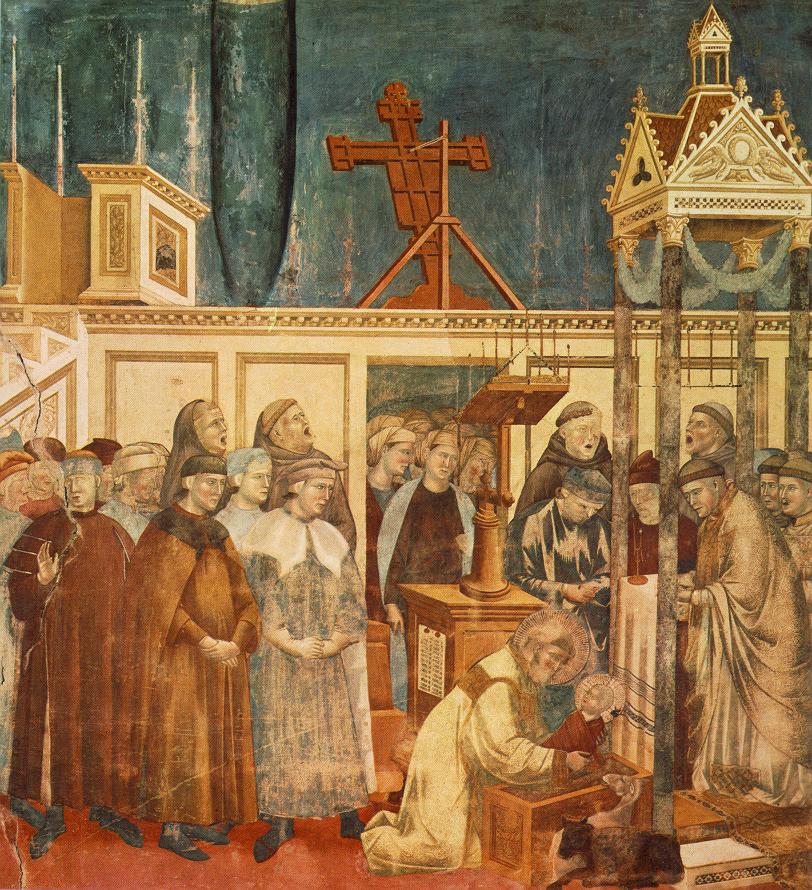
Greccio is in Lazio, not Umbria, about 80 kilometres south of Assisi in the Valle Santa above Rieti. It is a small hill village (population under 1,500) with a Franciscan sanctuary carved into the cliff face on its edge. In December 1223 Francis stopped here for Christmas. The local landowner, a man called Giovanni Velita, offered him the use of a cave near the village. Francis asked for an ox, a donkey, a manger, some hay, and permission to celebrate Mass in the cave on Christmas Eve. The result — real animals, a real manger, the Gospel sung in Italian rather than Latin — was the first nativity scene in history. Eight hundred years later, every Christmas presepe in every Italian town square is a direct descendant of that evening.
The sanctuary is still there. The chapel built over the original cave was decorated with frescoes in the 14th century, including a now-famous panel (c. 1409) showing the first nativity scene itself — a presepe of a presepe. The small monastery above the cave is functioning and open to visitors. The village of Greccio is a short walk further up the hill and has a handful of restaurants along a single main square; the view west across the Valle Santa is one of the great underrated Italian views.
Greccio is the last of the four canonical sites of Francis’s life — Assisi, La Verna, Greccio, and the Porziuncola — that modern Franciscan tradition identifies as the core pilgrimage circuit. If you are driving, Greccio fits into a loop: Assisi to Spoleto to Terni to Rieti to Greccio and back, across two days.
The edges — Spoleto, Nocera, Piediluco, Scarzuola
Several smaller Umbrian sites are worth adding if you have the time and the interest in a less-packaged approach to the biography.
Spoleto. This is where the 1205 turn happens. Francis, on his way south with Walter of Brienne’s army, stopped to sleep in the Chiesa di San Sabino on the edge of town. In a dream, a voice asked him “Who can do more for you — the lord or the servant?” and he turned back to Assisi. San Sabino is a working parish church, Romanesque, open for services. Spoleto itself has a cathedral with a Filippo Lippi fresco cycle, a Roman theatre, a Ponte delle Torri spanning the gorge on fourteen arches, and in October 2026 the Rocca Albornoz fortress will host a photographic exhibition dedicated to Franciscan pilgrimage routes — photographs by Fulvio Roiter and Luigi Spina of the landscape in black and white.
Nocera Umbra. Francis spent his last summer of 1226 in the hills above this small town, hoping to recover his strength at its famous mineral springs. He did not recover. When his followers realised he was dying, they carried him back down to Assisi, where he arrived in late September and died two weeks later. The town has a castle tower (the Campanaccio), a Pinacoteca with L’Alunno’s 1483 polyptych, and a thermal spring complex that dates back to Roman times. See the Nocera Umbra guide on this site for a fuller account.
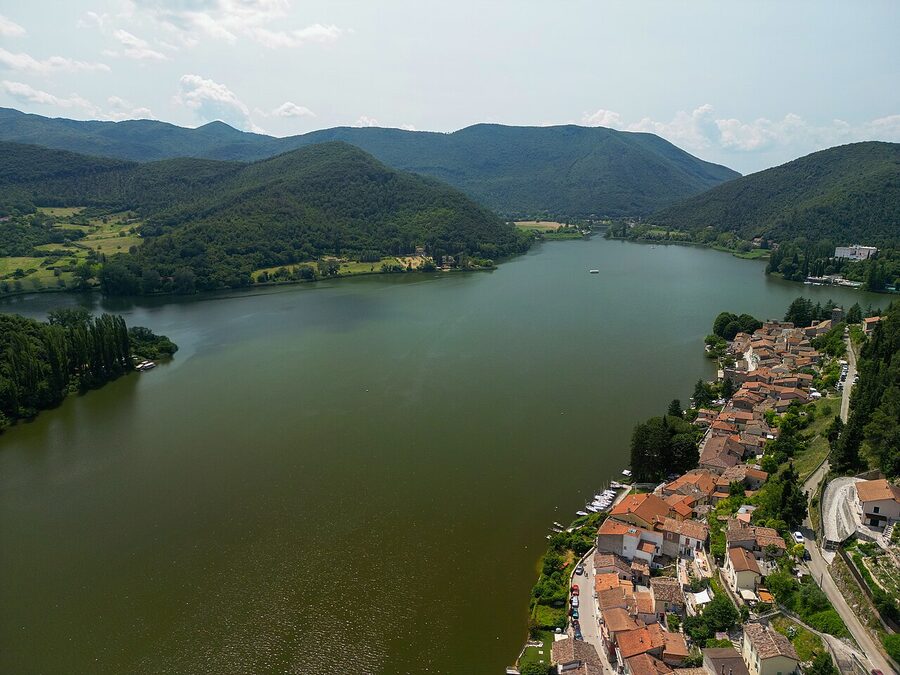
Lago di Piediluco. The hagiography places one of the more photogenic miracles here — Francis preaching to the fish on the shore of this small, almost-alpine lake in the Apennines south of Terni. It is a fifteen-minute stop, an hour if you take the boat; good in late spring.

La Scarzuola, near Montegabbione. Tradition says Francis built a small hut from scarza, a local reed, on a hillside between Assisi and Orvieto, and planted a laurel there that later bloomed. In the 1950s the architect Tommaso Buzzi bought the site and, over three decades, built on it one of the strangest private architectures in Italy — a “città ideale” of amphitheatres, stepped gardens, trompe-l’oeil towers, and philosophical symbolism that he called his own Buzzinda. You can visit by appointment (Saturday afternoons mainly). The contrast between Francis’s scarza-reed hut and Buzzi’s architectural fantasia is the single sharpest Franciscan-versus-modern contrast in Italy. Take the hour and a half.
Rivotorto, three kilometres south of Assisi. This is where Francis and the first brothers lived between 1209 and 1211, in a cluster of small huts arranged around a stone shelter. A 14th-century sanctuary now encloses the original huts, which are preserved as you find them in a cathedral reliquary. It is a twenty-minute stop on the way to the Porziuncola and worth it for the sheer strangeness of the preserved hovel inside the big church.
Walking the Via di Francesco
The Via di Francesco is not a single trail but a network of paths that link the Franciscan sites. There are two official routes, north and south, converging on Assisi:
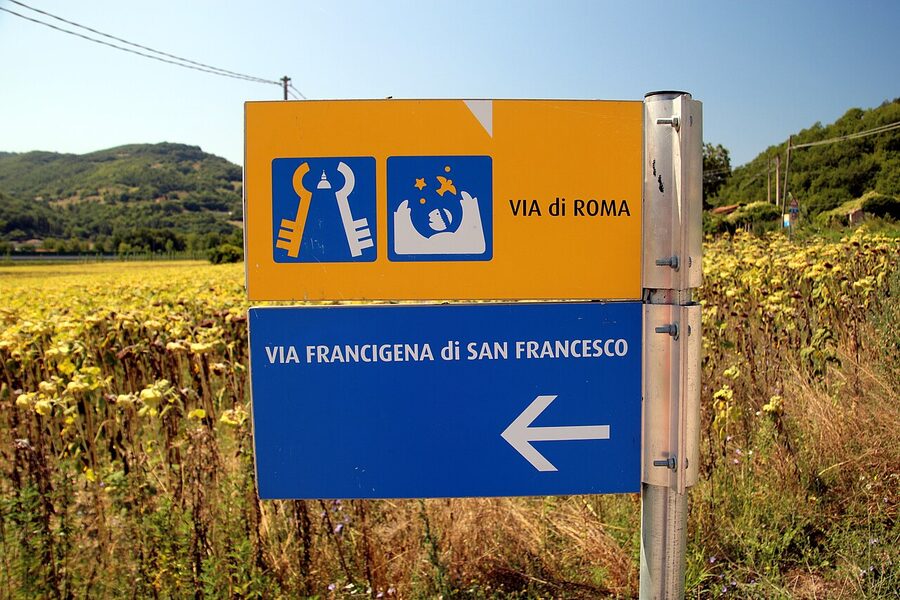

The northern Via di Francesco starts at La Verna and runs south through Chiusi della Verna, Badia Prataglia, Sansepolcro, Città di Castello, Gubbio, Valfabbrica, and into Assisi. It is about 180 kilometres and takes most walkers ten to twelve days. It is the more scenic of the two: Apennine forest, cornfields, hill towns every evening, and the occasional encounter with other pilgrims.
The southern Via di Francesco starts in Assisi and runs south through Umbria — Spello, Foligno, Trevi, Spoleto, Piediluco — into Lazio at Poggio Bustone, Greccio, and Rieti, and then up to the Vatican in Rome. It is about 250 kilometres and takes two to three weeks. It is less well marked than the northern route and more urbanised in places, but it includes the Valle Santa (Rieti’s Franciscan heartland) which is otherwise difficult to reach.
Total end-to-end from La Verna to Rome is roughly three to four weeks’ walking at a moderate pace, 20-25 kilometres a day, though many walkers do shorter sections over multiple visits. There is a pilgrim credential — credenziale — stamped at hostels and churches along the way; the official website at viadifrancesco.it handles registration. Accommodation is a mix of dedicated hostels, convents with spare rooms, small hotels, and private B&Bs, with prices in 2026 ranging from about €15 in a hostel dorm to €90 for a private room in a small town. Meals, local, reasonable — €15 for a pilgrim-menu dinner, €8 for a light lunch.
The walk is doable for a reasonably fit adult. It is not the Camino de Santiago in terms of traffic: you will often have trail sections to yourself, which is part of the appeal and, in safety terms, worth factoring in. Spring (April to early June) and autumn (mid-September to late October) are the right windows; high summer is hot on the open stretches and the small hill towns lose much of their atmosphere when the residents take their own August holiday. Winter walking is possible but accommodation availability drops sharply.
2026 — the eight hundredth year
2026 is the 800th anniversary of Francis’s death. A national committee — the Comitato Nazionale per l’Ottavo Centenario della Morte di San Francesco, chaired by the poet Davide Rondoni — has been coordinating exhibitions, conferences, and events across Italy; the programme updates live at sanfrancesco800.cultura.gov.it. A few dates worth noting if you are planning a trip during the year:
In Perugia, the Galleria Nazionale dell’Umbria is hosting Nel nome di Francesco. La rivoluzione di Giotto from 14 March to 14 June 2026, with international loans of Giotto-school paintings examining the link between Francis and the birth of Italian Renaissance painting. A second exhibition at the same gallery, I grandi dialoghi tra Francesco e i Grandi della cultura, is expected in autumn 2026, with manuscripts, illuminated codices, and paintings tracing the saint’s influence on Italian thinkers from the medieval period through the twentieth century.
In Assisi, the ostensione of Francis’s remains — the saint’s body is moved from the crypt to the Lower Basilica for public visitation — runs from 22 February to 22 March 2026. This is unusual; the body is normally only moved for major jubilees. Booking at sanfrancescovive.org.
In Spoleto, the Rocca Albornoz is hosting a photographic exhibition in October 2026 dedicated to Franciscan pilgrimage routes, with work by Fulvio Roiter and Luigi Spina.
In Gubbio — through an exhibition called Francesco e frate Lupo: l’arte racconta la leggenda dell’incontro, which I caught earlier this year at the Museo Civico di Palazzo dei Consoli — 250 paintings, sculptures, ceramics, and manuscripts treated the wolf story as an art-historical theme for the first time. The exhibition closed on 9 April 2026, but the catalogue (Silvana Editoriale) is still in print and worth tracking down for any future Gubbio trip.
For a full and updating calendar of centenary events, the sanfrancesco800.cultura.gov.it site is the authoritative source. Most events are free; the basilica ostensione requires booking.
Before you go
If you have three days, base in Assisi: spend one full day on the two basilicas and the town sites, one on San Damiano, the Porziuncola, and the Eremo delle Carceri, one on a driving loop to Gubbio or Montefalco. If you have a week, add Bevagna, Montefalco, Spoleto, Piediluco, and Rivotorto, with at least one night somewhere other than Assisi to get clear of the pilgrim-heavy Assisi evenings. If you have two weeks, add La Verna (an overnight with the friars), Greccio, the Valle Santa south of Rieti, and time to walk one or two days of the Via di Francesco. If you have a month, walk the whole of it.
Francis’s point — if he had one I feel qualified to summarise, which is doubtful — was that you need very few material things to live a good life. This is still a useful point, and hard to internalise from a book. You come to Italy and you look at the places he chose, and the landscape he walked, and the caves he slept in for weeks at a time, and the small oak above Cannara under which he stopped for an hour and talked to some birds, and something shifts about how you have been thinking about your own week. Whether or not you are religious, and whether or not the stigmata-seraph story convinces you, the topography does most of the work for him.
Drive slowly. Stop in the small towns. Eat the Sagrantino. Sleep in the convents when you can. Pay the €5 at the Porziuncola and stay inside for half an hour after the tour bus leaves. Come back for a second trip. For more on the wider region, start with the Umbria hub and the individual town guides for Nocera Umbra, Bevagna, and Orvieto.