
Ischia is the largest of the three Gulf of Naples islands, forty-seven square kilometres of volcanic rock at the northern mouth of the bay, with 62,000 permanent residents and around six million visitors a year, making it both the most populated Mediterranean island in Italy after Sicily and one of Europe’s oldest continuously inhabited thermal-bathing destinations. Euboean Greeks from Eretria and Chalcis founded a trading colony here in the 8th century BC, they called the island Pithekoussai, and Ischia has been continuously occupied ever since, through Roman, Byzantine, Norman, Aragonese, Bourbon, and republican Italian layers, all of which have left traces that you can still visit.
If Capri is the Gulf’s glamour island and Procida is the quiet one, Ischia is the one that works for actual holidays. It is large enough to drive around, the beaches are real sandy beaches, the thermal springs (active since Greek times and the island’s single biggest draw) run down the southern and western coasts, and the prices across the board, hotels, restaurants, beach clubs, are roughly 40-60% lower than Capri’s. Italian and German family travellers have been coming here for spa weeks since the early 1950s, when the film producer Angelo Rizzoli rebuilt Lacco Ameno into a jet-set resort and put Ischia on the international map for the first time since the 19th century. Ingeborg Bachmann lived here; William Walton lived here (from 1949 until his death in 1983); W. H. Auden wrote “In Praise of Limestone” on the island in 1948; the film Cleopatra was partly filmed here in 1962 with Elizabeth Taylor in residence; the Talented Mr. Ripley used Ischia Ponte as the fictional Mongibello in 1999; Elena Ferrante’s Neapolitan Novels send her characters here for summer holidays.
The thing to understand about Ischia is that the island has six distinct comuni, Ischia itself, Forio, Casamicciola Terme, Lacco Ameno, Serrara Fontana, Barano d’Ischia, and they feel like different places. The east coast around the town of Ischia is the busy ferry-port side; the north coast around Casamicciola and Lacco Ameno is the historic spa coast; the west coast around Forio is where the sunsets happen and the major gardens are; the south coast around Sant’Angelo and Maronti beach is the quietest and where the best thermal bathing is. Pick a base according to what you are actually coming for. Do not base yourself at the ferry port if you want a quiet week.
In This Article
Ischia in one paragraph
Volcanic island in the Tyrrhenian Sea at the northern mouth of the Gulf of Naples, 30 km from Naples. Area 47 km²; resident population 62,027 (2024). Highest point Monte Epomeo, 789 m, not in fact a volcano but a tectonic horst of green tuff that was uplifted from the seabed after the Green Tuff Ignimbrite eruption 56,000 years ago. Last active eruption 1302, producing the Arso lava flow on the northeast coast. Six communes: Ischia (the main town, 18,000 residents, on the east coast at the ferry port), Casamicciola Terme (north coast spa town, historically the oldest of the thermal centres), Lacco Ameno (rebuilt by Angelo Rizzoli in the 1950s as a jet-set resort), Forio (west coast, sunsets, La Mortella gardens), Serrara Fontana (south coast, including the car-free fishing village of Sant’Angelo), and Barano d’Ischia (inland southeast, Maronti beach). Greek colony from the 8th century BC (called Pithekoussai); Roman, Byzantine, Norman, Aragonese, and Bourbon rule in succession; part of Italy from 1861. Reached only by sea: hydrofoils and ferries from Naples (Molo Beverello and Calata Porta di Massa) and Pozzuoli, plus seasonal services from Procida. Demonym: Ischitano.
Getting to Ischia
All ferry traffic is from the mainland side of the Gulf of Naples, there is no direct ferry from Capri or from the Sorrento peninsula in most seasons. The three departure ports are Naples, Pozzuoli, and (seasonal) Procida.
From Naples, two terminals:
Molo Beverello in the centre of Naples runs hydrofoils (aliscafi) to Ischia Porto and to Forio, 50-60 minutes, €22-25 one-way, every 60-90 minutes from about 7am to 7pm. These are pedestrians-only; no cars. Operators are Caremar, SNAV, and Alilauro.
Calata Porta di Massa, about 10 minutes’ walk east from Molo Beverello, runs the larger car-and-passenger ferries (traghetti), 90 minutes, €15-18 foot passenger, €35-50 for a small car. Car ferries run every 2-3 hours. If you are taking a car, this is your terminal.
From Pozzuoli, 20 minutes by train west of Naples, Caremar and Medmar run both hydrofoils (40 minutes, €12) and car ferries (60 minutes, €10-12 foot; €30-45 for a car). Pozzuoli is faster and cheaper if you are coming from Rome by train, change at Napoli Centrale, take the Cumana line to Pozzuoli, walk 10 minutes to the port. The Pozzuoli route goes to Casamicciola and Ischia Porto; check which one stops closer to your hotel.
Bringing a car: Ischia is the one Gulf island where this is practical. The island is 10 km long and 7 km wide, with a good bus network but hill switchbacks that eat up time. If you are staying for a week and planning to move between Forio, Sant’Angelo, and Ischia Porto, a car makes sense. Book the car ferry slot a few days in advance in high season. You also need a permesso (entry permit) from June to September, which most hotels arrange on your behalf, send them your licence plate a week ahead.
On the island itself, buses are frequent and cheap (€1.50 per ride, €4.50 day pass, every 15-30 minutes on the main routes). The CD and CS lines circle the island in opposite directions and stop at essentially every town and beach, a full circuit takes about 90 minutes. Taxis and microtaxis (three-wheeled Piaggio Ape conversions) are available at the ports and main squares; a ride across the island is €30-50. Scooter rental from the port at Ischia Porto is €30-50 a day, Ischia is the one Gulf island where this is genuinely practical, because the roads are wide enough and the distances are long enough to make it worth the paperwork.
The Aragonese Castle and Ischia Ponte
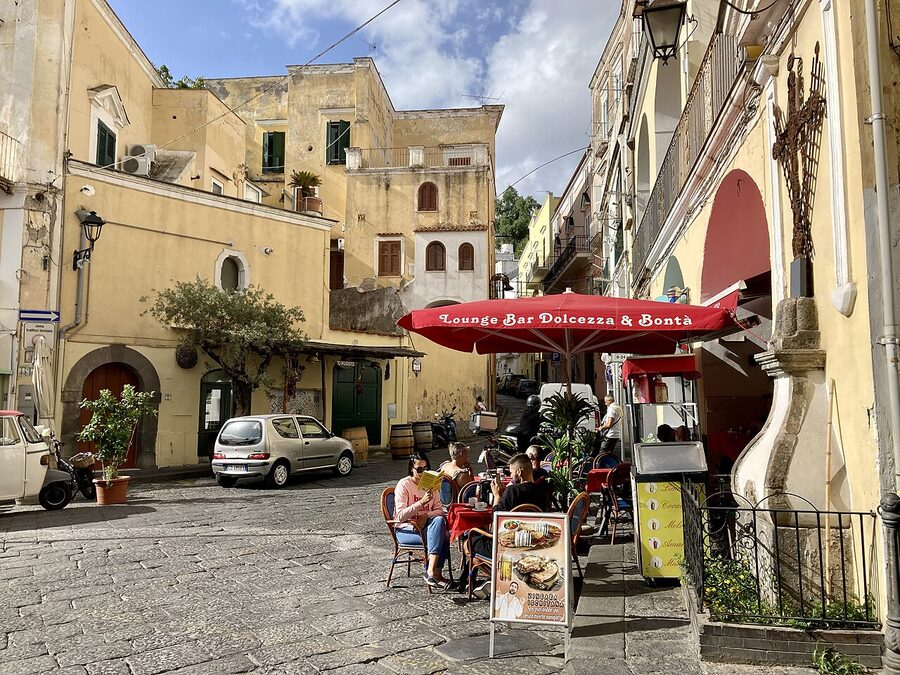
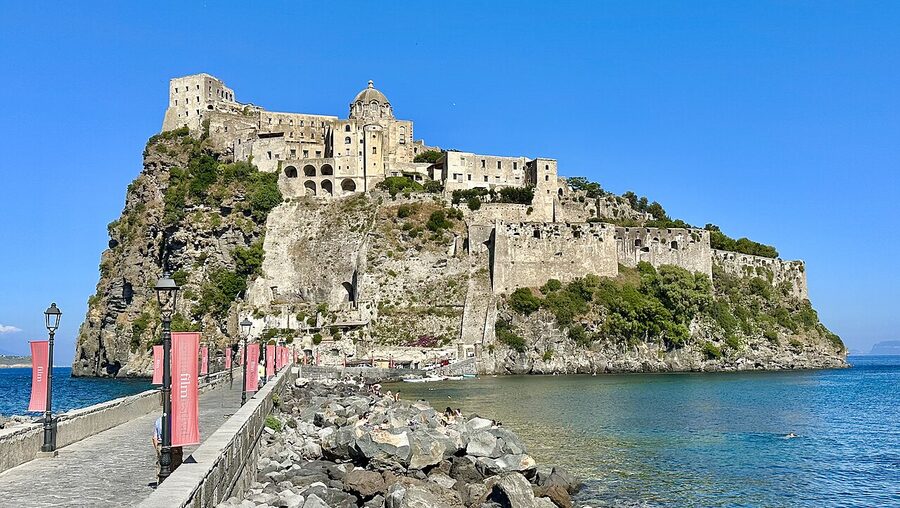
The town of Ischia has two halves. Ischia Porto, where the hydrofoils arrive, was built in the 1850s when the Bourbon king Ferdinand II had a natural crater lake cut open to the sea to create the harbour. It is busy and useful but not the evocative half. Walk east along Corso Vittoria Colonna, past the long beach of the Spiaggia dei Pescatori, and you arrive in Ischia Ponte, the older fishing quarter, named for the causeway (ponte) that links the mainland to the Aragonese Castle. This is the half you want to walk through at dusk. The narrow streets curve toward the sea; fishermen still mend nets on the beach in the morning; the restaurants are half the price of the port-side ones. Half a kilometre through the quarter, the stone causeway begins, 220 metres of bridge straight across the sea to the castle rock.
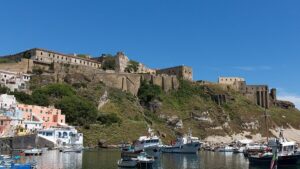
The Castello Aragonese itself is a 113-metre-tall volcanic rock with a castle on top and a thousand-year history of occupation. A fort was first built here in 474 BC by the Syracusan tyrant Hiero I after he helped the Cumaeans defeat the Etruscans at sea. The Romans took it; the Byzantines took it; the Normans, the Angevins, the Aragonese, and finally the Bourbons each added a layer. In 1441 Alfonso V of Aragon built the stone causeway that connects the rock to the main island, replacing an earlier wooden bridge. In the 1500s the castle became the refuge for the entire population of Ischia during Barbary corsair raids, around 1700, some 2,000 families lived inside the walls, along with a convent of Poor Clares, a monastery of Basilian (Greek Orthodox) monks, the bishop and his seminary, and the prince with a military garrison, plus thirteen separate churches. The castle was sold to a private owner in 1912 and remains in private hands today.
Entry is €12 and a visit takes 2-3 hours. The site is genuinely vast, you could spend a full day. A modern lift takes you up from the sea-level entrance; there is also a tunnel with large openings cut into the rock that lets in the light, which is the more evocative approach. At the top, the scattered ruins include the 14th-century Cathedral of the Assumption (destroyed by British naval bombardment in 1809, now a spectacular ruin with the sky where the roof should be), the small Church of the Immacolata (1737), the cell of the Clarisse convent (where the nuns’ skeletons were seated upright in stone chairs after death to decompose, the chairs are still there and genuinely disturbing), a museum of torture instruments, a café on the south side with the best view of Ischia Ponte from above, and a path that winds around the entire rock at cliff edge with constant views out over the Gulf. The castle was used as the fictional Riva’s Fortress in Men in Black: International (2019) and as a location in half a dozen other films.
Back on the main island at the foot of the causeway, the Chiesa di Santa Maria di Loreto and the Torrione di Ischia, a circular 15th-century watchtower now housing a small municipal museum, are worth a short detour. For the single best view of the castle from the mainland side, walk the Spiaggia dei Pescatori (fishermen’s beach) at dusk: the castle lit up across the bay against the evening sky is the image of Ischia.
Forio and La Mortella
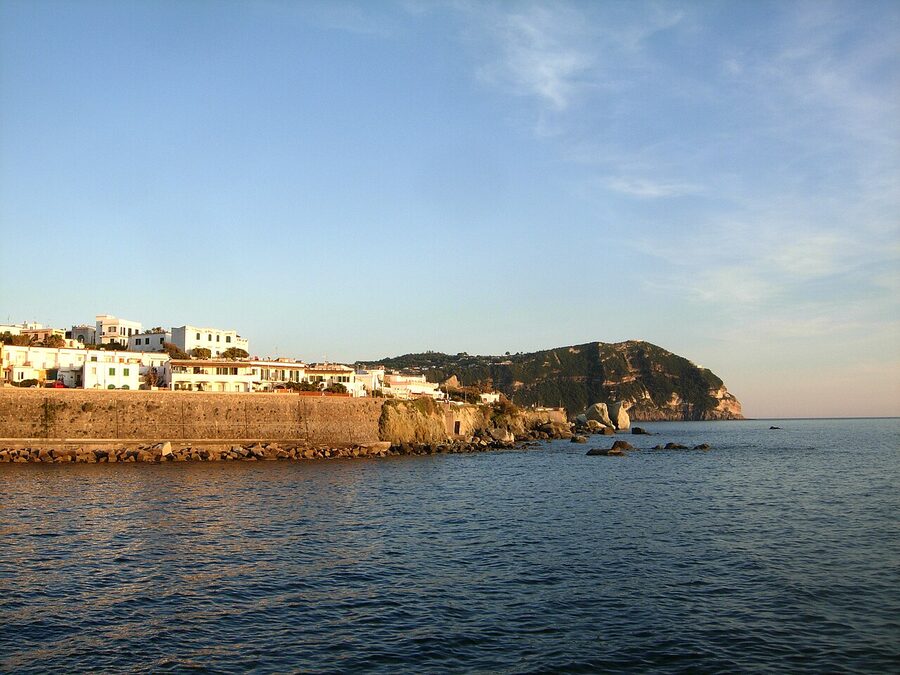
Forio is the most appealing town on Ischia and the one most independent travellers pick as their island base. It is on the west coast, which means sunsets over the water; it is large enough to have proper restaurants and shopping; and it sits closest to the major gardens, the thermal parks, and the main west-coast beaches. The historic centre is a warren of narrow streets around the Torrione watchtower (one of twelve 15th-century defensive towers built against Barbary raids, at its peak, there were 52 such towers on the island). On a small promontory at the north end of town, the Chiesa del Soccorso, a whitewashed cube-shaped church completed in 1791, is the classic Forio sunset spot: walk out at 7pm, sit on the low wall in front, watch the sun drop into the sea.
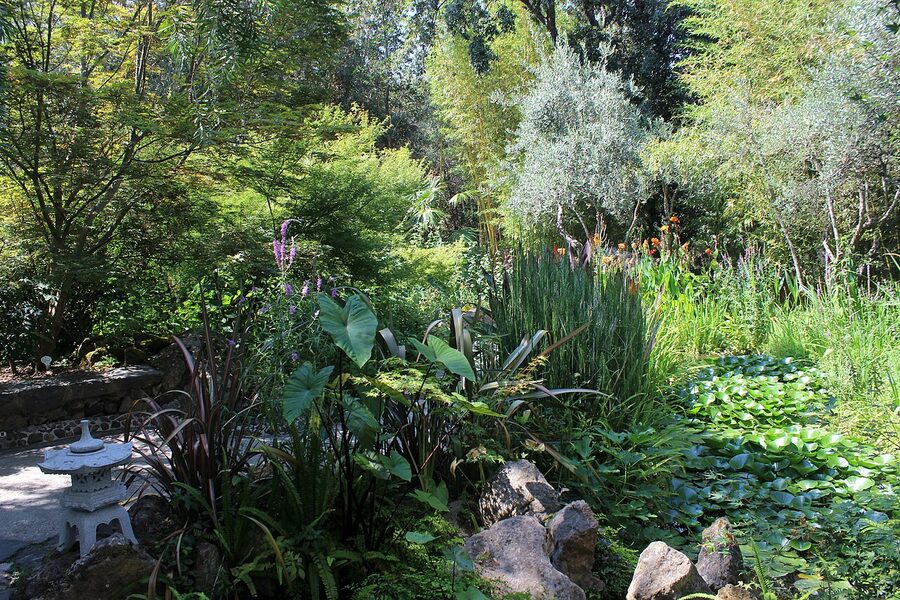
Two kilometres north of town, the Giardini La Mortella are the single greatest cultural destination on Ischia. The composer William Walton arrived on Ischia in 1946 and immediately commissioned the English garden designer Russell Page to lay out a tropical garden on an old quarry site his Argentinian wife Susana had bought. Walton sold his London house in 1956 and moved to Ischia permanently; he lived here until his death in 1983. Susana continued to expand the garden until her own death in 2010. The result is one of the most remarkable Mediterranean botanical gardens in private hands, 12 hectares of tropical and subtropical planting, winding paths through fern gullies, a hill garden with views over Forio and the sea, a small museum of Walton’s working life, and a recital room where a world-class chamber music programme runs from April to October on weekend afternoons. The garden is open Tuesday, Thursday, Saturday, and Sunday, 9am-7pm, April to October; entry €12, allow 2-3 hours, and if you can time your visit for one of the Saturday 5pm chamber concerts, do.
Just north of La Mortella, the Giardini Ravino are a 6,000-square-metre cactus and succulent garden created over 50 years by a single local botanist, Giuseppe d’Ambra. Smaller and less cultivated than La Mortella but arguably more unusual, some of the collection is extraordinary. Entry €10, 90 minutes, open March to November.
South of Forio, on the way to Panza, the Poseidon Thermal Gardens are the largest of Ischia’s commercial thermal spa complexes, 22 pools of varying temperatures (from 15°C to 40°C), saunas cut into the cliff, direct beach access, the lot. Entry €38-45 for the day depending on season, open April to October, this is the classic Ischia thermal day out. Smaller and more characterful: the Giardini Termali Negombo at Lacco Ameno (also €38, 14 pools in a Ravello-style terraced garden), and the Bagni di Sorgeto below Panza (free public thermal cove, hot springs bubbling up through the pebble beach; wade in at 38°C straight out of the rocks). Sorgeto is the one thermal experience on the island that is both entirely free and completely distinctive; expect the path down from the road to be 220 steps each way.
Sant’Angelo and the south
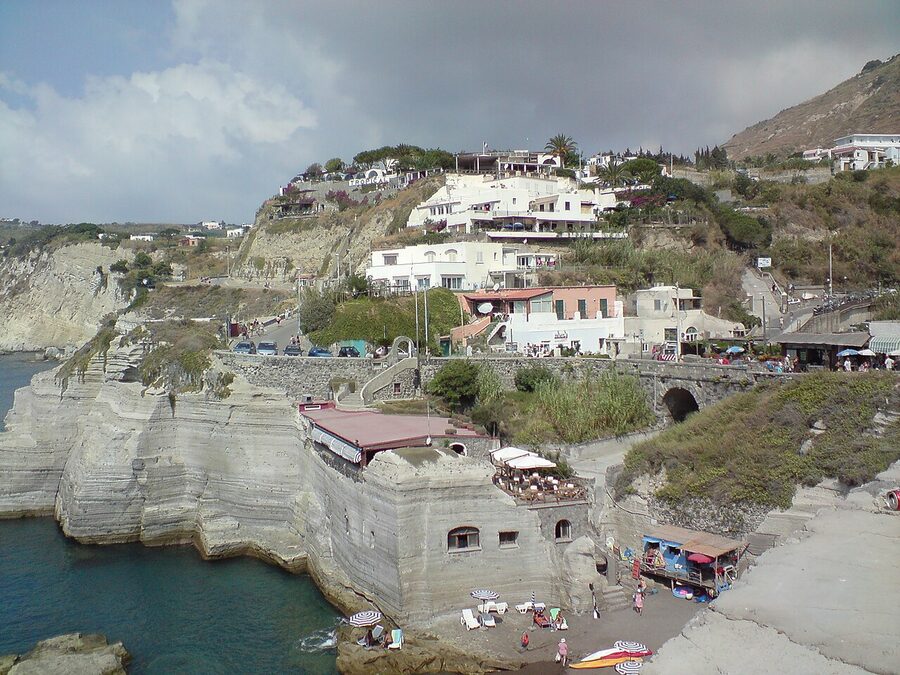
The southern coast of Ischia, from Sant’Angelo in the west to Maronti beach in the east, is the island’s quietest and most distinctive stretch. The road between the two drops through olive groves and vineyards; the sea is clearer than anywhere else on Ischia; the main beach is a 1.5 km curve of dark volcanic sand with no buildings behind it and no road access. This is where you come if you want the version of Ischia that looks nothing like a Capri day trip.
Sant’Angelo is a fishing village of perhaps 100 houses strung along a small harbour at the southwestern tip of the island, connected by a narrow spit of land to an isolated rock (Il Fungo, “the mushroom”) that used to be a lookout post. Cars are not allowed inside the village, you park at the top and walk down. The harbour has about eight fishing boats and the same number of small seafood restaurants; the village climbs up from the harbour in a tangle of whitewashed lanes with bougainvillea spilling everywhere and no signs. The writers Rudolf Levy, Werner Gilles, and Max Peiffer Watenphul lived here as an artists’ colony in the late 1930s before the war; the mood they described, quiet, shabby, unaffected, is essentially still the mood of the village today, albeit with higher hotel prices.
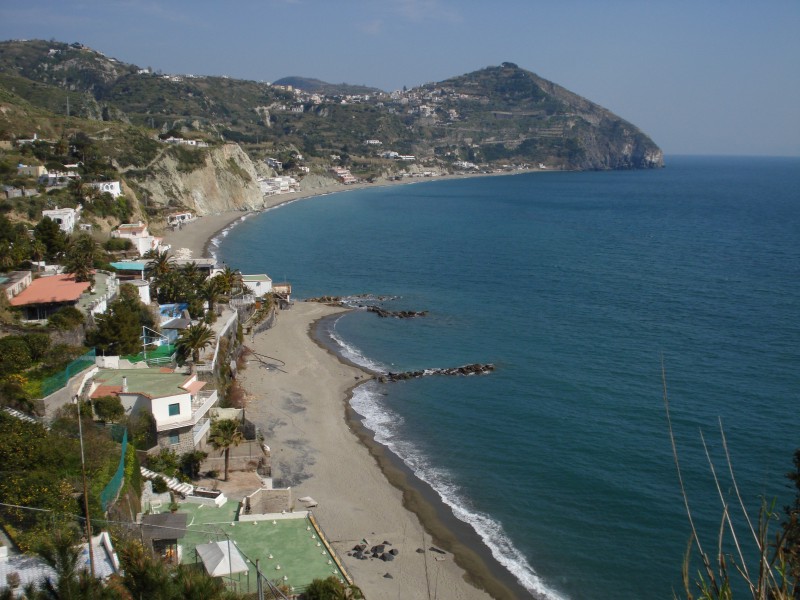
The Spiaggia dei Maronti runs 1.5 km east from Sant’Angelo, accessible on foot along the cliff path (30 minutes), by a small taxi-boat shuttle from the harbour (€5 one-way, every 30 minutes), or by road from Barano d’Ischia. The beach itself is dark volcanic sand, thermal springs bubble up at its western end (dig a shallow hole at the waterline and you get a natural hot-water basin), and the whole beach is backed by cliffs rather than a road, which makes it feel remote in a way that no other beach on the island does. A handful of small restaurants (Il Focolare is the best-known) sit on the cliff above the western end; a few stabilimenti (private beach clubs) run along the middle stretch.
Between Sant’Angelo and Maronti, along the cliffside path, the Parco Termale Aphrodite Apollon is a small private thermal complex, 12 pools, quieter than Poseidon, €30 day entry. Also on this stretch: the Cavascura, an ancient hot spring cut into a natural gorge, where the thermal water has carved a small tunnel in the rock that you can bathe in for a few euros, the Romans used this exact spring, and it is one of the oldest continuously used bathing sites in the Mediterranean.
Casamicciola Terme, Lacco Ameno, and the spa tradition
The north coast is Ischia’s historic spa coast. The waters here have been considered therapeutic since Greek times; there are some 150 distinct thermal springs on Ischia of varying mineral composition, and the northern and southern coasts sit over the two main hydrothermal systems. Casamicciola was the first of the spa towns to attract outside visitors, Norwegian nobility from the 18th century onward, and then a wider European clientele from the 1820s. In 1867 the Norwegian playwright Henrik Ibsen spent a summer in Casamicciola and wrote the third act of Peer Gynt in the house that is now called Villa Ibsen. Garibaldi was here in 1864 recovering from a battle wound. The Russian anarchist Bakunin lived in Casamicciola during 1866-67 and wrote to Alexander Herzen from the terrace.
That 19th-century spa culture was largely ended by a single catastrophic event: on the evening of 28 July 1883 an earthquake of magnitude 5.8 flattened Casamicciola Terme and Lacco Ameno. Around 2,300 people died; most of the town fabric was destroyed. The event entered the Italian language, for the next 50 years, the phrase qui pare Casamicciola (“this looks like Casamicciola”) was used to describe any scene of rubble and chaos. Ibsen had left the island only because of an earlier 1867 earthquake; the 1883 event was of a different order entirely.
Casamicciola and Lacco Ameno were rebuilt through the late 19th and early 20th centuries, but the spa industry didn’t fully revive until the early 1950s. The central figure in that revival was the Milanese film producer and publisher Angelo Rizzoli (1889-1970), who from 1953 onward bought up land in Lacco Ameno and built a cluster of luxury hotels, the Regina Isabella, the Sporting, the San Montano, that turned the village into the island’s jet-set resort. His newspapers (Rizzoli was the publisher of Corriere della Sera, among many others) acted as a publicity machine for Ischia’s thermal waters and its social calendar; his film production company made several features set on the island (Vacanze a Ischia, Appuntamento a Ischia); he hosted international film premieres on the island, including Chaplin’s A King in New York in 1957. The result was that between about 1955 and 1965, Lacco Ameno was the Italian equivalent of Cannes or St Moritz, ministers, industrialists, actors, royalty. Elizabeth Taylor stayed while filming Cleopatra in 1962. The Kennedys visited. Rizzoli also founded the island’s only hospital (the Anna Rizzoli, named for his wife) and bought the 18th-century Villa Arbusto, which is now the Pithecusae Archaeological Museum.
The Museo Archeologico di Pithecusae at Villa Arbusto in Lacco Ameno is essential if you have any interest in the Greek layer of Ischia. The collection is built around the finds from the necropolis at Monte Vico, 1,300 tombs excavated from the 8th-6th centuries BC, by Greek and Etruscan and Phoenician burials side by side. The headline object is Nestor’s Cup, a small Rhodian skyphos found in a child’s grave in 1953 and inscribed in c. 730 BC with a three-line Greek verse referring to King Nestor in the Iliad, one of the earliest Greek alphabetic inscriptions ever found, and possibly the oldest surviving written reference to Homeric poetry. The inscription reads, roughly: “I am the cup of Nestor, good for drinking. He who drinks from this cup shall at once be seized by desire for fair-crowned Aphrodite.” Entry to the museum is €7; allow 90 minutes.
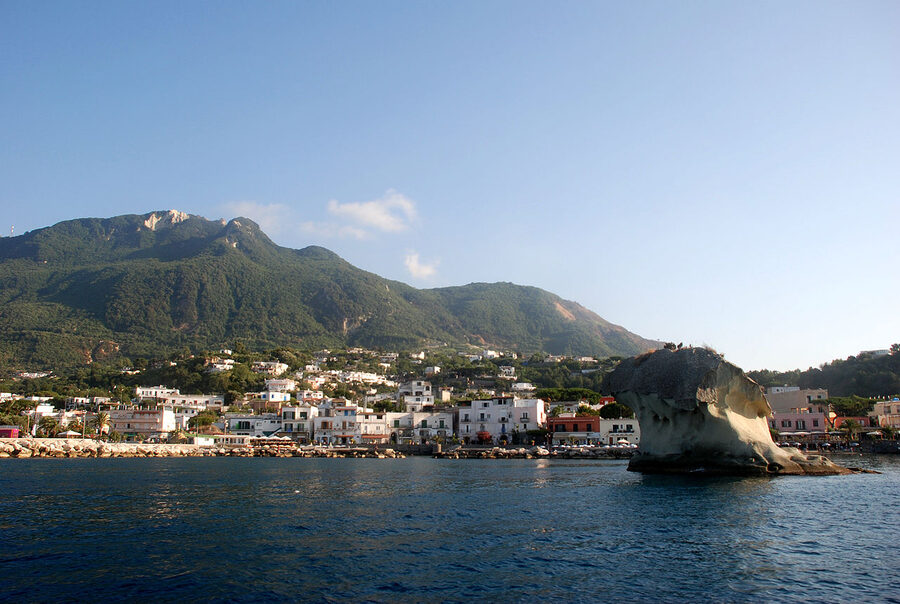
Lacco Ameno itself is a small, tidy seaside town with the 10th-century Church of Santa Restituta (built over an early Christian basilica that has been excavated underneath; you can go down), a sea-level piazza with Italian-Dolce-Vita-era cafés, and the distinctive offshore rock called Il Fungo (not to be confused with the Sant’Angelo Fungo), a 10-metre mushroom-shaped tuff formation that sits 50 metres off the beach and is the town’s postcard image.
Mount Epomeo and the island interior
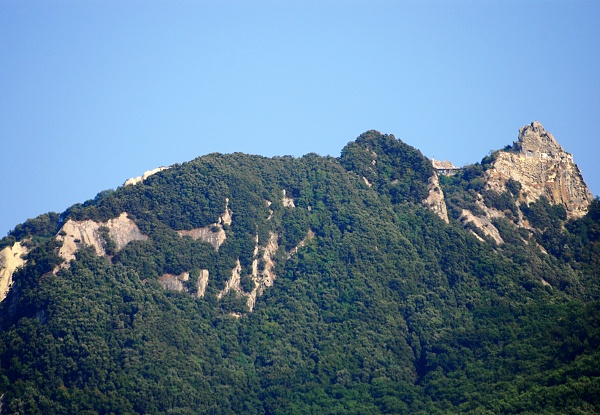
Most visitors to Ischia never climb Monte Epomeo. They should. The 789-metre peak is the highest point on the island and the single best viewpoint in the entire Gulf of Naples, on a clear day, the whole bay opens up: the mainland curving from Naples to Sorrento, Vesuvius smoking in the distance, Capri and Procida to the south and north, the full length of the Ischian coastline in both directions. Monte Epomeo is not a volcano, it is a tectonic horst of green tuff that was originally underwater and was pushed up to its current elevation by magmatic pressure over the last 33,000 years, but the view is the same as from any volcanic peak.
The walk up takes 90 minutes from the village of Fontana (on the CS bus line, 30 minutes from Forio). The path is a stone-laid mule track, well-maintained, not steep, with a final scramble up loose rock to the summit. At the top, a small hermitage, the Eremo di San Nicola, cut directly into the tuff in 1459 by a member of the d’Avalos family as penance for killing a rival, has been converted into a small restaurant (La Grotta da Fiore) where you can eat lunch in an actual rock-cut cave cell. Best done at 8am to catch the morning air and to have the summit to yourself; allow 3 hours round-trip plus time at the top.
The interior of the island, the villages of Barano, Buonopane, Serrara, Fontana, is largely agricultural and ignored by most visitors. This is where the Ischia wine comes from (grown on terraces on the lower slopes of Epomeo), where the older farming families still live, and where the cheapest restaurants on the island are. If you have a car, drive the back roads between Forio and Barano via Serrara and Fontana on a weekday afternoon, you’ll see essentially no tourists, and you’ll get a sense of what Ischia was before the tourist economy arrived.
Beaches and thermal bathing
Ischia has more and better beaches than either Capri or Procida. The main ones, going clockwise from the ferry port:
Spiaggia dei Pescatori (Ischia Porto), 500m of dark sand in front of Ischia Ponte, public, free, with the Aragonese Castle view. Swimmable but crowded in high season.
Spiaggia di Cartaromana (Ischia Ponte), a small cove under the castle on the east side, reached by a path. Much quieter than Pescatori, with clear water and underwater Roman ruins you can swim over with a mask.
Spiaggia di San Montano (Lacco Ameno), the most photographed beach on Ischia, a crescent of bright sand in a natural bay, sheltered, calm water, the Negombo thermal park takes up most of the frontage (entry €38) but there is a small free public strip at the western end.
Spiaggia di Citara (Forio), 1 km of dark volcanic sand on the west coast, with the Poseidon thermal park at the southern end and open public beach at the north. West-facing, so the best afternoon beach on the island, with sunset swims in June.
Spiaggia di Sorgeto (Panza), a small pebble cove reached by 220 steps down from the road, famous for the hot springs bubbling up at the waterline. Free, and the only place on the island where you can bathe in natural thermal water at sea level.
Spiaggia dei Maronti (Barano), 1.5 km of dark sand, the longest beach on the island, backed by cliffs, reachable by taxi-boat from Sant’Angelo or by car from Barano. The most remote-feeling beach.
Water temperature rises quickly in May, peaks in August at around 26°C, and stays swimmable through October.
Food, wine, hotels
Ischitano cooking is Campanian coastal with some specifically volcanic-soil angles. The signature dish is coniglio all’ischitana, rabbit slow-cooked in white wine with tomato, garlic, rosemary, and wild thyme, a peasant dish from the interior villages where the terraced vineyards and rabbit hutches sit on the same small farms. Eat this at Il Focolare in Barano (Via Cretaio 68, open lunch and dinner, €35-50 per person, the canonical Ischitano restaurant and run by the Buono family since 1985) or at Da Ciccio in Serrara Fontana.
Other dishes to look for: zuppa di pesce (local fish stew with saffron-garlic broth, different from the Neapolitan version), polpo alla luciana (octopus cooked in its own juices with garlic and cherry tomatoes), pasta con fagioli e cozze (beans and mussels with short pasta, a local peasant hybrid), and the classic pane cafone (the rustic volcanic-sourdough bread of the interior).
Wine: the Ischia DOC produces mostly whites, around 80% of island production, made primarily from Forastera (a grape native to Ischia) and Biancolella, grown on volcanic soils heavy with pumice, phosphorus, and potassium. The wines are crisp, mineral, with a distinctive iodine-note finish from the coastal air. The reds use mostly Piedirosso (known locally as Per’e Palummo, “pigeon’s foot,” for the colour of its stems) blended with Guarnaccia and a small amount of Barbera. The three key producers are Casa d’Ambra (the largest, the reference point for Ischitano wine), Pietratorcia (the most interesting recent producer, biodynamic), and Cenatiempo. Visit either of the first two for tastings, Casa d’Ambra’s cellars are at Forio and are open weekdays.
Hotels. The island has a wide range; the clustering differs by region.
Top tier, Lacco Ameno: Regina Isabella (Piazza Santa Restituta 1, €600-1,200, the Rizzoli-built flagship from 1956, five-star, private beach, full thermal spa); Mezzatorre (San Montano, €800-1,500, a converted 16th-century watchtower on a private headland, outstanding).
Top tier, Forio: Mezzatorre is actually classified as Forio (on the north edge of town); Il Moresco at Ischia Porto (Via Quercia 6, €350-700, classic Italian luxury, 66 rooms, own thermal park).
Mid-range: Hotel Semiramis at Forio (€180-350, on the west coast near Citara beach, with its own thermal pools and a reliably excellent restaurant); Hotel Floridiana in Casamicciola (€150-280, a family-run 40-room hotel from 1963 with good thermal facilities); Villa Angelica at Lacco Ameno (€140-250, the budget-friendly-but-not-budget option on the jet-set coast).
Budget: Hotel Parco Cartaromana at Ischia Ponte (€100-180, 20 rooms, own small beach, walking distance to the castle); Hotel Eden at Forio (€90-160, one block back from the seafront, unpretentious and reliable).
Sant’Angelo specifically: hotels in the village are limited because of the car-free rule; the one specifically worth booking is Hotel Miramare e Castello (€250-500, on the cliff above the harbour, 50 rooms, spa, the best-positioned hotel in the village).
When to visit
The island’s season is long: most hotels open at Easter and close in early November. The weather is reliably warm by mid-April and stays warm through late October.
May and early June: the best single window. Warm enough to swim (the sea climbs through 20°C in May, 22°C in June); thermal parks and gardens are fully open; crowds are moderate; prices have not yet climbed to peak. La Mortella’s chamber music programme is in its spring season. This is the month to come for a serious thermal-and-walking week.
Late June, July, early August: high summer. Sea is warm (24-26°C); everything is open; prices are at peak. Casamicciola and Forio town centres fill up; hotel availability is a real constraint by mid-July; Ferragosto week (around 15 August) is the single busiest week of the year and should be avoided unless you’ve booked a specific Ferragosto-programme hotel. You will still have a good holiday in July, but you’ll pay for it.
Late August, September: still warm, the August crowds begin to thin after the 20th. First week of September is often the single nicest week of the year on Ischia, warm, uncrowded, all infrastructure still running.
October: the sea stays swimmable until mid-month, the thermal parks stay open until 31 October, and prices drop 30-50%. The best month for walking Epomeo and for quiet thermal mornings at Sorgeto.
November through March: most of the island shuts. A handful of hotels in Ischia Porto and Forio stay open for local business; the thermal parks close; Sant’Angelo essentially empties out. Come in this window only if you want the version of Ischia that actual residents see, quiet, local, rainy, inexpensive, with fires in the trattorie.
Before you go
Ischia rewards a longer stay than the other Gulf islands. The classic visit is 5-7 nights with a hire car, splitting between Forio (for the west-coast gardens, beaches, and sunsets) and either Sant’Angelo (for the south) or Lacco Ameno (for the thermal history). A short three-night visit works only if you pick one base and don’t try to see everything.
The one thing most first-time visitors get wrong is basing themselves at Ischia Porto because it’s where the ferry arrives. The port is convenient for the castle and for onward ferries, but it is the busiest and plainest of the six communes. Take the bus the 25 minutes to Forio or the 40 minutes to Sant’Angelo on your first day and base yourself where you actually want to be.
For the other two Gulf of Naples islands, see the Capri guide (smaller, more dramatic, more expensive) and the Procida guide (tiny, quiet, the Italian Capital of Culture 2022). For the mainland Campania context, see the Campania hub. The Ischia ferry also runs from Pozzuoli, which is in the Phlegraean Fields area with Solfatara and Cumae, see the Campania hub for notes on that archaeological complex.
.jpg)


