

Paestum is an ancient Greek city in southern Campania — 85 kilometres south of Naples, 35 south of Salerno, on the flat alluvial plain of the Sele river, in the UNESCO-listed Cilento National Park. It has three intact Doric temples from the 6th and 5th centuries BC, a 5th-century BC painted tomb that is the only surviving example of Greek painted wall-painting from the Classical period, an excavated Greek-Roman city grid, a mile-long stretch of original Greek city walls, and almost no crowds. On a busy summer day it has 8,000 visitors; Pompeii has 20,000. In December it is deserted. It is, by any ordinary standard, one of the half-dozen most important archaeological sites in Europe, and it is consistently among the most underused.
The reason Paestum matters is that the three temples are the best-preserved Greek Doric temples in the world — better-preserved than the Parthenon, better-preserved than the temples at Agrigento, better-preserved than anything in Greece itself. This is not hyperbole: of the 50 or so complete Doric temples known to have been built by Greek colonists across the Mediterranean between the 7th and 4th centuries BC, only a handful survive with all their columns standing; only the Paestum three stand with their entablatures and pediments still partially intact. Two of them — the Temple of Hera II (also called, wrongly, the Temple of Poseidon) and the Temple of Hera I (also called, wrongly, the Basilica) — are fundamentally complete: you walk into them, you look up and see the entablature and the pediment as the 5th-century BC Greeks built them, and you understand for the first time what a Greek temple was supposed to look like.
Greek travellers have been coming to Paestum since the 18th century, when the Grand Tour brought aristocrats from northern Europe down the peninsula to see the classical ruins. Goethe came in 1787 and wrote about the temples in his Italian Journey. Shelley wrote a sonnet. Winckelmann argued, wrongly, that the temples were primitive because they were sturdier and less graceful than later Greek work (he never quite got Doric). For the past two centuries Paestum has existed as a secondary destination on the classical Italian circuit — overshadowed by Pompeii, overshadowed by Agrigento, overshadowed by the museums of Rome and Naples — and therefore protected, by relative neglect, from the worst pressures of tourism. You can still stand alone in the middle of the Temple of Hera II at 4pm on a weekday in October. There are few comparable experiences left in European travel.
In This Article
- Paestum in one paragraph
- Getting to Paestum
- Before the temples — who were the Greeks at Poseidonia?
- The Temple of Hera II (Poseidon)
- The Temple of Hera I (Basilica)
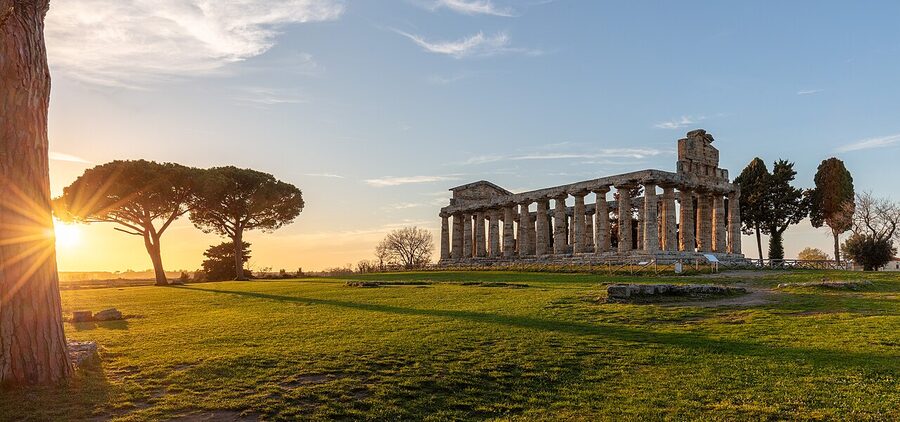
- The Temple of Athena (Ceres)
- The Tomb of the Diver and the Paestum Museum
- Walking the site
- Practical — tickets, timing, heat
- Staying nearby and the Cilento
- Combining Paestum with the rest of the trip
- When to visit
- Before you go
Paestum in one paragraph
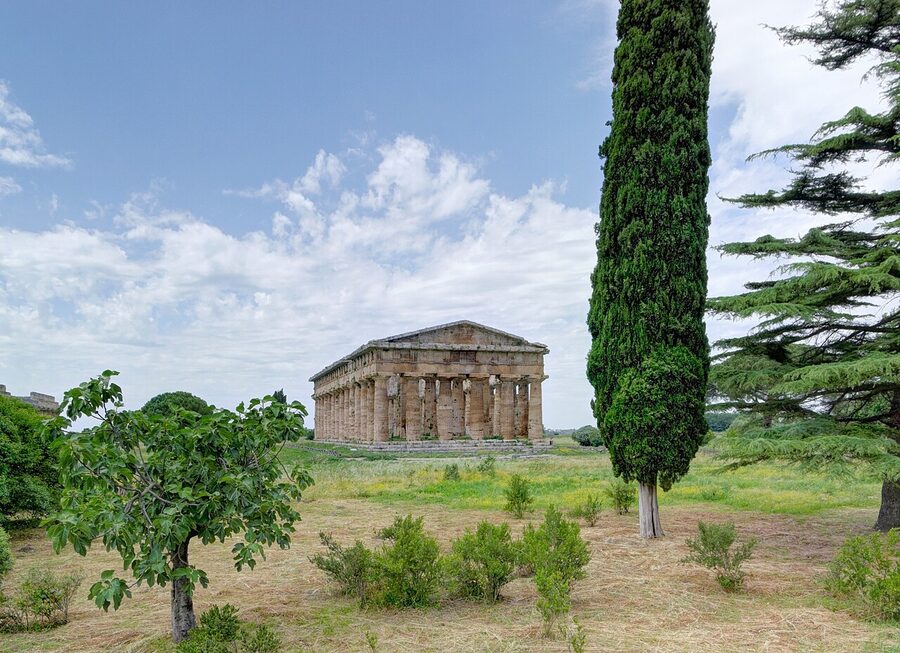
Ancient Greek city (original name Poseidonia) founded around 600 BC by settlers from the Greek colony of Sybaris, on the coast of the Tyrrhenian Sea at the mouth of the Sele river in southern Campania. Three intact Doric temples: Temple of Hera I (“Basilica,” c. 550 BC), Temple of Athena (“Temple of Ceres,” c. 500 BC), and Temple of Hera II (“Temple of Poseidon” or “Temple of Neptune,” c. 460 BC). Lucanian control from 400 BC, Roman colony from 273 BC (renamed Paestum), abandoned in the 8th century AD due to malarial swamp that developed on the coastal plain. Rediscovered in the 18th century; archaeological park open since the 19th. UNESCO World Heritage Site 1998 (together with the Cilento and Vallo di Diano National Park). Province of Salerno. The modern commune Capaccio Paestum is administratively the site’s host town; the archaeological park is open daily 9-19 in summer, 9-15:30 in winter. Entry €12; 3-day combined ticket with the separate Velia archaeological park €15.
Getting to Paestum
The archaeological site is served by its own rail station, Paestum, on the Naples-Salerno-Reggio Calabria line. Direct regional trains from Salerno take 30 minutes (€4), from Naples about 90 minutes with a change at Salerno (€11). The station is 400 metres from the main site entrance — a 5-minute walk. Trains run approximately hourly; the service is more frequent than you might expect.
By car, the route is A3 autostrada south from Naples or Salerno to the Battipaglia exit, then SS18 south for 20 minutes. Parking is free along the SP175 road that runs past the site. In summer, use the paid lot at the main visitor entrance (€5 for the day).
From Amalfi or Positano, the route is a SITA bus to Salerno (45 minutes from Amalfi, 75 from Positano), then train to Paestum. Total transfer time: 2-2.5 hours. From Ravello, add 25 minutes for the Amalfi bus connection.
From Rome, the trip is 3 hours by Frecciarossa to Salerno then regional train (the Rome-Salerno direct leg is 2h30). A day trip from Rome is possible but long; overnight in Salerno if you can.
A common route from the north is the “Pompeii + Paestum” southern-Campania archaeological day. The distance is 85 km by car, or 2 hours by train with a change at Salerno. Doing both in one day means 4 hours at Pompeii and 2 hours at Paestum, which short-changes both. Two days is the right commitment.
Before the temples — who were the Greeks at Poseidonia?
Paestum was founded around 600 BC, give or take two decades, by Greek colonists from Sybaris — a Greek city on the Ionian coast of what is now Calabria, itself founded a hundred years earlier by settlers from Achaea in mainland Greece. The colony was named Poseidonia after the sea god, who the Greeks conceived as the founding patron of their Mediterranean settlements. The site had everything a Greek coastal colony needed: a fertile alluvial plain for grain, a protected natural harbour, access to timber and stone from the nearby Lucanian mountains, and a navigable river for inland trade.
The Greek city thrived through the 6th and 5th centuries BC. At its height — probably around 500 BC — it had 15,000 to 20,000 residents, which is larger than any Greek colony in what is now Italy except Syracuse and Tarentum. It minted its own silver coinage (the famous Poseidonia coins show Poseidon hurling a trident on one face and a bull on the reverse); it had democratic institutions; it produced the three surviving Doric temples as part of a major 6th-to-5th-century BC building programme; and it was the administrative centre of a territory that extended from the modern Agropoli coast to the Lucanian hills.
In 400 BC the city was conquered by the Lucanians — the Italic people who lived in the mountains to the east. Greek administration was replaced by Italic, but the physical city continued largely unchanged; the new rulers were sufficiently hellenised to preserve what they found. The Lucanians are also the people who produced the Tomb of the Diver (about 480 BC, painted around the time of the Greek-to-Lucanian transition) and the painted tombs of the Lucanian necropolis outside the city walls.
Rome took the city from the Lucanians in 273 BC after the end of the Pyrrhic War, and refounded it as a Latin colony under the new name Paestum. The Romans built a forum in the centre of the old Greek agora, laid out an amphitheatre, added baths and civic buildings, and integrated the city into the Roman road network via the Via Popilia. The population probably dropped during the Roman period to about 10,000.
Paestum was abandoned not by invasion but by malaria. The coastal plain began to silt up in the 3rd and 4th centuries AD, the drainage systems that the Greeks had built failed, and the resulting swamp brought endemic malaria that made the city progressively uninhabitable. By the 8th century AD, the city was deserted; the surviving population had migrated to the hilltop town of Capaccio Vecchia 10 km inland. The temples, the walls, and the forum were left standing in the middle of an empty plain, and the whole site was slowly reclaimed by forest. When Grand Tour travellers rediscovered them in the 18th century, the temples were standing in buffalo-grazed wetland and local farmers used the Temple of Hera II as a stable.
The Temple of Hera II (Poseidon)
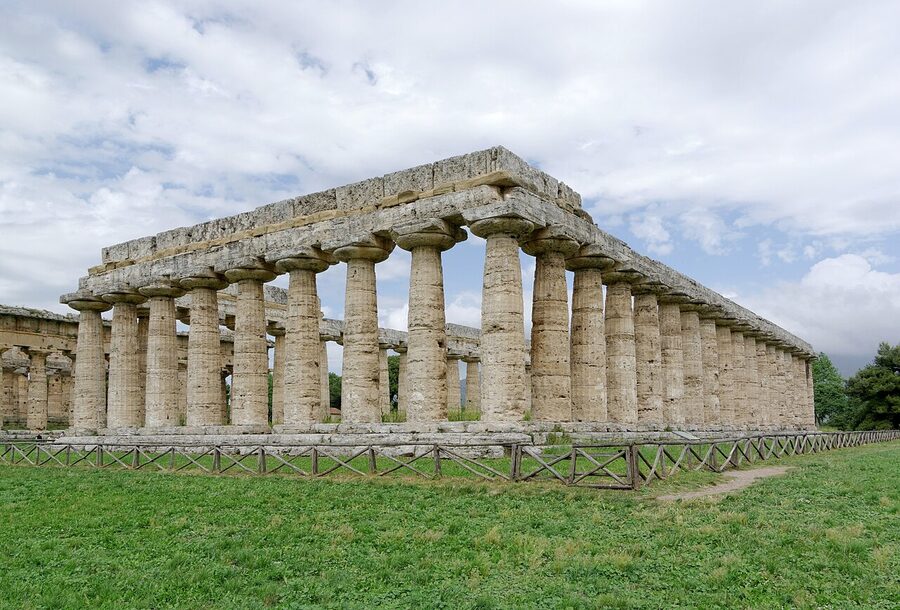
The Temple of Hera II — built about 460-450 BC and almost always still called the “Temple of Poseidon” in guidebooks — is the single finest surviving Doric temple in the world. It stands on a three-stepped stylobate, with six columns at each end and fourteen on each long side. The columns are 9 metres tall and 2.1 metres in diameter at the base, with the characteristic Doric fluting (twenty flutes per column). The capitals have the broad, flattened profile of the middle Archaic period. The entablature is intact the full length of the temple on both long sides; the triglyph-and-metope frieze is complete; the pediments at both ends are intact to roughly half their height. The interior colonnade of the cella (the inner room that housed the cult statue) is also standing — a two-storey arrangement of smaller columns, the only surviving example of this interior-doubled-column design from the period.
You walk up the stylobate steps, between the outer columns, and into the pronaos (porch) of the temple, and then into the open roofless cella itself. The 5th-century BC Greeks would have walked the same steps, stood in the same spot, and looked at the same architecture — with the addition of a painted cult statue of Hera (now lost, removed in Roman times), a painted architrave (the colour traces survive in fragments, now in the museum), and the ritual gold and silver offerings that hung from the walls. The feeling of standing in the cella is the feeling of having walked into the 5th century BC without any substantial intermediary.
The misnaming. The temple was called “Temple of Poseidon” from the 18th century onward because 18th-century antiquarians assumed a city named Poseidonia would have its best temple dedicated to Poseidon. The archaeological evidence — votive offerings found in the immediate surroundings, ritual inscriptions, comparative analysis of the other dedicated sanctuaries — makes clear it was Hera’s. The three temples at Paestum are: Hera I (the “Basilica,” to the south), Hera II (the “Poseidon,” immediately north of the first), and Athena (the “Ceres,” to the north of the city centre). Poseidon had his own sanctuary in the city but it was a smaller temple that did not survive. The misnaming persists in most guidebooks and signage because Doric architecture history was written in the 18th and 19th centuries under the wrong labels, and correction has been slow.
The Temple of Hera I (Basilica)
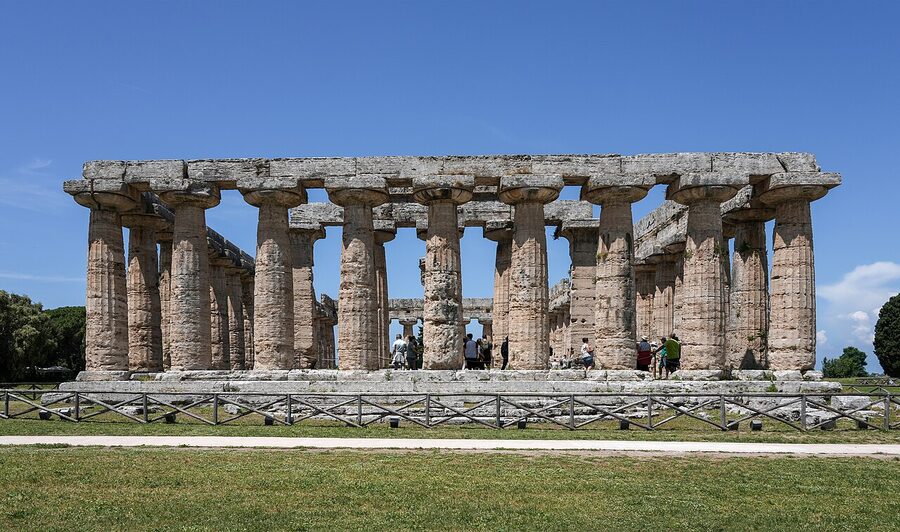
Eighty metres south of the Temple of Hera II stands the Temple of Hera I, traditionally known as the “Basilica.” It is older — about 550 BC — and represents the Archaic phase of the Doric order before the refinements of the Classical period. The architecture is unusual: 9 columns on each narrow end and 18 on each long side (an asymmetric arrangement, rather than the standard 6×13 of most Greek temples), with an off-centre line of interior columns that divides the cella into two parallel naves. This interior arrangement is extremely rare; the only clear parallel in the Greek world is the contemporary Temple of Athena at Metapontum (also in southern Italy).
The 18th-century antiquarians saw the two-naved cella plan and the missing architrave-pediment at the front of the temple — the western end had already collapsed by the time of the rediscovery — and concluded that the building was a civic structure, specifically a basilica (Roman civic assembly hall), not a temple. This misidentification lasted for two centuries. The archaeological work of the 1950s, based on votive offerings found in the immediate precinct and on detailed structural analysis, established the building as a temple to Hera and probably the original sanctuary around which the Greek city’s civic life was organised.
The Archaic Doric columns of the Basilica are visibly different from the Classical columns of the Temple of Hera II next door: squatter, with more pronounced entasis (the bulging of the column’s middle section that creates a visual correction), and with flatter, more blocky capitals. Looking at the two temples together — 80 metres apart, 90 years apart in construction date — you see the evolution of the Doric order in a way that no other single site allows. Start at the Basilica, then walk to the Hera II, and the shift from Archaic to Classical Doric becomes visually obvious.
The Temple of Athena (Ceres)
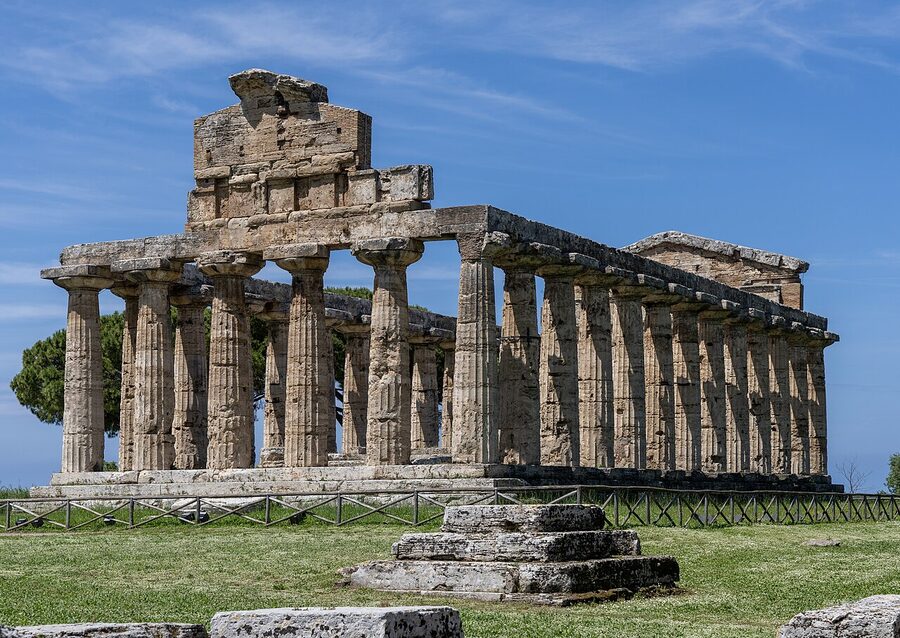
The third of the three surviving temples, the Temple of Athena, sits in the northern part of the city about 200 metres from the Hera temples, on slightly higher ground. Built around 500 BC, it is smaller and stylistically transitional — Doric on the exterior colonnade but with Ionic columns in the pronaos porch, one of the earliest known combined-order temples in Greek architecture. The experimentation of the mixed orders would become more common a century later under Classical architects like Ictinus.
The Temple of Athena has been traditionally misnamed the “Temple of Ceres” in the same 18th-century manner. Ceres is the Roman agricultural goddess; the temple was Greek and dedicated to Athena. Modern archaeology has settled this identification; the signage on site uses the correct name.
Unlike the Hera temples, Athena’s temple shows the clearest evidence of Christian adaptation — a Christian baptistery was built inside the cella in the 6th or 7th century AD, and three medieval Christian tombs are embedded in the floor (these are now marked but preserved in situ). The building functioned as a small Christian church through the early Middle Ages before Paestum’s abandonment.
The Tomb of the Diver and the Paestum Museum
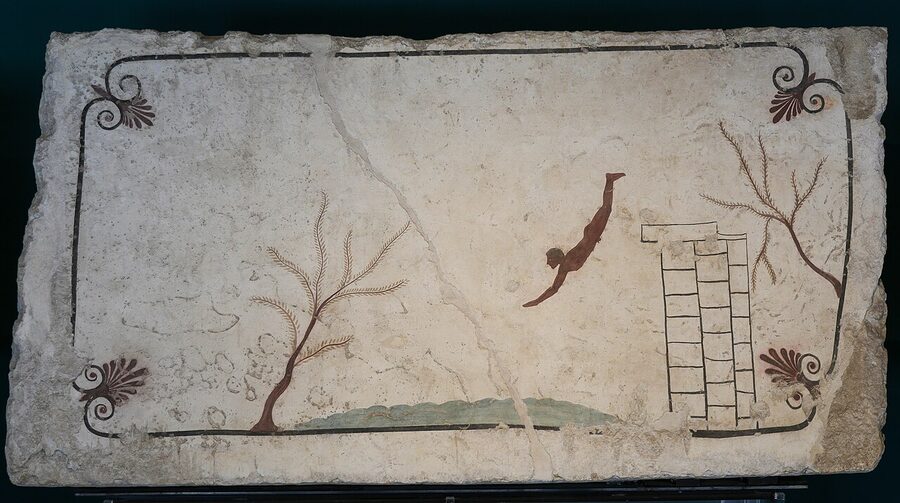
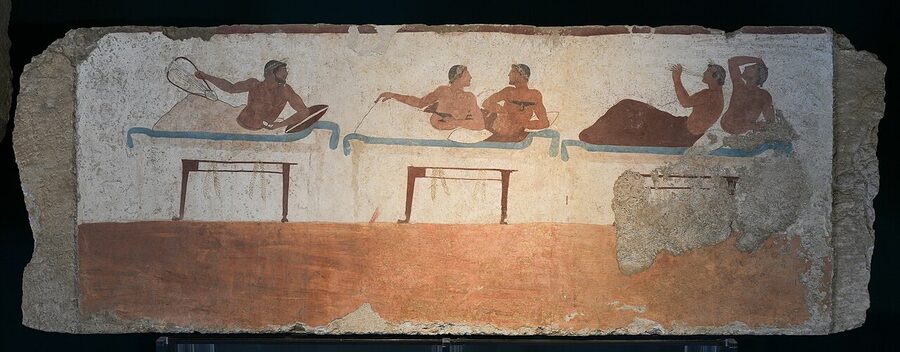
The Tomb of the Diver is the single most important object at Paestum and possibly the single most important surviving Greek painting anywhere. It was discovered in 1968 in a necropolis about a kilometre south of the city walls, during a casual excavation of the Laghetto di Fusaro cemetery. The tomb is a small stone sarcophagus made of five painted limestone slabs — four side walls and a cover — all dating to approximately 480 BC. The four side walls show a symposium scene (reclining men drinking wine, playing music, conversing). The cover — the slab you can see in the image above — shows a naked young man diving from a stone platform into a body of water, with two trees framing the scene.
The cover is the famous piece. It is the only surviving example of Greek painted wall-painting from the Classical period. Everything else we know about Greek painting — and Greek painting was, according to the ancient sources, the greatest of the Greek visual arts, ranked above sculpture by most ancient commentators — comes from Roman copies, vase paintings, and literary descriptions. Nothing else has survived. The Tomb of the Diver is the sole direct window onto what 5th-century BC Greek figurative painting actually looked like.
The interpretation is debated. The most common reading is that the diver represents the soul passing from the world of the living to the afterlife, with the water as the boundary between the two. Some scholars read it as a specific reference to Orphic or Pythagorean mystical doctrines (the Greek philosopher Pythagoras was based in nearby Metapontum and had a significant school of followers in 5th-century BC Magna Graecia). Some read it as a symposium image with the drinker “diving into” the afterlife party the side walls depict. Some read it as a swimmer’s athletic scene without mystical content.
What is not debated is the technical skill. The diver is rendered in continuous line with economical colour — three tones, carefully modulated — and captures the moment of flight with remarkable freshness. Critics have compared the line work to early Matisse drawings. The original vase-painting styles of the same period tend to be stylised and formal; the Tomb of the Diver is looser, more immediate, more emotionally alive. If the ancient sources are correct that Greek painting was a major art form, this is the one object that lets us see what they meant.
The tomb is in the Paestum Archaeological Museum, across the road from the main archaeological park. The museum is open 9-19 in summer, 9-15:30 in winter, and is included in the €12 site ticket. Allow 90 minutes for the museum. The Tomb of the Diver is displayed in a dedicated room on the upper floor, with the five slabs separately mounted and lit to allow close inspection.
The museum also holds the votive offerings, the metopes from the 6th-century BC Temple of Argiva Hera (a sanctuary about 9 km north of Paestum at the mouth of the Sele river, now destroyed), the archaic Greek statuary from the temple precincts, the Roman-period material from the forum, and a remarkable collection of Lucanian painted-tomb panels from the necropolis around Paestum. The Lucanian tombs are the lesser but still remarkable second category of surviving pre-Roman Italian painting — they are the “everyday” painted tombs of the period, while the Diver is the masterpiece.
Walking the site
The archaeological park is an enormous flat site — about 120 hectares — but most of the visitable area is the 30-hectare central zone containing the temples and the Greek-Roman city plan. A sensible walking order, entering from the main gate on SP175:
From the main entrance, walk south along the ancient cardo (main north-south street) past the Roman forum to the Temple of Hera I (Basilica). Spend 20 minutes. Walk 80 metres north along the sanctuary path to the Temple of Hera II (Poseidon). Spend 30 minutes — walk inside, up to the cella, around both long sides. This is the heart of the site.
North from the Hera II, the ancient agora and then the Roman forum (with the remains of basilica, temple of the Capitoline triad, curia, and macellum) run along the eastern edge of the central zone. Spend 45 minutes, including the Roman-era amphitheatre just east of the forum (small, well-preserved, free to walk into).
Continue north to the Temple of Athena. Spend 20 minutes, including the Christian-era tomb embedded in the floor.
Walk west from the Temple of Athena to the city walls. The full perimeter is 4.7 km; walking the whole thing takes 75 minutes. If time is limited, walk the western section from the Porta Marina (the sea gate) south to the Porta Giustizia (the south gate) — about 1.5 km, 20 minutes, with the temples framed by the walls on one side and the Sele plain on the other.
Return via the ancient Greek road past the Greek-era sanctuary to Aphrodite and back to the main entrance. Allow 30 minutes.
Across the road from the main gate: the Paestum Archaeological Museum. Allow 90 minutes for the full circuit, with the Tomb of the Diver room as the main destination.
Total: 4-5 hours on site, with the museum adding another 90 minutes. A full day is realistic; a half-day gives you the temples and the Diver but skips the Roman forum and city walls.
Practical — tickets, timing, heat
Entry €12 full, €2 online booking fee. The combined ticket with the separate Velia archaeological park (the Greek colony 40 km south, with an excavated acropolis and the surviving Porta Rosa gate) is €15 for 3 days — if you are in the region for more than a day, the Velia addition is a natural second site.
Opening hours: daily 9-19 in summer, 9-15:30 in winter. Last entry 60 minutes before close. The site is closed on 1 January, 1 May, and 25 December.
The archaeological park is large and the temples are entirely exposed to sun. The summer heat on the Sele plain is significant — midday temperatures of 32-35°C are standard from June to mid-September. Sun hats, sunscreen, and water are essential. The single on-site café near the Temple of Athena is minimal; bring your own food. Start at 9am in summer, 10am in winter. After 4pm in summer the sun angle becomes dramatic on the temples, which is the photographer’s best hour.
Guide options: the audio guide is €7 and worth it; a licensed private guide runs €120-180 for 3 hours. The Parco Archeologico di Paestum (museopaestum.cultura.gov.it) maintains the official list of licensed guides. For a serious architectural visit, the Italian Institute for Greek and Etruscan Studies offers specialised half-day architectural tours of the temples on selected Saturdays — check ahead.
Staying nearby and the Cilento
Paestum is the northern gateway to the Cilento and Vallo di Diano National Park — a UNESCO biosphere reserve covering 180,000 hectares of Campania’s southernmost coast and mountains, one of the least-touristed protected areas in the Italian peninsula. If you only visit Paestum as a day trip from Naples, you have missed what is arguably the more interesting second half of the experience. The Cilento is a genuine alternative to the Amalfi Coast for those who want seaside Campania without the crowds.
Four places to consider basing in:
Paestum itself — the small tourist resort immediately around the archaeological park. Hotel Savoy Beach (Via Poseidonia 41, €180-280) is the long-established four-star with private beach access. Tenuta Duca Marigliano (Via Magna Graecia 246, €250-450) is the converted ducal villa with the best restaurant in the area. Both are 15 minutes’ walk from the temples.
Agropoli, 12 km south — a fishing-town-turned-summer-resort with a castle, medieval centre, and reasonable restaurant scene. Cheaper than Paestum proper. Hotel Serenella (Via Trieste 7, €120-180) is the family-run three-star option.
Castellabate and San Marco di Castellabate, 20 km further south — hilltop medieval village and working fishing village respectively, the twin centres of the “slow food” Cilento movement. The film Benvenuti al Sud (2010) was shot here. Hotel Santa Maria (Lungomare Perrotti 5, €150-250) is right on the beach at San Marco.
Palinuro, 60 km south — the southern Cilento coast, a 1960s summer-resort town with dramatic cliffs, sea caves reached only by boat, and the Arco Naturale. Grand Hotel San Pietro (€200-380) is the classic.
Food in the region: the mozzarella di bufala campana DOP is made here. The Tenuta Vannulo (Contrada Galdo, 5 km inland, €10 entry) is the premium producer with organic buffalo dairy, on-site cheese production, and a tasting room. Caseificio Barlotti (Via Torre di Paestum 1) is the workaday producer at the archaeological park’s edge. Eat mozzarella the day it is made; the texture breaks down after 18 hours of refrigeration.
The Mediterranean Diet was formally defined by Ancel Keys, the American physiologist, in the 1950s — in the small Cilento village of Pioppi, where Keys lived for decades and conducted the Seven Countries Study that established the link between Mediterranean eating and cardiovascular health. The Pioppi Museum of the Mediterranean Diet (Via Pisacane 3) is worth 30 minutes if the framework interests you.
Combining Paestum with the rest of the trip
Paestum is the natural southern extension of a Campanian archaeological tour. The canonical sequence is Pompeii → Herculaneum → Paestum, covering a thousand years of southern Italian antiquity from Greek colonial through Roman imperial. Four days is the right minimum; five or six allows time for the Cilento.
Day trips from Paestum: the Certosa di Padula (80 km inland, the largest Carthusian monastery in Italy, UNESCO 1998, also part of the Cilento park); Velia (40 km south, the Greek colony with the Porta Rosa gate, entry included in the Paestum combined ticket); Santa Maria del Cedro for the cedar-citrus orchards; Grotte di Castelcivita (karst caves, 25 km inland, €12).
On a broader Italy trip, Paestum pairs naturally with a Sicily leg — the classical sites there (Agrigento’s Valley of the Temples, Segesta, Selinunte, Syracuse) are the natural continuation of the Magna Graecia Greek-colonial story.
When to visit
Late April through mid-June and mid-September through October are the windows. The wildflowers in May — asphodels, poppies, Mediterranean orchids — are remarkable. The autumn light in late September has a specific angle that favours the temples. Summer (July-August) is hot and empty (Italian domestic tourism goes to the coast); winter (November-March) is cool, quiet, and cheap.
The Festa della Madonna del Granato — the Paestum region’s distinctive religious festival — is 15 August, with a procession that incorporates elements of Greek-pagan and Catholic tradition. The pomegranate (granato) was sacred to Hera; the Madonna del Granato is the Christian continuity of the Greek cult. The festival at the Sanctuary of the Madonna del Granato in Capaccio Vecchio is worth seeing.
The Festival Paestum (mid-July to late August) holds classical-music and jazz concerts on a stage in front of the Temple of Hera II, at sunset. Tickets €30-80. This is the Paestum experience to have if you can time it.
Before you go
Paestum is the most underused of Italy’s major classical sites. The three temples are more intact than almost anything else in the Greek world. The Tomb of the Diver is the only surviving example of Greek painted wall-painting from the Classical period. The Cilento National Park beyond adds 180,000 hectares of protected Campanian coast and mountains. Every one of these elements, taken alone, would justify a day’s trip. Together they constitute one of the best two-day archaeological-and-landscape experiences available in Italy, and they are perpetually outside most visitors’ itineraries.
Plan two days minimum if you are going specifically to Paestum — one for the site and museum, one for the Cilento or for Velia. Stay overnight in Paestum town or Agropoli rather than day-tripping from Naples. Come in May or late September.
For wider context, see the Campania hub. The direct archaeological companions on this site are Pompeii and Herculaneum — Roman imperial cities of the 1st century AD, to Paestum’s Greek colonial and Classical. Across the water, Sicily‘s Valley of the Temples at Agrigento is the closest direct parallel to Paestum’s temple cluster.



,_East_view.jpg)
_-_Facade_East.jpg)


