
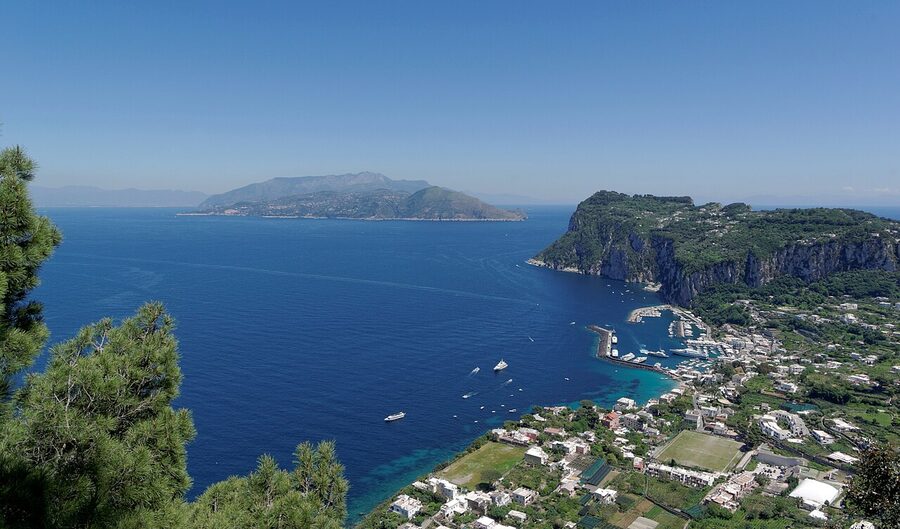
Capri is a ten-square-kilometre limestone island off the tip of the Sorrento peninsula, in the Bay of Naples, with a resident population of 14,000 that swells to five or six times that on a summer day. It has been, at different points in its recorded history, a remote goatherd island of the Oscan-speaking Italic peoples, a favoured Roman imperial retreat under Augustus and then Tiberius, a monastic outpost of the Byzantine Greeks, a fortified waypoint against Barbary corsair raids, a Grand Tour stop for German Romantic writers in the 1830s-1840s, the place Maxim Gorky lived from 1906 to 1913 while writing the Russian revolution in advance, a mid-century artists’ colony where Norman Douglas and Elsa Morante and Graham Greene and Curzio Malaparte all had houses, and, from the late 1950s onward, the single most famous luxury-tourism destination in the Mediterranean.
Those layers are still visible if you know where to look. Augustus bought Capri from the Neapolitan republic in 29 BC; Tiberius moved there in 27 AD and ruled the empire from the island for the last ten years of his reign; the ruins of Villa Jovis where he lived are still standing on the eastern promontory at 334 metres above the Tyrrhenian. The Palaepolis basilica where Byzantine monks prayed in the 8th century AD is now built into the medieval Certosa. Maxim Gorky’s villa is a small museum. Malaparte’s extraordinary 1938 modernist house on the southern cliff is one of the landmark pieces of 20th-century Italian architecture. The overlapping layers are the thing Capri does that other Italian islands don’t, and if you come only for the Piazzetta and the Blue Grotto, you will miss most of them.
The other thing to say up front: Capri in July and August is a place to avoid. Italian day-trippers, cruise-ship excursions, and international luxury tourism converge on the same 10 km² at the same time, and the Piazzetta at 2pm in August is a zoo. Capri in October and April is a different island entirely, quiet, local, walkable, with the main sights genuinely accessible and the restaurants charging 40% less. The visiting season is long (the hotels stay open roughly April through October) and the off-peak window is the one to aim for.
In This Article
Capri in one paragraph
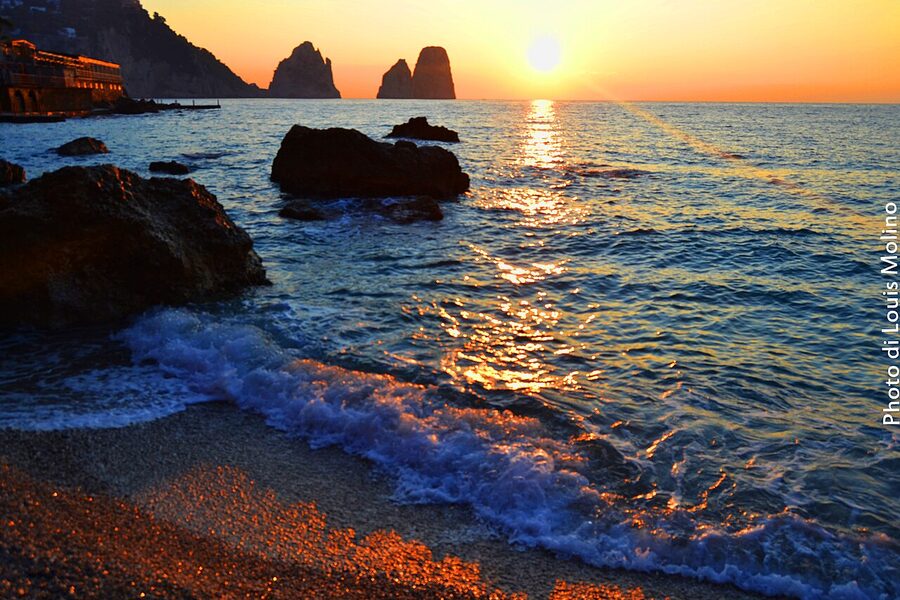
Italian island in the Tyrrhenian Sea, 6 km off the southern tip of the Sorrento peninsula. Area 10.4 km²; resident population 14,000 (split between two communes: Capri, 7,000, and Anacapri, 7,000). Highest point Monte Solaro (589m). Greek and Phoenician remains from the 8th century BC; Roman imperial villa complex from the 1st century AD (Augustus built twelve villas here, Tiberius expanded the main one and moved permanently in 27 AD); under Neapolitan and Aragonese rule through the medieval period; Bourbon from 1734; part of the Italian republic from 1861. Two main settlements: Capri town (the original main village on the eastern ridge at 150m elevation) and Anacapri (the “upper village” on the western plateau at 280m, historically the poorer, working village). The island is reached only by sea; ferries and hydrofoils from Naples (Molo Beverello, 45-50 minutes), Positano (30 minutes), Amalfi (50 minutes), and Sorrento (25 minutes). No airport. Demonym: Caprese.
Getting to Capri
Three ferry routes, all seasonal for the two non-Naples origins.
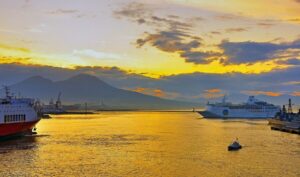
From Naples, ferries run from Molo Beverello (hydrofoils, 45 minutes, €24 one-way) and Calata Porta di Massa (larger car-ferries, 80 minutes, €18; cars €40 extra and by permit only). Both leave every 30-60 minutes through the day; the last return in summer is around 7:30pm, in winter around 6pm. Book the return leg in advance, August return ferries sell out.
From Sorrento, hydrofoils every hour, 25 minutes, €22. This is the most convenient route if you are already on the Sorrento peninsula.
From the Amalfi Coast (Positano and Amalfi), seasonal ferries run daily April-October, two or three services per day, €25-30 one-way. Check schedules at capri.com, they change week to week depending on the weather.
Arriving at Marina Grande. All ferries dock at the same harbour at sea level. Once there, you have three ways up to the town: the funicular (6 minutes, €2.40, runs every 15 minutes, the quickest and most used); the public bus (15 minutes, €2.40 with a day pass €12, via a hairpin road); or a taxi (€25-35 depending on time of day, the signature convertible white Capri taxis with striped canopy roofs are part of the experience). On the island itself, buses run between Capri town, Anacapri, and Marina Grande every 15-20 minutes; taxis are plentiful but expensive (€20-35 for almost any short run). Walking between Capri town and Anacapri takes 45 minutes uphill; I have done it many times and would mostly not recommend it, the bus costs €2.40 and gives you 20 minutes to look at the view.
No cars. Capri has a complete private-car ban from April to October for non-residents. If you are driving down from Naples, park in the paid garages above Marina Grande in Sorrento and take the hydrofoil. Bicycle rental on the island is limited and expensive; most visitors walk and bus.
The Piazzetta and Capri town
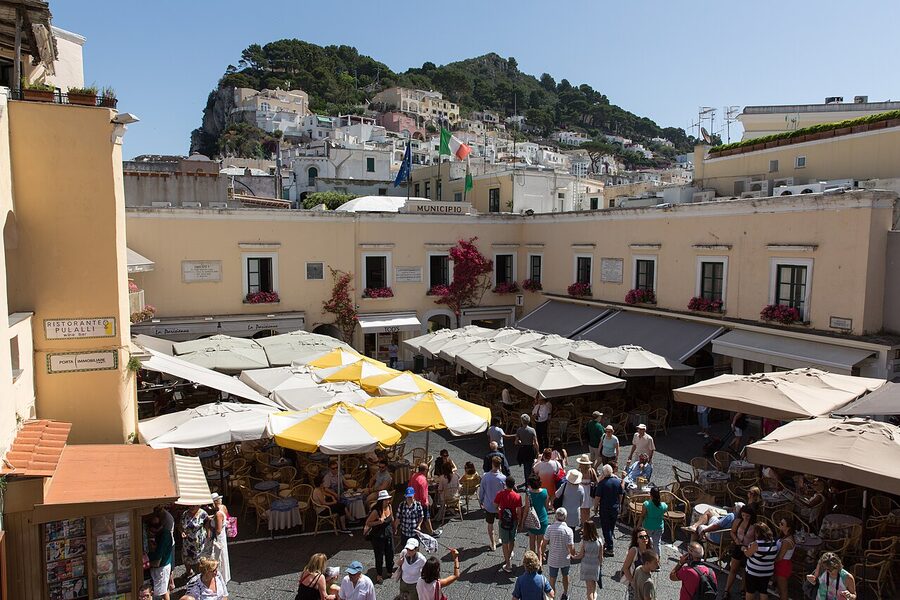
The Piazzetta, officially Piazza Umberto I, but nobody calls it that, is the heart of Capri town. A 30-metre square at the top of the funicular, surrounded on three sides by small cafés and on the fourth by the 17th-century Church of Santo Stefano. The 17th-century clock tower on one corner is the island’s visual anchor. It is absurdly small for the amount of tourism it receives, and for most of the 20th century it has been the single most glamorous public square in southern Italy: Jackie Kennedy had her morning coffee here; Mariah Carey and Beyoncé have both been photographed at the same tables; half of the Italian film industry between 1960 and 1980 used the Piazzetta as the drop-in set for scenes of jet-set life.
You will walk through the Piazzetta at least twice. The thing to understand: the cafés are expensive for a reason (position, history, service) and genuinely pleasant if you have accepted that a coffee is €6. Sit at Gran Caffè or Bar Caso, the two with the best people-watching, at around 6:30pm, order a Campari spritz (€18), and watch the evening passeggiata arrive. The view looking out from the south side is over the Marina Piccola beach and the Faraglioni in the distance. The view from the café chairs is the other reason to sit.
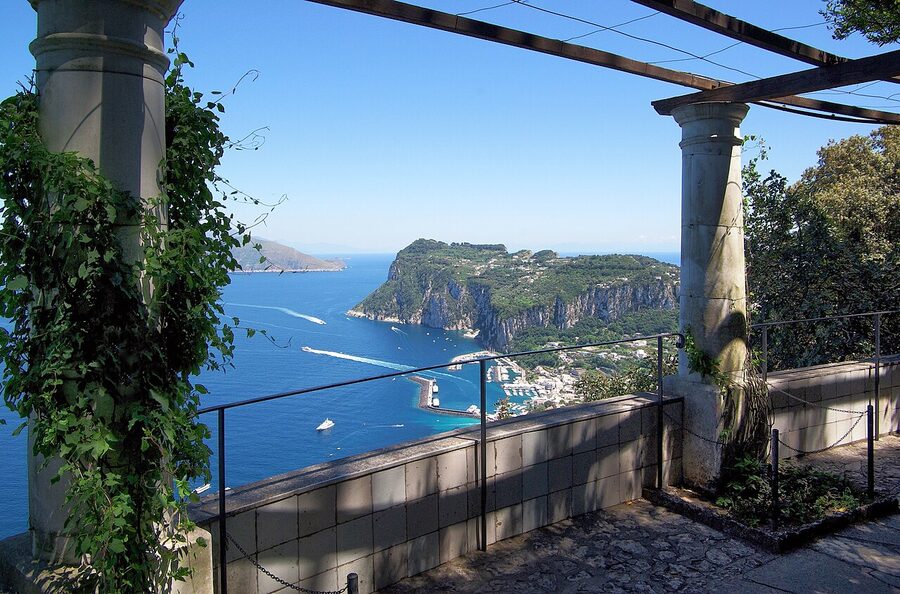
From the Piazzetta, four streets radiate into the old town. Via Le Botteghe runs east-west through the commercial centre (linen boutiques, sandal makers, the ceramic studios, Scugnizzo on Via Le Botteghe 3 has been making hand-painted Capri ceramics since 1948). Via Camerelle is the luxury shopping street (Gucci, Hermès, Prada, all with the same small-footprint-big-window pattern). Via Tragara climbs east toward the Belvedere di Tragara, which is one of the four canonical Capri viewpoints. And Via Federico Serena goes south to the Giardini di Augusto, the terraced public gardens looking down to Marina Piccola.
Also on the Piazzetta axis: the Certosa di San Giacomo, a 14th-century Carthusian monastery converted to public museum in the 19th century, with two cloisters and a small museum of 1920s-1930s Capri art. Short detour, €6, 45 minutes. The Belvedere di Tragara, 20 minutes’ walk along Via Tragara with several small hotels and villas on the way, gives the most famous of the Faraglioni views, the one that ends up on every Capri postcard. The Via Krupp, a stepped switchback path cut into the cliff from the Giardini di Augusto down to Marina Piccola, is currently closed for geological stabilisation (check status at the tourist office); when open, it is the most dramatic single walk in the Mediterranean.
Villa Jovis and the Tiberian east
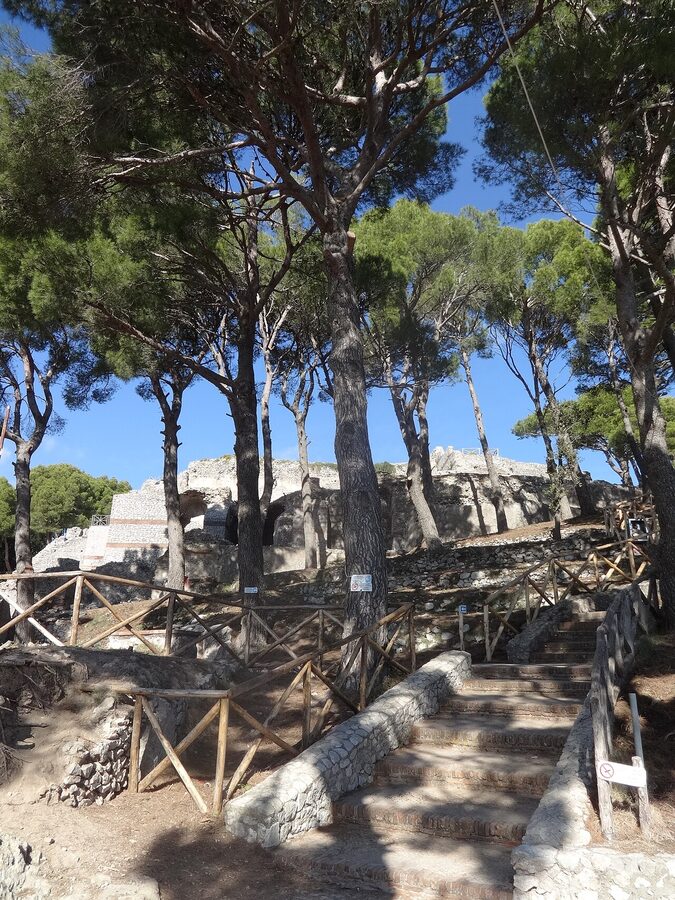
In 27 AD, at the age of 68, the Emperor Tiberius abandoned Rome permanently and moved to Capri. He lived there for the last ten years of his reign and died on the island in 37 AD. The main residence he built, Villa Jovis, the “Villa of Jupiter”, was the nerve centre of the Roman Empire during a politically fraught decade. Imperial dispatches went out from here; senators came from Rome for audiences; the practical government of a Mediterranean-spanning empire happened on a cliff-top villa complex at 334m above the Tyrrhenian.
Suetonius’s biography of Tiberius gives the most lurid surviving account of his Capri life, sexual depravity, arbitrary cruelty, an old tyrant isolated from the world, and modern historians have been unwinding those charges for about a century. What is certain is that Villa Jovis was an extraordinarily ambitious building. Seven thousand square metres of imperial residence on a narrow clifftop, with cisterns for water storage, a bath complex, imperial reception rooms on the south, a semicircular ambulatory looking north over the Bay of Naples, a signal tower to relay messages to the mainland, and a specific “cliff of Tiberius” (the Salto di Tiberio) over which, Suetonius claims, the emperor had disfavoured courtiers thrown to their deaths.
The ruins today. Villa Jovis is a 45-minute walk east from Capri town, along Via Tiberio, climbing steadily. The path ends at the ruined entrance to the villa, and you pay €8 (winter half-price) for the archaeological park. The upper levels of the villa are mostly gone; what survives is the lower-level storage cisterns, the bath ruins with some mosaic floor fragments, the foundations of the reception rooms, and, at the very edge, the Salto di Tiberio, still with its vertiginous 300-metre drop. The signal tower is at the north end. Allow 90 minutes on site, and go at dawn or late afternoon, the ruins offer no shade, and summer heat up there is serious.
The Tiberian villas aren’t just Villa Jovis. Augustus built 12 villas across Capri before Tiberius; the Villa Damecuta ruins at Anacapri, and the Grotta di Matermania (a Roman nymphaeum in a natural sea cave), are the two other survivors. Most of the others are underneath modern buildings or vanished into the terracing. If you are here for the Roman layer, Villa Jovis is the one that cannot be missed.
The Blue Grotto
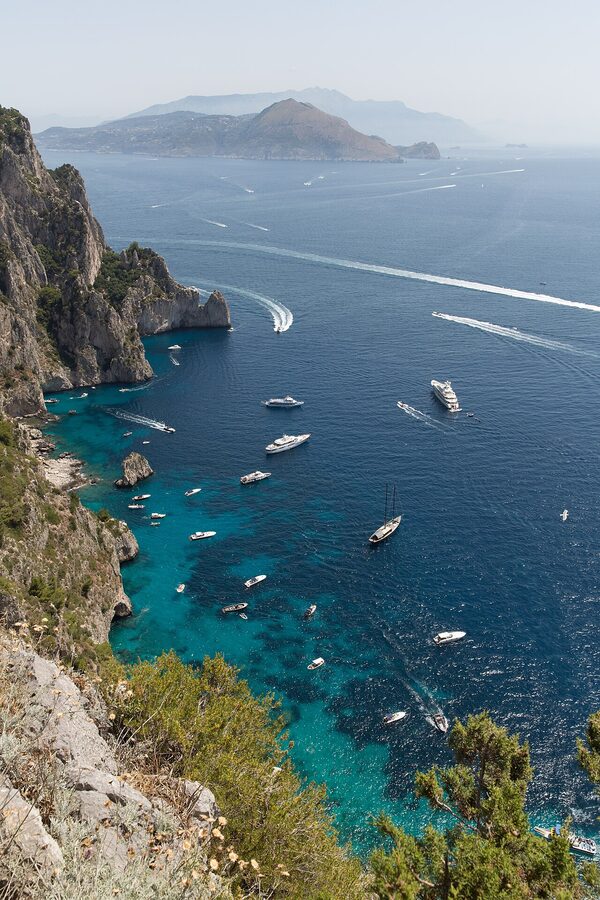
The Grotta Azzurra, Blue Grotto, is a sea cave on the northwest coast of Capri, about 60 metres long, with an entry opening so narrow (2m × 1m) that you can only enter by lying flat in a small rowboat while the rower crouches and pulls you through. Once inside, the cave interior, roughly 50m by 30m, 15m deep at the water level, is illuminated from below by daylight passing through the underwater portion of the entry gap and reflecting up through the seawater. The result is an intense electric-blue light that fills the chamber. Silver fish moving through the water visibly glow.
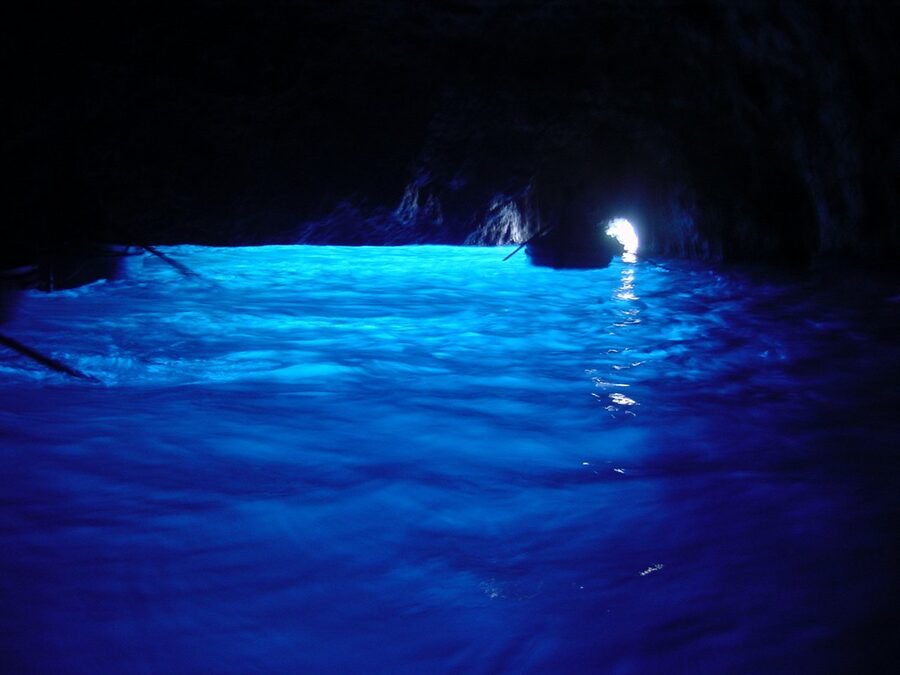
Practical notes. Reach the entrance by boat from Marina Grande (the larger boat tours run €18 plus a €16 entry fee for the rowboat); by the public bus from Anacapri to the Grotta Azzurra stop, then a 10-minute walk down to the sea-level access point where you transfer to a rowboat; or by walking down from Anacapri. The visit takes 15-20 minutes inside the chamber including the transfer. Open roughly 9am-5pm from April to October; closed entirely in winter (sea conditions) and frequently closed in summer on windy days. In August, the queue for the transfer rowboat can be 2 hours long, go in May or October.
The cave is one of those attractions where the advertised experience is underwhelming for about 30% of visitors (the chamber is small, the boats are rushed in and out in 5-minute slots, the rowers sing for tips) and genuinely extraordinary for the other 70%. The light quality really does do what the photographs show. I would go once if you are in Capri; I would not make it a top-three reason to visit.
Anacapri and Monte Solaro
Anacapri is the “upper village”, smaller, quieter, historically the poorer working village of the island, now an alternative to the main Capri town that has its own character. Reach it by bus from Marina Grande (20 minutes) or from Capri town (10 minutes). The village centre is built around Piazza Vittoria and the 17th-century Church of San Michele, which has a remarkable majolica-tiled floor (1761) depicting Adam and Eve’s expulsion from Eden, entry €3, the floor is covered in protective walkways, 20 minutes.
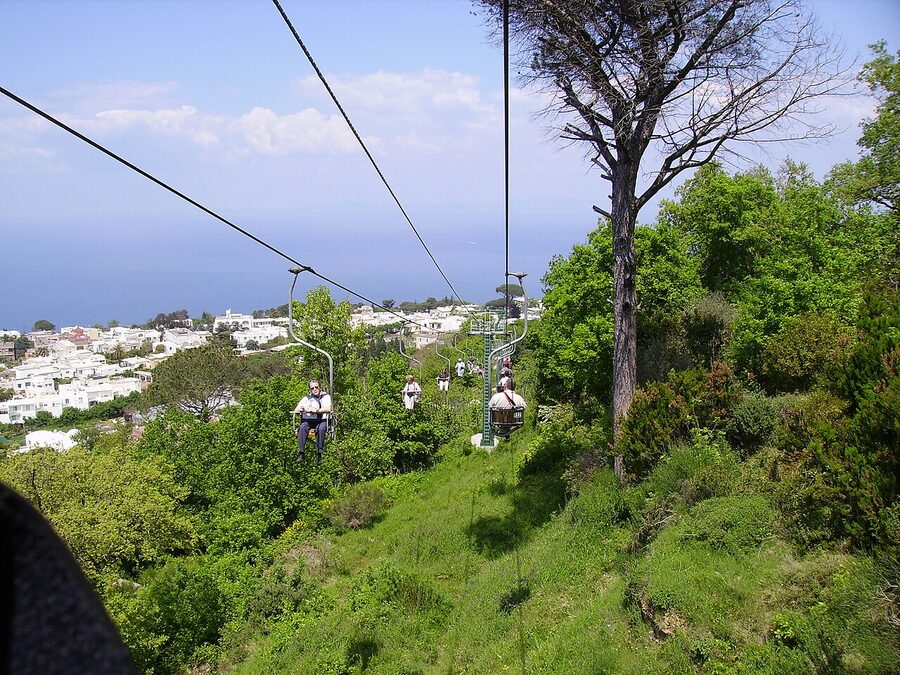
From Piazza Vittoria, a 13-minute single-seat chairlift takes you up to the summit of Monte Solaro, Capri’s highest point at 589m. The ride is one of the more atmospheric bits of mid-20th-century tourist infrastructure in Italy (it opened in 1952, essentially unchanged, and on the way up you pass over lemon groves, terrace gardens, and the 19th-century Capri cemetery). At the top, a café, a small ruined medieval chapel, and the canonical Capri-from-above view: both coasts of the island in one frame, the Faraglioni visible below, the Bay of Naples stretching north, Vesuvius in the distance on a clear day. Return €14, open 9:30-sunset.
Down a path from Monte Solaro, 40 minutes’ walk, you reach the ruins of Fortino di Bruto, a Napoleonic-era fort from 1808, built during the brief Franco-Neapolitan occupation. Not compelling in itself; the walk is the point.
Back in Anacapri proper, Villa San Michele, the home of the Swedish physician and writer Axel Munthe (1857-1949), who bought the site of an old Roman chapel on the cliff edge and built a neoclassical villa with a gardens full of ancient fragments he had collected. Munthe wrote The Story of San Michele here in 1929, which sold 20 million copies in 40 languages and built an entire aura around Capri as a literary-romantic destination. The villa is open to the public (€10, 45 minutes), and the sphinx-topped terrace looking over the gulf is one of the island’s most specific single experiences.
The beaches and the coast
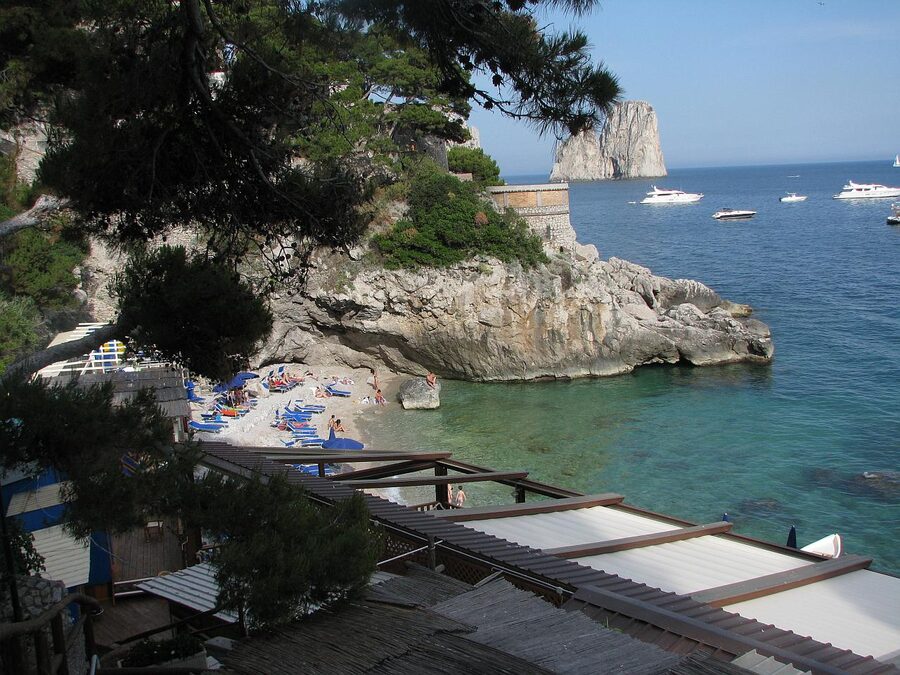
Capri is not primarily a beach island. The coastline is cliffs, not sand; there are three accessible beach areas and they are all small, pebbly, and expensive. If beach time is your main goal, go to Ischia or Procida instead.
Marina Piccola, the south-facing beach below Capri town, is the best-known of the three. Reached by bus or a 25-minute walk down Via Krupp from the Giardini di Augusto. Pebble, sheltered, with views east to the Faraglioni. Public access at the western end; paid beach clubs (La Canzone del Mare, Da Luigi ai Faraglioni) in the middle. Lunch at Da Luigi (€80-100 per person) is a classic.
Bagni di Tiberio, on the north coast, is reached only by boat from Marina Grande (€8 round-trip shuttle). Small beach, Roman villa ruins in the cliff behind (the beach was Tiberius’s private swimming spot), a single restaurant. Quieter than Marina Piccola.
Faro beach at Punta Carena on the far western tip, a small rocky swimming area at the base of the 1867 lighthouse. Reached by a 30-minute bus from Anacapri. Sunset here is the best on the island. A beach bar called Lido del Faro is the thing; book ahead for dinner.
The water around Capri is exceptionally clear, the limestone bottom means visibility is usually 15-20 metres. If you can, take a boat tour around the island. The standard 2-hour circumnavigation, leaving from Marina Grande, €25 per person, visiting the Faraglioni, the Blue Grotto exterior, the Green Grotto, the White Grotto, and Marina Piccola, is the best single experience on Capri. A private gozzo for up to 6 people for the day is €350-500 and is genuinely the best way if your group can split it.
Food, hotels, the glamour tier
Capri food is Campanian coastal, fresh fish, lemon-based sauces, insalata Caprese (invented here, allegedly, in the 1920s, mozzarella di bufala, tomato, basil, olive oil, nothing else), ravioli capresi (filled with caciotta cheese and marjoram), pezzogna all’acqua pazza (local sea bream poached in a light tomato broth). Three specific restaurants to know about:
Le Grottelle, halfway up the Via Matermania toward the Arco Naturale, an open-air family trattoria built into a natural rock overhang, €55-70 per person, lunch only, a long-established island classic that has somehow stayed unfussy. Book a week ahead in summer.
Da Paolino on Via Palazzo a Mare at Marina Grande, the famous “lemon-tree restaurant, ” where every table is under a different lemon tree, the tables lit by candlelight, fresh-caught fish served in unpretentious Neapolitan home style. €80-100. Book two weeks ahead.
Villa Verde on Vico Sella Orta 6, the go-to for the island’s reliable mid-range dinner, €45-60, classic Italian with a long wine list.
Coffee: Caffè Michelangelo on Via Camerelle for a straight espresso without Piazzetta markups; Pasticceria Buonocore in Piazzetta for the island’s signature torta caprese (a flourless chocolate and almond cake invented in Capri in the 1920s).
Hotels. The top tier is internationally famous: Grand Hotel Quisisana (on Via Camerelle, €800-1,800, the 1845 founding hotel of luxury tourism on Capri, still family-owned by the Morgano family); Capri Palace in Anacapri (Via Capodimonte 2, €700-1,200, a Leading Hotel of the World, Jasmine Michelin-two-star restaurant); JK Place (Via Marina Grande 225, €800-1,500, the fashion-industry favourite). The mid-tier is surprisingly strong: Hotel La Scalinatella (Via Tragara 8, €350-600, 30 rooms, the “small luxury” classic); Hotel Villa Brunella (Via Tragara 24, €300-500, family-run since 1975). Below that, genuine budget is rare on Capri, try Relais Maresca at Marina Grande (€180-280) or consider day-tripping from Sorrento.
When to visit
Go in May, early June, late September, or October. The sea is warm from June through early October. Pedestrian traffic is tolerable in May and October, thick in June and September, oppressive in July and August. The hotels are open from about Easter through early November; most close for three months in winter.
August is the single worst month. The island’s resident population is outnumbered six-to-one by visitors; the Piazzetta is saturated; the Blue Grotto queue can be 2 hours; the ferry back to Naples on Ferragosto weekend is standing-room-only. If you must come in August, arrive Monday and leave Friday, the weekend peak arrives Saturday.
The off-season experience. Capri in February is a genuinely different island, half the hotels closed, most restaurants closed, the Piazzetta occupied by locals rather than tourists, the sea cold but the light extraordinary. If you are a serious Capri person and you want the version of the island that resident Capresi actually live in, come in the winter months. You will not swim. You will see what the island used to be.
Before you go
Capri works best as a 2-3 night stay, not as a day trip. The day-trip experience, 45-minute ferry in, funicular up to the Piazzetta, quick look at the Giardini di Augusto, rushed boat ride around the Faraglioni, back on the ferry by 5pm, hits the headline sights but misses the island’s actual character, which only reveals itself after the last day-ferry leaves at 7pm and the Piazzetta fills with residents rather than tourists.
The single recommendation I’d give a first-time visitor: do a 2-hour boat circuit of the island in the late afternoon, do Villa Jovis at dawn on the second day, and have dinner at Da Paolino or Le Grottelle. Those three things in this order will give you the Capri that sits underneath the Instagram version.
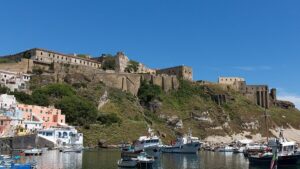
For the other two Gulf of Naples islands, see the Ischia guide (larger, thermal-spa focused, less touristy) and the Procida guide (smallest, Italian Capital of Culture 2022, genuinely quiet). For the mainland Campania context, see the Campania hub. For the natural-landscape counterpart on the opposite side of the Sorrento peninsula, see Positano and Amalfi.

,_2016.jpg)
_(1).jpg)
.jpg)


