

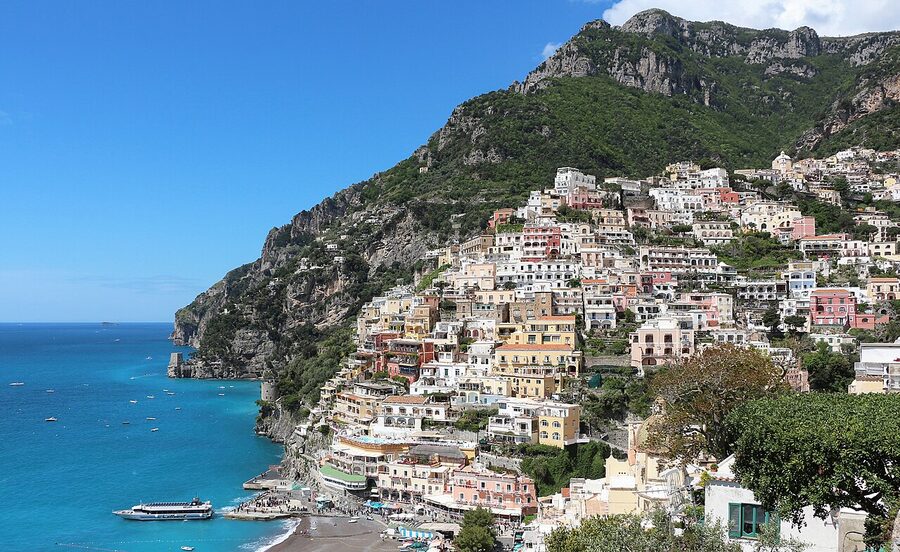
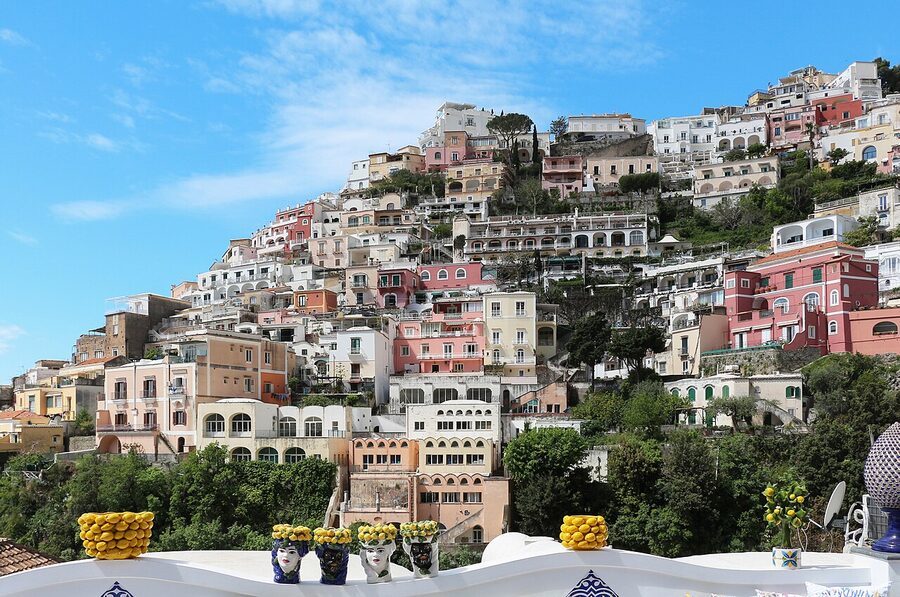
Positano is a fishing village of 3,900 residents on the western end of the Amalfi Coast, built into the cliff face of a former riverbed that drops 400 metres from the mountains to the sea. The town is so vertical that almost every building visible from the water is stacked above another one. There is one main road that loops down and back up, a network of perhaps three hundred staircases that function as the actual pedestrian infrastructure, and something in the neighbourhood of twenty thousand pots of bougainvillea and wisteria in bloom between May and September. It is the town that gets put on the covers of travel magazines because, frankly, nowhere else in Italy looks quite like this.
The paradox of Positano is that it is very nearly not a fishing village anymore. The SS163 coastal road, built between 1836 and 1850 under Bourbon engineering, was the first step; it connected what had been a marginal coastal settlement to the Sorrento Peninsula. The second and much bigger step was John Steinbeck’s Harper’s Bazaar essay in May 1953, titled “Positano,” which described the town in a way that launched fifty years of international tourism. Steinbeck wrote: “Positano bites deep. It is a dream place that isn’t quite real when you are there and becomes beckoningly real after you have gone.” This is still roughly true. By the 1960s, an Italian fashion label called “Positano Moda” had been invented, linen beach clothing was being exported worldwide under the name, and the fishing fleet had shrunk from two hundred boats to about forty. Today, most of the village’s economy is tourism, including a luxury-hotel tier that puts Positano’s nightly rates on par with Lake Como and the Amalfi Coast’s most expensive hotel market.
That is the town you are coming to see, and it is worth seeing. But two things to know before you book: the first is that Positano in June, July, or August is the single most crowded single village in Italy, and the experience is not what the photographs suggest. The second is that Positano in April, October, or May is not — it is genuinely and obviously the prettiest small town on the Italian coast, and worth coming for. Plan your visit around the first fact if you can.
In This Article
Positano in one paragraph
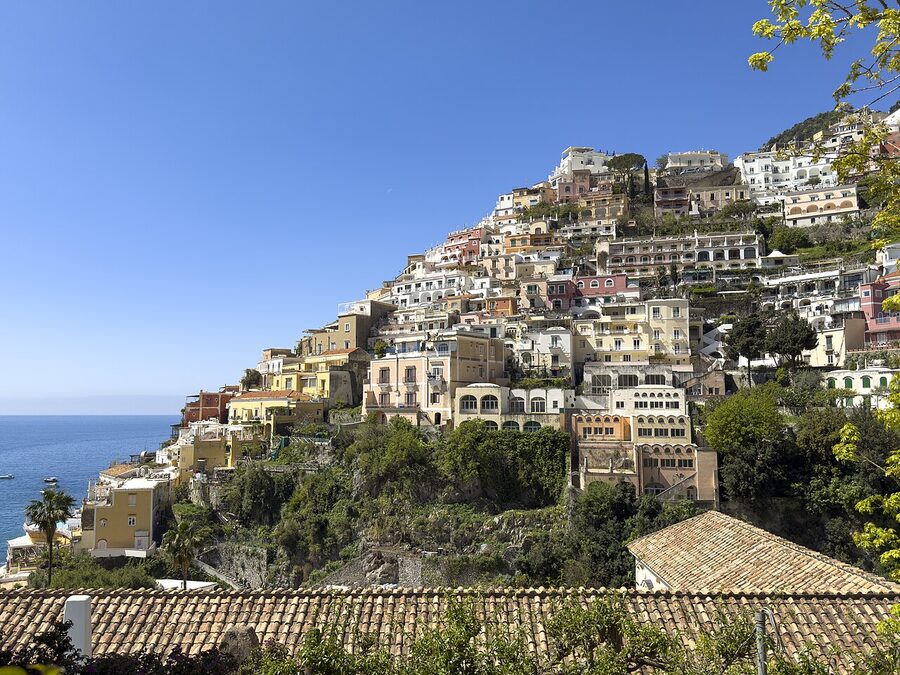
A coastal village and comune at 16m elevation (town centre) rising to 450m at the upper village, 8.64 km² of municipal territory, 3,913 residents (2024). Province of Salerno. 16 km west of Amalfi, 16 km east of Sorrento. Patron saint Santa Maria Assunta; saint’s day 15 August (Ferragosto, the town’s single biggest festival, with a choreographed evening procession from the church down to the beach and a night-time candlelit boat procession). Part of the UNESCO-listed Amalfi Coast world heritage site since 1997. Demonym: Positanese (singular) or Positanesi (plural).
Getting to Positano
Three practical routes:
By ferry from Salerno (80 minutes, €14 one-way) or Sorrento (35 minutes, €16). Both run hourly in season. The ferry lands at the Spiaggia Grande jetty, a three-minute walk from the town centre. Ferries stop running in rough weather, which on the Amalfi Coast can mean mid-afternoon cancellations during a summer thunderstorm — check the return time and have a plan B.
By SITA bus from Sorrento (60-75 minutes depending on traffic, €3.50 one-way) or from Amalfi (50 minutes, €2.70). The bus is the cheap option and the scenic one — the Amalfi Coast drive is the point of it — but the SITA is famously overcrowded in July and August. In peak season you often wait through two or three buses at mid-route stops before you can board one. A 24-hour ticket is €10 if you’re doing multiple legs.
By car, via the SS163 Amalfitana from either end. Parking in Positano is the single worst parking situation on the Amalfi Coast — genuinely. The main paid garages are the Garage Cervo at the top of the town (€7-10/hour, fills by 10am), Parking Mandara behind the Covo dei Saraceni (€5/hour), and the Parking Palazzo Murat near the church (€8/hour). You will not find free parking within a kilometre of the centre in summer. If you are day-tripping, come by ferry.
If you are flying in, the nearest airport is Naples Capodichino (NAP), about 90 minutes by car. A private transfer runs €140-180 one-way for up to four people and is the easiest option if your budget allows. Otherwise, take the Curreri Viaggi shuttle bus from NAP to Sorrento (€10, 75 minutes) and connect to a ferry or SITA bus to Positano from there.
The single most important logistical fact about Positano: the town is all stairs. The streets loop down to the sea and back up; the quickest routes between any two points are typically steep pedestrian staircases (scalinate). If you have luggage, arrange a hotel porter in advance — walking a suitcase down 120 steps to a waterfront hotel is a bad start to the trip.
The town — Santa Maria Assunta, the beach, and the lanes
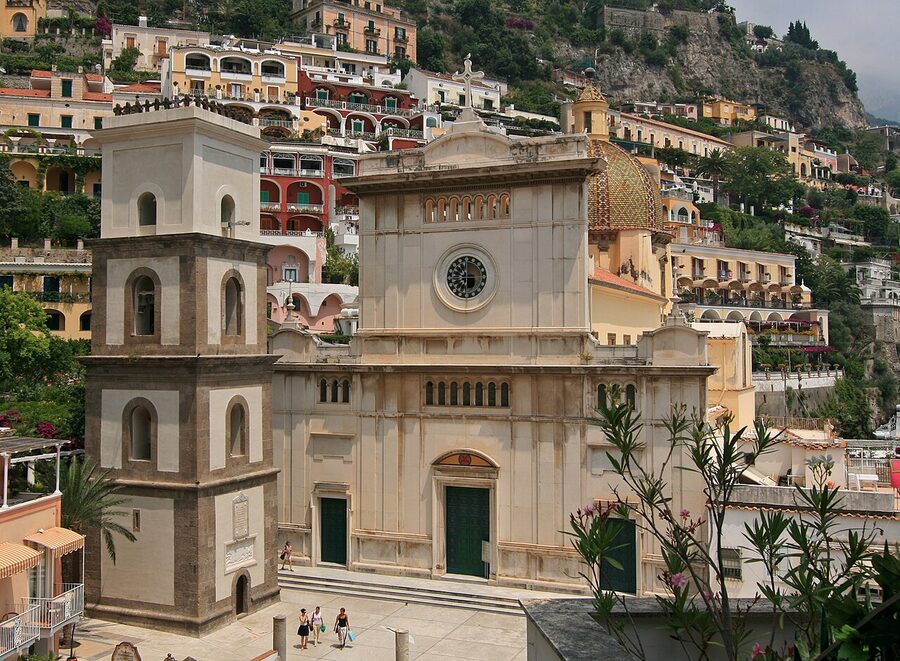
The Chiesa di Santa Maria Assunta is the parish church at the heart of the village, reached by a short set of steps from the main waterfront square. The majolica-tiled dome is the most photographed single object on the Amalfi Coast; close up, the ceramic pattern is yellow and green and dark blue, with seventy thousand hand-fired tiles covering a hemispherical roof. The current church dates to the mid-13th century, on the site of an earlier Benedictine monastery; the dome was added in the late 18th century; the facade and the baroque bell tower are 1777. Free entry, open during daylight hours.
Inside, behind the main altar, is the church’s single most important object: a Byzantine icon of the Black Madonna, dated around 1200, which local tradition says was thrown overboard by pirates during a storm off the coast in the 11th or 12th century (the exact date varies by retelling) and washed up on the Positano shore. The story goes that a voice was heard from the icon saying posa, posa — “put me down, put me down” — which is one of the several claimed etymologies for the town’s name. The icon is dressed in brocaded fabric that is renewed every few decades by the parish women’s guild; on 15 August, for the feast of the Assumption, it is brought out in procession to the beach.
Below the church, the small MAR Positano — Museo Archeologico Romano “Santa Maria Assunta” opened in 2018 in the crypt. The excavation began in 2003 revealed a Roman-era luxury villa — dating from the 1st century AD — with remarkable wall frescoes in situ, buried by the 79 AD eruption of Vesuvius (which hit Positano as well as Pompeii but was less destructive here). The frescoes are the finest Roman wall paintings on the Amalfi Coast; the site was turned into the medieval church directly on top of the Roman ruin, which is why the church has been above it for eight hundred years. €15 entry, by timed appointment only, book online. One hour inside. Worth the time and price.
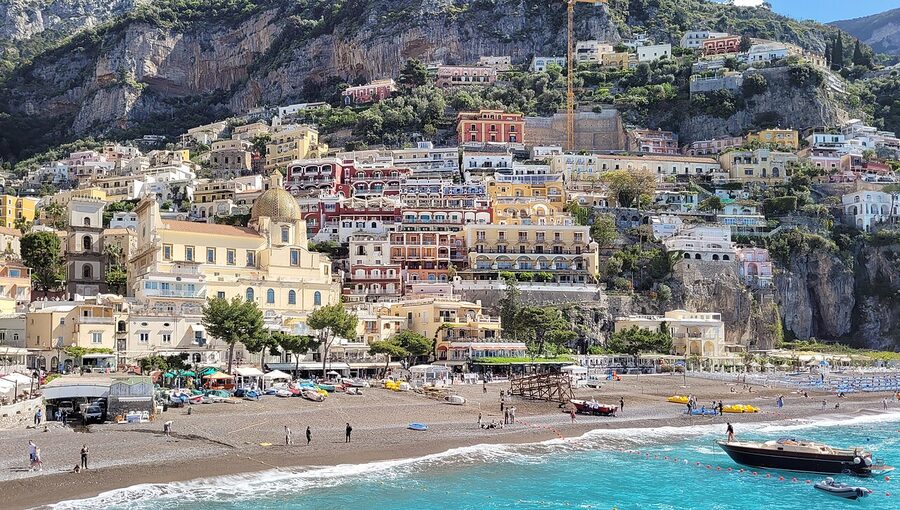
The Spiaggia Grande is the main beach, a 300-metre curve of dark-sand pebble fronting the waterfront square. It is split between a central free section (surprisingly large, maybe half the beach) and paid lidi on either end (chair + umbrella for €25-40 per day in season). The water deepens quickly, to about three metres within ten metres of shore, so good for swimming but not especially for children who want to wade. The beach itself is passable rather than outstanding; the view from it is exceptional.
The quieter beach is Spiaggia Fornillo, reached by a ten-minute walk west from Spiaggia Grande along the cliff path that leaves from the Torre Trasita tower. Fornillo is smaller, slightly pebblier, and has the town’s second-best view (back at the Spiaggia Grande, framed by the cliff of Positano village); more local, less touristed. Two beach bars, Pupetto and Da Costantino, both have hotel rooms upstairs and reasonable lunch menus (spaghetti ai ricci €18, insalata caprese €10).
The lanes. Walk away from the beach in any direction and you’re in stair-and-alley territory. The central pedestrian artery is Via dei Mulini, which climbs from the beach through the main shopping cluster (linen clothing, handmade sandals at Da Costanzo since 1964, ceramics at Ceramiche Assunta since 1948) up to the Chiesa di Santa Maria Assunta and out via Via Cristoforo Colombo toward the upper village. A parallel lane, Via Pasitea, is the one street in Positano where cars actually drive — a single-lane switchback that goes up from the waterfront to the SS163 high above. Walking it is four minutes; driving it in July, when the garage lot is full and cars circulate waiting, can take an hour.
The Torre Trasita, at the western end of Spiaggia Grande, is one of three surviving coastal watchtowers (along with the Torre Fornillo and Torre Sponda) built in the 1560s as part of the Spanish-era defensive network against Barbary pirate raids. The Trasita is now privately owned; the other two can be climbed for free from the respective beach paths.
Li Galli — the islands of the sirens
Four kilometres offshore, visible from the Positano waterfront on a clear day, sit three small rocky islets called the Li Galli archipelago. In classical tradition, the islets are the home of the Sirens — the singing sea-nymphs who tried to lure Odysseus to his death in Homer’s Odyssey. The ancient Greek name for the islands was Sirenum Scopuli, “Rocks of the Sirens.” Strabo describes them; Virgil refers to them in the Aeneid; the 13th-century Sicilian chronicler Saba Malaspina claims the Emperor Frederick II visited them to hear the sirens sing for himself.
The largest of the three, Gallo Lungo, has a 14th-century watchtower on it, a 1st-century BC Roman villa excavated between 2003 and the present, and a private residence built in the 1920s by the Russian ballet-master Léonide Massine. Rudolf Nureyev bought the island in 1989 from the estate of Massine’s heirs and spent his final summers there; on his death in 1993 the island passed to various intermediary owners and is now privately held by a Sorrento hotelier, who occasionally allows guided day visits. Boat tours from Positano (€35-60 per person, 3 hours) circle the islands and usually stop at the small beach on Gallo Lungo.
The boat trip to Li Galli is the single best half-day from Positano. The other boat trip is the Amalfi Coast day tour — typically Positano → Conca dei Marini (Emerald Grotto) → Amalfi → Vietri sul Mare → return — which runs €80-150 per person and is how most visitors actually see the coastline. A private gozzo (traditional wooden fishing boat) for 6 people for the day is €450-700 depending on season and is easily the best way if you have a group. Book at the port (the booking huts line the Molo jetty) or through the hotel.
Walking above the town — the Sentiero degli Dei
The Sentiero degli Dei — the “Path of the Gods” — is a 7-kilometre cliff-top trail that runs between Bomerano (village of Agerola, above Positano) and Nocelle (a satellite hamlet of Positano at 450m elevation), with drops of 300-500 metres to the sea for most of its length. It is, fairly obviously, the best walk on the Amalfi Coast and one of the best coastal walks in Europe. Google “Sentiero degli Dei” and every article will tell you this; it is still true.
Practical notes. The trail is walked most commonly downhill from Bomerano (east end) to Nocelle (west end), which saves the steepest descent for last. You can also walk it in reverse — harder uphill climb, but more dramatic arrival. The total walking time is three to four hours. There is one small refreshment stop halfway (Rifugio dei Tartarughi, run by a shepherd’s family, €5 for a panino and a beer). From Nocelle at the western end, you can continue down to Positano via 1,800 stone steps (about an hour) or take the shuttle bus. Start early in summer; the trail has minimal shade and gets hot by noon.
To get to Bomerano at the east end of the trail, take the SITA bus from Amalfi to Agerola (40 minutes, €2.70) and then a local shuttle to Bomerano. The whole loop (bus to Bomerano, walk the Sentiero, descent to Positano, ferry or bus back to base) is a full day. If you only do one outdoor experience on the Amalfi Coast, make it this.
Food — where to eat in and around town
Positano restaurants are, on average, the most expensive on the Amalfi Coast. They are also, on average, excellent — the competition is fierce and the raw ingredients are excellent. Book everything in advance in summer. Three tiers:
High end. La Sponda at Le Sirenuse hotel (Via Cristoforo Colombo 30, €250+ for tasting menu, one Michelin star since 2014, classic Amalfi cuisine at its most refined, 400 candles lit nightly in the dining room) is the dinner of a trip. Zass at Il San Pietro di Positano (Via Laurito 2, just east of town, two Michelin stars since 2020, €280 tasting, arguably the best restaurant on the coast at the moment).
Mid-range with view. Chez Black on Spiaggia Grande (€45-60 for a full meal, reliably good seafood, open for 60 years, occupies the prime beachfront location) is the canonical local restaurant. Da Vincenzo on Viale Pasitea 172 (€40-50, family-run since 1958, specialises in fish and homemade pasta) is the less-tourist-filled option a bit up the hill.
Casual / beach. Da Adolfo at Laurito beach (reached by free shuttle boat from Positano port, 10am-6pm, €30-40 for lunch, open May-October, charcoal-grilled mozzarella wrapped in lemon leaves is their signature dish, cash only) is the regional institution for casual Mediterranean lunch on a hidden pebble beach. Pupetto at Spiaggia Fornillo (€25-35, no-frills hotel restaurant with a view and uncomplicated pasta).
Pastry: Pasticceria La Zagara on Via dei Mulini 10 has the best delizia al limone in town (€3.50) plus excellent sfogliatelle and a Campari spritz on a vine-covered terrace. Coffee: Bar Internazionale on Via Pasitea 127 (working-class Italian morning espresso for the town’s residents, €1.20, and the owner’s family has been there since 1948).
Limoncello: the largest sfusato amalfitano lemon grove operating in Positano is visible on the terraces above Fornillo beach, still cultivated by the La Tagliata family up the hill (drive 20 minutes up Via Liparlati). Their agriturismo restaurant on the terraces is extraordinary in its own right — fixed-price lunch of whatever came from the garden that morning, €45, book ahead.
Where to stay
The most expensive cluster of hotels on the Amalfi Coast is concentrated in Positano. Realistic tiers:
Luxury (€800-2,500/night peak season). Le Sirenuse (Via Cristoforo Colombo 30, the Sergio family’s hotel since 1951, 58 rooms, the “La Sponda” restaurant, quintessentially Positano); Il San Pietro di Positano (Via Laurito 2, just east, cliff-face terraces, eight-acre gardens, the 1970s reference Amalfi Coast hotel); Villa TreVille (Via Arienzo 30, the former home of Franco Zeffirelli, 14 rooms, the most discreetly extravagant option); Palazzo Murat (Via dei Mulini 23, 17th-century palazzo that hosted Joachim Murat in 1808, only 28 rooms).
Mid-range (€350-600). Hotel Miramare (Via Trara Genoino 27, family-owned, solid three-star choice with a pool); Hotel California (Via Cristoforo Colombo 141, 17 rooms above the town, unfussy hospitality, same owners since the 1970s); Hotel Villa delle Palme (Viale Pasitea 232, 16 rooms, up-hill location with bus access, free parking — a rarity in town).
Budget (€180-300). Genuinely difficult in Positano. Try Pupetto Hotel at Spiaggia Fornillo (14 rooms above the beach bar, €250-350); Hostel Brikette (Via G. Marconi 358, €60-120 dormitory or private, only genuinely budget option); or look at Praiano or Conca dei Marini (the villages immediately east along the SS163) where similar-quality hotels run 40% cheaper.
Day trips from Positano
Positano’s position on the western end of the Amalfi Coast means your day-trip options are better on the west and less good on the east.
Amalfi, 30 minutes by ferry or 40 by SITA bus — the maritime republic town; combine with Ravello (another 25 minutes up the mountain) in the same day.
Capri, 30 minutes by hydrofoil in summer. The Blue Grotto + faraglioni + town; a full day trip. Ferry schedules from Positano are more limited than from Sorrento; check times.
Sorrento, 40 minutes by ferry or an hour by SITA bus. Larger town, more amenities, good museum (Correale); a half-day visit is usually enough.
Pompeii, 90 minutes by combined bus-train via Sorrento. Full day.
The Path of the Gods (see above) — technically a day in itself.
If you have an extra half-day, take the boat to Conca dei Marini (20 minutes east) for the Emerald Grotto — a sea cave with emerald-green light refraction — and to see the tiny Fjord of Furore, a narrow rocky inlet spanned by a 30-metre road bridge that is the site of a summer high-diving championship. Combined boat half-day is about €40 per person.
When to visit
April, May, and early June — and all of September through mid-October — are the right windows. The sea is swimmable from mid-June onwards; the air is warm without being hot in May and September; the crowds are bearable; the restaurants are at full capacity without being overbooked; the Sentiero degli Dei is not dangerous from dehydration.
July and August are the season and the season is hard. I would not come to Positano in August unless you are booked into a specific hotel that you trust and have budgeted for the experience to be slightly worse than you imagined. The SS163 can take two hours to drive. The SITA bus does not work. The beach is shoulder-to-shoulder. The restaurants charge tourist-menu prices. Ferragosto (15 August), the town’s patronal feast, brings crowds but also brings the genuine annual procession, which is worth seeing if you accept the constraint.
Winter (November-March) is quiet, some hotels close, the ferry runs a reduced schedule. Positano in January is pleasant in a specific way — the village becomes a working-class Italian fishing village again, you can walk Via dei Mulini alone in the dark, the pastry shops open for the locals at 7am. A week here in off-season is the experience Positano used to be before the 1970s tourism boom. If that is what you want, January is when it is available.
Key dates: Ferragosto (15 August, Santa Maria Assunta feast day, procession and fireworks); Festa del Pesce (mid-September, fish festival at Spiaggia Fornillo); Positano Premia la Danza (early September, the international dance prize — named after Nureyev since 2000 — held on an outdoor stage on Spiaggia Grande).
Before you go
Positano is worth seeing. It is also one of the more heavily commercialised small-town experiences you can have in Italy. The two sentences are compatible. The way to handle it: come off-season if you possibly can (May or October), stay at a hotel with a view rather than a street-level one (the view is the point of being here), book restaurants in advance, and give yourself at least two full days — one to be in the village, one to use it as a base for Li Galli, the Path of the Gods, or a day trip to Amalfi and Ravello.
What Positano has that no other Amalfi Coast town has: the specific vertical composition of the village against the cliff, the Byzantine Madonna inside the majolica-domed church, the Roman fresco cycle under the church, the Li Galli mythology in the near-offshore, and the fact of being the town John Steinbeck accidentally invented. What Positano does not have that Amalfi and Ravello do have: weight, history, and a working town beneath the tourism layer. Plan accordingly.
For wider context, see the Campania hub. For the other Amalfi Coast towns, see the Amalfi and Ravello guides. For the Ligurian coast equivalent, the Cinque Terre is the closest cousin on this site.


_03.jpg)
_04.jpg)

_02.jpg)
_05.jpg)