
Naples is a city of 914,000 people on a bay framed by an active volcano, with 2,800 years of continuous occupation, a UNESCO-listed historic centre that contains more medieval and baroque architecture per square kilometre than any other Italian city, the oldest continuously active opera house in Europe, the largest collection of Pompeian frescoes anywhere, the place where pizza was invented, and a reputation among foreign visitors that has, for most of the last fifty years, told them to skip it. They go to Sorrento. They go to the Amalfi Coast. They take the Circumvesuviana train through Naples to Pompeii and they look out the window at the suburbs and decide they were right not to stop. This is, I think, the single largest mistake that visitors to Italy regularly make.
The case for Naples runs like this. The city was the capital of an independent kingdom for 535 years, from 1282 (when Charles I of Anjou made it his seat) to 1816 (when the Bourbons formally merged the Kingdom of Naples with the Kingdom of Sicily). For most of that period it was the largest city in southern Europe; in 1700 it had 300,000 residents to Rome’s 138,000. The Bourbon kings built the Royal Palace, the Capodimonte palace and porcelain factory, the Caserta Reggia, the San Carlo opera house, the first public archaeological museum in Europe (filled with the loot from the just-discovered Pompeii). They commissioned Sanmartino’s Veiled Christ. They funded the conservatories that produced Pergolesi and Cimarosa. They built the dual road network that made the Bay of Naples accessible. When Italy unified in 1861, Naples became one of dozens of mid-sized provincial cities and lost the capital functions; the southern emigration crisis of 1876-1913 sent four million people from Campania to the Americas; the Allied bombing of 1943 flattened the port and the eastern districts; the post-war organised-crime presence and the cholera epidemic of 1973 cemented a foreign reputation that the actual current city does not deserve.
What you get in Naples in 2026 is something specific. A historic centre that is more lived-in than Florence’s, more layered than Rome’s, less tourist-polished than either. Streets that are loud and crowded and where the laundry hangs across the calle and the espresso bar at 7am is the social centre of the block. The single most technically extraordinary baroque sculpture in Italy (the Cristo Velato) in a small chapel where you can stand a metre away. The single most important Roman archaeological collection in the world (the Naples Archaeological Museum, which has the entire Pompeian fresco programme). The pizza, which is its own subject and which you have not actually eaten until you have eaten it here. And underneath all of this, the city’s defining feature: a parallel underground city of Greek cisterns, Roman aqueducts, Bourbon tunnels, and wartime bomb shelters running beneath every street. You can tour about three kilometres of it. The full network is roughly 700.
In This Article
- Naples in one paragraph
- Getting to Naples
- The historic centre and Spaccanapoli
- Cappella Sansevero and the Veiled Christ
- The Duomo and San Gennaro
- San Gregorio Armeno and the presepe tradition
- The Naples underground
- Castel Nuovo, the Royal Palace, and the Plebiscito
- Galleria Umberto and the elegant Naples
- The Quartieri Spagnoli
- Vomero: Castel Sant’Elmo and the Certosa di San Martino
- Castel dell’Ovo and the seafront
- Museo Archeologico Nazionale
- Capodimonte
- Pizza, sfogliatella, ragù: Naples food
- Where to stay
- When to visit, and day trips
- Before you go
Naples in one paragraph

Italian city on the Tyrrhenian coast, capital of the Campania region. City population 914,000 (2025); metropolitan area 3.0 million. Founded as the Greek colony of Parthenope in the 9th-8th century BC, refounded as Neapolis (“new city”) in the 6th century BC by colonists from Cumae. Roman from 326 BC, where it preserved Greek language and culture; Byzantine Duchy from 661; independent from Constantinople by 763; Norman from 1139; capital of the Kingdom of Naples from 1282 (Angevin) through Aragonese, Spanish, Austrian, and Bourbon rule until Italian unification in 1861. UNESCO World Heritage historic centre since 1995. Active stratovolcano (Vesuvius) 9 km east. Three port complexes: Molo Beverello (passenger ferries to the Gulf islands), Calata Porta di Massa (car ferries), and Mergellina (smaller passenger services). University of Naples Federico II, founded 1224, is the world’s oldest state university. Demonym: Napoletano; the local language is Neapolitan, distinct from Italian and spoken as a first language by roughly four million people in the region. Patron saint: San Gennaro, feast day 19 September.
Getting to Naples
Three usable airports plus a fast train network make Naples the easiest major southern Italian city to reach.
Naples International Airport (NAP, Capodichino) is 7 km from the city centre, with direct flights from London (Heathrow, Gatwick, Stansted, Luton), Paris, Frankfurt, Munich, Berlin, Madrid, Amsterdam, Brussels, Vienna, Athens, and most other European capitals; plus a smaller long-haul programme to New York (JFK seasonally). The Alibus shuttle runs between the airport and Napoli Centrale station every 15 minutes (€5, 20-25 minutes); a separate Alibus also runs to Molo Beverello (€5, 30 minutes). A taxi to the centre is €25 fixed-price (“tariffa fissa”) if you confirm with the driver before getting in. Don’t accept a meter run, the airport-to-centre fixed rates are posted on the wall.
By train, Napoli Centrale is on the high-speed Frecciarossa and Italo backbone. From Rome Termini, 1h10, €40-70 depending on booking window. From Florence, 2h40. From Milan, 4h30. From Bologna, 3h20. The high-speed services run roughly every 30 minutes through the day. Slower regional services connect Salerno (40 minutes), the Cilento, and the Vesuvian commuter loop (Circumvesuviana to Herculaneum, Pompeii, and Sorrento).
By ferry, three terminals matter. Molo Beverello in the centre runs hydrofoils to Capri (45 minutes, €24), Ischia (50 minutes, €22), Procida (40 minutes, €19), and seasonal services to the Aeolian Islands and the Amalfi Coast. Calata Porta di Massa, ten minutes east on foot, is the car-ferry terminal for the same destinations plus longer-haul services to Palermo, Cagliari, and Tunis. Mergellina, two kilometres west along the seafront, is a secondary hydrofoil hub mostly used for the Ischia and Procida overflow.
By car: don’t drive in Naples. The traffic is a contact sport, the parking is a black market, and the city has a strict ZTL (limited traffic zone) covering most of the historic centre. If you arrive by car, leave it at one of the long-stay garages near the train station (Garage Cavour, €18-25 per 24 hours) and walk or take the metro for the rest of your stay. Bring an Italian-friendly insurance policy; Naples has a non-trivial rate of car break-ins.
Inside the city, the metro line 1 (the orange “art station” line) runs from Garibaldi/Centrale through Toledo, Dante, Museo, and up to Vomero. €1.10 per single ride, €4.50 day pass; many of the stations are themselves worth a stop (the Toledo station, by Oscar Tusquets Blanca, has appeared on every “world’s most beautiful metro stations” list since it opened in 2012). The funiculars, four of them, climb from the centre up to Vomero and Posillipo. Buses run everywhere but are slow in centro storico traffic; for short journeys, walking is faster.
For the bookable layer of a visit — guided walks, catacomb entries, day trips out to the coast — naples-guide.com covers the current options ranked by traveller reviews, and Visit Naples, the city’s official portal, carries opening hours and the artecard cumulative tickets.
The historic centre and Spaccanapoli
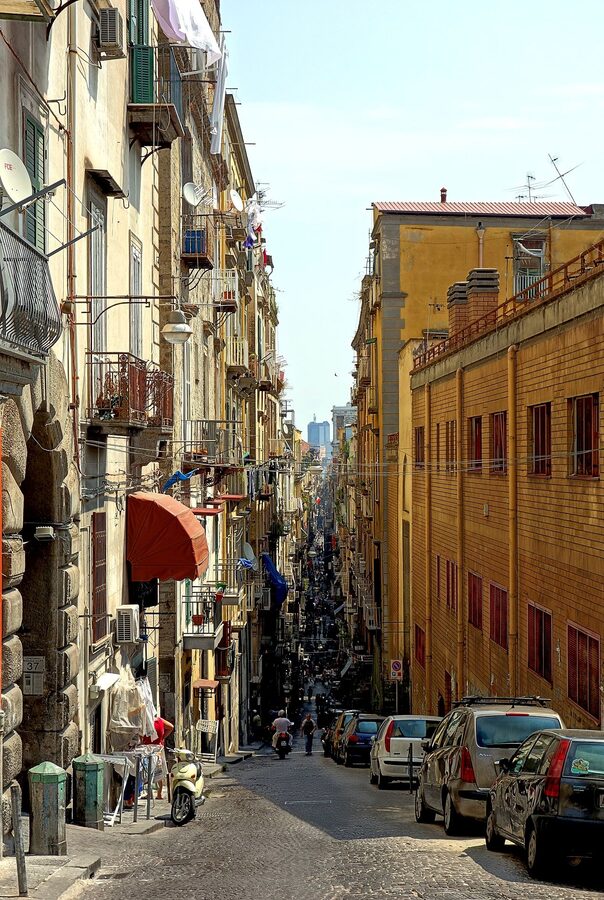
The UNESCO-listed centro storico of Naples is laid out on the Greek-Roman grid, three parallel east-west streets (the decumani) crossed by north-south ones (the cardines). The southernmost decumanus, called Spaccanapoli (“Naples-splitter”) for the way it cuts a perfectly straight line through the medieval fabric, is the single most useful walking axis in the city. It runs about 2 km from the Spanish Quarter in the west to the Forcella neighbourhood in the east, and it is still pedestrian, still dense, still a working street rather than a tourist spine. Walking it slowly takes 90 minutes if you don’t stop, half a day if you do.
From west to east: Piazza del Gesù Nuovo, with the Guglia dell’Immacolata (a baroque obelisk) and the Church of the Gesù Nuovo, whose extraordinary diamond-pointed grey stone facade was originally the wall of a 15th-century Renaissance palace and was converted into a church in 1601 by simply attaching the doors. The interior is full-on Neapolitan baroque. Free entry. Across the small square, the Basilica of Santa Chiara (1310) was built by Robert of Anjou; the cloister with its 18th-century painted majolica tiles is the canonical “everyone-photographs-this Naples cloister”, €6 entry, 45 minutes.
Continuing east on the street as it changes name to Via Benedetto Croce and then Via San Biagio dei Librai: San Domenico Maggiore (where Thomas Aquinas taught in the 13th century, in a small cell that you can visit upstairs); the obelisk of San Domenico in the small piazza outside; Cappella Sansevero (one block north, the most important short detour you will make in Naples, see below); and the Pio Monte della Misericordia, a charitable foundation founded in 1602 that commissioned, among many other paintings, Caravaggio’s Le Sette Opere di Misericordia (1607). The Caravaggio still hangs in its original location above the high altar; entry is €8, the painting is the single best Caravaggio outside the Vatican Pinacoteca, and the chapel is small enough that you can stand close. Twenty minutes there will pay for itself.
Further east, where Spaccanapoli enters the Forcella neighbourhood, the street starts to feel more residential and less polished. This is the texture you do not get in Florence or Venice, the centro storico still functioning as the working housing stock of the city, with hardware shops and primary schools and Vespa workshops alongside the historic churches. Don’t be put off by the visual chaos; this is what a 2,500-year-old urban centre looks like when it has not been gentrified into a museum.
Cappella Sansevero and the Veiled Christ
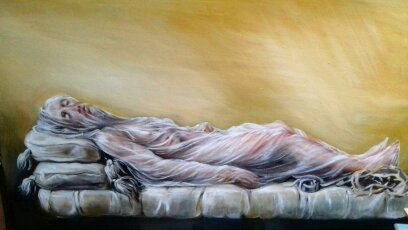
One block north of Spaccanapoli, on Via Francesco de Sanctis, the Cappella Sansevero is a small private chapel completed in 1613 and converted into a museum in the 19th century. It contains the most technically remarkable single piece of sculpture in Naples and one of the great pieces of European baroque art: the Cristo Velato (“Veiled Christ”), carved from a single block of marble in 1753 by Giuseppe Sanmartino on commission from the chapel’s owner, the alchemist-prince Raimondo di Sangro. The figure of Christ is laid out on the floor of the chapel under what appears to be a translucent gauze veil. The veil is marble, carved from the same block as the body. The level of carving sophistication, the way the underlying form of the body shows through what reads, at distance, as fabric, is genuinely without parallel in 18th-century European sculpture.
Sansevero himself is part of the legend. Raimondo di Sangro, Prince of Sansevero (1710-1771), was a 18th-century inventor, alchemist, and freemason who spent much of his life in this chapel performing experiments. The chapel basement contains two “anatomical machines”, glass-cased standing figures of a man and a woman whose entire circulatory system is preserved in vivid detail; Sangro is alleged to have either injected the bodies of two of his servants with a metallic preservative while they were still alive, or to have constructed the circulatory systems from wax, depending on which story you prefer. Modern X-ray studies have confirmed the systems are mostly artificial, but the local legend has not died.
Practical: timed-entry tickets, €10 (€8 reduced), book online at the Cappella Sansevero website at least three days ahead in season. Allow 45 minutes inside. Photographs forbidden. The chapel is small (perhaps 15m × 10m), which means the impact of standing two metres from the Cristo Velato is genuinely disproportionate to the size of the visit. This is the single sight in Naples that I would not skip even on a half-day visit.
The Duomo and San Gennaro
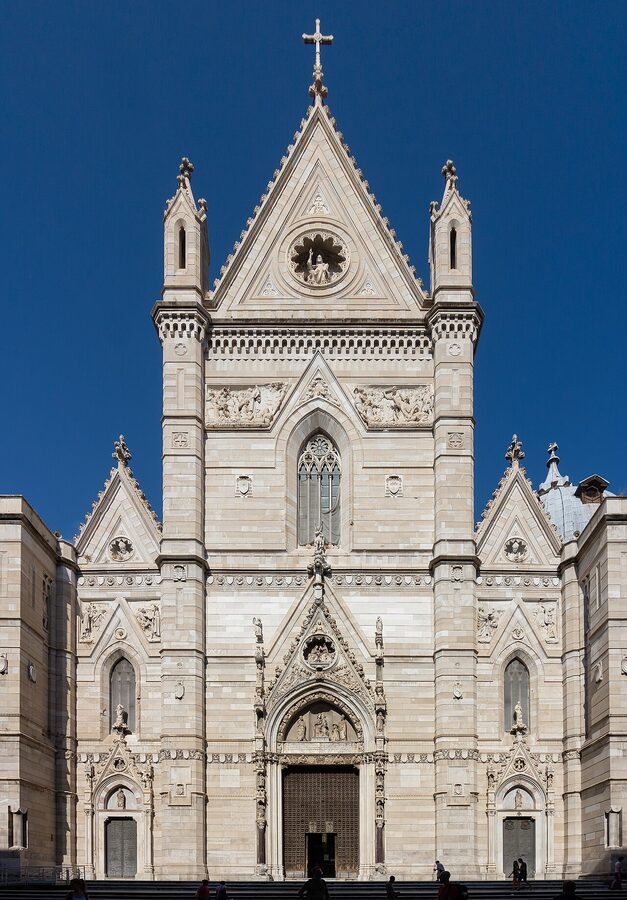
The Naples Cathedral, dedicated to the Assumption of Mary and known to everyone simply as the Duomo, sits one block north of the central decumanus on Via Duomo. The current building is 14th-century at core, with major Renaissance and baroque additions and a 1905 Gothic-revival facade by Errico Alvino. Free entry. What you come for is not the architecture, which is uneven, but the Cappella del Tesoro di San Gennaro, the chapel of the city’s patron saint, an early-17th-century baroque side-chapel whose interior is so densely covered in silver, gold, and lapis lazuli that the eye genuinely struggles to focus. The chapel houses two reliquaries containing the blood of San Gennaro (Saint Januarius), bishop of Naples, beheaded by Diocletian in 305 AD.
The blood, dried and preserved in two glass vials, is said to liquefy three times each year: on 19 September (the saint’s feast day), on 16 December (commemorating the saint’s intercession during the 1631 Vesuvius eruption), and on the first Saturday of May (the translation of the relics to Naples). On those days, the cathedral fills with worshippers and clergy and the Archbishop holds the reliquary up to the crowd; if the blood liquefies, the city is safe for the year. If it doesn’t, the consequences in popular belief are bad (1939, 1940, 1973 are all years when failures preceded earthquakes, war damage, or epidemics). You can take this seriously or not; the Vatican has refused to either confirm or refute the miracle, classifying it as “popular devotion of long-standing tradition”. The ritual itself is unironically observed.
Adjacent to the cathedral, the Museo del Tesoro di San Gennaro (€10) holds the cumulative gifts to the saint over four centuries, which include some staggering pieces of jewellery donated by various Bourbon kings and Napoleon. The most-cited single object is a 1679 silver mitre with 3,694 diamonds. The collection is genuinely surprising; visitors who skip the museum side and only see the chapel miss the better half.
San Gregorio Armeno and the presepe tradition
Via San Gregorio Armeno is a 200-metre cross-street running south from the central decumanus toward Spaccanapoli. It has, since the 18th century, been the workshop street of the Neapolitan presepe (nativity-scene) tradition, and today it has perhaps 30 specialist workshops and shops, all making the small clay-and-wire figurines that are placed in the elaborate panoramic nativities that decorate Neapolitan houses each Christmas. The figurines run from the standard biblical cast (Mary, Joseph, the magi, the shepherds) to a bewildering range of contemporary additions: politicians, footballers, pop stars, the previous Pope, the current Pope, Napoli FC’s Diego Maradona (a near-religious figure here), Donald Trump, the King and Queen of England. Walking the length of the street at any time of year is one of the things you cannot replicate in another Italian city. In December the street is so packed you cannot get through it.
Halfway up the street, the Church of San Gregorio Armeno itself is a 16th-century baroque church and convent built over the site of an earlier 8th-century convent founded by nuns who had fled the Iconoclast persecutions in Constantinople (bringing with them, the legend says, the remains of Saint Gregory the Illuminator of Armenia, hence the name). The cloister, accessible from a side entrance, has a beautiful 18th-century fountain and is one of the city’s quieter pieces of historic atmosphere. €5, 20 minutes.
The Naples underground
Underneath every street in central Naples runs a parallel city. Greek cisterns, cut into the soft yellow tuff in the 4th century BC, expanded by Roman engineers into a 400-kilometre aqueduct system, then connected, blocked, reopened, used as quarries, used again as cisterns, used as ossuaries, used as garbage dumps, and finally, between June 1940 and the autumn of 1943, used as bomb shelters by the Neapolitan civilian population during Allied air raids. The total underground network, mapped only partially, is estimated at around 700 kilometres. About three kilometres are open to public tours.
Two organisations run tours that cover essentially the same physical space from different historical angles. Napoli Sotterranea (entry from Piazza San Gaetano in the centro storico, on the central decumanus) runs 90-minute tours every hour from 10am, €15 per person, in Italian and English; this is the more historical-archaeological tour, which takes you into the Greek cisterns, an intact Roman theatre buried by 16th-century construction (the actor Eduardo De Filippo’s family lived in a house built directly on top of it), and the WWII shelters. Galleria Borbonica (entry on Vico del Grottone in the Chiaia) runs the Bourbon-tunnel programme, focusing on a 19th-century military escape tunnel commissioned by King Ferdinand II in 1853 and the WWII shelter use; €15-25 depending on the version (the boat-tour version through the flooded cistern is the more memorable, book ahead). Allow a half-day for either; do not do both on the same day.
The thing the underground tours do that no above-ground site can match: they make the geological and historical depth of Naples physically present. You walk down 130 steps and you are at Greek-colonial-era ground level. Eight metres further you are at Roman-Imperial ground level. The accumulated overburden of Naples is literal; the city has been raising itself up over its own past for 2,800 years. This is one of the most specific things Naples does that no other Italian city does at scale.
Castel Nuovo, the Royal Palace, and the Plebiscito
Where the centro storico meets the seafront, the civic and royal heart of Naples is concentrated in a 600-metre stretch from the Castel Nuovo east to the Galleria Umberto and across to the Palazzo Reale and Piazza del Plebiscito. You can walk all of it in 90 minutes; doing it carefully is closer to a half-day.
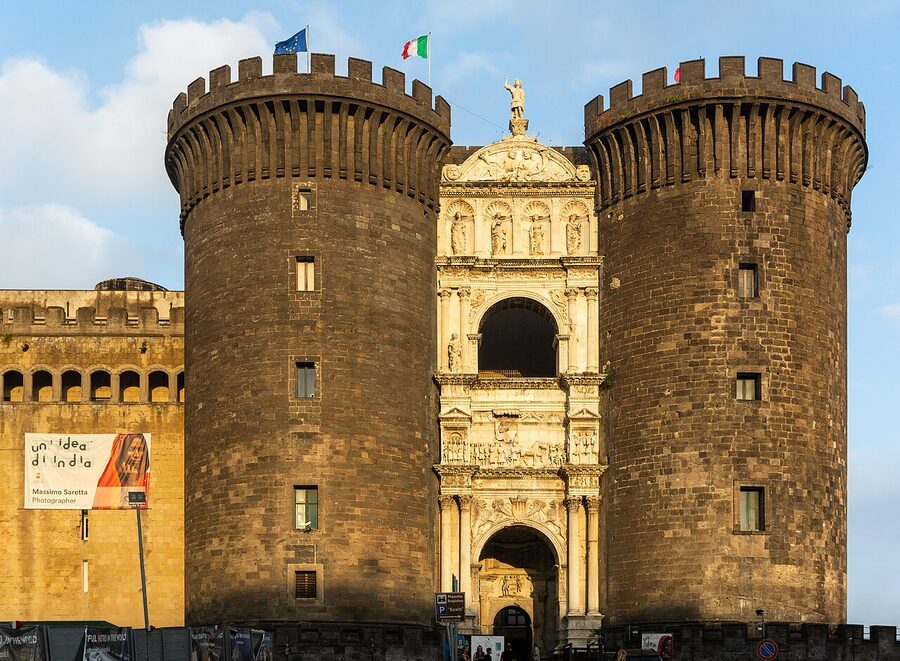
Castel Nuovo, called locally the Maschio Angioino, is a 13th-century Angevin fortress built by Charles I in 1279 when he moved the kingdom’s capital to Naples and decided he didn’t want to live in the old hilltop Castel dell’Ovo. The square footprint with five circular towers in black tuff is the original Charles design; the white marble triumphal arch in the middle of the southern wall, framed by two of the towers, is a 1453-1471 addition by Alfonso V of Aragon (Alfonso the Magnanimous), commissioned to commemorate his triumphal entry into Naples in 1443 after taking the kingdom from the Angevins. The arch is the most-photographed civic doorway in southern Italy. Entry to the castle is €6; the Civic Museum inside is fine but not unmissable, the visit is mostly for the courtyard, the chapel of Santa Barbara, and the Sala dei Baroni where the medieval parliament met.
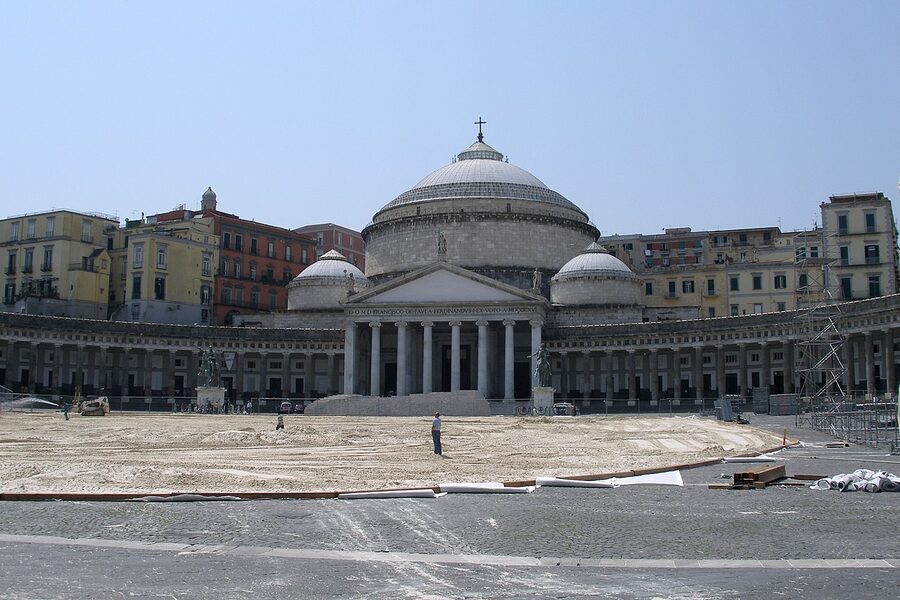
Three hundred metres west, Piazza del Plebiscito is the largest square in Naples and the city’s civic showpiece. The semicircular early-19th-century Church of San Francesco di Paola (1816-1846, a Pantheon-influenced neoclassical design by Pietro Bianchi) closes the western side; the Palazzo Reale faces it on the east. The square is named for the 1860 plebiscite that voted Naples into the unified Kingdom of Italy. Two equestrian statues anchor the centre, of Charles III of Bourbon and his son Ferdinand I. Until 1995 the square was a chaotic car park; the centenary of Italian unification eventually got it pedestrianised, and the result is one of the most successful urban-design recoveries in Italian history. On a summer evening, the whole city walks across it; in the morning, it is empty enough that the scale finally makes sense.
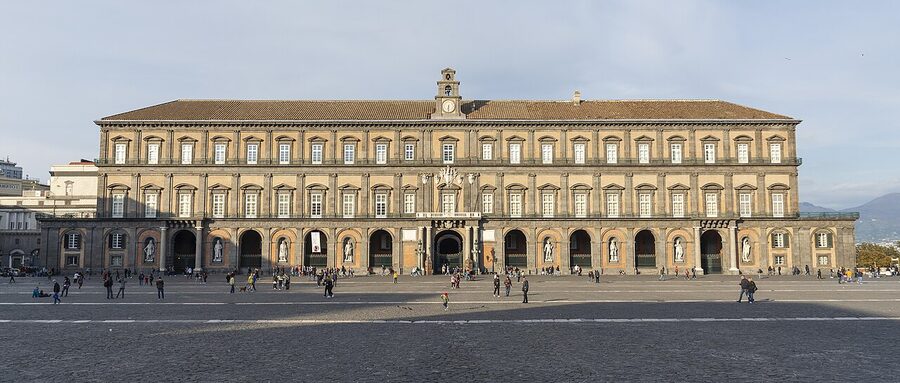
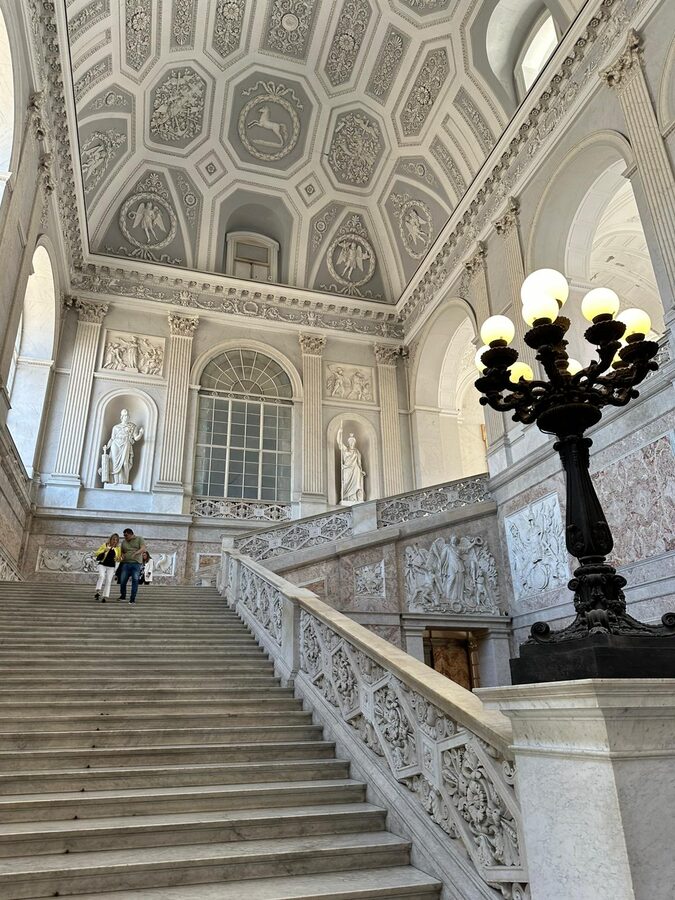
The Palazzo Reale is the 17th-century royal palace, built by Domenico Fontana in 1600 for the Spanish viceroys and continuously expanded by the Austrian (1714-1734) and Bourbon (1734-1860) administrations that followed. The eight statues in the niches along the front facade represent the eight kings of Naples, in chronological order from north to south: Roger II of Sicily (1130), Frederick II of Hohenstaufen (1197), Charles I of Anjou (1265), Alfonso V of Aragon (1442), Charles V (1516), Charles III of Bourbon (1734), Joachim Murat (1808), and Vittorio Emanuele II (1861). The interior is open as a museum (€10), with Bourbon-era state apartments, the throne room, and the historic Biblioteca Nazionale; allow 90 minutes. The throne room is the third stop after the Cristo Velato and the Caravaggio in the small list of Naples interiors I would not miss.
Adjacent to the Palazzo Reale, the Teatro di San Carlo is the oldest continuously active opera house in Europe and arguably the most beautiful working opera theatre in the world. Built in 1737 by order of King Charles III of Bourbon (yes, the same king who founded the Reggia di Caserta, the Capodimonte porcelain factory, and the public archaeological museum, his decade-long building programme essentially defines modern Naples), it pre-dates La Scala in Milan by 41 years. The original building burned down in 1816; the rapid rebuild was commissioned by Ferdinand IV and is the auditorium you see today, six tiers of red-and-gold velvet boxes with a royal box centred above the stalls. The acoustics are remarkable. The opera season runs October to June; the ballet and concert season runs through the summer. Booking a performance is the single best way to experience the building. Cheap upper-balcony tickets for a Sunday matinée are €30-50; main-floor stalls run €100-280. Daytime guided tours of the empty theatre run €15, every hour 10:30am-4:30pm.
Galleria Umberto and the elegant Naples
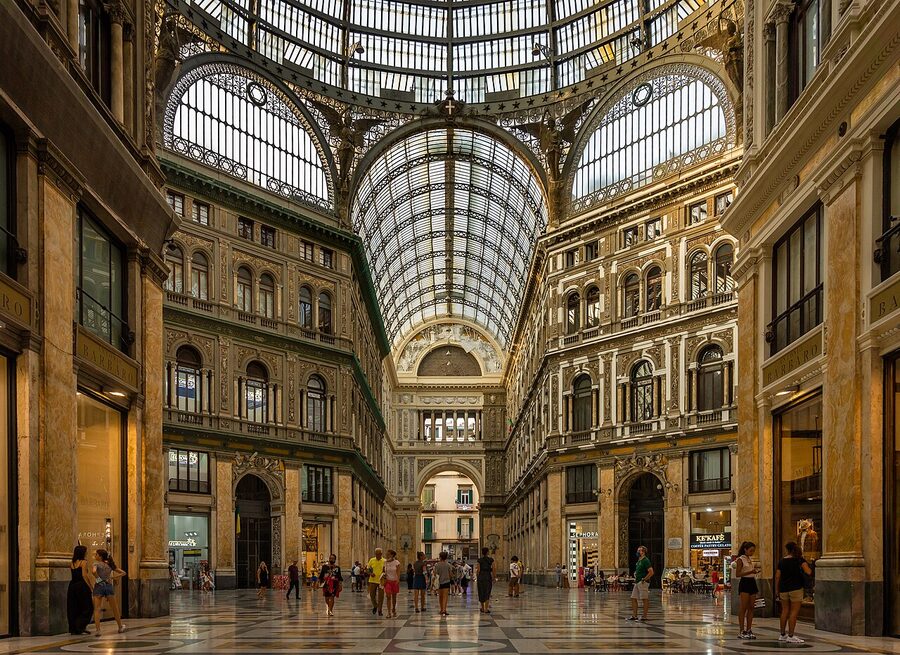
Across Via San Carlo from the Teatro, the Galleria Umberto I is Naples’ answer to Milan’s Galleria Vittorio Emanuele, a steel-and-glass-domed shopping arcade built between 1887 and 1890. The dome is 56m high; the cross-shaped plan replicates the Milan original almost exactly but on a slightly smaller scale. Bombed during WWII, restored in the late 1940s. Today the ground floor has a handful of cafés and the upper-floor offices are mostly empty; the gallery is more architectural set-piece than working market. You walk through it twice if you stay in the area, once to admire and once because it is the natural shortcut from the Teatro to Via Toledo.
From the Galleria, Via Toledo runs north, the canonical pedestrian shopping street of Naples and the western boundary of the Quartieri Spagnoli (see below). The metro station Toledo on Via Toledo (line 1, opened 2012, designed by Catalan architect Oscar Tusquets Blanca) is itself a stop worth making, the descent through deep-blue mosaic walls down through the city’s water table to the platform 50m below has been called the most beautiful metro station in Europe. The station re-uses the Anglo-American WWII bomb shelters that occupied the same vertical space.
West of the Galleria, the Chiaia neighbourhood is the elegant Naples, the 19th-century expansion district where the embassies, the fashion houses, and the better hotels are. Via dei Mille and Via Filangieri have the major Italian luxury brands; Piazza dei Martiri is a small leafy square that is the natural pause point on a Chiaia walk. The neighbourhood runs west along the seafront to Mergellina; spend an early evening walking its full length and finishing with an aperitivo at a Lungomare bar, that is the Naples that does not appear in the tourist guides.
The Quartieri Spagnoli
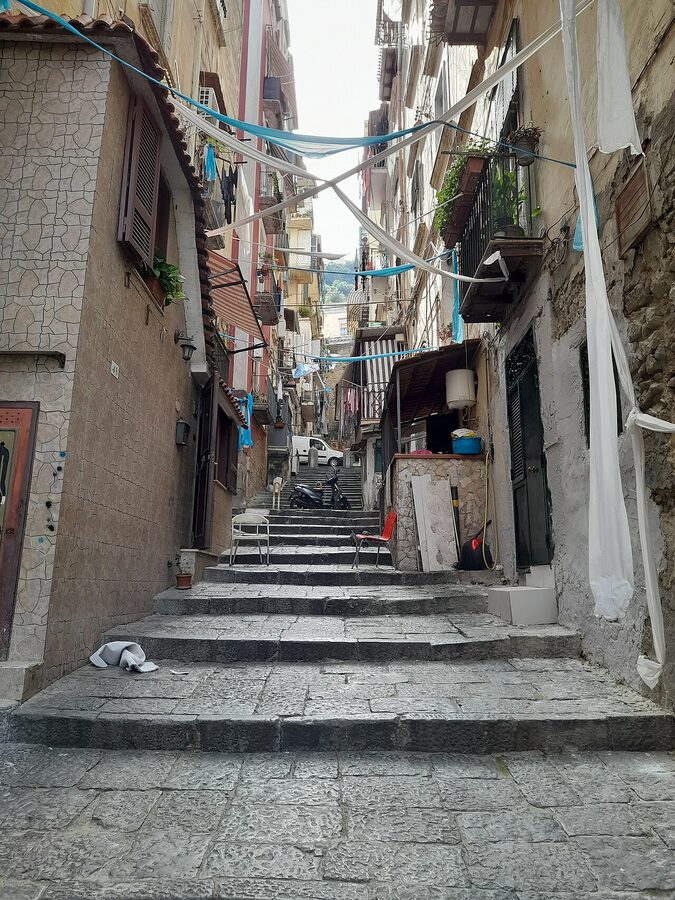
West of Via Toledo, climbing the slope toward the Vomero hill, the Quartieri Spagnoli (“Spanish Quarters”) are a rectangular grid of about 18 short streets built between 1530 and 1540 as garrison housing for the Spanish troops occupying the kingdom under the Habsburg viceroy Pedro de Toledo. The grid was deliberately tight; the streets are 250 centimetres apart in places, the buildings rise three or four storeys, the ground floor of every house was originally a stable, and the upper floors were soldiers’ quarters. The Spanish troops left in the 17th century; the working-class Neapolitans who replaced them have been the area’s residents continuously since.
For most of the 20th century, the Spanish Quarters had a reputation as one of the city’s tougher neighbourhoods, dense, poor, with a heavy Camorra presence. That reputation has been progressively softened since about 2000; the area is now genuinely safe for visitors during the day and lively in the evening, though still substantially gentrified-resistant in a way that gives it an edge most centre-city Italian neighbourhoods don’t have. The famous Maradona mural on Via Emanuele de Deo, painted by Mario Filardi in 1990 the day after Napoli won the Serie A title, has become a pilgrimage site since Maradona’s death in 2020; the small alley around it now functions as an informal shrine. The mural is at street level and free.
For food, the Spanish Quarters are where you find some of the city’s best low-budget restaurants. Trattoria Nennella on Vico Lungo Teatro Nuovo 103-105 is the cult cheap-Naples lunch (no reservations, queue from 12:30, €15-20 a head, raucous, the waiters interrupt the meal with songs); Tandem on Via Giovanni Paladino 51 is the classic Neapolitan ragù sit-down (€20-25); Pizzeria da Concettina ai Tre Santi on Via Arena della Sanità 7 (technically just outside the Quartieri, in the Sanità district north of the Duomo) is the best pizza in the world according to a sequence of recent rankings, €15 for a margherita, book a week ahead.
Vomero: Castel Sant’Elmo and the Certosa di San Martino
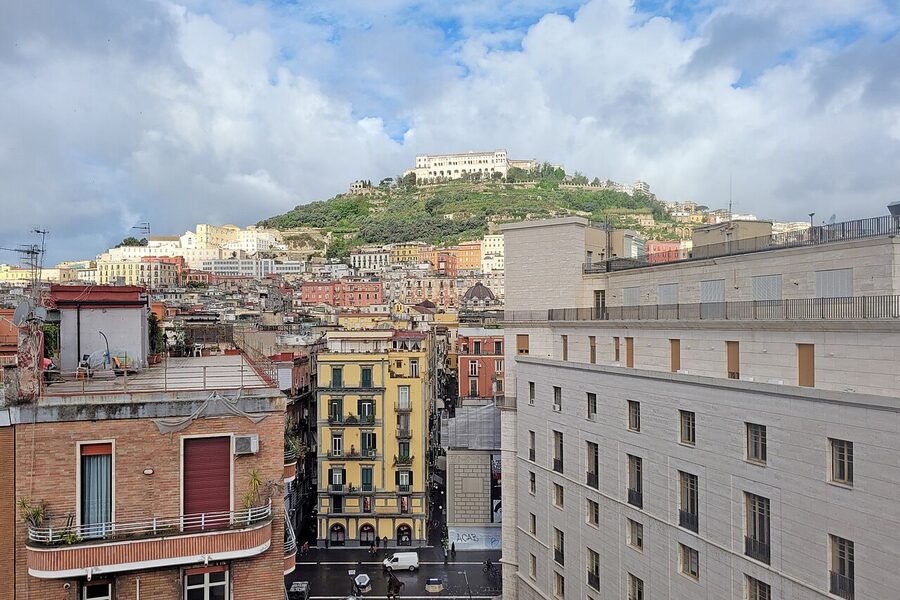
Above the Quartieri Spagnoli, the Vomero hill (250m) is the residential and museum-rich Naples. Take the Funicolare di Montesanto from Piazza Montesanto (€1.10, runs every 10 minutes) up to the upper station; from there it is a 15-minute walk through pleasant residential streets to the joint complex of the Castel Sant’Elmo and the Certosa di San Martino, perched on the very edge of the hill with the entire bay below.
Castel Sant’Elmo is a 14th-century star-shaped fortress in dark grey-yellow tuff, built originally by Robert of Anjou as a royal residence and converted to a military fortress by the Spanish in 1537. From the 16th century until 1952 it was used variously as a state prison, a barracks, and a barracks again. Today it is a public museum (€5) but the main reason to visit is the rooftop terrace, which is the single best 360-degree view in Naples: the historic centre below, the bay and Vesuvius east, Capodimonte and the inland districts north, the Phlegraean coast west to Capo Miseno. Allow an hour; go at sunset if you can.
The Certosa di San Martino, immediately adjacent, is a 14th-century Carthusian monastery built by Charles of Anjou’s son Charles of Calabria; expanded into one of Italy’s most lavishly decorated baroque monastic complexes between 1581 and 1631 by Giovanni Antonio Dosio and the Florentine architect Cosimo Fanzago. The monastery was suppressed during Italian unification in 1866 and the entire complex was converted to a public museum, the Museo di San Martino, which now holds one of the great collections of Neapolitan baroque painting (Ribera, Stanzione, Caracciolo, Giordano), a remarkable collection of historic Neapolitan presepi from the 17th and 18th centuries, and the church and the cloisters of the original monastery. €6 entry, allow 2-3 hours, weekday afternoons are quietest. The Cloister Grande, with the marble skull on the parapet that the Carthusian monks used as memento mori, is one of the great cloisters of Italy.
Castel dell’Ovo and the seafront
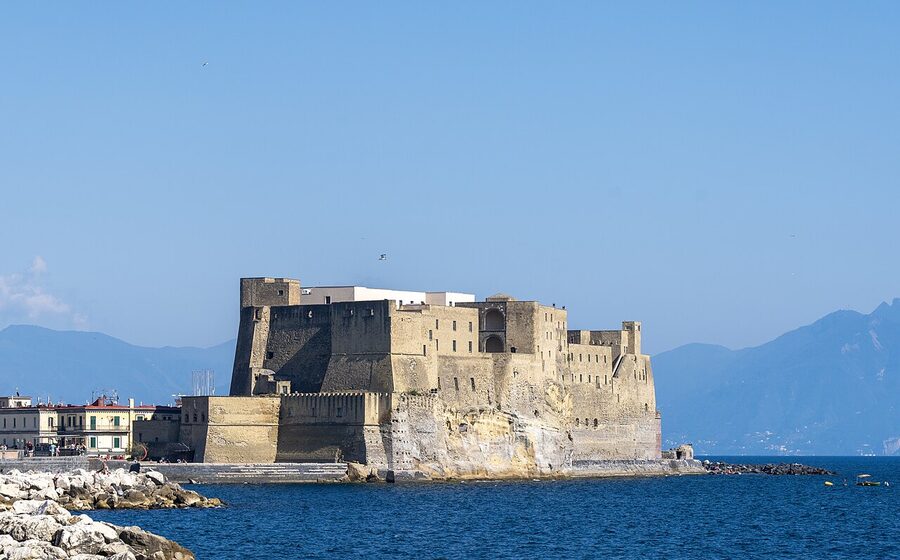
Two kilometres west of Castel Nuovo along the seafront, Castel dell’Ovo (“Egg Castle”) sits on a small rocky islet called Megaride that is connected to the mainland by a 200-metre stone causeway. This is the oldest occupied site in Naples; the original Greek colony of Parthenope was founded here in the 9th-7th century BC, and the islet has had successive military and residential structures built on it ever since. The current castle is essentially Norman in foundation (1140), with major Hohenstaufen, Aragonese, and Spanish-viceroyal layers. The name comes from a medieval legend, attributed to Virgil (who was popularly imagined as a magician in the Middle Ages), that the wizard had hidden a magical egg in the foundations whose breaking would cause both the castle and the kingdom of Naples to fall. The egg is, presumably, still intact.
Free entry. The interior rooms hold a small archaeological collection but the main reason to visit is the rooftop walk along the parapet, which gives a 270-degree view of the Bay of Naples and is, like the Castel Sant’Elmo terrace, one of the canonical Naples photographs. Around the base of the islet, the small Borgo Marinari is a fisherman’s harbour-turned-restaurant district, with about ten seafood restaurants squeezed onto the causeway, mostly tourist-priced (€60-90 a head) but pleasant for an evening meal.
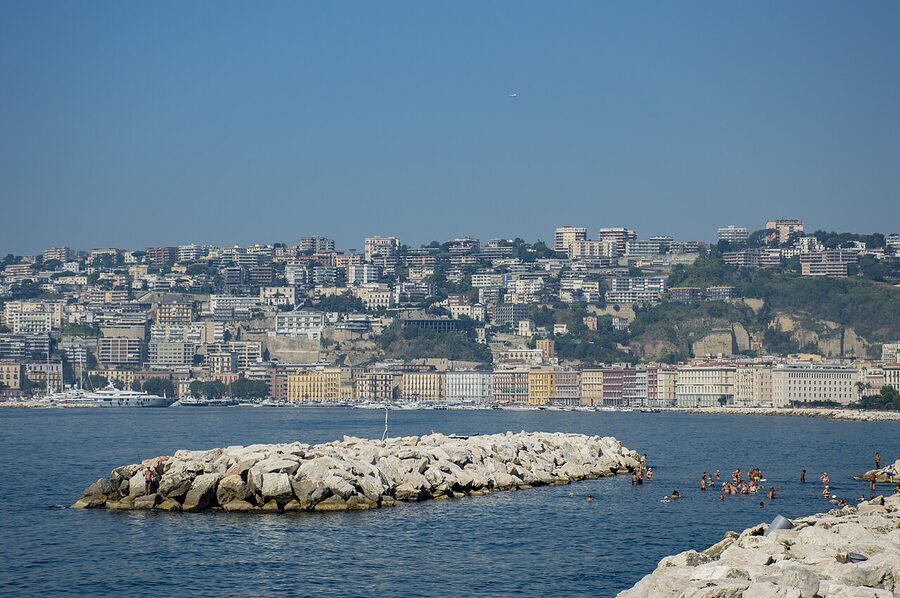
From Castel dell’Ovo, the Lungomare Caracciolo seafront promenade runs four kilometres west to the Mergellina ferry port, pedestrianised end-to-end in 2012 (a contested but ultimately successful piece of mayor Luigi de Magistris’s urban policy). This is the city’s evening passeggiata route. Locals start to appear at around 6pm; by 7:30 the whole stretch is full; by 9 it has thinned out to families finishing gelato and couples leaning on the seawall. A kiosk on the western end sells cuoppo (paper cones of fried fish) for €5. Two cafés along the way, Ciro a Mergellina and the bar at the Hotel Excelsior, both serve a perfectly good Aperol spritz at €8 (the same drink in Chiaia is €15). On a clear evening, the view across the bay to Vesuvius and the Sorrento peninsula is something you will want to photograph.
Museo Archeologico Nazionale
The Museo Archeologico Nazionale di Napoli (MANN) on Piazza Museo, north of the centro storico, is the single most important Roman archaeological museum in the world and the place that determines, more than any other single sight in Italy, how seriously you take a visit to Pompeii and Herculaneum. The museum holds essentially all of the movable finds from the two cities, the frescoes, the mosaics, the bronze and marble sculpture, the everyday objects, the gold, the loaves of bread carbonised in 79 AD, the lot. The Pompeii frescoes you see at the site itself are, with a handful of exceptions, copies. The originals are here.
The museum was founded by King Charles III of Bourbon in 1750 to display the dynasty’s Farnese inheritance (he was the son of Elisabetta Farnese and inherited the entire collection of the Farnese family in Rome) and to provide a controlled display environment for the just-discovered Pompeii finds. It opened to the public in 1816 and has been continuously open since (with WWII closures). The collection is organised on three floors. The ground floor holds the Farnese marbles, including the colossal Hercules and the Farnese Bull, the largest single piece of Greco-Roman sculpture surviving from antiquity. The mezzanine holds the Pompeii mosaic collection, including the Alexander Mosaic from the House of the Faun, the largest and most famous Hellenistic floor mosaic ever discovered. The first floor holds the frescoes, including the Villa of the Mysteries cycle, the Gabinetto Segreto (the “secret cabinet” of erotic Pompeian material that was kept locked from the 19th century until 2000 and is now openly displayed, age-restricted entry), and the bronze and silver collection.
Practical: €22 entry, open Wednesday to Monday 9am-7:30pm. Allow four hours minimum. Plan to do the museum either before or after Pompeii rather than between, the relationship between the site and the museum is the central point and seeing them together makes both more legible. The museum’s audio guide is mediocre; if you can, hire a private guide in advance for two hours, €60-80, focused on the Pompeii rooms. The museum bookshop has the best academic Pompeii literature in Italy.
Capodimonte
Three kilometres north of the centro storico, on a hill above the urban sprawl, the Reggia di Capodimonte is an 18th-century Bourbon royal palace built by Charles III of Bourbon (the same king, again) between 1738 and 1759 as a hunting lodge and as a showcase for the Farnese collection. The collection has stayed; today the palace functions as the city’s main fine-art museum, the Museo di Capodimonte, with a remarkable concentration of Renaissance and baroque painting that is genuinely competitive with the Uffizi. The headline rooms hold Caravaggio’s Flagellation of Christ (1607, painted during his Naples exile), Titian’s Danaë and the Farnese pope Paul III portraits, Parmigianino’s Antea, Masaccio’s Crucifixion panel, the entire painting collection of the Farnese family, and a major holding of southern Italian Renaissance and baroque material that is essentially absent from the northern Italian museums. The grounds are an 80-hectare park (the Bosco di Capodimonte), the largest green space in Naples, free to enter, with the porcelain factory at the far end.
The Real Fabbrica della Porcellana di Capodimonte, founded in 1743 by the same Bourbon king who founded everything else of importance in 18th-century Naples, was the first European porcelain factory to develop a soft-paste body that could compete with Saxon Meissen. The original factory was disbanded in 1759 when Charles III moved to Madrid to become Charles III of Spain; the Buen Retiro porcelain factory in Madrid is its direct continuation. The Naples factory was refounded in 1771 by Charles’s son Ferdinand IV and ran until 1808; the contemporary Capodimonte porcelain industry is a 19th-century revival. The original factory building can be visited (€5, weekends only); the museum holds the largest single collection of 18th-century Capodimonte work in the world.
Practical: from the centro storico, take bus C63 or R4 to Capodimonte (€1.10, 25 minutes) or a taxi (€18-22). The Bosco park is free; museum entry €15. Allow a full half-day. The view from the Capodimonte park back south to the city, with Vesuvius behind, is the third of the canonical Naples viewpoints (Castel Sant’Elmo and Castel dell’Ovo being the other two). Combine with a walk through the Sanità district on the way back, the historically poor district directly north of the centro storico, which has been reinventing itself since around 2010 as the city’s arts neighbourhood and which holds the catacombs of San Gennaro (€10, the most extensive early-Christian catacombs in southern Italy).
Pizza, sfogliatella, ragù: Naples food

You have not eaten pizza until you have eaten it in Naples. The Neapolitan style, formally codified by the Associazione Verace Pizza Napoletana in 1984 and now a UNESCO-listed intangible heritage technique, uses a soft, wet dough fermented for 24-72 hours, hand-shaped (not rolled), topped with San Marzano tomatoes from the Vesuvian foothills and fresh fior di latte or mozzarella di bufala, and cooked at 485°C for 60-90 seconds in a wood-fired oven. The crust is fat at the rim (the cornicione) and almost wet at the centre; you eat the centre with a knife and fork. The first true Pizza Margherita, with mozzarella, tomato, and basil in the colours of the Italian flag, was created in June 1889 by Raffaele Esposito at the Pizzeria Brandi (still operating, on Salita S. Anna di Palazzo) for Queen Margherita of Savoy, who had asked to try the local food during a royal visit. A handwritten thank-you note from her court chamberlain hangs in the restaurant.
The pizzerias to know, in roughly the order I recommend them:
Pizzeria Da Michele, Via Cesare Sersale 1, Forcella. The one in Eat Pray Love, but also genuinely the most traditional pizzeria in the city; only two pizzas on the menu (margherita and marinara), €5-8 each, served on paper plates with no cutlery. Queue from 11:30am or after 9pm to avoid the worst of the wait. Closes at 11pm.
Gino e Toto Sorbillo, Via dei Tribunali 32. The strictest interpretation of the AVPN dough technique; the better technical pizza in the purist view. €5-12, 45 of them on the menu. Queue is shorter than Da Michele’s but still real.
50 Kalò, Piazza Sannazaro 201/B, Mergellina. Ciro Salvo’s modern-school flagship; the dough is more hydrated and the rim is taller than the AVPN purists like. The pizza is excellent. €8-15, easier reservations.
Pizzeria da Concettina ai Tre Santi, Via Arena della Sanità 7, Sanità. Ranked first or second in successive 50 Top Pizza rankings since 2018. €15 margherita, set tasting menus from €30, book three weeks ahead. The Sanità walk is part of the experience.
Beyond pizza, Naples has a deep traditional cuisine that is poorly represented outside the city.
Sfogliatella, the layered shell-shaped pastry filled with sweetened ricotta, semolina, and candied citrus peel, comes in two forms: riccia (the crisp puff-pastry version, the original) and frolla (the shortcrust version, sweeter and softer). The standard pastry-shop test is a sfogliatella riccia at Pintauro on Via Toledo 275 (the inventor of the form, c. 1818) or Scaturchio on Piazza San Domenico Maggiore 19. €1.80-2.50 each.
Babà al rum, the rum-soaked sponge cake, was imported from Poland in the 18th century via the Bourbon court and is now more associated with Naples than with anywhere else. Casa del Nonno 13 in Mergellina makes the best in the city.
Ragù alla napoletana is not the same dish as Bolognese ragù; it is a slow-cooked pork-and-beef stew (4-5 hours minimum, 7 hours preferred), tomato-heavy, served as a sauce over thick pasta (typically ziti) with the meat eaten as a second course. Tandem in the Spanish Quarters and Trattoria da Nennella nearby are the everyday spots; Mimì alla Ferrovia near the train station is the upscale version (€40-55).
Coffee in Naples is its own specific world. The local style is short, scalding, intensely bitter, served already sweetened (you have to ask for “amaro” if you want it without sugar) and accompanied by a small glass of room-temperature water that you drink before the coffee, not after. Two specific bars: Caffè del Professore on Piazza Trieste e Trento 46 (across from the Teatro San Carlo, run by the same family since 1955; the house specialty is the caffè alla nocciola, hazelnut-flavoured espresso); and Gran Caffè Gambrinus next door on Via Chiaia 1, the 1860 Belle Epoque marble palace where Hemingway, D’Annunzio, Oscar Wilde, and (post-1947) Sartre all wrote at the upstairs tables. €1.20 espresso at the counter, €5+ if you sit at a table; the difference is the city’s standard two-tier pricing model and not a tourist trap.
Where to stay
Three districts work well for visitors, and each suits a different kind of stay.
Centro Storico (around Spaccanapoli, the Decumano Maggiore, and the Duomo): the densest, loudest, most-immediately-Neapolitan option, with the historic centre at your doorstep. Best for first-time visitors who want to be in the middle of everything. Hotels: Decumani Hotel de Charme (Via S. Giovanni Maggiore Pignatelli 15, €130-220, 27 rooms, a converted 18th-century palazzo with frescoed ceilings, on the southern decumanus); Hotel Piazza Bellini (Via Costantinopoli 101, €110-180, 50 rooms, modern design in a converted historic building, two minutes from the archaeological museum); Bovio Suite (Via S. Giovanni Maggiore Pignatelli 8, €100-160, family-run B&B, 5 rooms, friendly).
Chiaia: the elegant 19th-century neighbourhood, quieter, more residential, walking distance to the seafront. Best for repeat visitors who want a base rather than to be in the centro storico. Grand Hotel Vesuvio (Via Partenope 45, €280-500, the canonical Naples grande dame on the Lungomare, where Caruso lived for years and where the rooftop restaurant has the best Castel dell’Ovo view in the city); Grand Hotel Parker’s (Corso Vittorio Emanuele 135, €250-450, on the slope of the Vomero, with the highest rooftop terrace in the city, opened 1870); Hotel Excelsior (Via Partenope 48, €260-450, on the Lungomare next to the Vesuvio, the alternative grande dame).
Vomero: the residential hill, quietest of the three, requires the funicular to get into the centro. Best for travellers who want to escape the noise. Grand Hotel Parker’s (above) is technically Vomero. Hotel San Francesco al Monte (Corso Vittorio Emanuele 328, €170-300, a converted 16th-century Franciscan monastery with a swimming pool in the cloister) is the more characterful option.
Don’t stay near the train station (Piazza Garibaldi). The hotels are cheaper and the access to the high-speed trains is a strength, but the immediate area is the city’s least pleasant streetscape and you will not enjoy it after dark.
When to visit, and day trips
Naples works through the year better than most Italian cities; the climate is mild even in January (10-13°C average), and the indoor sights make it a credible winter destination. The season I’d actually pick is April-May or October, with the May feast of San Gennaro (first Saturday) and the Settimana Santa processions before Easter as specific reasons to time around. July-August is hot, smoggy, and emptied-out as Neapolitans head for the islands; the city centre runs at perhaps 60% normal capacity, which has its own appeal but means many local restaurants close for the month. September brings San Gennaro’s main feast day (19 September) and is one of the city’s most evocative weeks. December is when the San Gregorio Armeno presepi market is at its peak; if you can tolerate the crowds, this is one of the most distinctive Italian Christmas experiences anywhere.
Naples works as a regional base for the whole of Campania. The major day trips, in roughly the order most visitors do them:
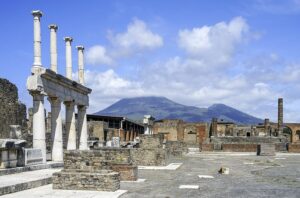
Pompeii: 35 minutes by Circumvesuviana from Napoli Centrale (Pompei Scavi station). €22 entry, allow 5 hours minimum. Combine with the Naples Archaeological Museum either before or after. Herculaneum: 20 minutes by Circumvesuviana from Naples (Ercolano Scavi station). €14 entry, 3 hours; better preserved than Pompeii and quieter, the better single-site visit if you only have one day. Vesuvius: shuttle bus from Pompei Piazza Anfiteatro to the upper car park at 1,000m, then a 25-minute walk to the crater rim. €15, open 9am-5pm in summer.
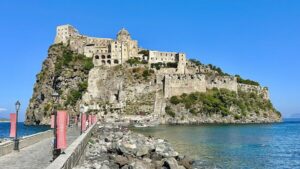
Capri: 45-minute hydrofoil from Molo Beverello, €24. A long day trip works (last return ferry around 7pm); two nights overnight is much better. Ischia: 50-minute hydrofoil, €22. Better as a 3-5 night base than as a day trip. Procida: 40-minute hydrofoil, €19. The smallest and quietest of the three Gulf islands.
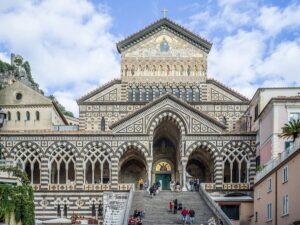
Amalfi, Positano, and Ravello: longer day from Naples (90 minutes by SITA bus from Sorrento, which is itself an hour by Circumvesuviana from Naples). Realistically the Amalfi Coast wants at least two nights of its own; from Naples the practical day-trip option is to go to Amalfi by ferry from Molo Beverello (April-October seasonal hydrofoil, 90 minutes, €30) and back the same day.
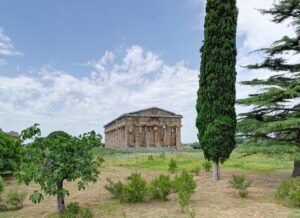
Paestum: 90 minutes south of Naples by regional train (€10 each way), the three Greek Doric temples in a field, more intact than anything in Greece itself. Combine with a Cilento mozzarella-di-bufala farm visit on the way.
Reggia di Caserta: 35 minutes north by regional train (€3.40), Italy’s largest royal palace, designed by Vanvitelli for Charles III of Bourbon (yes, the same king) between 1751 and 1780. UNESCO-listed, 1,200 rooms, gardens 3 km long. Most filming location for any Italian palace exterior in modern cinema (Star Wars, Mission Impossible, Angels & Demons). €15 entry, allow 5 hours.
Phlegraean Fields: 30 minutes west by Cumana train, the volcanic-caldera area west of Naples that holds Pozzuoli (Roman amphitheatre, the Solfatara fumarole field, the Macellum/temple of Serapis half-submerged), Baia (the underwater archaeological park, snorkelling among Roman villas), and Cumae (the original Greek colony and the Antro della Sibilla, the cave of the Cumaean Sibyl). Less famous than Pompeii and far less crowded; for serious Roman archaeology I prefer it.
Before you go
Naples rewards a longer stay than the day-trip routine most northern European visitors give it. Three nights is the minimum that lets you do the centro storico properly plus one of the day trips above. Five nights gets you the centro storico, the major museums, two day trips, and an evening at the San Carlo. A full week makes Naples your Campania base from which you can do Pompeii, Herculaneum, the Reggia di Caserta, Paestum, and an island in proper depth. I would not stay fewer than three nights. The single hardest mistake to undo is a Naples day-trip from Sorrento: you arrive at the train station, you don’t get further than the first three blocks of the historic centre, and you leave with the worst possible impression of one of Europe’s most singular cities.
The thing most foreign visitors ask before a first trip is whether Naples is safe. The plain answer: yes, in the parts of the city visitors actually go to, with the same kind of street-smarts you’d use in Rome or Marseille. Don’t wear an obvious wristwatch in the centro storico in summer. Don’t take a flashy phone out in Forcella or Sanità at night. Don’t accept rides from anyone at the train station who isn’t in a numbered taxi from the queue. The city’s overall street crime rate has improved considerably since the early 2000s and the centro storico is genuinely calmer than it was. The current rate of pickpocketing is roughly comparable to Rome’s, which is to say lower than Barcelona’s or Paris’s.
The thing most second-time visitors learn: Naples is dense. You will not see all of it. You will not even see all of the centro storico. The right way to come here is not to chase a list of major sights but to pick a base, walk one neighbourhood per day, eat slowly, and accept that the city’s accumulated layers of Greek, Roman, Byzantine, Norman, Aragonese, Spanish, Bourbon, and modern Italian fabric are not actually possible to disentangle. They are happening simultaneously in every street. That is the point.
For the wider Campania context, see the regional hub. For the archaeological day-trip cluster, see Pompeii, Herculaneum, and Paestum. For the coastal day trips, see Amalfi, Positano, and Ravello. For the Gulf islands, see Capri, Ischia, and Procida. Together with this Naples guide, those nine articles cover essentially the whole of what most visitors come to Campania for.


.jpg)
,_Entrance,_Naples_(5257).jpg)


.jpg)

.jpg)


