
Procida is the smallest of the three Gulf of Naples islands, four square kilometres of volcanic rock, 10,500 permanent residents, a single long fishing harbour painted in a hundred shades of ochre, pink, and cream, and essentially no luxury-tourism infrastructure of the kind that defines its two larger neighbours. It sits between Ischia (to the west, four kilometres across the strait) and the mainland at Capo Miseno; a 40-minute hydrofoil from Naples gets you there. For most of the post-war period Procida was the unvisited Gulf island, the one Italian day-trippers didn’t bother with, the one where the fishermen still fished, where foreign tourists were too rare for the local restaurants to bother with English menus. That changed, slowly, after Michael Radford filmed Il Postino on the island in 1994 and Anthony Minghella used Marina Corricella as Mongibello in The Talented Mr. Ripley in 1999, and then, all at once, in 2022, when the Italian Ministry of Culture named Procida the Italian Capital of Culture.
The choice was not obvious. The previous Italian Capitals of Culture had been Mantua, Ravenna, Matera, Parma, cities with 50 major monuments each. Procida has essentially three: the Terra Murata citadel on its headland, the Abbey of San Michele Arcangelo inside the citadel, and Marina Corricella. What the Ministry specifically rewarded was something different, the project called La cultura non isola, “culture does not isolate”, an island-as-cultural-model argument that placed Procida as an exemplar of the small-scale, artisanal, non-industrial Mediterranean coastal culture that is disappearing across southern Europe. The 2022 programme brought four hundred cultural events to the island and about ten times the normal number of visitors, and it locked in a permanent structural change: Procida is now a known stop. But because it is so small, and because the infrastructure to host large volumes of tourism simply doesn’t exist, the character of the island has not yet followed its two larger neighbours into mass tourism. Come now.
If Capri is the Gulf’s glamour island and Ischia is the spa island, Procida is the quiet island, the fishermen’s island, the one where the houses are painted because the painters wanted colour and not because a tourist board did a study. The Greek name Prochyta probably meant “poured out,” referring to how the island looks from the sea, low, flat, spread across the water rather than piled up into a peak. You can walk the whole island in a day.
In This Article
Procida in one paragraph
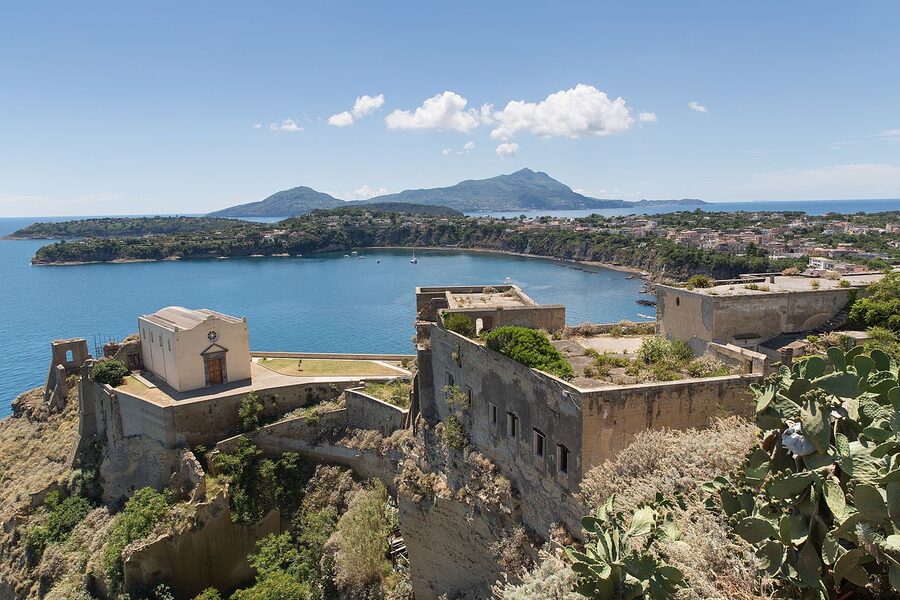
The smallest of the Phlegraean Islands in the Gulf of Naples, four kilometres west of Cape Miseno on the mainland and four kilometres east of Ischia. Area 4.1 km²; resident population 10,596 (2010 census). Formed by the eruption of four now-submerged and dormant volcanoes. Highest point Terra Murata at 91m. A small satellite islet, Vivara (0.4 km²), is connected to the southwestern tip by a 100m footbridge and is a protected nature reserve. Greek settlement from the 8th century BC (with Mycenaean traces from the 16th-15th centuries BC); Roman imperial-era resort for the patrician class; medieval retreat to the fortified Terra Murata against Saracen raids; Norman, Angevin, Aragonese, and Bourbon rule in succession. Patron saint Michael the Archangel (feast day 29 September); demonym Procidani. Named 2022 Italian Capital of Culture. Reached only by sea, hydrofoils and ferries from Naples (40-50 minutes), Pozzuoli (30 minutes), and Ischia (20 minutes).
Getting to Procida
The ferry network is closely tied to the Ischia routes, many vessels serve both islands on the same loop.
From Naples Molo Beverello, hydrofoils run 40 minutes, €19-22, departing every 60-90 minutes from 7am to about 8pm. Operators: Caremar, SNAV, Alilauro. From Calata Porta di Massa (the car-ferry terminal, 10 minutes walk east of Molo Beverello), larger ferries take 60 minutes, €12-14 foot passenger, €30-40 for a small car, roughly every 2 hours.
From Pozzuoli, 20 minutes by train west of Naples on the Cumana line, car ferries run 30-40 minutes, €10 foot, €25-35 for a small car, every 1-2 hours. This is the best route if you are coming from Rome or the mainland north of Naples.
From Ischia Porto, Caremar runs about six hydrofoils a day (25 minutes, €11) and three car ferries (30 minutes, €8 foot passenger). If you want to do both islands in one trip, base on Ischia for the longer stay and do Procida as an overnight.
Bringing a car: practical but pointless. Procida is the one Gulf island where a car is genuinely unnecessary, the island is 4 km long and most of the interesting areas are walkable or reachable by the one bus line that circles the island. Local cars are mostly three-wheeled Piaggio Ape pick-ups, many of them converted into taxis (the microtaxi system). A Piaggio Ape taxi across the island costs €12-15.
On the island: two buses (L1 and L2) loop between Marina Grande (the ferry port), Terra Murata, and Marina Chiaiolella at the far end, every 20-30 minutes, €1.50 per ride. On foot, Marina Grande to Marina Corricella is 10 minutes; Marina Corricella to Terra Murata is 15 minutes uphill; Marina Grande to Marina Chiaiolella is 30 minutes by path along the south coast. Bicycle and scooter rental from shops near the ferry port is €15-30 a day.
Marina Corricella
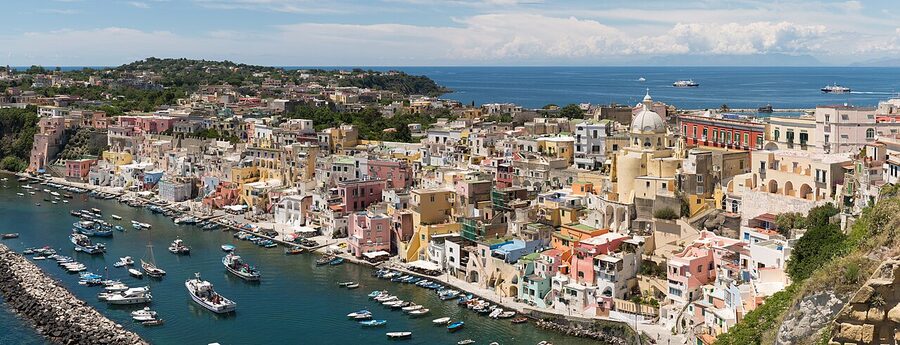
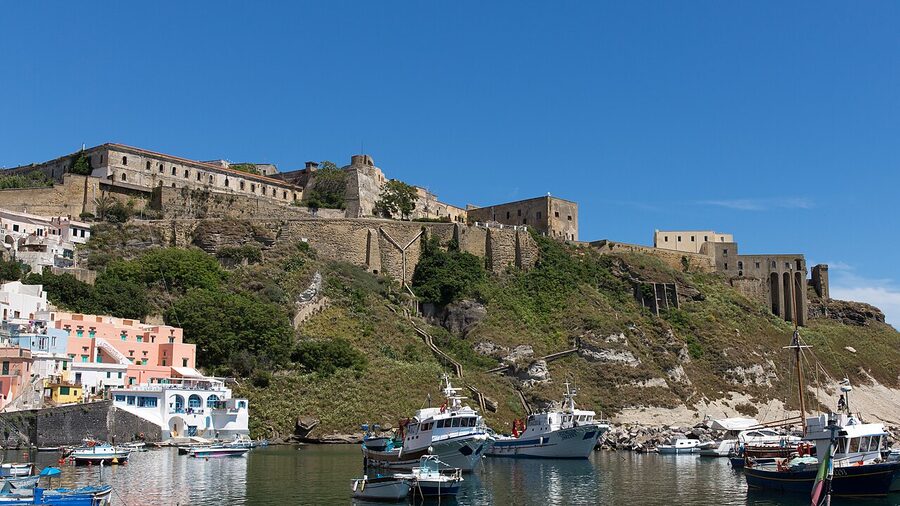
Marina Corricella is the image that sells Procida. A crescent of fishermen’s houses, built directly onto the sea at the foot of the Terra Murata cliff, every house painted a different shade, pink, ochre, cream, salmon, pale green, pale blue. The village is car-free and entirely pedestrian; the only way in is on foot, down the Scalinata della Gradinata from the upper road, or along the cliff path from Marina Grande. The houses are 16th-18th-century, four to five storeys tall, their ground floors opening directly onto the quay where the fishing boats still tie up. The painting is functional and always has been, each family painted its house a different colour so that fishermen out at sea could identify their own home from the water. There was never a colour scheme; the effect you see now is the accumulated choices of 150 generations of families, each picking from the pigments that were available and cheap that year.
The village is genuinely a working one. Roughly 200 people live full-time in the Corricella houses; about forty fishing boats still tie up here and go out before dawn; the fish markets on the quay at 6am are not theatrical. Through the summer, five or six small restaurants and cafés run tables out on the quay, the food is standard Neapolitan coastal (spaghetti alle vongole, polpo alla luciana, grilled orate), the prices are higher than they should be but lower than Capri, and the light at dusk as the harbour lamps come on and the Terra Murata silhouette darkens above is the one specific Procida experience that justifies the trip. La Conchiglia at the eastern end is the most reliable; Il Pescatore in the middle is the most authentic; Graziella in the western curve is the most upmarket (booking essential). In winter, most of these close and the harbour returns to being a village square.
The walking approach to Corricella is half the experience. From the ferry port at Marina Grande, follow Via Principe Umberto, then Via San Rocco, then the steep stepped path called the Scalinata della Gradinata. Allow 20 minutes. The view as you come down the steps with the painted houses unfolding below is one of the most photographed scenes in southern Italy, it was the establishing shot in both Il Postino and The Talented Mr. Ripley.
Terra Murata
Above Corricella, the fortified citadel of Terra Murata, “walled land”, sits on the island’s highest point at 91 metres. This is the oldest inhabited part of Procida and the place the islanders retreated to during Saracen raids from the 9th century onward. A 16th-century circuit of defensive walls still stands; within them, three buildings matter.
The Abbey of San Michele Arcangelo was founded as a Benedictine monastery in the 11th century and rebuilt multiple times. The current church is 17th-century with baroque interior, ornate gilded ceiling, a panel painting of the island’s patron saint Michael defeating the Turks (commissioned after a specific 1544 raid by Barbary corsairs), and underground cisterns and catacombs that can be visited. The abbey is free; the underground spaces require a €3 ticket. The church has its own minor treasures (a 16th-century silver bust of Michael, a sequence of votive panels from saved sailors); the catacombs are genuinely worth the detour.
The Palazzo d’Avalos is a 16th-century fortified palace built by the d’Avalos family (the same Aragonese family that ruled Ischia from the Aragonese Castle). In 1830 the Bourbons converted the palace into a state prison, and it remained a working prison, holding political prisoners and later ordinary criminals, until it was closed in 1988. The prison wing was abandoned intact and can now be visited on a guided tour (€5, 45 minutes, usually scheduled at specific hours, check locally). The contrast between the 16th-century palazzo shell and the 20th-century prison interior (barred cell doors, peeling wall-chart rules, flaking paint) is striking. The 2022 Italian Capital of Culture programme restored significant parts of the prison as a museum and exhibition space.
The Piazza d’Armi, the parade ground in front of the abbey, has the best view on the island, a 270-degree panorama from Ischia in the west, across Procida’s own south coast and Vivara, to Cape Miseno and the Phlegraean mainland in the east, with Vesuvius and Naples in the background on a clear day. The village of Terra Murata is small, a single central alley, a handful of restaurants, the parish church of Santa Maria delle Grazie, but walking the circuit of the outer walls at 7pm with the whole Gulf in view is essential.
The Easter Procession of the Mysteries, which runs from Terra Murata down to Marina Grande on Good Friday, is the single most important cultural event on the island and has been running continuously since the late 17th century. Young men of the Confraternity of the Turchini dress in white tunics and blue capes and carry wooden mysteries, elaborate allegorical sculptures on wheeled wagons, depicting biblical scenes, through the streets over a six-hour procession. The mysteries are built over months by the young men themselves and are largely unseen until procession morning; after the procession, most are dismantled or destroyed. If you are coming in Holy Week, this is the thing to see.
Marina Grande and the main town
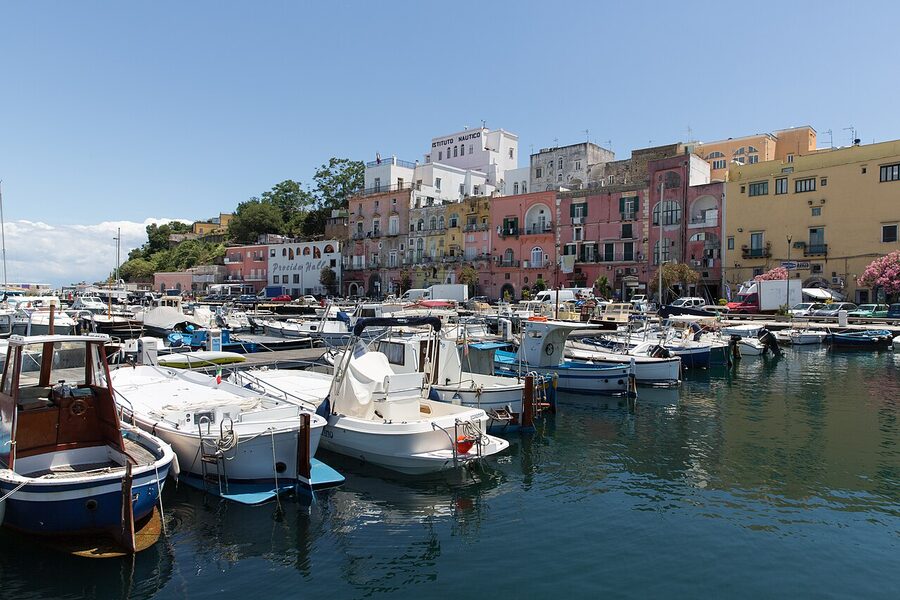
Marina Grande, the ferry port, also called Marina di Sancio Cattolico, is where you arrive. The harbour is flanked by several rows of four- and five-storey tenement buildings painted in the same pastel register as Corricella, though here the colours are less dense and the buildings more modern. The main town (il centro) spreads inland from the port along Via Roma and Via Vittorio Emanuele; this is where the everyday island life happens, the bakeries, the greengrocers, the hardware shop, the two small supermarkets, the post office, the public school. Budget most of your non-food shopping here rather than at Corricella, where prices are tourist-level.
The Church of Santa Maria della Pietà on the seafront (1616) has the distinctive yellow-and-white façade that appears in the background of half the Cleopatra harbour scenes, when Elizabeth Taylor’s golden barge arrives at “Tarsus” in the 1963 film, the barque is actually docking at Marina Grande Procida, with this baroque dome visibly and anachronistically behind the ancient-Egyptian set dressing. It’s a good example of how routinely the 20th-century Italian film industry used Procida as an all-purpose Mediterranean background.
A 10-minute walk west along the coast from Marina Grande, past the Chiesa della Madonna della Libera, brings you to the 19th-century Casale Vascello, a small neighbourhood of stacked flat-roofed houses built directly into a former quarry, with internal stairs connecting levels and external loggias. This is where the photographs of “Procida interior courtyards” come from. It is small, residential, and has no specific attraction beyond being one of the most distinctive pieces of southern-Italian vernacular architecture on any of the Gulf islands.
Marina Chiaiolella and Vivara
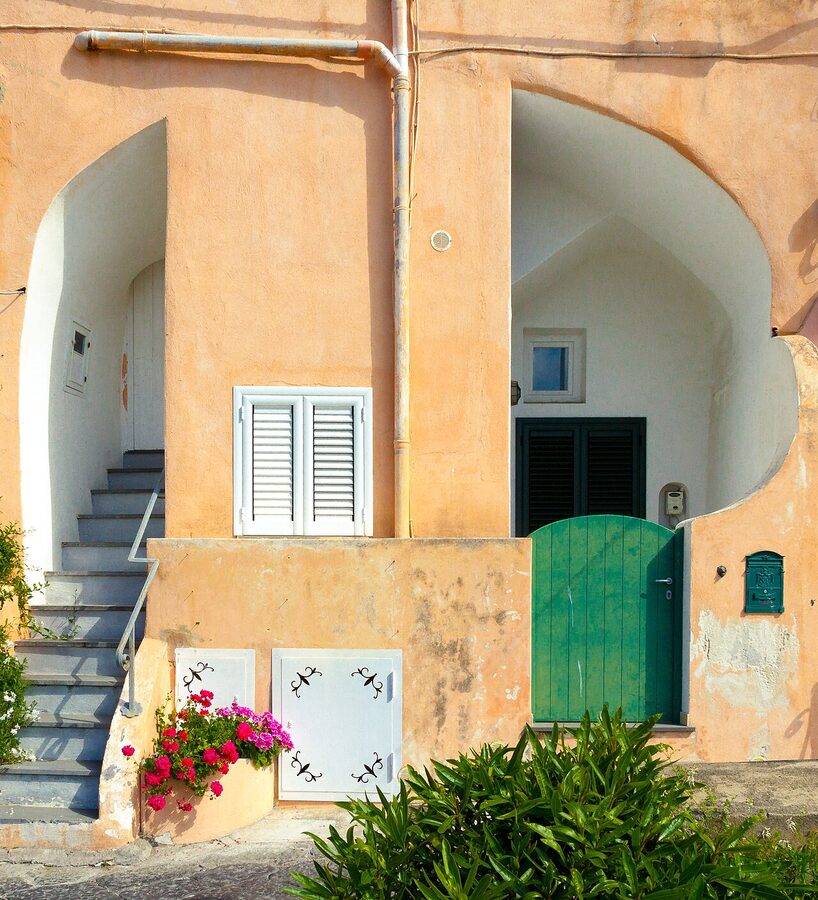
Marina di Chiaiolella, at the southwestern tip of the island, is Procida’s second harbour, smaller and less photographed than Corricella, but arguably more pleasant to spend time in. A natural semicircular bay, formed by the flooded caldera of one of the four original volcanoes, with a 200-boat marina, a half-kilometre of public beach, three or four low-key restaurants and ice-cream places, and the sunset view. This is where local Procidani actually swim. The bus from Marina Grande takes 12 minutes.
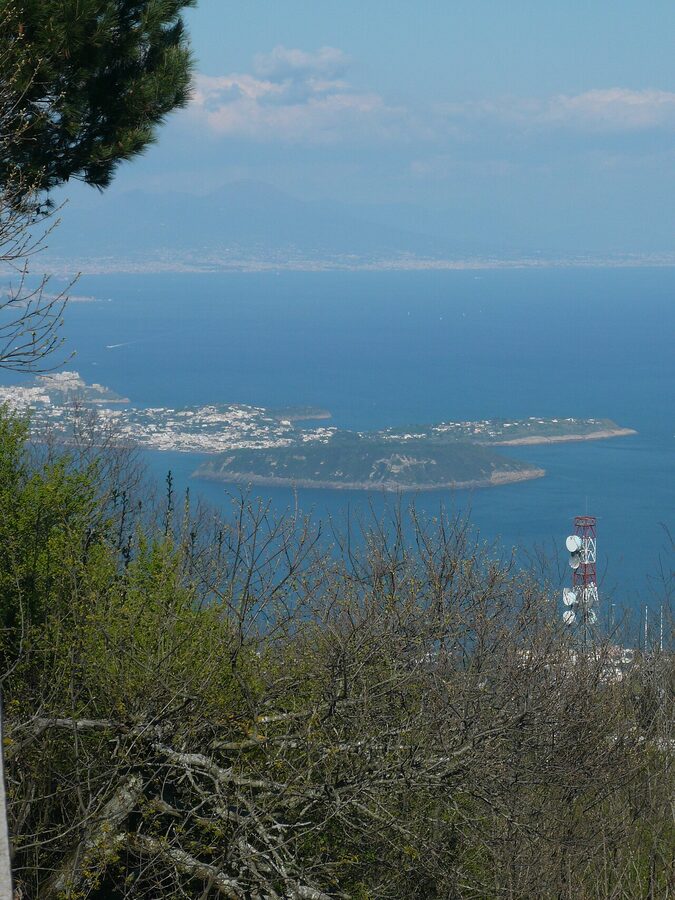
At the far southwestern end of Chiaiolella, a 100-metre footbridge crosses the narrow strait to the islet of Vivara, a 32-hectare nature reserve that forms part of the Procida comune but is essentially uninhabited. Vivara was the outer volcanic crater of the archipelago; the whole islet is the surviving rim. The reserve protects rare Mediterranean flora and is a stopover point for migrating birds (around 150 species pass through each year). Vivara is open to the public only by guided tour, booked in advance through the visitor centre, the tour runs about 2 hours, €10, ending with a walk up to the former hunting lodge of the Bourbon kings (Charles III made Procida a royal game reserve in 1744 and had the Vivara lodge built for deer hunting; it now houses a small natural-history museum). If you are on Procida in spring or autumn, book a Vivara tour; in July and August the reserve is often closed to visitors to protect nesting birds.
From Chiaiolella, the coastal path called the Via del Faro runs south along the cliffs to the 1870 Punta Pioppeto lighthouse, 25 minutes each way, good sunset walk. A small rocky swimming platform at the lighthouse base is the locals’ sunset spot.
Beaches
Procida has four meaningful beaches, which for an island of 4 km² is a lot.
Spiaggia della Chiaia, the main beach below Terra Murata on the eastern coast, reached by a steep staircase (about 180 steps) down from the Piazza dei Martiri. Dark volcanic sand, half public and half paid beach clubs, with the Terra Murata cliff rising directly behind. The water is clearer here than at the port-side beaches. This is the beach most day-trippers use.
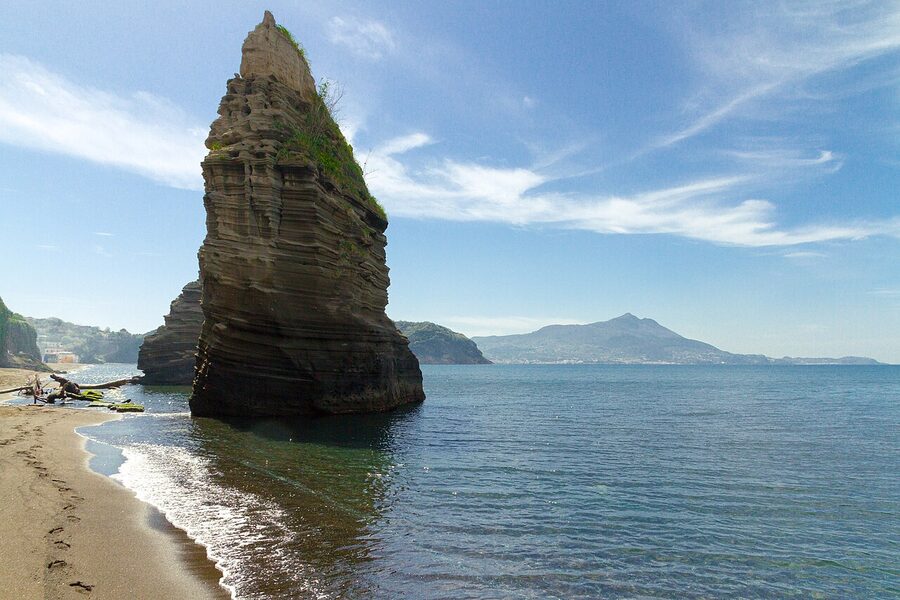
Spiaggia di Ciraccio and Spiaggia di Ciracciello, a single long beach on the western side of the island, split into two by a small rocky outcrop. Over a kilometre of dark sand, the longest beach on Procida, shallow water, family-friendly. Reached by bus to Chiaiolella and then a 10-minute walk north, or by direct path from Terra Murata (25 minutes). The Faraglioni di Ciraccio, two dramatic tuff sea stacks offshore, are the swimming landmark. Arrive before 11am on summer weekends for a good spot.
Spiaggia del Postino (officially Spiaggia di Pozzo Vecchio, known after the film as “the Postman’s beach”), the small pebble beach on the northeastern coast where Massimo Troisi’s character bicycled to meet Philippe Noiret’s Neruda in Il Postino. Reached by the bus L1 from Marina Grande or a 20-minute walk. Smaller than Ciraccio, usually less crowded, with the island’s most cinematic-feeling cove setting.
Spiaggia di Chiaiolella, the calm, shallow beach in the Chiaiolella bay itself. Best for children and for late-afternoon swims. The sunset view from the water looks straight across to Vivara.
Water temperature climbs through 20°C by May, peaks at 25-26°C in August, stays swimmable through mid-October.
Food, wine, hotels
Procidan cooking is close to Neapolitan but with two defining ingredients: the local lemons (huge, thick-skinned, almost sweet, the Limone di Procida is a recognised Slow Food presidium), and the lifelong family fishing tradition. The signature dish is insalata di limoni, a simple salad of peeled and sliced Procida lemons, dressed with olive oil, garlic, peperoncino, and a handful of mint and pecorino. It sounds strange; it works perfectly as a side to grilled fish. Other local dishes: coniglio all’ischitana (the rabbit preparation shared with Ischia), linguine al limone (pasta in a lemon-butter-anchovy sauce, developed specifically for Procida lemons), tortano (the Neapolitan Easter cheese-and-pepper bread ring that is still made fresh daily on the island), and any fish caught that morning from the Corricella fleet.
Restaurants to know:
Fammivento, Via Marina Corricella 39, the hidden Corricella classic, €35-45 per person, essentially the neighbourhood fish trattoria, book ahead in summer.
La Lampara, Via Marina di Chiaiolella 12, a beachfront seafood specialist on the Chiaiolella side, €45-60, their spaghetti alla procidana (with sea urchin) is the house classic.
Osteria La Farinella, up in the main town on Via Roma 18, the place the locals go, €25-35, classic Neapolitan-Procidan home cooking, no sea view and all the better for it.
Il Pirata, Via Marina Corricella 4, small, family-run, grilled fish and Procida wines, €30-40, excellent value for the location.
Chiaro di Luna, Via Salita Castello 14, just below Terra Murata, with a small roof terrace that gets the full sunset view; €40-55 for a dinner menu heavy on the local lemon-and-herb direction.
Coffee and granita: Bar del Cavaliere on Via Roma for the island’s best lemon granita; Bar Capriccio at Marina Grande for breakfast with ferry-watching.
Wine: Procida has a small indigenous wine tradition, mostly produced by Vigne del Pizzo Paolillo, a single family winery in the island’s interior that makes modest but genuinely distinctive whites from Biancolella and Forastera grown on tiny terraces cut into the old volcanic slopes. The winery is open for tastings by appointment. Most restaurants on the island carry both Paolillo wines and Ischia wines from Casa d’Ambra and Pietratorcia.
Hotels. The island’s hotel sector is small, about twenty hotels total, most with under 20 rooms, and the best-known are boutique conversions of old Procidan family houses rather than purpose-built hotels.
Top tier: La Suite Boutique Hotel (Via Flavio Gioia 81, €250-500, a converted 18th-century villa in the Terra Murata area, nine rooms, pool, outstanding restaurant); Hotel Terra Murata (Via Boscia 8, €200-400, a six-room guesthouse inside the walls of the citadel itself, the most dramatic location on the island).
Mid-range: La Tonnara Resort (Via Marina Chiaiolella, €150-280, 20 rooms, the largest proper hotel on the island, Chiaiolella beachfront); Hotel Celeste (Via Rivoli 6, €120-200, a long-established family-run hotel near Marina Grande); Casa Sul Mare (Salita Castello 13, €140-250, a small inn just below Terra Murata with direct views over Corricella).
Budget and alternative: Il Giardino delle Esperidi (€80-150, B&B with private garden near Chiaiolella) and various case vacanza (holiday apartments) through the Corricella quarter, the latter are often the best experience, staying directly in one of the painted fishermen’s houses. Look on the standard booking platforms for “Corricella apartment” or arrange through the local agency Procida Holidays.
When to visit
The season is similar to Ischia’s but slightly shorter at the shoulders because fewer hotels stay open year-round.
April-May: the single best window. The spring flowers on Vivara; the temperature warm enough for lunch on the Corricella quay; no crowds; the Good Friday Procession of the Mysteries (variable date, usually late March to mid-April) is the year’s major cultural event. Hotels open for Easter. Book for Easter weekend at least three months ahead.
June: sea warm enough to swim (21-22°C), all restaurants and hotels open, still manageable crowds. The weather is reliably warm and the light is the best of the year.
July-August: high summer. Procida fills up but is still less crowded than Capri or Ischia, the day-tripper numbers climb but the hotel capacity is so limited that most overnight visitors are Italian repeat customers. Ferragosto (15 August) is busy but nothing like Capri’s. The sea is at 25-26°C and the beaches at Ciraccio genuinely fill up by 11am; the Terra Murata walk is best done at dawn or after 6pm.
September: the second-best window. Weather still warm, sea still at 23°C into October, crowds drop after the 10th. The feast of St Michael the Archangel on 29 September is the island’s main religious festival outside Holy Week.
October: quiet, cool but swimmable until mid-month, prices drop 30-40%. Most restaurants still open, most hotels still open until the end of the month.
November through March: off-season. A handful of hotels stay open (roughly four or five); most restaurants close; Corricella empties out. Come for the genuine version of Procida, the fishermen’s island unalloyed, the weather cold but rarely below 10°C, bonfires in the quayside restaurants that stay open. The ferry schedule thins to about six a day, but it keeps running.
Before you go
Procida is a day trip for most visitors and an overnight for those who know what they are doing. Day-trip from Naples, Ischia, or the Amalfi Coast works: the ferry in, walk to Corricella, up to Terra Murata, lunch on the Corricella quay, ferry out. That will give you a good summary but will miss the thing that makes Procida distinctive, which is the evening and early morning, the light on Corricella at 7pm, the fishermen coming back at dawn, the Terra Murata walls with nobody on them after the last day-ferry leaves. One or two nights on the island is the right length.
The single thing most visitors underbook is dinner at Corricella. The quay restaurants fill up by 7pm in season; if you are planning to eat at Fammivento or Il Pescatore, book the day you arrive. The other thing most visitors skip but should not: the prison tour at Palazzo d’Avalos. It is one of the most unusual museum experiences in southern Italy, and the 2022 restoration has turned it into a genuinely impressive piece of cultural infrastructure.
For the other two Gulf of Naples islands, see the Capri guide (smaller than Ischia but more dramatic, and by far the most expensive) and the Ischia guide (largest and most varied, thermal-spa focused, a week-long destination). For mainland Campania context, see the Campania hub. The Procida ferry route from Pozzuoli makes it easy to combine the island with the Phlegraean Fields archaeological sites, Solfatara, Cumae, Baia, for a full day of volcanic-Gulf touring.
,_2016.jpg)
.jpg)
_from_Corricella_(1).jpg)
_2016_(2).jpg)


