Ravello sits at 365 metres above sea level on a promontory between the Dragone and Reginna Maior valleys, about seven kilometres up a twisting road from Amalfi. It has 2,400 residents, a single functioning main square, two late-medieval villas with Mediterranean-wide reputations, one 11th-century cathedral, the oldest outdoor music festival on the Amalfi Coast, and a particular ability to attract writers. Between roughly 1880 and 1960, Ravello was visited at length by Richard Wagner, Edvard Grieg, D. H. Lawrence, Virginia Woolf, E. M. Forster, André Gide, Igor Stravinsky, Tennessee Williams, Truman Capote, Gore Vidal, and Graham Greene. Wagner said it, in a marginal note in his diary during an 1880 visit: Klingsor’s magic garden has been found. He meant the Villa Rufolo, and he spent a fortnight sketching the second-act stage set of Parsifal from the garden railings.
That is the single fact that most distinguishes Ravello from its neighbours on the Amalfi Coast. Positano has the view and the beach. Amalfi has the history. Ravello has the reputation as the place where people come to write. Gore Vidal lived here from 1972 until 2006 at La Rondinaia — a villa on the cliff below Villa Cimbrone — and once said that Ravello had “the most beautiful view in the world, probably.” He was a difficult man to quote as a reliable narrator, but in this case he was not wrong.
The view he meant is the one from the Terrazza dell’Infinito at Villa Cimbrone — a belvedere lined with 18th-century marble busts, looking east over a 350-metre drop to the sea, with the coast of Calabria visible on clear days and the Gulf of Salerno opening below. The terrace is the single most photographed single view on the Amalfi Coast. It is also — unlike most such things — even better in person. The arrangement of the busts, the paved stone floor, the black-and-white checkerboard pattern pointing south, the rows of cypresses that line the approach — it is one of the great Italian 20th-century garden compositions, made by an English aristocrat in 1904 on the fabric of a 13th-century Ravello noble house, and it has been sitting there for a century in almost unchanged form.
That is what Ravello is. The rest of this guide is practical.
In This Article
Ravello in one paragraph
A hill town and comune at 365m elevation, 7.76 km² of municipal territory, 2,400 residents (2024). Province of Salerno. Seven kilometres by road from Amalfi, reached by an SITA bus (25 minutes) or the 1,500-step historic footpath through the lemon groves. Founded in the 5th century as a refuge from the barbarian invasions by people fleeing coastal settlements; raised to a bishopric by Pope Victor III in 1086; autonomous from Amalfi after 1081; part of the UNESCO-listed Amalfi Coast world heritage site since 1997. Patron saint Saint Pantaleon of Nicomedia; saint’s day 27 July (with the “miracle of Saint Pantaleon” — the liquefaction of the saint’s blood, same kind of phenomenon as the Naples San Gennaro miracle, same day every year). Demonym: Ravellese. Best known internationally for the two villas, the Ravello Festival, and the concentration of 19th- and 20th-century writers who lived or worked here.
Getting to Ravello
Three routes, all starting from Amalfi.
The SITA bus runs approximately every hour from the Amalfi waterfront (Terminal Flavio Gioia) up to the Ravello piazza (25 minutes, €1.40). The return direction runs the same. In summer, the bus is full; you often wait through one or two before boarding. A return ticket is worth getting — the main change to make in the last few years is that bus queuing at Amalfi now starts at 9am.
A taxi from Amalfi runs €30-40 one-way; from Positano, €100-120 because of the circuitous route; from Salerno, €60-80. For a group of three or four, the taxi is cost-competitive with the bus and much faster.
The walking route is the best option if you are reasonably fit. A signposted 4-km footpath climbs from Atrani (the tiny village immediately east of Amalfi) through lemon-grove terraces, up about 1,500 old stone steps in total, to arrive at Ravello through a back gate near the cathedral. The climb is strenuous — a 400m gain over 90 minutes to two hours — and should not be done in midday heat. Bring water. The reward is the route itself: you see the landscape in a way that driving or taking the bus cannot match, and the arrival at Ravello through a side gate rather than the main piazza is atmospherically the right way. Going down is about 75 minutes and much easier.
If you are coming directly from Naples or Rome without stopping in Amalfi, the practical approach is: train to Salerno → ferry or bus to Amalfi (25 minutes) → bus to Ravello. Transfer cars from Naples airport run €160-200 direct to Ravello.
Villa Rufolo and the gardens
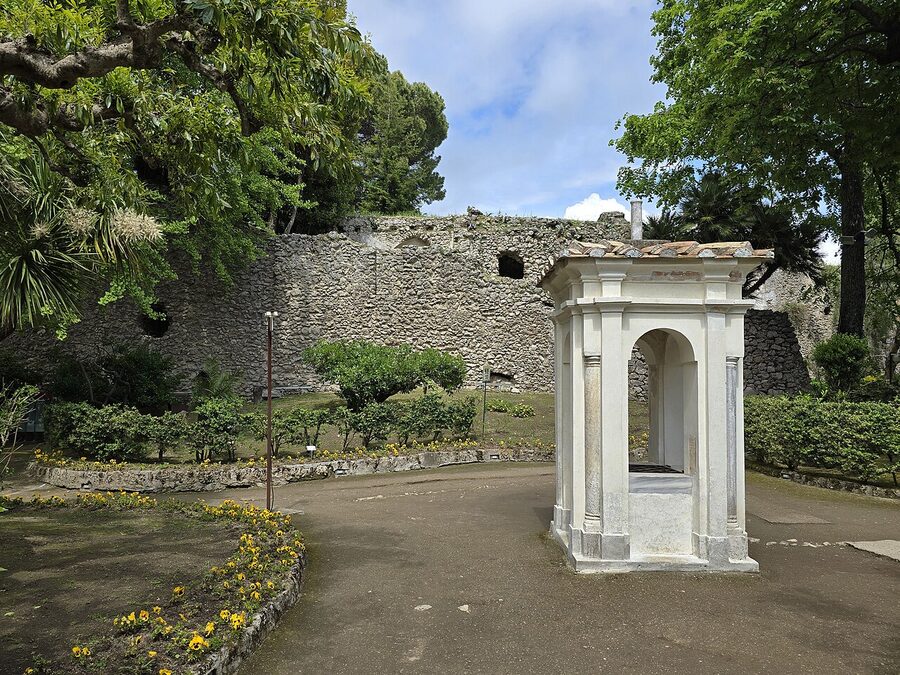
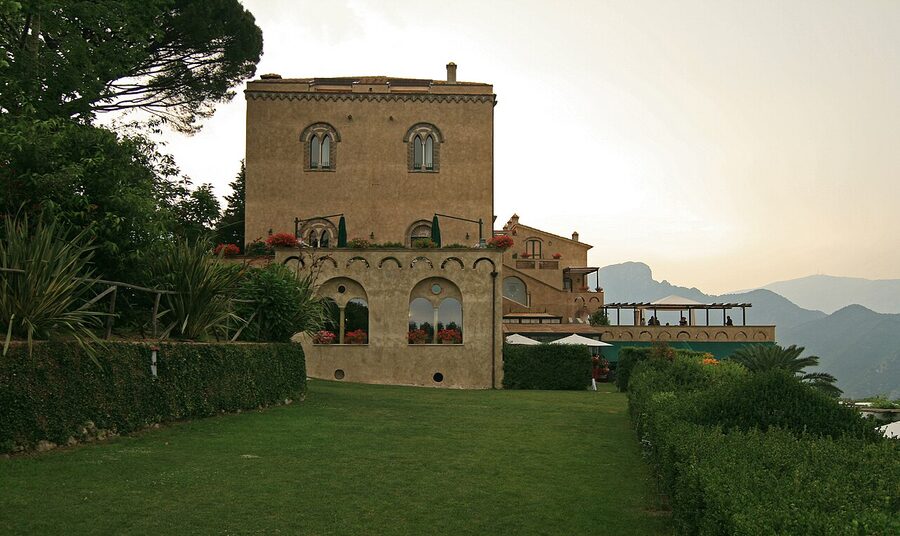
Villa Rufolo sits immediately off the cathedral square, entered through a 14th-century Moorish-style tower. It was built around 1270 by Nicola Rufolo, one of the richest merchants of the Duchy of Amalfi; his family lost its fortune in the 1283 Vespri Siciliani rebellion and the villa passed through various owners before falling into abandonment by the early 19th century. In 1851 it was bought by a Scottish collector named Francis Nevile Reid, who restored the buildings and laid out the gardens that are now the villa’s main attraction.
The architecture is an Arab-Norman composition — pointed arches on paired columns, polychrome stonework, intricate geometric floor patterns — contemporary with the Chiostro del Paradiso in Amalfi and clearly built by the same craftsmen. The 14th-century Torre Maggiore tower (the entrance gate) is climbable and offers the first of the Ravello views — north to Monte Cerreto, south over the Gulf of Salerno.
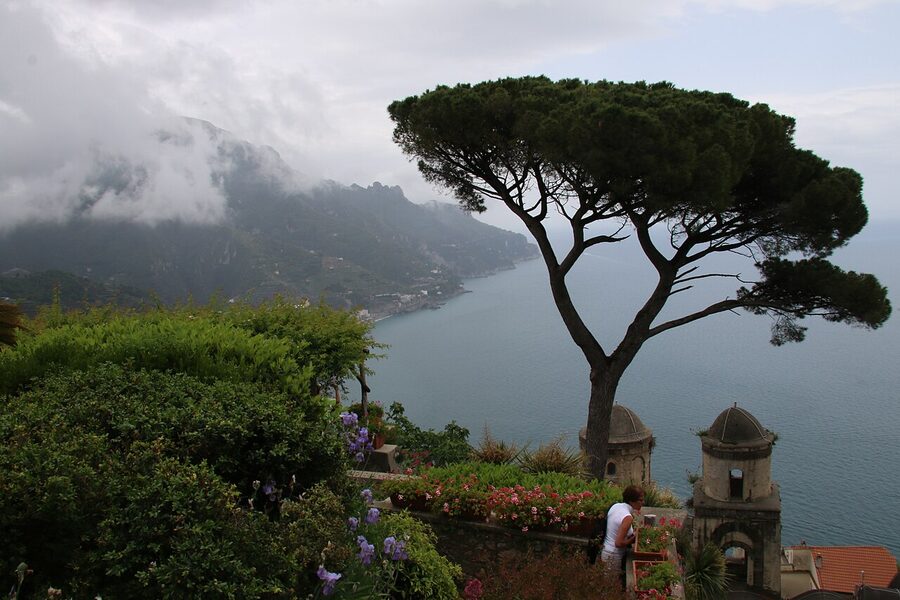
The lower garden is the famous one — a flat terrace projecting over the 350-metre drop, planted with flowerbeds in the Scottish-Italian garden hybrid style, anchored by an umbrella pine at the centre and a row of cypresses along the sea side. This is where the Ravello Festival stage is erected each summer: a temporary wooden platform, extended over the sheer drop, that turns the terrace into an outdoor concert hall with the Gulf of Salerno as the backdrop. Every program for the past 70 years has been performed on this stage.
The upper garden is the more botanical of the two — carefully composed with Mediterranean perennials and climbers, stone pergolas, water channels, and wrought-iron belvederes. A small greenhouse holds what the villa’s gardeners say is the largest collection of camellias on the Amalfi Coast. Between May and October, this is where you walk first if you want solitude — the lower terrace gets most of the visitors.
Practical information: entry €8, open 9-20 in summer and 9-17 in winter. You can walk through the gardens in 45 minutes; allow 90 minutes if you want to explore the tower and the main villa halls. The villa is also used for small exhibitions (contemporary Italian art in summer, regional historical shows in winter) included in the ticket.
Villa Cimbrone and the Terrazza dell’Infinito
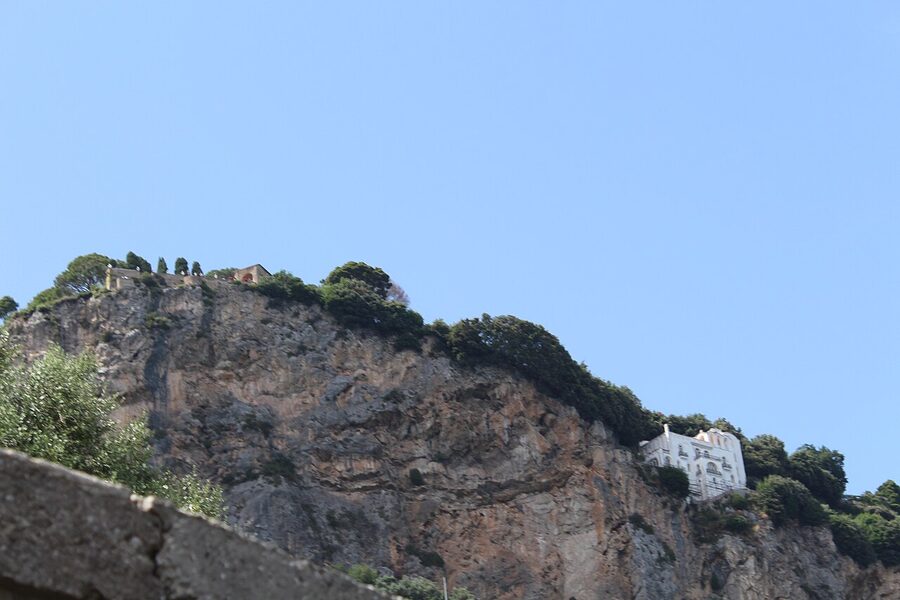
Ten minutes’ walk from the main square, along a quiet paved lane through the town’s residential quarter, a large 14th-century limestone gateway opens into Villa Cimbrone. The medieval core is a Rufolo-era building that was abandoned by the 17th century and restored between 1904 and 1917 by the Englishman Ernest William Beckett, 2nd Baron Grimthorpe — an Edwardian-era aristocrat, member of the Souls circle in London, and lover of Alice Keppel (Edward VII’s mistress and great-grandmother of Camilla Parker Bowles).
Beckett’s restoration is what you see today. He brought in an English landscape architect, acquired statues from all over Italy (most of the marble busts in the belvedere came from estate sales of old Roman families during the post-Risorgimento period when many aristocratic collections were being dispersed), and designed the gardens as a deliberate sequence of experiences — the long axial allée through formal plantings, the sequence of open and closed rooms among the cypresses and camellias, the grotto at the lower end with a statue of Venus, the Temple of Bacchus with its view southwest over Positano, and finally the main set piece: the Terrazza dell’Infinito.
The terrace is 80 metres long, paved in local limestone, open on three sides, with the fourth closed by the main villa wing. The far edge is a stone balustrade and then a sheer drop to the sea. The busts are arranged along the long sides facing inward, 14 on each side plus 2 at the far end, 30 in total. They are 18th-century Roman copies of earlier classical originals, purchased by Beckett around 1905 from a Roman dealer; their individual attributions are mostly speculative. The arrangement — busts facing inward rather than outward, which is unusual for a belvedere — creates a kind of formal processional that the visitor walks between, looking at heads on one side and the sea on the other.
Come at sunset. The angle of the light against the east-facing busts is the reason the photograph of this place is the canonical photograph. Arrive by 6pm in summer, 5pm in winter. Allow 45 minutes on the terrace itself, plus another hour for the rest of the garden, plus time at the Cimbrone cafe in the crypt (one of the few Ravello cafés where you can sit with a book for an afternoon). Entry €10, open 9-20 in summer, 9-18 in winter. The hotel upstairs (which operates as a Relais & Châteaux property) is worth mentioning separately; see accommodation below.
The Duomo di Ravello
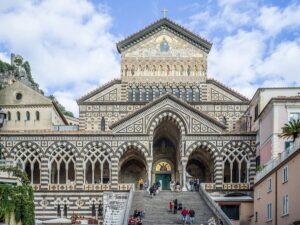
On Piazza del Duomo, across from the Villa Rufolo entrance, stands the 11th-century Cathedral of Santa Maria Assunta. The church was founded in 1086, the year Ravello became an independent diocese; it has been in continuous use since. The facade is 18th-century baroque over the original Romanesque front. The bell tower (12th-13th century) is Arab-Norman. The main bronze doors — on the central arch — were cast by Barisano da Trani in 1179, with 54 inset figural panels, and are contemporary with the same artist’s door cycles at Trani and Monreale. They are, along with the Monreale doors, arguably the finest Norman-era bronze doors in southern Italy.
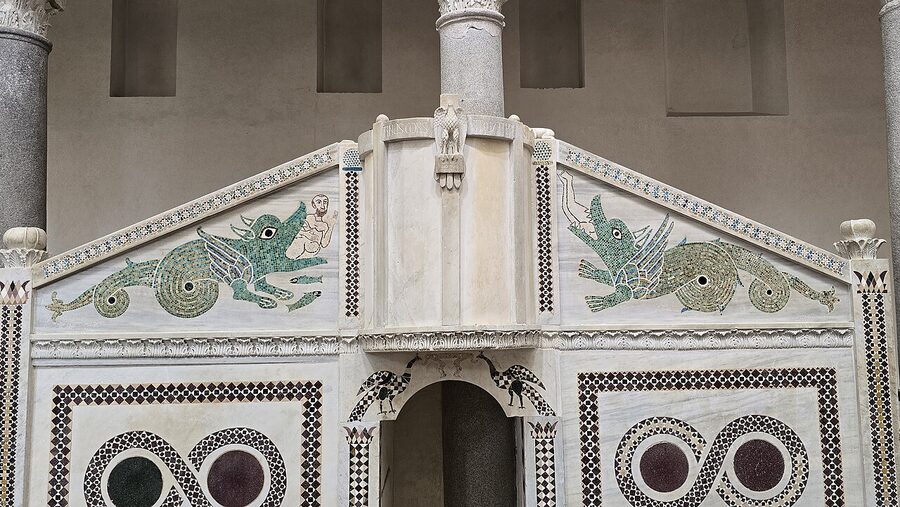
Inside, the single most important object is the Pulpit of the Gospels — commissioned by Nicola Rufolo (the same Rufolo who built Villa Rufolo) and executed by Nicolò di Bartolomeo of Foggia in 1272. The pulpit stands to the right of the central nave, supported on six spiral columns that rest on the backs of six marble lions. The columns are inlaid with mosaic; the pulpit itself is carved in relief with a remarkable 13th-century portrait of Sigilgaita Rufolo (Nicola’s wife) on one of the main panels — the face is realistic to the point of being almost contemporary, which was unusual in Romanesque sculpture and is one of the earliest examples of realistic individual portraiture in Italian art.
On the left side of the nave is the smaller Pulpit of San Pantaleone, late 11th or early 12th century, with a simpler geometric design and four marble columns. The cathedral’s patron, Saint Pantaleon, is represented in the crypt-chapel; his vial of dried blood liquefies every 27 July — the town’s main annual miracle, same phenomenon as San Gennaro in Naples, and documented since at least the 13th century.
Entry is free to the cathedral itself; €3 to the small Museo del Duomo in the crypt, which holds fragments of medieval frescoes, liturgical items, and a set of Byzantine ivories the republic acquired during the 11th century.
The town — Piazza Duomo and walking
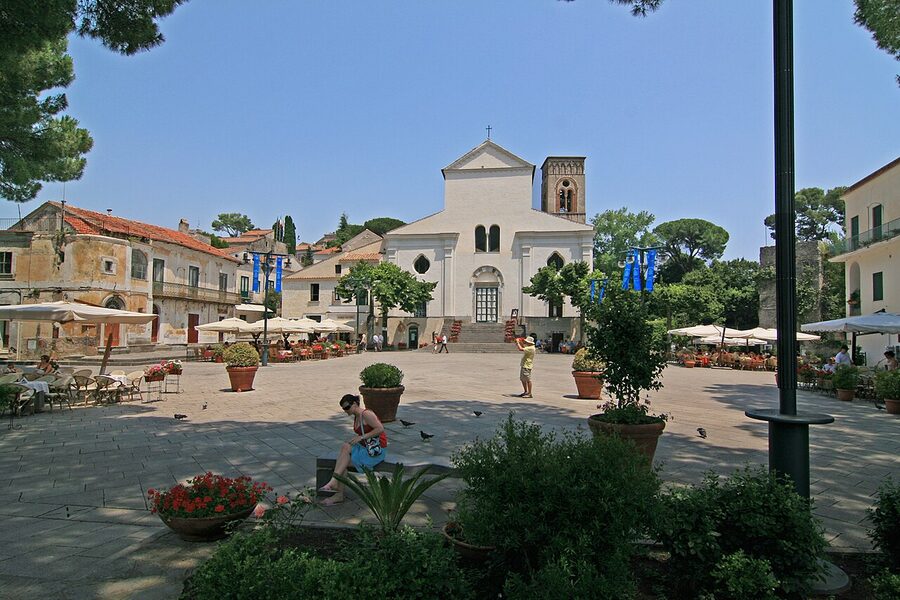
Ravello is very small. The entire town can be walked end to end in fifteen minutes. Piazza Duomo is the working centre — about 60 metres square, with the cathedral on one side, Villa Rufolo’s gateway on another, a clutch of cafés (Caffè Calce has been there since 1830, classic espresso and the best granita in the town) and the small bookshop Libreria Bohemia on the third, and the town hall on the fourth. In summer evenings, the SITA bus arrivals from Amalfi disgorge onto the square every half hour and for about 90 minutes the square fills up; it empties again around 7pm when the last bus for Amalfi leaves and the day-trippers have gone.
From Piazza Duomo, four streets radiate out: north to Villa Cimbrone; east along Via Annibaleanesio to the small satellite church of San Giovanni del Toro (12th century, with an excellent pulpit by the same Nicolò di Bartolomeo school as the cathedral’s, free entry); south to the residential quarter and Villa Cimbrone’s back entrance; and west down Via Roma, the town’s main commercial street.
Via Roma is the Ravello shopping axis — which is to say four ceramic boutiques, two artisanal food shops, and one excellent bookshop specialising in books about the Amalfi Coast. The ceramic boutiques to know are Ceramiche di Ravello (Via della Marra 4, run by the Picciariello family since 1936) and Cosmolena (Via Annibaleanesio 12, specialises in lemon-pattern designs). The food shops: Profumi della Costiera (Via Trinità 37, the premium Amalfi Coast limoncello, also good lemon-peel biscotti and savoury taralli); Gran Caffè on Via Roma for delizia al limone.
Beyond Villa Cimbrone, a 10-minute walk through olive terraces leads to the village of Torello — a small Ravello satellite with its own church (Santa Maria di Gradillo, 11th century, Arab-Norman on a smaller scale than the Duomo), a winery (Ettore Sammarco, Ravello’s only wine producer, tasting €15), and a single trattoria (Cumpà Cosimo, €40 per person, book ahead). The walk back to Ravello is another 10 minutes. This is the half-hour detour I would make after Villa Cimbrone.
The Ravello Festival
The Ravello Festival runs from early July to late August on the Belvedere of Villa Rufolo, with a programme of concerts, ballet, choral music, and occasional jazz. The festival was founded in 1953 — in 2023 it celebrated its 70th anniversary — and is the oldest established music festival on the Amalfi Coast. It was conceived to celebrate the Ravello connection with Wagner and the centenary of Wagner’s death (which fell on 13 February 1883). Early festival programmes were Wagner-heavy; contemporary programming is broader.
The experience: orchestra and soloists on a temporary wooden stage extended over the 350-metre drop, audience seating arranged in a single tier on the terrace behind the orchestra, the Gulf of Salerno opening below, sunset during the concert (most start at 7:30pm in July, 7pm in August). When the programme calls for a large orchestra (the Mahler cycles are famous here), the stage extension is doubled. A 25-minute extension of the stage is built in front of the Villa’s conventional entertainment area. Tickets are €30-150 depending on the night and the programme; the annual festival opening (always a Mahler symphony) is the most expensive and books six months in advance.
The programme also includes chamber music afternoons in the Duomo cloister, and — a recent addition — dawn concerts at 5am on the terrace, facing east to catch the sunrise as the first movement ends. These are the most oversubscribed tickets in the festival. If you are staying in Ravello during July or August, book something — anything — as early as possible. The festival website is ravellofestival.com.
Food and where to eat
Ravello’s restaurant scene is small and competitive. The hotels are the serious tier; the town restaurants are good but fewer than you might expect. Five places I would recommend:
Rossellinis at Palazzo Avino (Via San Giovanni del Toro 28, Michelin two-star since 2020, tasting menu €180, à la carte €110+) is the reference high-end restaurant in Ravello — regional seafood and Amalfi Coast vegetables handled with total precision. Reserve 14 days ahead.
Il Flauto di Pan at Villa Cimbrone (Via Santa Chiara 26, one Michelin star, €140 tasting, €80 à la carte, in the converted crypt of the villa) is the atmospheric choice — low-ceilinged, candlelit, with slightly more adventurous cuisine than Rossellinis. Book through the Villa Cimbrone reception.
Cumpà Cosimo (Via Roma 44, €45 per person, owned and cooked by the Bottone family since 1929) is the mid-range classic — heavy wood beams, an open kitchen, hand-rolled scialatielli and a famously large wine list with serious Tramonti reds (Amalfi Coast’s mountain wines — see the Amalfi guide). The family’s matriarch, Netta Bottone, was a well-known figure in the Italian culinary world; her grandchildren still run the kitchen.
Da Salvatore (Via della Repubblica 2, €55-70 per person, lunchtime terrace looking south over the Gulf of Salerno) is the panoramic-view option — the location is the point, but the kitchen is competent and the ingredients are local. Book for a clear afternoon.
Pizzeria Garden (Via Chiunzi 23, €12 for a pizza, on a terrace with a west view toward Positano) is the cheap-and-cheerful option when you want a pizza with a view and don’t want to pay Ravello’s luxury-restaurant prices. It is genuinely excellent pizza.
For pastry: Gran Caffè on Via Roma (delizia al limone €3.50, babà al limoncello €4, good espresso); Caffè Calce on Piazza del Duomo (granita al limone with fresh pineapple, €5). For wine tasting: the Ettore Sammarco winery in Torello (see walking section above) is the only Ravello producer; a 90-minute tasting with light food is €25.
Where to stay
Ravello’s hotels are the concentrated high end of the Amalfi Coast — per capita, Ravello has more Michelin-starred restaurants and five-star hotels than anywhere else in Italy outside the Lake Como ring. Four tiers:
Landmark luxury (€1,200-3,500/night). Palazzo Avino (Via San Giovanni del Toro 28, a 12th-century palazzo turned hotel, on the cliff with a private beach accessible by a funicular — the only hotel in Ravello with beach access); Hotel Caruso (Piazza San Giovanni del Toro 2, Belmond Group, the landmark 19th-century grand hotel where Greta Garbo went to hide in 1938, pool with the Amalfi Coast view on every poster of the region); Belmond Hotel Caruso (the same hotel; it rebranded in 2008 under Belmond and the new name is technically what’s on the sign); Palazzo Sasso (now the Palazzo Avino; same building, different owner).
Upper-mid (€500-800). Hotel Rufolo (Via San Francesco 1, 35 rooms, owned and managed by the Schiavo family since 1919, the longest continuously family-owned hotel on the Amalfi Coast, excellent pool with view); Hotel Villa Maria (Via Santa Chiara 2, 23 rooms, smaller and quieter, better value at the upper end); Hotel Villa Cimbrone (the villa itself operates as a Relais & Châteaux hotel, €800+, only 19 rooms and you will have to book six months ahead, but the experience of being in Villa Cimbrone after hours is the single most extraordinary lodging experience on the Amalfi Coast).
Mid (€250-450). Hotel Toro (Viale Trinità 16, 10 rooms in a converted 16th-century palazzo, genuinely friendly family hospitality, one of the quietest options); Villa Amore (Via dei Fusco 5, 7 rooms, 19th-century villa with a garden, the best value-for-view option in Ravello); Hotel Parsifal (Via G. d’Anna 5, 18 rooms, named for the Wagner connection, 15th-century convent-building with a terrace).
Budget (€120-200). Hard to find in Ravello proper; consider Albergo Ristorante La Moresca (Via Roma 1, €140-180, six rooms above the restaurant), or B&B Villa Casale (Via della Marra 32, €110-170, four rooms). Off-season these prices drop by 40-50%.
Day trips from Ravello
Ravello is itself often done as a day trip from Amalfi or Positano. In reverse, it also works well as a base for the central Amalfi Coast.
Amalfi, 25 minutes downhill by SITA bus (€1.40), more interesting on foot via the 1,500-step path. Do the Duomo and Chiostro del Paradiso; walk the Paper Museum; eat lunch on the waterfront. Half-day.
Positano, 70 minutes by SITA bus or 35 minutes by taxi (change at Amalfi). Full day. The cliff-hanging visual counterweight to Ravello’s mountain perch.
Atrani, immediately next to Amalfi and one of the walking-path stops on the way down — the Amalfi Coast’s smallest commune (800 residents) and, in my view, its most atmospheric small village. Lunch at A’ Paranza (Traversa Dragone 1, €35-45 per person).
Minori and Maiori, 25-35 minutes east by bus. Minori has a 1st-century Roman imperial villa with mosaics (€4, 30 minutes) and Sal De Riso’s famous pastry shop (the best delizia al limone on the coast, also excellent gelato). Maiori has the Amalfi Coast’s longest beach (800 metres) and is the cheaper-and-better-than-Positano beach day.
The Sentiero degli Dei — start at Bomerano, end at Nocelle, about three to four hours of walking on a cliff-top trail with views back to Ravello the entire time. The best half-day out of any Amalfi Coast base.
Vietri sul Mare, 35 minutes east, Amalfi Coast’s ceramic capital — about 30 small ateliers, the biggest being Solimene, with a remarkable 1950s Paolo Soleri building.
Salerno, 50 minutes east, the regional hub city. The Duomo of Salerno has an intact 11th-century atrium with 28 ancient Roman columns; the Museo Diocesano has a set of ivory panels from 1085-1100 considered the finest Norman-era ivory work in Europe. Half-day.
When to visit
May, early June, September, and October are the windows. The Ravello Festival runs July-August — if you are coming for the festival, you book around the festival; if you are not, avoid those two months. Weather is warm and consistent from mid-June through mid-October; the cypress avenues of Villa Cimbrone and the flower beds of Villa Rufolo are at their photographic best in early-to-mid May (wisteria, bougainvillea, camellias still in bloom) and mid-September (summer perennials plus the first Mediterranean light change).
Winter (November through March, excluding Christmas week) is quiet and the town takes on its local character. About half the restaurants close for the low season; the festival is of course dormant; Villa Cimbrone closes in January for winter maintenance. The Villa Rufolo gardens stay open year-round. Hotels drop to 40-50% of peak prices. The town is genuinely underused in winter, and if you want a three-night literary retreat in an Italian hilltown that still has good restaurants and a working bookshop, Ravello in February is a genuinely compelling option.
The feast of Saint Pantaleon on 27 July is the big annual religious event (liquefaction of the saint’s blood, processions, fireworks). The Wagner Festival — a subset of the main Ravello Festival specifically devoted to Wagner programming — runs in late July and is an institution in itself. The Concerto all’Alba — the dawn concert — happens once a year in early August on the Villa Rufolo belvedere at 5am, with a Mahler symphony or equivalent starting before sunrise and finishing as the first light hits the Gulf of Salerno. This is one of the great single experiences in European classical music.
Before you go
Ravello is small enough to cover in a single afternoon — Villa Rufolo, Duomo, Villa Cimbrone — but rewards staying. The standard day-trip pattern from Amalfi (bus up at 10am, three hours in town, bus back at 1pm) gets you the structural highlights and misses nearly everything else: the Ettore Sammarco winery, the walk to Torello, the San Giovanni del Toro pulpits, the crypt cafe at Cimbrone, the Ceramiche di Ravello workshops, the sunset from the Terrazza dell’Infinito, the post-dinner walk back along Via Santa Chiara in the dark. For a town of 2,400 people at 350m above the sea, Ravello packs an unusual amount of rewarding stuff into a small footprint. Treat it as a two- or three-night stop, not as a bus day.
My single recommendation: spend one evening at the Terrazza dell’Infinito from about 45 minutes before sunset until the lights come on along the coast. If the Ravello Festival is on, go to whatever concert is running — the physical fact of a symphony being played on a platform suspended over the sea is the thing the Amalfi Coast has that no other Italian location has. If you are here for a quieter trip, have dinner at Cumpà Cosimo and walk back to the square by the lit-up side streets.
For wider context, see the Campania hub. For the other Amalfi Coast towns, see Amalfi (the maritime republic town below Ravello, reached by 25-minute bus or 90-minute walk) and Positano (the cliff-hanging village 40 minutes west along the coast).