

Herculaneum is the smaller, more obscure, and — by a significant margin — better-preserved twin of Pompeii. It was a coastal town of about 4,000 to 5,000 residents on the Bay of Naples, 11 kilometres northwest of Pompeii itself, whose ruins now sit 20 metres below the level of the modern town of Ercolano built directly on top of them. The site is 20 hectares of excavated ground, less than a third of Pompeii’s size, with about 75% of the original ancient city still deliberately unexcavated beneath the modern apartment blocks of present-day Ercolano. You can walk the entire exposed site in 2-3 hours. You can look at every house, every shop, and every fresco in 6 hours. You cannot do this at Pompeii.
The specific thing that makes Herculaneum different is not the size — it’s the preservation. Pompeii was buried by four metres of falling pumice and ash over 18 hours; the pumice compressed over the centuries, and most organic material (wood, fabric, food, roofing) eventually rotted and disappeared. Herculaneum was hit, on the second day of the eruption, by a series of pyroclastic surges — ground-hugging flows of 500°C superheated gas and ash, moving at about 100 km/h. The surges buried Herculaneum under 20 metres of volcanic material that hardened into a dense tufaceous rock, and the heat of the arriving gas did two things: it killed everyone instantly, and it carbonised organic material rather than burning it. What this means in practice is that Herculaneum has preserved wooden doors, wooden beams, wooden staircases, wooden boat hulls, wooden furniture, loaves of bread, fig and fava bean stores, papyrus scrolls, and the actual fabric of clothing. The frescoes are brighter because less moisture reached them. The upper floors of many buildings survived, which at Pompeii almost never happened. The skeleton of a horse still stands tethered in one garden. None of this exists at Pompeii.
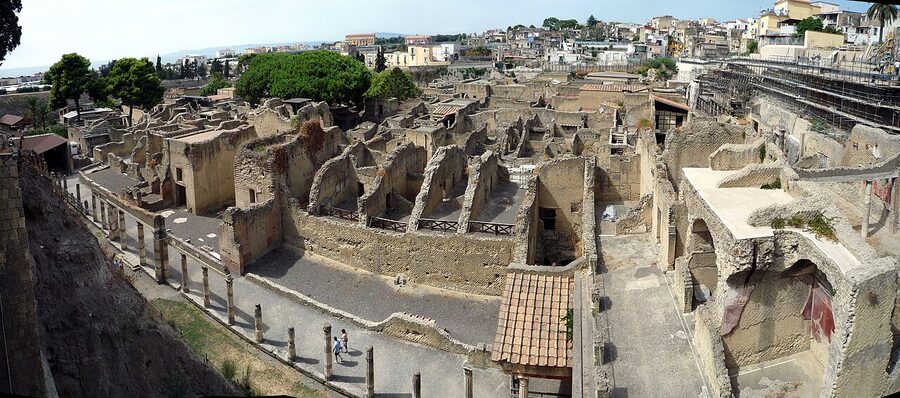
The other specific thing is that the modern town of Ercolano is directly on top of the ancient one. When you descend the 20-metre ramp from the visitor entrance into the excavated area, you are walking down into a time layer below the city above. When you look up from the ancient streets, you see modern Ercolano’s apartment buildings, washing lines, and the occasional Vespa parked at the edge of the excavation cliff. The visual effect — present directly above past, with the 1800-year gap made horizontal — is not quite like any other archaeological experience.
If you are doing Pompeii, you should be doing Herculaneum too. The two sites tell different halves of the same story, and most visitors miss the more rewarding half.
In This Article
- Herculaneum in one paragraph
- Getting to Herculaneum
- Herculaneum before the eruption
- The eruption — and how it hit Herculaneum differently
- What survives that Pompeii doesn’t
- The Villa of the Papyri
- The main tour — what to see in three hours
- Excavation history — the tunnels, the Bourbons, the present
- Herculaneum and Pompeii — which to see, in what order
- Practical — tickets, timing, what to bring
- Eating and where to stay in Ercolano
- When to visit
- Before you go
Herculaneum in one paragraph
Roman coastal town buried by the 79 AD eruption of Mount Vesuvius on the second day of the disaster, under roughly 20 metres of pyroclastic material. Pre-eruption population 4,000-5,000. Excavated area 20 hectares (of about 80 total in the original city); 75% still deliberately unexcavated. Sits directly under the modern town of Ercolano (pop. 52,000), which is 15 minutes east of Naples on the Circumvesuviana line. Rediscovered in 1709 by Emmanuel Maurice de Lorraine (Prince d’Elbeuf); regular excavations begun under Charles III of Bourbon in 1738. UNESCO world heritage site since 1997, together with Pompeii and Torre Annunziata. Contemporary site management: Parco Archeologico di Ercolano (ercolano.cultura.gov.it). Entry €16; 5 days €22 combined with the Pompeii + Boscoreale + Oplontis “Parco Campano” ticket.
Getting to Herculaneum
Thirty-five minutes from Naples on the Circumvesuviana train. Get off at Ercolano Scavi, walk downhill for 500 metres along a pleasant lemon-shaded street, and you reach the main gate of the archaeological park. The same train continues to Pompeii and Sorrento if you want to combine. From Sorrento, the reverse direction takes 30 minutes to Ercolano Scavi.
From Amalfi or Positano on the coast, the route is SITA bus to Sorrento, then Circumvesuviana to Ercolano Scavi — about 90 minutes total. From Ravello, add 25 minutes for the Amalfi bus connection.
Driving is possible but inconvenient. The Ercolano exit on the A3 Naples-Salerno autostrada drops you near the town; parking is on narrow residential streets, mostly paid, and full by 10am in season. The private lots near the archaeological entrance charge €8-10/day. If you have a rental car and are going to both Herculaneum and Vesuvius, the car makes sense — there is a dedicated Vesuvio Express shuttle bus from Ercolano Scavi station to the Vesuvius crater road (€20 round-trip, 45 minutes each way, four departures per day).
Single-day combination. The Ercolano Scavi station is also where you start the Vesuvius climb. A realistic full day: Herculaneum in the morning (arrival 9am, 3-4 hours on site), lunch in Ercolano town, Vesuvius in the afternoon (Vesuvio Express 1pm, back by 5pm). If you want to combine with Pompeii in the same day, pick one for the morning and one for the afternoon — both together in a single day is a physical endurance test that leaves you missing most of each.
Herculaneum before the eruption
Herculaneum’s origins are Greek-influenced Italic. According to Strabo the town was founded by the Oscan-speaking Osci people and then passed to the Etruscans, the Pelasgians, and the Samnites in succession. The mythology claims Hercules founded the town on his return from his eighth labour — hence the Latin name Herculaneum. It became Roman in 89 BC, when the Social War resulted in Italian allies being granted full Roman citizenship, and was refounded as a municipium around 80 BC.
At the time of the eruption, Herculaneum was a smaller, wealthier version of Pompeii. Where Pompeii was a genuine commercial town with wine trade, textile production, garum factories, and a mixed-class population of 11,000-12,000, Herculaneum was a select coastal resort with about 4,000-5,000 residents — mostly the families of Neapolitan aristocrats with summer houses, plus the servants, merchants, and fishermen who served them. The city’s north-south axis ran down a gentle slope toward the harbour, with the wealthy residential quarter closest to the sea. The ancient shoreline in 79 AD was about 400 metres further inland than the modern coast — the pyroclastic flow deposits pushed the sea out.
Herculaneum was a smaller grid than Pompeii’s — about nine cardines (north-south streets) crossed by three decumani (east-west streets), with the forum at the intersection of the main decumanus and the main cardo. The excavated area you visit is mostly the southern third of the city, including the forum, the theatre, the main residential quarter, and the boathouse arcades at the ancient shoreline. The theatre, the basilica, and the upper residential quarters are mostly still buried.
The eruption — and how it hit Herculaneum differently
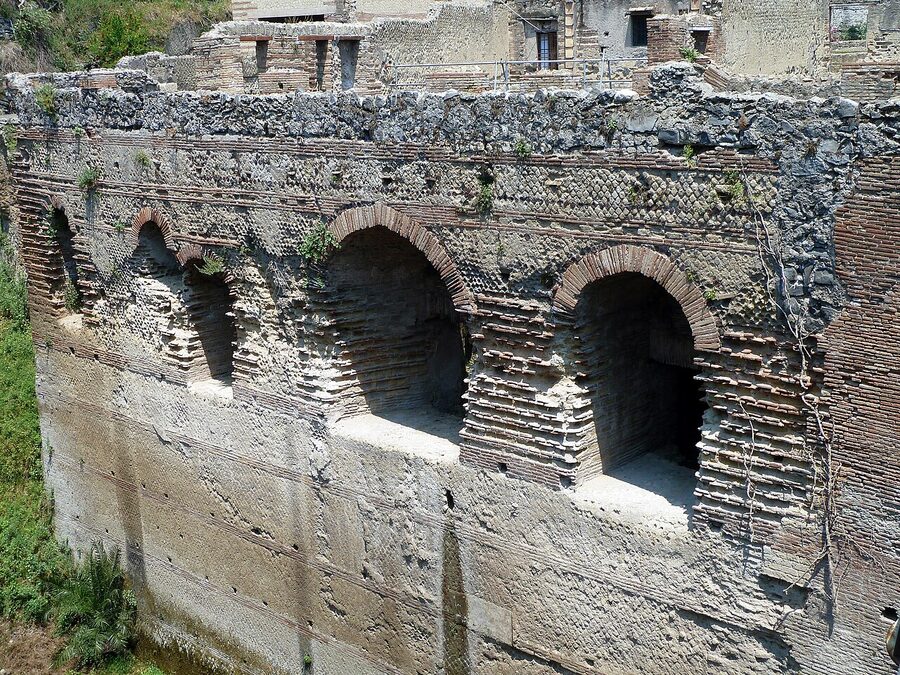
The timing of the eruption is covered in detail in the Pompeii guide; the short version is that it started on the morning of (probably) 24 October 79 AD. Herculaneum, being closer to the volcano and on the northwest side, was hit differently from Pompeii. Almost no pumice fell on Herculaneum during the first day — the prevailing winds pushed the ash column south toward Pompeii. On the first afternoon, the residents of Herculaneum could see Vesuvius erupting but their own town was unaffected. Many evacuated by sea to Misenum or elsewhere in the bay; the ones who didn’t evacuate took shelter in the stone-vaulted boathouses at the ancient shoreline, hoping to be rescued by boat.
At about 1 AM on the second day, the first pyroclastic surge reached Herculaneum. The surge was a ground-hugging flow of 400-500°C superheated gas and ash, moving at about 100 km/h. It killed everyone in the town within seconds — the temperature was high enough to boil the brain tissue inside the skulls and to vaporise blood. Subsequent surges, six of them over the next four hours, buried the city under 20 metres of volcanic material.
The boathouse skeletons are the single most affecting thing at Herculaneum. In 1980-1982, excavations at the ancient shoreline found about 300 skeletons crammed into twelve stone-vaulted arcades — families who had fled to the water’s edge hoping to escape by boat, and who were killed instantly when the first surge arrived. The skeletons were discovered in the positions they died in: adults shielding children with their bodies, couples embracing, individuals in postures of panic. About 100 skeletons have been carefully studied; recent DNA analysis (2020-2024) has identified extended family groups, confirmed estimated ages and genders, and in some cases identified diseases the victims were suffering from at the time of death. The skeletons are displayed in situ in the boathouse arcades, protected by glass panels but visible to visitors. This is Herculaneum’s equivalent to Pompeii’s Garden of the Fugitives, and it hits harder because the skeletons are real rather than plaster casts.
Elsewhere in the town, the 2007-2016 Herculaneum Conservation Project identified over 300 additional sets of human remains in the streets and houses, suggesting a death toll closer to the entire 4,000-5,000 population than the thousand-or-so commonly cited. Most of these people did not make it to the boats.
What survives that Pompeii doesn’t
The preservation difference is the point of visiting Herculaneum. Eight specific things survive here that are either absent at Pompeii or survive only in fragmented form:
Wood. Wooden doors, wooden shutters, wooden staircases, wooden roof beams, wooden partitions between rooms, wooden serving counters in bars, wooden shop shelves, wooden cupboards. The House of the Wooden Partition still has its carbonised wooden folding screen in the original opening. The Casa del Bicentenario has its upstairs bedroom preserved with the wooden bed frame and wooden chest of drawers still in place. Almost none of this kind of survival exists at Pompeii.
Upper floors. At Pompeii, the weight of the pumice mostly collapsed upper stories. At Herculaneum, the hot pyroclastic flow compressed but did not crush — the second-storey rooms of many houses are preserved, sometimes with their original frescoes, shelf systems, and furnishings.
Fabric. Several houses contain textile survivals — a basket of wool spinnings, a fabric awning, strips of dyed linen used as room dividers. These are mostly displayed at the nearby Museo Archeologico Nazionale (Naples), but about a dozen pieces are in situ in the houses themselves.
Food. Carbonised bread loaves in ovens, intact fig harvests, amphorae of wine and garum with residues identified by modern analysis, a set of eight carbonised eggs in a kitchen cupboard. The Casa del Tramezzo di Legno kitchen has its carbonised food stores still on the shelves.
Fresco brightness. The carbonising heat was less destructive of pigment than Pompeii’s wet ash burial; Herculaneum’s frescoes retain more of their original colour. The House of the Deer (Casa dei Cervi) and the Casa dell’Atrio a Mosaico have fresco cycles that make the equivalent Pompeian examples look faded by comparison.
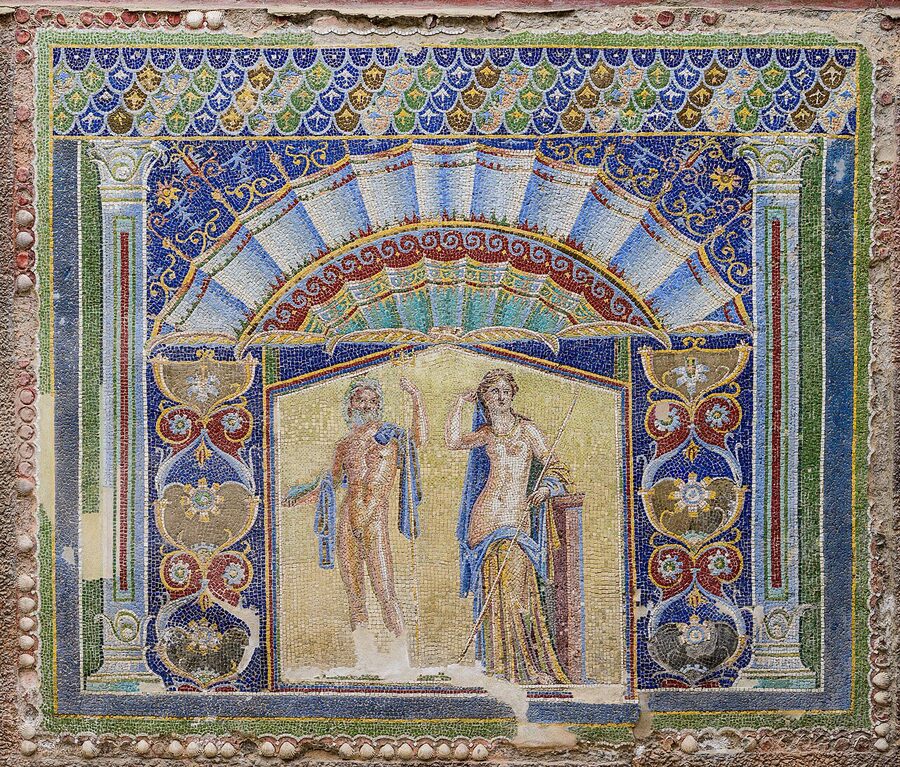
The Neptune and Amphitrite mosaic. The most famous mosaic at Herculaneum is not on a floor — it is on the back wall of the summer dining room in the House of Neptune and Amphitrite. A glass-mosaic technique (rather than stone-tile mosaic) used only on walls, only briefly, and almost nowhere else preserved. The colours — blues, greens, gold, copper red — are as intense as they were on the morning the owners last saw them.
A Roman boat. A wooden sailing boat, 9 metres long, was found carbonised and intact on the ancient shoreline during the 1982 excavations. It is now in the Antiquarium building at the site entrance. The only surviving Roman-era Mediterranean merchant vessel from the Classical period.
A horse. The skeleton of a saddled horse was found tethered in the garden of the Casa del Colonnato Tuscanico. It is still there. The tether rope itself is not, but the horse is still tied to the post.
The Villa of the Papyri
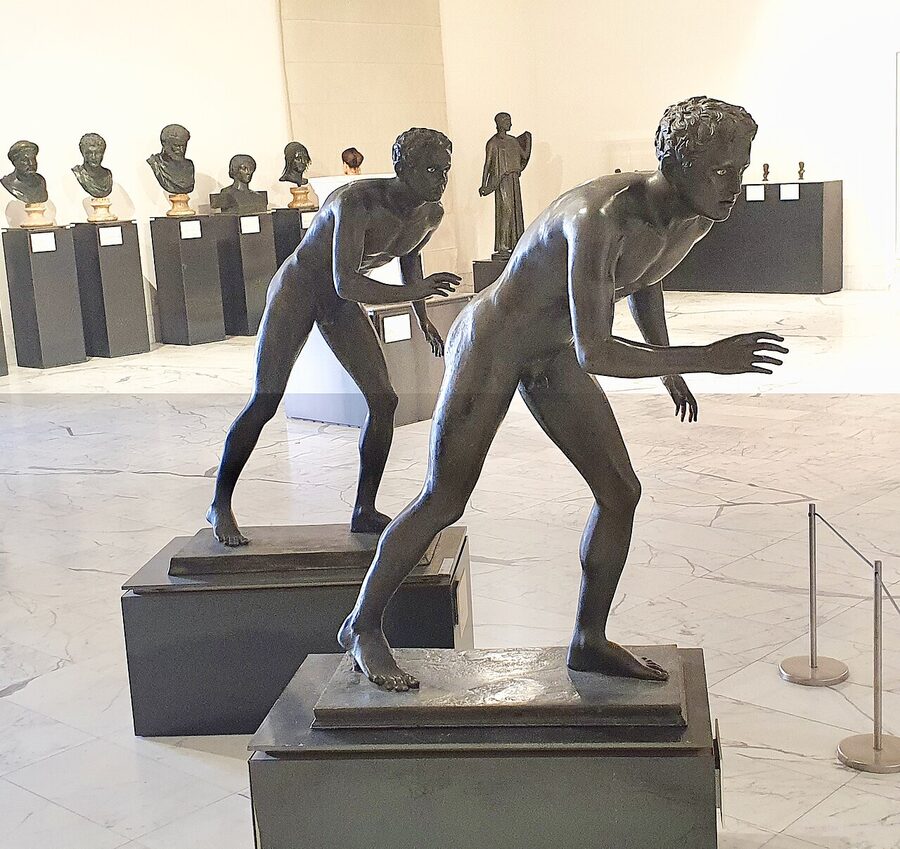
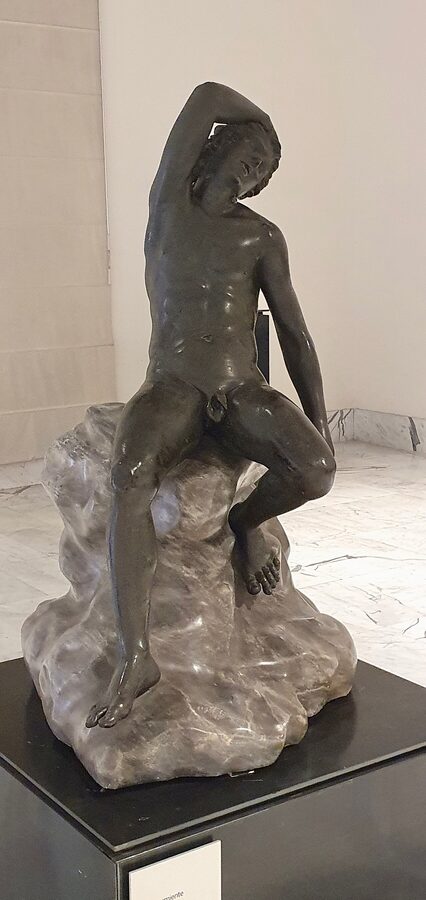
The Villa of the Papyri is a large suburban villa — about 2,500 square metres — on the northwest edge of the ancient town, buried deeper than the rest of the site (under about 25 metres of material) and still only partially excavated. The villa belonged to Lucius Calpurnius Piso Caesoninus, the father-in-law of Julius Caesar and a senior Roman senator. Its 1st-century BC decoration programme was remarkable: 90 bronze and marble sculptures (including the Bronze Runners, the Sleeping Satyr, and a Drunken Faun) ornamented the pool area and gardens, and the library contained between 1,800 and 2,000 papyrus scrolls of Greek and Latin philosophical, historical, and literary texts. The scrolls were all carbonised by the pyroclastic flow — charred into unreadable coal-black cylinders.
The scrolls are the single most interesting artefact category to come out of Herculaneum, because they constitute the only known surviving library from the Classical world. Until the 21st century, most of the scrolls were unreadable — opening them physically destroyed them. A few dozen had been partially unrolled by the end of the 19th century, producing the texts of Epicurean philosopher Philodemus of Gadara, a contemporary of Piso’s. The rest sat in the Naples museum as charcoal cylinders for 250 years.
The breakthrough is recent. In 2023, the Vesuvius Challenge — a prize competition founded by a team of computer scientists — awarded the first major prize to a 21-year-old student named Luke Farritor, who used machine learning to read the first legible Greek word (“πορφυρας,” porphyras, “purple”) from a CT scan of an unrolled scroll. By mid-2024, the Vesuvius Challenge team had read the first legible complete passage — a Philodemus discussion of pleasure as the chief good — from one scroll. As of 2026, an additional 14 scrolls have been partially read by the same methods. The text recoveries are transforming classical scholarship in real time. Roughly 600 scrolls remain in the Naples museum, most of them unread. More will be. In a hundred years we may have a significant addition to the classical canon.
The villa itself is mostly unvisited — it is about 400 metres west of the main excavated area, and only a partial excavation is open to visitors (typically on restricted-access guided tours). The famous sculptures are in the Naples Archaeological Museum. You can see the exterior of the villa building from a signposted terrace on the edge of the main site. Worth knowing about, and worth tracking the Vesuvius Challenge news; otherwise most visitors see the Villa of the Papyri only through the Naples museum.
The main tour — what to see in three hours
Starting from the main gate on Corso Resina, a sensible three-hour tour covers the following in order. Allow fifteen minutes per named stop plus transit time.
The boathouse skeletons. Descend the ramp and turn left immediately — the boathouses are along the ancient shoreline at the west side of the site. The 300 skeletons in the stone arcades. Allow 20 minutes, and do this first rather than last — it recalibrates the visit.
The forum. The civic centre, at the intersection of the main decumanus and the main cardo. Much of the forum proper is unexcavated; what you see is mostly the Augustan College building on the south side and the remains of the basilica on the east. The open space now is smaller than the original — the decumanus was twice as wide as it currently appears.
The Suburban Baths. Just south of the forum. The best-preserved bathing complex at Herculaneum: men’s and women’s sections, elaborate stucco ceiling decorations (athletes in relief), the water systems visibly intact, and the changing-room cupboards still in place. Most visitors skip this. Don’t.
The House of the Wooden Partition (Casa del Tramezzo di Legno). The one with the carbonised wooden folding screen still in place. Classical Roman atrium house, the best single structure for feeling how Herculaneum’s preservation exceeds Pompeii’s.
The House of Neptune and Amphitrite. The house with the glass-mosaic wall panel in the summer dining room. Spend fifteen minutes here. The adjacent shop (a carbonised wine bar with the amphorae still on the counter) is part of the same building and is often closed — check at the entrance.
The House of the Deer (Casa dei Cervi). The largest and most aristocratic of the excavated houses, named for two marble sculptures of deer found in the garden (now indoor-displayed). Most intact fresco cycle at the site. About halfway up the main decumanus.
The Casa dell’Atrio a Mosaico. Near the House of the Deer. Full mosaic floor in the atrium, frescoes of mythological scenes in the side rooms, and — unusually — the second-storey bedrooms partially preserved.
The Villa of the Papyri exterior view. From the signposted terrace at the western end of the site — or an additional visit on one of the restricted-access tours if available.
Plus: the theatre (mostly unexcavated, viewed through an 18th-century tunnel access), the Casa del Bicentenario (Christian cross graffiti controversial: earliest known or later addition?), and the Augustales building (where the cult of the emperor was administered). All open to visitors but shorter stops.
Excavation history — the tunnels, the Bourbons, the present
Herculaneum’s modern rediscovery began in 1709. Emmanuel Maurice de Lorraine, Prince d’Elbeuf — an Austrian general commanding in the then-Austrian Kingdom of Naples — bought land at Portici (now part of modern Ercolano) for a country villa. His workers digging a well ran into marble sculptural fragments at about 20 metres below ground level. D’Elbeuf recognised the significance, and over the next eight years he ran tunnel excavations to extract sculptures for his own collection and for sale. The Austrian viceroy eventually stopped him in 1716, but not before he had removed dozens of major bronze and marble works.
Regular excavation started in 1738, when Charles III of Bourbon (then king of Naples) began the official excavations that would eventually uncover both Herculaneum and Pompeii. The Bourbon method was tunnel excavation — narrow shafts dug through the solidified pyroclastic material, without exposing the surface. Finds were extracted, catalogued, and sent to the royal collection at Portici Palace. Many of the Villa of the Papyri sculptures were found in these tunnels. The tunnels themselves can still be entered on specialised tours (booking required; they run irregularly).
Surface excavation began in the late 18th century but progressed slowly. Systematic open-area excavation started only in 1927 under the fascist-era archaeologist Amedeo Maiuri, who directed the site for 38 years and uncovered most of what you see today. His methods were not always preservation-friendly by modern standards — houses were sometimes excavated in a single season without the careful protection needed for the organic materials — but the scale of what Maiuri exposed is still the basis of the modern visit.
The modern era of Herculaneum preservation is defined by the Herculaneum Conservation Project (2001-present), a partnership between the Italian archaeological authorities and the Packard Humanities Institute (funded by David Packard of Hewlett-Packard). The project has restored and stabilised over 80% of the exposed buildings, improved drainage, stabilised the upper-cliff boundary, and introduced the in-situ preservation of carbonised wood. The site today is in far better shape than it was twenty years ago, and the improvement is directly visible when compared with Pompeii, which has not had the same sustained private-foundation partnership.
Herculaneum and Pompeii — which to see, in what order
If you have one day, go to Pompeii; if you have two, add Herculaneum; if you have three, add Vesuvius and the Naples Archaeological Museum. The sequencing is the interesting question.
Pompeii first. The advantage is that the smaller, better-preserved Herculaneum benefits from the mental framework that Pompeii provides — by the time you’re looking at a specific wooden partition or a set of eight carbonised eggs, you already know the Roman everyday from the larger Pompeian sample. The disadvantage is that Pompeii is exhausting; visitors often don’t have the energy left for a serious Herculaneum visit the next day.
Herculaneum first. The advantage is that the smaller, more manageable site is easier to process as a first introduction; you learn to read Roman architecture and painting in a 3-hour visit rather than a 7-hour one. The disadvantage is that Pompeii’s scale afterwards can feel exhausting in comparison.
My own preference: Herculaneum first, Naples Archaeological Museum second, Pompeii third, over three separate days with a night in between each. The museum is the pivot that connects the two — the Alexander Mosaic and most of Pompeii’s best paintings are there, and the Villa of the Papyri sculptures plus the still-being-read papyri are there too. Doing the museum between the two sites means you understand what the ruins once contained. If you have only two days: Herculaneum morning, museum afternoon, Pompeii the following day.
If you have one day and you have already seen Herculaneum on a previous trip — do Pompeii. If you have one day and have not seen either — do Pompeii. Herculaneum is what you come back for.
Practical — tickets, timing, what to bring
Entry is €16 full, €2 booking fee if online. The “Parco Campano” combined ticket (€22 for 5 days) adds Pompeii, Oplontis (the spectacular Villa of Poppaea), and Boscoreale (the small but excellent suburban Villa Regina). At €6 extra for three additional sites, it is the right ticket to buy even if you think you won’t visit them all.
Opening hours: daily 9-19:30 in summer (April-October), 9-17 in winter, with last entry 90 minutes before close. The site is smaller than Pompeii and crowding is less of an issue — you do not need to be first in the queue. 10am arrival is fine; 2pm arrival works in winter.
What to bring: walking shoes (less demanding than Pompeii but still Roman paving); water (no cafés inside the site, though the entrance complex has a café); sunscreen and hat in summer; a small notebook and pen if you take notes. A camera or phone with good light: the Neptune and Amphitrite mosaic is in a dim indoor setting and rewards a longer exposure.
Guide options: the audio guide is €8 and worth it, covering 40 stops. A licensed private guide runs €150 for a 2.5-hour tour. For scholars or serious amateurs, the Herculaneum Conservation Project occasionally runs English-language architectural-conservation tours — check the herculaneum.org site.
Eating and where to stay in Ercolano
Ercolano town is a working Naples suburb — not a tourist town. This means eating in Ercolano itself is cheaper and more authentic than at most of the Vesuvian destinations. Two specific recommendations.
Viva lo Re (Corso Resina 261, just up the street from the archaeological entrance) is the pre-Covid-era classic — a wine bar / trattoria with a deep Campanian wine list and a proper no-frills kitchen. The pasta e patate con provola (pasta and potatoes with smoked mozzarella) is the house signature and one of the best versions in the region. Lunch €25-35 per person.
Casa Rossa al Vesuvio (Via Marittima 5, 15 minutes’ walk south of the site), on a small vineyard on the volcano’s slope with a view toward the sea, is a family-run agriturismo with Vesuvio-label wines and a fixed-price lunch built around whatever came from the garden that morning. €35-45 per person, book ahead.
Coffee: Gran Caffè Pica (Corso Resina 178) is the working-class morning espresso spot. For pastry, the Pasticceria La Fama (Via del Parco 29) has the best sfogliatella in the town — better than most of Naples proper.
Accommodation. Most visitors don’t stay in Ercolano; they day-trip from Naples or a Sorrento peninsula base. If you want to stay specifically, Miglio d’Oro Park Hotel (Corso Resina 296) is a converted 18th-century Bourbon villa on the “Mile of Gold” — the royal-summer-residence district of the villa suburban. €220-380, with a garden and pool. Herculaneum Suites & Breakfast (Corso Resina 181) is the smaller alternative, €120-180 for one of four rooms in a restored 19th-century palazzo.
When to visit
Late April to mid-June and mid-September to mid-October are the right windows. The site has limited shade but significantly less than Pompeii, making summer bearable even in July. Visitor numbers at Herculaneum peak at about 20% of Pompeii’s — you will not queue for anything.
Winter (November-March) is quiet and cheap. Ercolano in January is a working Neapolitan suburb without tourism; the site is open with reduced hours and prices; the restaurants I mentioned above are open to locals rather than to visitors. If you want the Herculaneum that has the smallest tourist footprint, February is the answer.
Specific dates: the Herculaneum Notte d’Estate (summer nighttime openings) — a handful of evenings in July and August when the site is open until midnight, lit atmospherically, with live music in the Augustan College building. €20, advance booking. It is the Herculaneum experience to have if you can get a ticket.
Before you go
Herculaneum is the better-preserved, less-visited, more rewarding half of the 79 AD story. It is also smaller, easier to complete in a day, and significantly less famous than Pompeii — which is why it is quieter and why the preservation is more intact. Plan three hours minimum on site; plan for a second visit on a later trip to catch the details you will certainly miss the first time.
The Villa of the Papyri scrolls are the running story. Watch the Vesuvius Challenge — the progress on reading the carbonised scrolls is accelerating, and the next decade may produce Philodemus texts, previously lost Hellenistic philosophy, and possibly the rest of Aristotle’s On Poetics (which the library may have contained). Check vesuviuschallenge.com before you go; the specific house and scroll of the month may be newly famous.
For the larger Campanian archaeological programme, see the Campania hub and the detailed Pompeii guide. Paestum, the Greek-temple archaeological site 100 km south of here, is the natural third leg of the 5th-century-BC-to-1st-century-AD Campanian sequence; see the Paestum guide on this site.

.jpg)

.jpg)

.jpg)
.jpg)