

Pompeii is the single best-preserved ancient city in the world. Not the oldest, not the largest, not the most beautiful — the best-preserved. On the morning of 24 October 79 AD (or possibly 24 August, the traditional date, though modern scholars now favour the October one), Mount Vesuvius erupted and buried Pompeii under four metres of pumice and ash over roughly eighteen hours. Eleven thousand to twelve thousand residents lived there at the time. Somewhere between one and two thousand of them were killed. The rest evacuated before the pyroclastic flows hit. The city itself, and everything in it — the frescoes, the furniture, the bread in the ovens, the political graffiti scratched into the plaster, the dog chained in the courtyard, the aristocratic dining rooms, the bakeries, the brothel, the theatre programmes, the election posters — was sealed under a depth of volcanic material that preserved almost all of it almost exactly as it was.
This is what makes Pompeii different from every other Roman archaeological site. At most Roman sites, you see stone walls and column stubs and imagine the rest. At Pompeii, the rest is still there. You walk through a wine merchant’s tavern where the amphorae are still leaning against the counter. You stand in a bakery where the round bread loaves are preserved in the brick oven they were baked in the morning of the eruption. You read shopping lists and price tariffs and political endorsements scratched into the wall beside the entrance. You see the casts of the victims — plaster poured into the voids left by decomposed bodies in the hardened ash, the technique perfected by Giuseppe Fiorelli in 1863 — in the exact pose and location they died in. The dog in the courtyard still wears a collar with a metal tag. This is not an archaeological site that wants to be imagined; it is an archaeological site that wants to be walked through.
Pompeii is also the hardest-won preservation job in the European heritage system. The 66-hectare site has been excavating since 1748 and is still about 60% done; the remaining 40% is deliberately left unexcavated because the preservation techniques of each era have worked against the long-term survival of what the previous era dug up. The frescoes that were uncovered in the 1750s have mostly faded. The ones uncovered in the 1990s and 2000s are still bright because the techniques have improved. New discoveries continue — the House of the Vettii was reopened in January 2023 after a 20-year restoration; a remarkable fresco of Helen of Troy and Paris was uncovered in December 2023 in Regio IX; a full-size Black Hall fresco cycle from a newly excavated villa was revealed in April 2024. The city keeps producing. It is not a finished place.
I have been visiting Pompeii since 2005. On average I go for four hours, which is not enough for any visit, and every time I come back I plan better for next time. If you are going for the first time, start with this: you need five hours minimum. Six or seven is realistic. A full day is better. Walk slowly. Pay for the audio guide or a proper tour. Go in shoulder months. What follows is the structure I wish someone had given me on my first visit.
In This Article
- Pompeii in one paragraph
- Getting to Pompeii
- Pompeii before the eruption
- The eruption of 79 AD
- From Renaissance rediscovery to modern archaeology
- The Forum and the centre of public life
- The amphitheatre and the theatres
- The great houses — Faun, Vettii, Menander
- The Villa of the Mysteries
- The plaster casts and the Garden of the Fugitives
- Baths, the Lupanare, and everyday life
- Practical visit — timing, tickets, route
- Pompeii and Herculaneum — which to see
- Day trips and combining
- When to visit
- Before you go
Pompeii in one paragraph
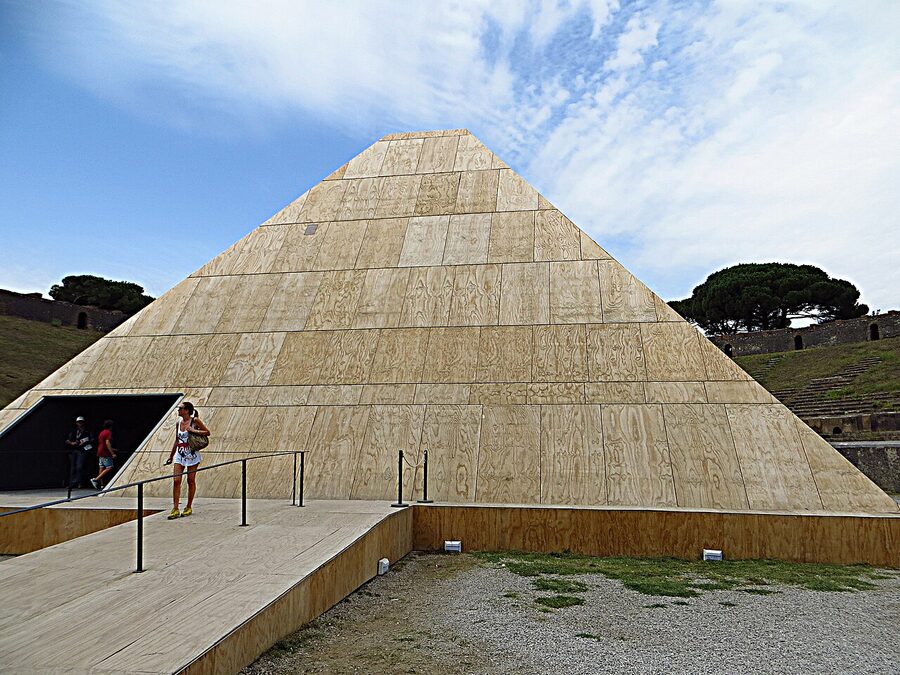
An ancient Roman city buried by the 79 AD eruption of Mount Vesuvius, partially excavated since 1748, UNESCO-listed in 1997 along with Herculaneum and Torre Annunziata. Located in the modern Province of Naples (Campania, southern Italy), 23 km southeast of Naples, 8 km from the coast. 66 hectares of excavated area within the original 64-67 hectare city walls; about 40% of the site still deliberately unexcavated. Estimated pre-eruption population 11,000-12,000. The modern Parco Archeologico di Pompei is the administering body; 4 million visitors per year (2024 figure); €22 full admission; open daily 9-19 in summer, 9-17 in winter. The adjacent modern town of Pompei (note: single-i spelling for the modern city, double-i for the ancient one) has 25,000 residents and is a pilgrimage site for the Basilica del Santissimo Rosario, the Catholic shrine of the Virgin of Pompeii (1891). The archaeological site is reached from Naples in 35 minutes by the Circumvesuviana commuter train to the station Pompei Scavi – Villa dei Misteri.
Getting to Pompeii
The practical route from Naples is the Circumvesuviana commuter train — the private narrow-gauge line that loops around Vesuvius connecting Naples Centrale, Herculaneum (Ercolano Scavi), Pompeii (Pompei Scavi – Villa dei Misteri), and Sorrento. Trains run every 30-45 minutes, take 35 minutes from Naples, and cost €3.60 one-way. The Circumvesuviana is famously rattly, occasionally overcrowded, and the carriages are 1970s-vintage — but it works, and the station name Pompei Scavi – Villa dei Misteri drops you 100 metres from the main Porta Marina entrance. Do not take the Trenitalia train to Pompei station instead; that station serves the modern town on the wrong side of the site.
From Amalfi Coast towns, the combined route is: SITA bus to Sorrento, then Circumvesuviana from Sorrento to Pompei Scavi (40 minutes, €2.70). This takes 90 minutes to 2 hours from Positano depending on SITA bus delays. A direct Campania Express tourist train runs in summer between Sorrento and Naples with a Pompei Scavi stop — faster, cleaner, €15 for an all-day ticket, worth the upgrade.
By car, you take the A3 Naples-Salerno autostrada, exit at Pompei Ovest, and park at one of the private lots near the Porta Marina entrance (€5-10 per day). Driving to Pompeii is not recommended because the traffic into and out of the site area is heavy and the public transport is actually adequate; if you are driving, you are in the minority.
From Rome, the fastest route is Frecciarossa or Italo to Naples (1h10, €40-70), then Circumvesuviana as above. A day trip from Rome is possible — it is what most of the coach tours do — but makes the archaeological site a 4-5 hour visit squeezed between 3-hour transfers in each direction, and you arrive already tired. Overnight in Naples if you possibly can.
The site has three main pedestrian entrances, and choice of entrance matters for your day. Porta Marina is the standard one and the Circumvesuviana’s default — the entrance closest to the Forum and the famous photographic axis. Piazza Esedra is an alternative next to Porta Marina — useful mainly if the Porta Marina queue is long. Piazza Anfiteatro is at the opposite end of the site (eastern edge, near the amphitheatre) — much shorter queues, and better if you are planning to walk the site east-to-west. On busy days (which is most days in May, June, September, October), using Piazza Anfiteatro saves you 45 minutes at entry.
Most visitors without a car arrive from Naples or Sorrento on the Circumvesuviana line; from Rome, the realistic options are the high-speed train to Naples or an organised day tour, and The Rome Traveler has the current from-Rome day trips written up with traveller reviews. UNESCO’s World Heritage listing explains the conservation pressures that dictate which houses are open in a given season.
Pompeii before the eruption
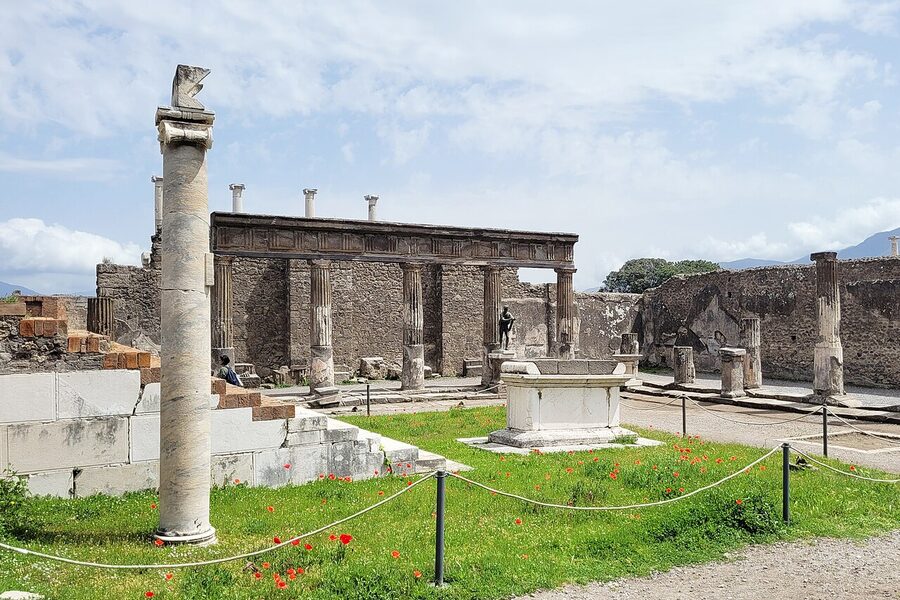
Pompeii was not originally Roman. The oldest settlement on the site is Oscan, from the 7th century BC; Greek colonists from Cumae used the harbour in the 6th century BC and built the small Greek Doric temple whose ruins survive in the Triangular Forum; the city came under Etruscan influence in the 6th-5th centuries; and from 424 BC it was dominated by the Samnites, the Italic mountain people who controlled most of Campania before the Roman conquests. The Samnite city of Pompeii was built to the street grid you still walk today — a rectangular plan of about 64 hectares, with two main east-west streets (decumani) and the main north-south street (cardo) dividing the city into nine regions. The Samnite-era public buildings — the Stabian Baths, the Basilica, the first Forum, the small theatre — are all still there as the Roman city’s foundation layer.
Rome took Pompeii in the aftermath of the Social War (91-88 BC), when the city rebelled along with other Italic allies demanding Roman citizenship. The Roman general Sulla captured the city in 89 BC, resettled it with Roman veterans in 80 BC, and Pompeii became a Roman colony — Colonia Cornelia Veneria Pompeianorum, after Sulla’s family name and the patron goddess Venus. This is the Pompeii that you see today: Roman in its governance, architecture, and religion, but with the Samnite street plan and much of the Samnite building fabric underneath.
By 79 AD, Pompeii was a well-off provincial city of the Roman Empire. 11,000-12,000 residents. Coastal, though silted up and the shoreline had moved south — the city was by then 2 km from the sea rather than directly on it. Known for wine, olive oil, garum (the fermented fish sauce that was the standard Roman condiment), and wool production. A popular summer retreat for Roman aristocrats, with a concentration of luxury villas along the coast and on the south-facing slopes of Vesuvius (the Villa of the Mysteries is one of these).
On 5 February 62 AD, a severe earthquake damaged large parts of the city — including the Temple of Jupiter in the Forum — and seventeen years of reconstruction were still under way when the eruption hit. Some of the damage from 62 had not yet been repaired. This is why the 79 AD Pompeii is a city caught mid-renovation: you see half-finished work in almost every major public building.
The eruption of 79 AD
The eruption started on a morning in the autumn of 79 AD (the exact date is now contested — Pliny the Younger’s letters say 24 August, but a recent discovery of a charcoal inscription at Pompeii dated 17 October 79 suggests the eruption came after that; most current scholars favour 24 October). The first phase was the Plinian column — a vertical ejection of pumice and ash that rose 30 km straight up before the atmospheric winds pushed it southward over Pompeii and Herculaneum. Pumice began falling on Pompeii within an hour of the eruption’s start. For the first 18 hours of the disaster, it rained pumice stones — eventually piling to about 4 metres in depth over the city, collapsing roofs, and burying most one-storey structures.
The second phase — the one that killed most of the remaining residents — was the pyroclastic surges, which began in the early morning of the second day. These are ground-hugging flows of 300°C superheated gas and ash that move at about 100 km/h. Six separate surges hit Pompeii between 6:30 and 8:00 AM; the first was the deadliest. Almost everyone who had not evacuated was killed by the first surge. The victims died in seconds, from thermal shock — temperatures in the surge reached 300°C, enough to boil blood and vaporise brain tissue. The bodies were then buried under another 2 metres of ash from the surges and the following pumice fall. The total depth of material over the city after eruption was about 6 metres.
The only contemporary account we have of the eruption is Pliny the Younger’s pair of letters to the historian Tacitus, written about 25 years later. Pliny watched the eruption from Misenum across the Bay of Naples, where he was staying with his uncle Pliny the Elder, the Roman naval commander and natural historian. Pliny the Elder took a squadron of ships toward the eruption to rescue friends and fellow Roman citizens from coastal towns; he landed at Stabiae (modern Castellammare di Stabia, directly south of Pompeii) and died there the following morning, probably from inhalation of ash and fumes. Pliny the Younger’s description is the foundation document for modern volcanology — his description of the eruption column as “shaped like a pine tree, with a trunk extending up from the mountain and branches spreading out at the top” is why this eruption type is called Plinian. His account also preserves the two-day timeline, the direction of the ash fall, and the behaviour of the pyroclastic surges.
Modern estimates put the death toll in Pompeii at between 2,000 and 2,500 people — of the 11,000-12,000 residents, most had evacuated in the 18 hours between the first pumice fall and the first pyroclastic surge. At Herculaneum, where the first surge hit earlier and at 500°C, the death toll was higher as a proportion of the population. At Stabiae, where Pliny the Elder died, most of the town was destroyed. The total number of known victims from the 79 AD eruption, across the affected area, is about 2,000-3,000.
From Renaissance rediscovery to modern archaeology
After 79 AD, the memory of Pompeii faded. By the Middle Ages, the city’s location was unknown; farmers on the plain occasionally dug up wall fragments and called the area la Civita, “the city,” but no one connected it to the Pompeii mentioned in Pliny. A Roman water engineer named Domenico Fontana accidentally tunnelled through buried buildings in 1599 while digging an aqueduct channel — his workmen found frescoes and inscriptions, and Fontana correctly identified the ruins as Pompeii, but no excavation followed. It took another 150 years before serious work began.
The Bourbon king Charles III of Spain, who was king of Naples from 1735 to 1759, started formal excavations at Pompeii in 1748. He had already begun excavating Herculaneum in 1738 (more difficult because of the harder rock-like layer over that site); Pompeii was easier because the ash-and-pumice cover was softer. The Bourbon-era excavations were really treasure-hunting — the finds were stripped from the ruins, taken to the royal collections at Portici, and eventually formed the core of the Naples National Archaeological Museum. What you see at Pompeii today, frescoes excepted, is mostly the structure. The movable finds — frescoes, mosaics, bronze and marble statuary, jewellery, silverware, the Alexander Mosaic — are at the museum in Naples. If you are doing Pompeii properly, go to the Naples Archaeological Museum first or second (see the Campania hub).
The modern era of Pompeii archaeology begins with Giuseppe Fiorelli, the Neapolitan scholar appointed director in 1863 by the new post-unification Italian government. Fiorelli introduced the systematic numbering of insulae (city blocks) and doors that is still in use today — the famous notation “Regio VI, Insula 15, Doorway 1” for the House of the Vettii — and invented the plaster-casting technique for the victims. He also shifted the focus from treasure-hunting to preservation, which was already a century late but saved the rest.
Twentieth-century Pompeii has been a series of preservation battles. American and British bombing during World War II hit the site repeatedly — the Macellum, the House of Loreius Tiburtinus, and parts of the Forum were damaged. Heavy rainfall in 2010 collapsed several houses including the famous House of the Gladiators, prompting international criticism and a massive EU-funded restoration programme (“Grande Progetto Pompei,” €105 million 2012-2019). The current director, the German archaeologist Gabriel Zuchtriegel, has pursued a strategy of targeted excavation and more aggressive public education since his 2021 appointment; the 2023 reopening of the House of the Vettii, the 2024 Helen-and-Paris fresco, and the Black Hall cycle in a newly excavated villa in Regio IX are all from his tenure.
As of 2026, about 60% of the 66-hectare site is excavated. The remaining 40% (mostly in Regio III, V, and IX) is deliberately left buried, because current archaeological consensus is that anything dug up will be harder to preserve than anything left in the ground. New excavations are targeted — specific buildings, specific research questions — rather than wholesale uncovering of new districts.
The Forum and the centre of public life
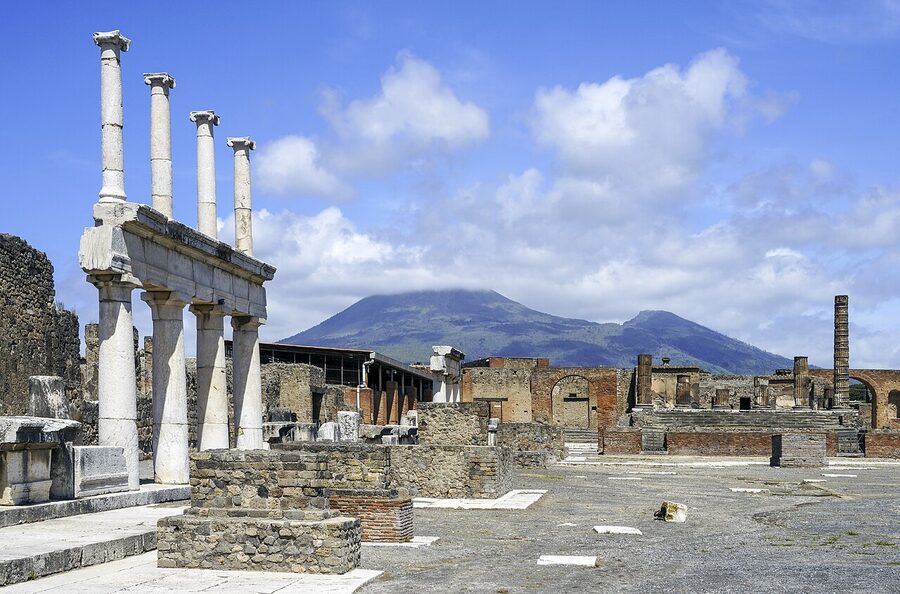
The Forum is the first major set piece you reach from the Porta Marina entrance. A rectangular paved space about 150m × 40m, surrounded on three sides by a two-storey colonnade; closed on the north by the Temple of Jupiter at the top of a high podium, with Mount Vesuvius framed directly behind it. This north-south axis — temple, Forum, view to volcano — is the single most photographed composition at Pompeii, and it is the central framing the Romans intended: their chief god’s temple with the natural landmark of their territory behind it. They did not know it was a volcano. That is the other thing the photograph captures.
Around the Forum, the city arranged its civic and religious institutions. The Basilica on the south-west corner (the law courts, with a central aisle and semicircular apse at the west end); the Temple of Apollo on the western long side (the city’s oldest religious structure); the Macellum on the northeast corner (the market, with a central rotunda where a round-table of fishmongers’ slabs has been excavated); the Building of Eumachia on the east side (a meeting hall for the wool merchants’ guild, funded by a wealthy priestess named Eumachia); and the Comitium for elections on the south-east. Allow an hour for the Forum complex; two if you go inside each building.
The Forum was the civic centre of Pompeii’s life. Political elections, religious processions, market days, the emperor’s formal visits, the regular trial days at the Basilica, the ritual sacrifices at the Temple of Jupiter — all happened here. The painted election notices on the walls of the buildings around the Forum (and especially on the shops along the streets leading out of it) give the most direct glimpse of Roman political life: dozens of candidate endorsements (“VOTE QVINTVS POSTVMIUS MODESTVS — A GOOD MAN, WIDELY KNOWN” would be a rough translation), endorsements by named groups (“the wool-finishers support Modestus”), and occasional opposition graffiti. The electoral rhetoric was not very different from modern political advertising; it is, for most visitors, the single most alienating-and-familiar thing at Pompeii.
The amphitheatre and the theatres
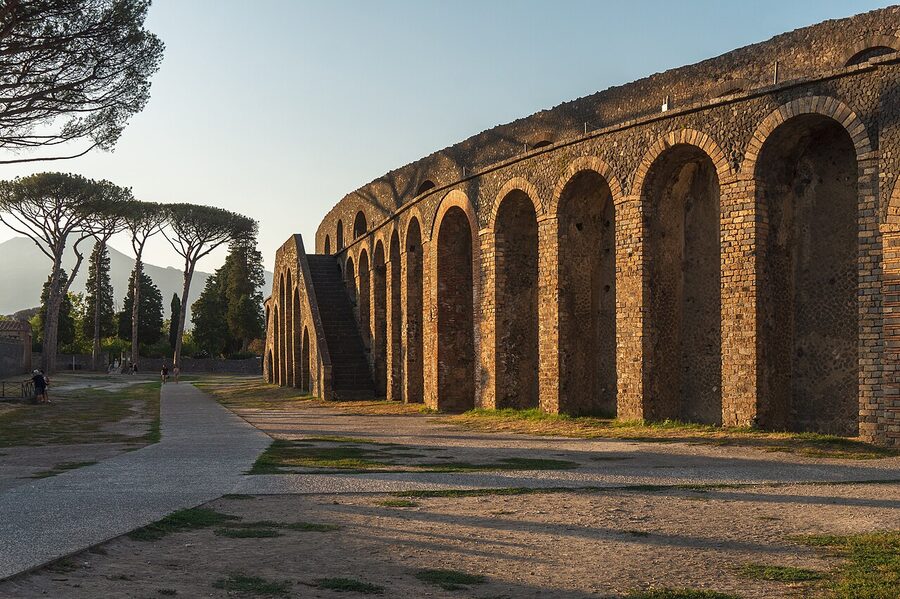
The Amphitheatre sits at the southeast corner of the city, at the far end from the Forum. It was built in 70 BC, which makes it the oldest surviving stone Roman amphitheatre — pre-dating the Colosseum in Rome by about 140 years. It held about 20,000 spectators, which is larger than the entire population of Pompeii; the capacity was intended for games that drew audiences from the whole Bay of Naples region. Construction was funded by two named Roman citizens, Caius Quinctius Valgus and Marcus Porcius, whose funding inscription is still readable on the monument.
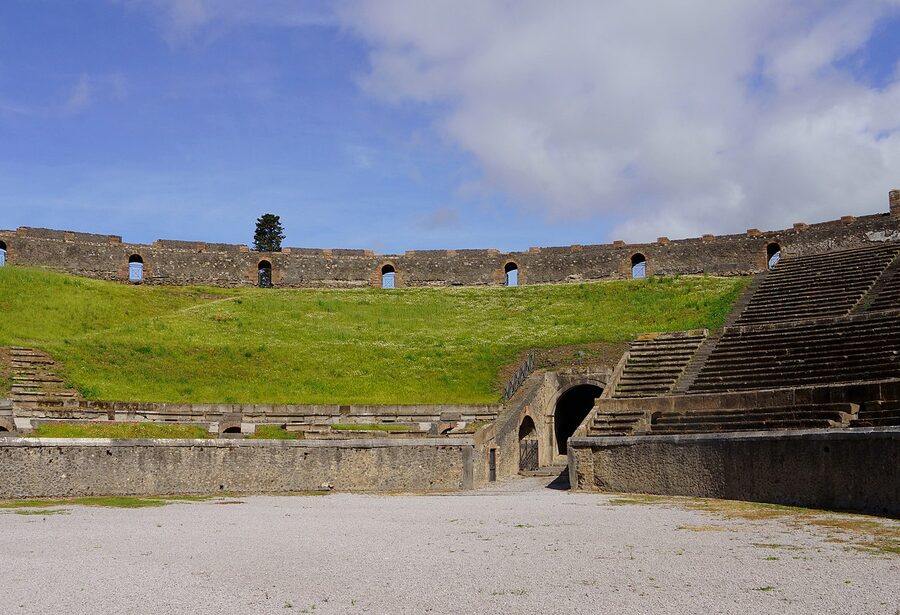
The amphitheatre is historically famous for a specific event: the riot of AD 59, between Pompeian supporters and visiting Nucerini (residents of the nearby town of Nuceria). The fight broke out in and around the amphitheatre during a gladiatorial show, escalated into a full-scale brawl with multiple deaths, and resulted in the Roman Senate banning gladiatorial games at Pompeii for ten years. A fresco depicting the riot itself — with figures fighting in the stands and spilling into the streets — was painted on the wall of a private house shortly after the event and is now in the Naples Archaeological Museum. It is one of the most direct pieces of visual journalism we have from the Roman world.
West of the amphitheatre, the Grand Theatre (Teatro Grande) is a 2nd-century BC Greek-style open-air theatre, holding about 5,000, built into the natural slope with a semicircular tiered audience area cut into the hillside. The adjacent smaller Odeon (covered theatre for musical and poetic performance, holding about 1,500) is connected to it and formed Pompeii’s performance-arts district. Behind both is the Gladiators’ Barracks (Caserma dei Gladiatori) — a quadrangular complex of 70 small cells on two levels, built for the gladiators living at Pompeii. When it was excavated in the 1760s, the skeletons of 18 gladiators were found chained in their cells, trapped by the eruption.
The great houses — Faun, Vettii, Menander
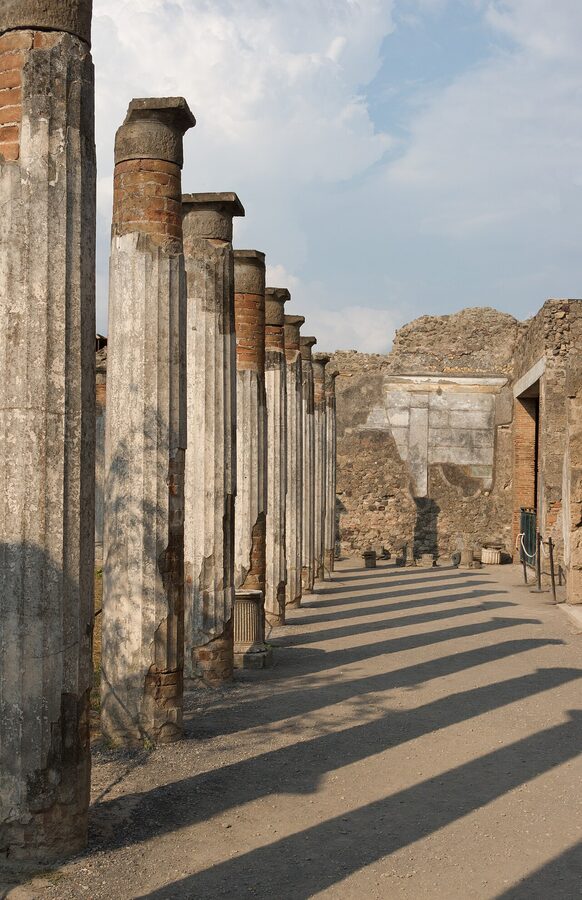
The House of the Faun (Casa del Fauno) is the largest private residence in Pompeii — 3,000 square metres, an entire insula block to itself, two atria, two peristyle gardens, and the city’s highest-quality surviving mosaic floors. Built in the 2nd century BC during the Samnite period, expanded and refurbished under Roman rule. Named for the bronze Dancing Faun statue that stood in the first impluvium; the original is in the Naples Archaeological Museum, and a replica is now in the house. The house’s most famous object — the Alexander Mosaic depicting the Battle of Issus between Alexander the Great and Darius III of Persia — was found in 1831 and also moved to the Naples Museum. The mosaic is 5 metres by 3 metres, made of 1.5 million tiny tiles (tesserae), and considered one of the greatest surviving works of late classical art. It is worth seeing in Naples to complete a Pompeii visit.
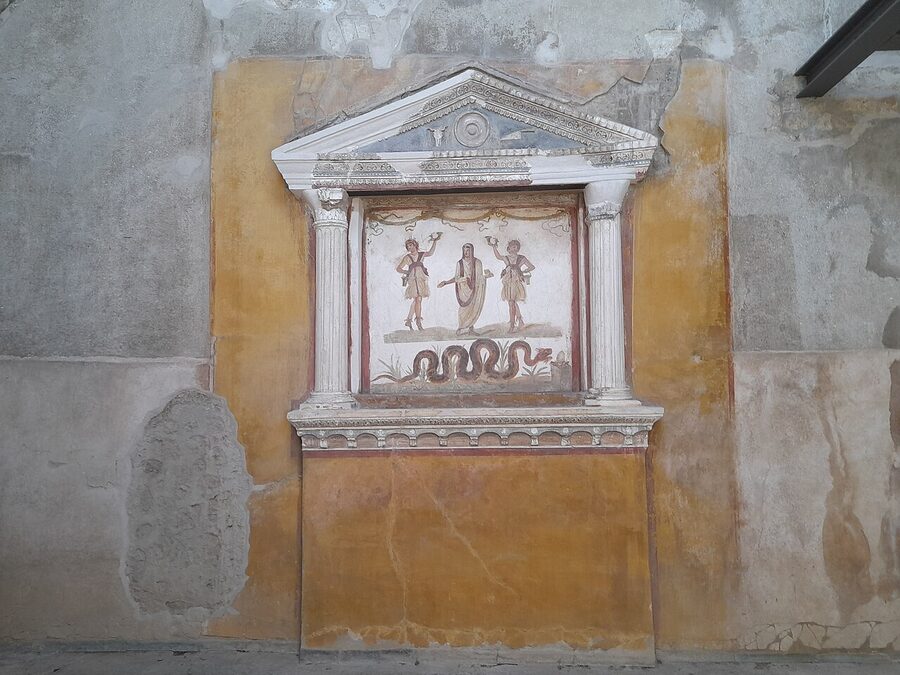
The House of the Vettii (Casa dei Vettii) is the best-preserved mid-sized residence at Pompeii. Belonged to two brothers, Aulus Vettius Restitutus and Aulus Vettius Conviva — wealthy freedmen (former slaves) who had made their fortune in wine and oil trade. The house has a modest entrance hall and a small atrium, but opens into a main peristyle garden surrounded on all sides by a series of small reception rooms, each with complete fresco cycles — mythological narratives in the Pompeian “Fourth Style,” c. 62-79 AD. The “Ixion Room” showing the punishment of Ixion on the wheel, the “Pentheus Room” with the death of Pentheus at the hands of the Maenads, and the “Ariadne Room” are the three most impressive. The house also contains two famous specific frescoes: the Priapus weighing his oversized phallus against a bag of gold (at the entrance, traditional good-luck image, a reminder to visitors that the owner was rich), and a frieze of cupids pursuing various trades (making perfume, selling wine, running a bakery) around the triclinium. The house was closed for 20 years of restoration from 2002 and reopened in January 2023 with strictly controlled visitor flow. It is the single most important house in Pompeii today. Go early in the visit before the queue builds.
The House of the Menander (Casa del Menandro) is the third of the trio of great houses — named for a fresco of the Greek playwright Menander found on the wall of a niche. Belonged to the Poppaea family, the same family as Nero’s second wife Poppaea Sabina; the house is larger than the Vettii’s, with a peristyle, private baths, and a carbonised wooden library cabinet that preserved a set of wax writing tablets (now in Naples). A silver hoard of 118 pieces was found buried in an underground storage room in 1930; the pieces are among the finest Roman silverware ever recovered. House of Menander is in Regio I, near the Stabian Gate, about 15 minutes’ walk from the House of the Vettii.
The Villa of the Mysteries
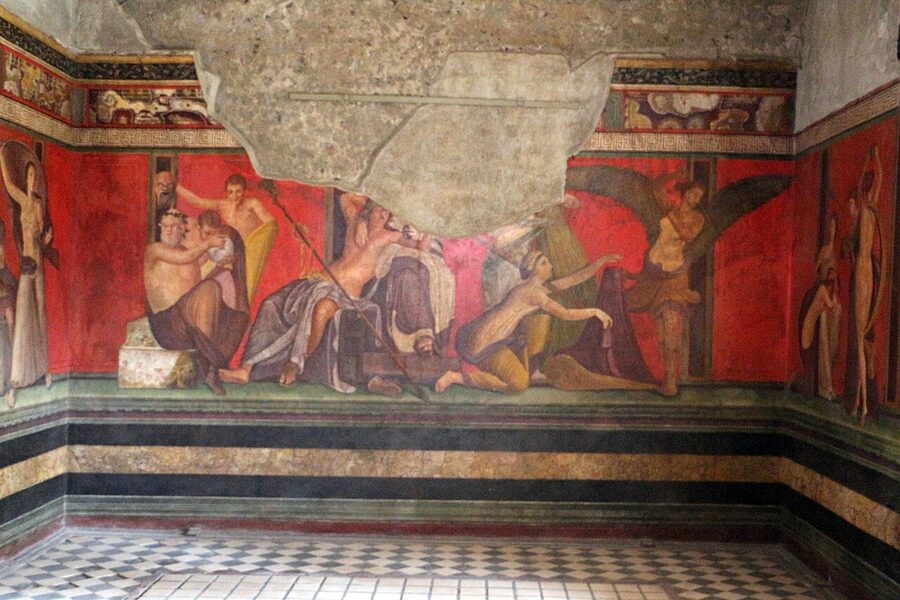
The Villa of the Mysteries (Villa dei Misteri) is a suburban Roman villa 400 metres northwest of the main city walls, reached by a 15-minute walk along Via Consolare from the Porta Marina entrance. The villa is 2nd century BC in origin, expanded in the Augustan era, and had about 60 rooms at the time of the eruption. It is visited for one specific reason: the frescoes in the Sala del Grande Dipinto, the large dining room (triclinium) at the southern end of the villa.
The frescoes — painted in about 60 BC, so nearly 150 years before the eruption — cover three walls of the room in a continuous narrative sequence. The scenes, in the order conventionally read, show: a young woman uncovering a ritual object in a winnowing basket; the god Dionysus reclining with his mother Semele (or his wife Ariadne — the identification is debated); a satyr gazing into a shallow silver bowl; a woman with a whip raised over a kneeling figure; and, at the far end, a seated woman being prepared for her wedding. The entire cycle is life-size and executed at the highest level of Roman painting. The figures are weighted, gestural, psychologically alive in a way that almost no other surviving Roman painting achieves.
What the frescoes actually depict remains one of the great argument points of Roman art history. The current scholarly consensus is that the scene shows a woman’s initiation into the cult of Dionysus, with the bride-preparation at the end suggesting the initiation was also preparation for marriage. But specific interpretations vary — the flagellation scene, the winnowing basket, the child reading a scroll on one panel have all been argued over. What is not debated is the painting’s quality. If you are in Pompeii for any reason at all, you come to see this room.
Practical notes: the villa is open 9-17:30 (closes earlier than the main site). It is included in the standard Pompeii entry ticket. You can enter the villa itself and walk around the peristyle gardens, but the Sala del Grande Dipinto is behind protective glass for preservation; you view it from a raised walkway constructed in 2015. Allow 45 minutes at the villa. The walk from Porta Marina to the villa and back is 30 minutes each way.
The plaster casts and the Garden of the Fugitives
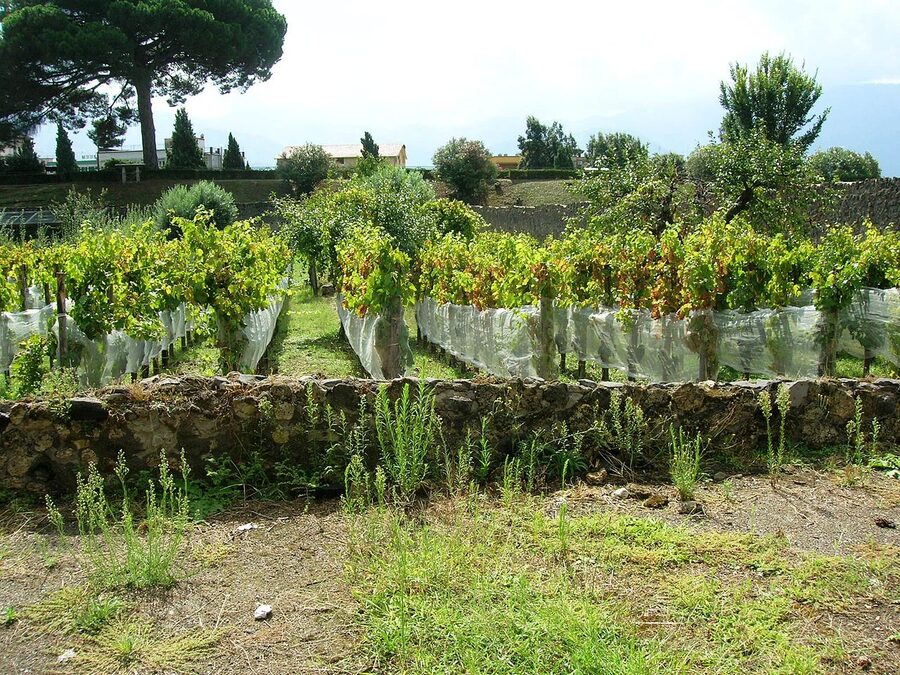
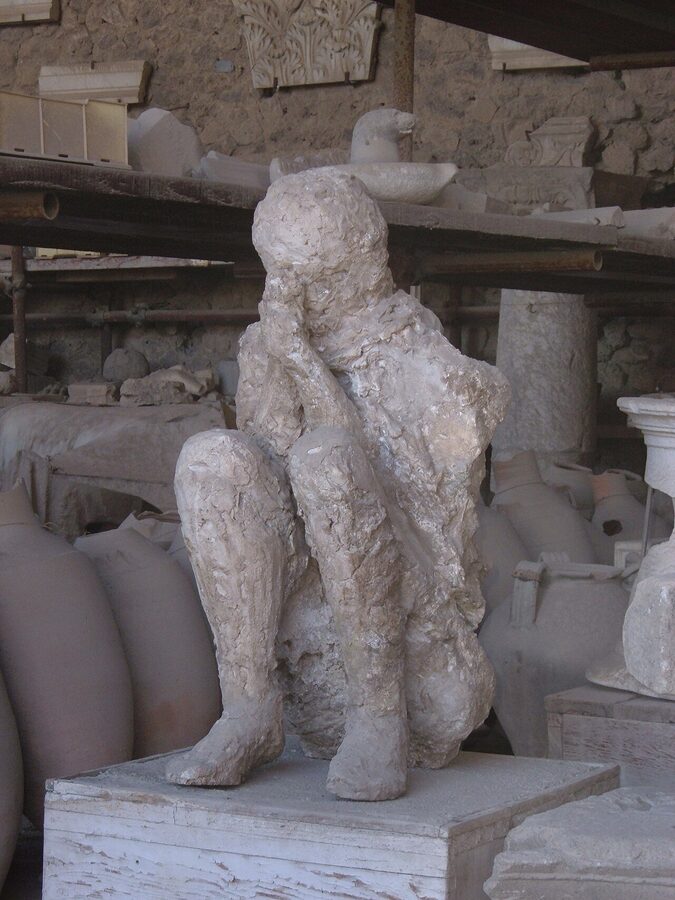
Of the 2,000-2,500 victims of the eruption at Pompeii, about 104 have been preserved as plaster casts. The bodies decomposed in the hardened ash, leaving body-shaped voids. When Giuseppe Fiorelli discovered in 1863 that pouring plaster into one of these voids produced a life-size replica of the victim — complete with clothing folds, hair, facial expression, and gesture — he revolutionised both Pompeii’s narrative power and its emotional register. The casts are the single most visually devastating thing at Pompeii. They are also the reason visiting the site is different from visiting other archaeological sites. Most ruins are about buildings; the Pompeii casts are about specific people who died at specific moments.
The casts are distributed across the site, usually displayed where the bodies were found. The Garden of the Fugitives (Orto dei Fuggiaschi) in the southeastern corner of the city is the single largest grouping — 13 casts of what appears to be a family or extended-household group, caught in mid-flight toward the Porta Nocera sea gate. Small children, adults, postures of terror and resignation. The casts are protected by a glass wall but displayed in situ; you see them where they died. 10 minutes’ walk southeast from the Amphitheatre; give yourself 20 minutes with them.
Elsewhere on site, individual casts are preserved at the House of the Cryptoporticus (the famous cast of a sitting figure, head on knees); the Casa del Menandro (a guard dog cast, still wearing its collar); the Antiquarium near the Forum (several casts including the “pregnant slave woman” cast); and the Villa of the Mysteries surroundings. Recent work since 2015 has used clear resin instead of plaster, allowing recovery of the bones inside; DNA analysis of a 2022-recovered victim showed he had leprosy at the time of death, and a 2024 analysis of the two victims found in the Casa del Criptoportico determined that one was a freeborn Pompeian and the other was a slave, based on dental isotopes.
Baths, the Lupanare, and everyday life
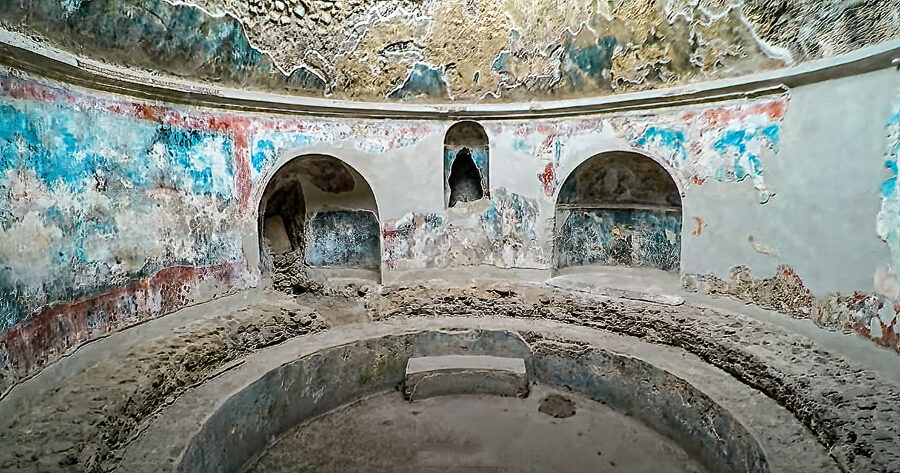
The Stabian Baths (Terme Stabiane), on Via Stabiana in the southern part of the city, are the oldest public baths at Pompeii — Samnite foundations, 4th-2nd century BC, upgraded in Roman times to include the now-standard apodyterium (changing room), frigidarium (cold bath), tepidarium (warm bath), caldarium (hot bath), and palaestra (exercise courtyard) sequence. The stucco decorations on the ceilings of the men’s rooms are the best-preserved bath ceilings anywhere in the Roman world — athletes and mythological scenes in relief. The Forum Baths (Terme del Foro), near the Forum itself, are smaller but cleaner-preserved, and worth 20 minutes after the Forum.
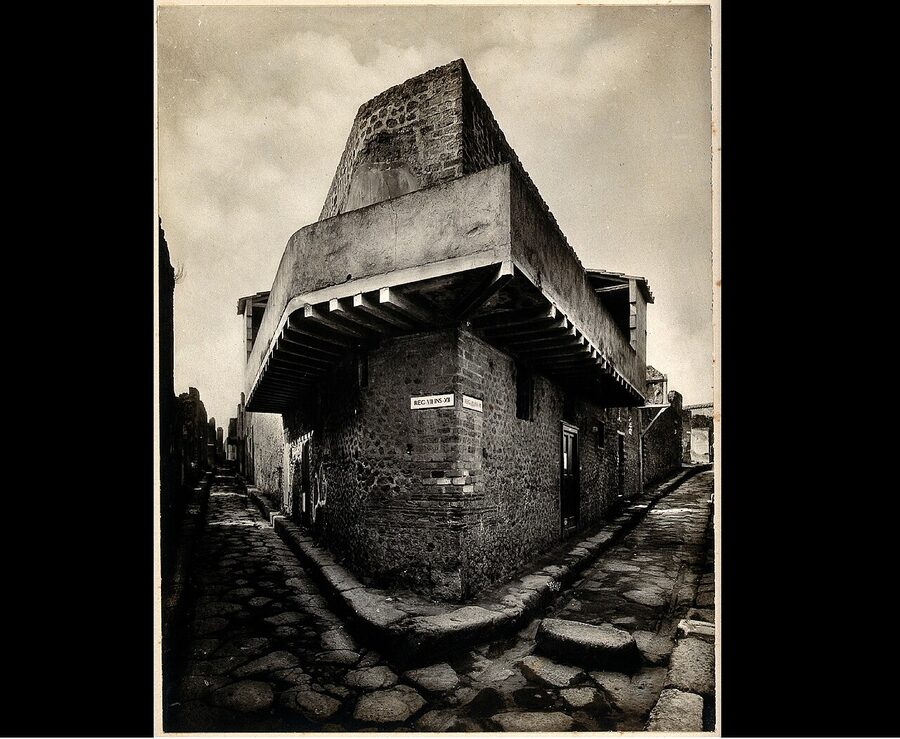
The Lupanare — literally “wolf’s den,” the Roman slang for brothel — is the largest identified purpose-built brothel in the ancient Roman world. Ten rooms arranged on two floors, each with a stone-built bed, and above each doorway a short erotic fresco depicting one of the services available. The frescoes were both menu (illiterate or foreign visitors could point to what they wanted) and display (Roman brothels were highly visual spaces). The graffiti scratched into the walls — about 150 distinct inscriptions — are a remarkable survival of Roman non-literate language: a mix of dirty jokes, brags, and client-reviews of individual sex workers. The most famous reads, in translation, “Here I, Harpocras, had a good fuck for a denarius with Drauca” — and is the single direct price reference we have for the Roman sex trade. The Lupanare is on the main tour route and can be crowded; go early in your visit.
Beyond these headline stops, everyday Pompeii is visible in every direction. The thermopolia (takeaway food shops) with their counters and sunken storage jars (over 80 identified throughout the city — the one on Via dell’Abbondanza, excavated 2019-2020, is the best-preserved, with a painted peacock on the counter). The bakeries with their large round millstones and wood-fired ovens — one contained 81 carbonised loaves on the morning of the eruption. The wool-cleaning workshops (fullonicae) where the urine-based washing vats are still in place. The garum factories where the fermented fish sauce was processed. The latrines — communal, stone-benched, with water channels still clear — that were standard even in private homes.
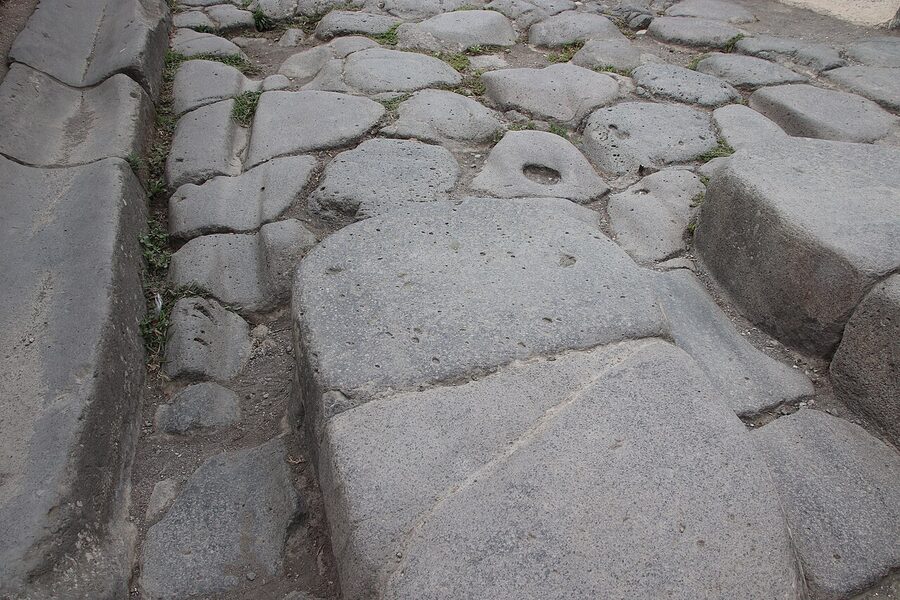
The streets themselves are worth paying attention to. Roman streets at Pompeii had stepping stones — large raised blocks that let pedestrians cross without touching the road. The spacing between the stones allowed the wheels of a standard Roman cart to pass between them without the cart getting stuck; the stone height meant the pedestrians stayed above the road’s running water, waste, and seasonal flooding. This is the single most photographed piece of Roman urban engineering; it also tells you most of what you need to know about Roman cities as dense, wet, filthy places with strict pedestrian-cart separation. You will walk past a hundred of these in a day at Pompeii; notice them.
Practical visit — timing, tickets, route
Entry is €22 for a full ticket; €2 online booking fee (the official site is ticketone.it). The “Pompei + Villa dei Misteri” combined ticket is the default — don’t get only the basic one without the Villa, because most visitors want the Villa and the walk is included. A “Pompei+” combined ticket (€28) adds the nearby Boscoreale villa museum, Oplontis, and Stabiae, but you cannot realistically do all of these in one day. The amphitheatre is inside the main ticket.
Timing. The site opens at 9am, closes at 19:00 in summer (April-October), 17:00 in winter (November-March), with last entry 90 minutes before close. Crowds peak between 10:30am and 2pm. For serious visits, be at the gate at 9am on the dot; go first to the House of the Vettii and Villa of the Mysteries (both limited-capacity and busy by 11am); then do the Forum and the main Via dell’Abbondanza axis before lunch. After a (quick) lunch at one of the on-site cafeterias or, better, at the café near Porta Marina outside, come back and do the Amphitheatre + Garden of the Fugitives + House of the Menander in the afternoon. That is a full day of 7-8 hours on site. Less is possible but you will miss things; more is also possible — some visitors spend three days.
What to bring. Proper walking shoes (the site is stone paving and uneven ground; bring actual walking shoes, not sandals). Water — 2 litres per person minimum in summer. Sunscreen and a hat — the site has very little shade, which is one reason July-August is unpleasant. A small snack — the on-site cafés are passable but overpriced, and you will be hungry before you finish. A portable phone charger or power bank — you will use your phone for the map and the audio guide’s app. Cash for emergencies; card works at most ticket counters.
Guide options. The audio guide is €8 and worth it — 90 minutes of specific-building commentary in 10 languages. A licensed private guide (around €180 for 3 hours for up to 6 people) is the better option if you have the money; the Pompeii archaeological park maintains an official register of licensed guides on its website. The main alternative is to rent an audio-enabled Archea tablet (€15/day) that navigates the site as a self-guided tour with GPS-triggered commentary. Group tours in English depart at fixed times from the Porta Marina entrance (€30 per person for a 2.5-hour tour). Do not go without some kind of guiding — the site is vast and you will miss the best of it otherwise.
Accessibility. A signposted accessible route covers the Forum, the main axis of Via dell’Abbondanza, and the Amphitheatre, with stone ramps at major elevation changes. About 30% of the site is genuinely wheelchair accessible. The Villa of the Mysteries access has a dedicated accessible path from the Porta Marina entrance. The Park’s accessibility staff (+39 081 8575347) can arrange in advance.
Pompeii and Herculaneum — which to see
Many first-time visitors conflate Pompeii and Herculaneum. They are different experiences. Pompeii is bigger (66 hectares vs Herculaneum’s 20), more thoroughly excavated, and the name you have heard. Herculaneum (modern Ercolano) is smaller, better-preserved (the pyroclastic flow that buried it carbonised rather than destroyed wood and fabric, so you see preserved wooden doors, staircases, roof beams, and even furniture in situ), less crowded, and easier to walk through in a single visit.
My recommendation: do both on consecutive days. Pompeii in the morning on day one, the Naples Archaeological Museum to see the Pompeii movables (Alexander Mosaic, bronze statuary, the Secret Cabinet of erotic art) in the afternoon; Herculaneum in the morning on day two, Vesuvius itself in the afternoon (climbable from the south side via the Rifugio Sapienza road, €15, four hours). Three serious days spent this way give you the full 79 AD story in a way that any single day cannot. If you only have one day, make it Pompeii; skip Herculaneum and come back.
Herculaneum details are covered in the dedicated Herculaneum guide on this site — the smaller, better-preserved companion to Pompeii.
Day trips and combining
Pompeii is halfway between Naples and the Amalfi Coast, which makes it a natural day-trip hinge. Three standard patterns:
Naples base, day trip to Pompeii. Morning train from Naples Centrale on the Circumvesuviana (35 minutes), full day at the site, return for dinner in Naples. Easy. If you add the archaeological museum in the afternoon, it is a full two days from a single base.
Sorrento base, day trip to Pompeii. 30 minutes on the Circumvesuviana from Sorrento to Pompei Scavi. Better connections than from Positano or Amalfi. Combine Pompeii + Herculaneum in the same 3-4 day Sorrento stay.
Combined with Vesuvius. The shuttle bus from Pompeii’s Piazza Anfiteatro entrance goes to the Vesuvius crater road (Rifugio Sapienza) in 45 minutes; the climb to the crater is another hour round-trip with a guided ascent of the final 280m. A half-day stop at Vesuvius + a half-day at Pompeii is a full day of 79 AD volcanology + archaeology. The shuttle bus is €15 round-trip, leaves every 60 minutes.
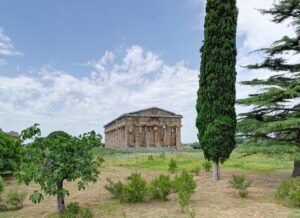
Combined with the Amalfi Coast. Pompeii is 40 minutes from Amalfi by train via Sorrento. A day-trip from Amalfi Coast hotels is doable but long. If you are staying on the coast and want to do Pompeii in one shot, consider taking the 7am ferry to Salerno, the train to Pompei Scavi, and returning by SITA bus via Amalfi in the evening. Combine with the Paestum Greek temples (45 minutes further south from Salerno) for a full day of ancient Campania archaeology.
When to visit
Late April through mid-June and mid-September through mid-October are the right windows. The site is fully open, the weather is bearable, the crowds are manageable, the on-site shade (little as there is) is at least occasional.
July and August are hot, crowded, and tiring. The site temperature hits 35°C+ on many summer days and there is almost no shade. The crowds peak at 11am and the tour-group queues at the House of the Vettii and Villa of the Mysteries can exceed 45 minutes. If you must come in high summer, be at the gate at 9am on the dot and plan an early lunch. The Circumvesuviana in August is also at capacity and the return train in late afternoon is standing-room-only from Pompei Scavi.
November through March is quiet, off-peak priced, and the site is at its most atmospheric — mist rising off the Forum in December, grasses and wildflowers through the paved streets in spring. Some smaller houses are closed during restoration cycles in winter; check the Park’s website for the monthly list. Winter also has the lowest ticket demand, so same-day online booking works.
Specific dates to plan around: the Pompei Theatrum Mundi season of performances at the Grand Theatre in July-September; the International Day of Archaeology (last Sunday of November) with free entry; and the Park’s periodic nighttime openings (summer Saturdays, with the site lit dramatically; €15, book ahead, 4-hour slots). The nighttime visit is the Pompeii experience to have if you can get in.
Before you go
Pompeii is a working archaeological site that is also a major tourist destination and also one of the most important places in Western civilisation’s understanding of its own ancient past. Treat it as all three. You will walk more than you expect. You will see more than you can process. You will miss most of the detail unless you come back. Bring proper shoes, water, a hat, and the patience to spend 7 hours on a site that wants 70. Go early and plan the morning around the limited-capacity houses (House of the Vettii, Villa of the Mysteries) before the queues build.
One final note about the scale. Pompeii had 11,000-12,000 residents at its destruction, which by modern standards is a small town. The fact that we can walk through almost every street of such a town, from 2,000 years ago, with the wine bars and bakeries and brothels and election posters and temples and baths and tiny household shrines and the precise pattern of the stepping stones at each intersection — that fact is not quite like any other archaeological experience available anywhere. Other ancient sites are ruins. Pompeii is a city.
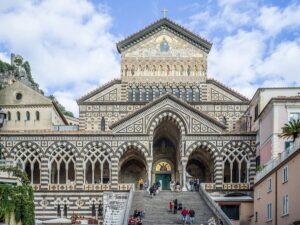
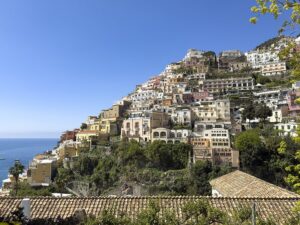
For regional context, see the Campania hub. For the other Campania city guides now live, see Amalfi, Positano, and Ravello. For other Greek and Roman archaeological sites across southern Italy on this site, see Sicily for Agrigento’s Valley of the Temples, Segesta, Selinunte, and Syracuse; For the Greek-colonial Campanian companion 85 km south, see the Paestum guide — the Doric temples of the ancient city of Poseidonia.

.jpg)
_01.jpg)

_and_the_Vesuvio.jpg)

_-_Arena_inside.jpg)


_in_the_Stabian_Baths_Pompeii_Prowalk.jpg)

.jpg)